Planning guide · greenhouse and irrigation design
Greenhouse and irrigation system design: a brief worksheet that explains cost and becomes a comparable RFQ
Reviewed: · SeedMatchGroup
A good greenhouse design starts with a written brief, not a structure catalogue: the crop, the market it serves, the output you aim for and the growing calendar. Site climate, light, water and energy then decide which structure, climate equipment and irrigation design make sense. That is also why there is no single answer to “how much does a greenhouse cost” — cost follows these choices. Capture them in one worksheet and every supplier can quote the same scope.
This is a planning guide, not an engineering design or agronomic prescription. It makes no yield, savings or return promises. Structural, electrical, hydraulic and permit questions must be confirmed by qualified local specialists.
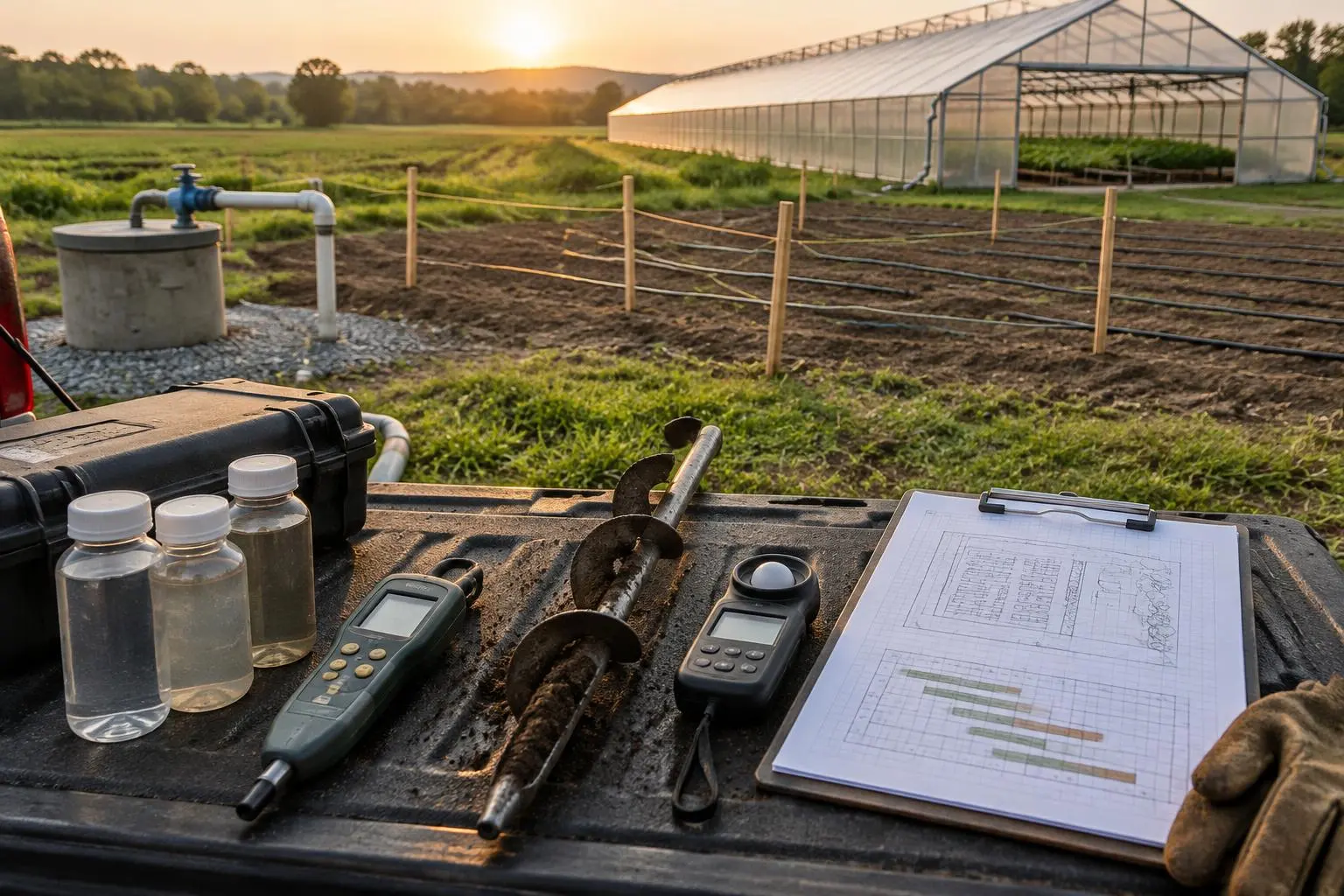
What is a greenhouse design brief?
A greenhouse design brief is a short document that states what the project must produce, for whom and when, and the site facts that limit the design. It is not a drawing. Engineers and suppliers use it to propose a structure, climate system, irrigation and fertigation layout, controls and utilities that fit the brief.
Why design must follow the crop and local conditions
Penn State Extension’s greenhouse production guidance treats water, temperature, ventilation and irrigation as linked decisions. A leafy-green crop under strong summer radiation needs different ventilation and shading from a long-cycle tomato crop in a cold winter; a well with high alkalinity changes filtration and fertigation choices. FAO’s irrigation scheduling guidance ties water quantity and timing to crop, growth stage and climate. Copying a design from another site imports its assumptions.
From brief to comparable proposals
- 1Crop, market and calendar
- 2Site, water and energy facts
- 3Worksheet = one RFQ scope
- 4Compare lifecycle fit
Ten planning steps
1. Crop, market and target output
Name the crop and variety type, the market grade and buyer, and a target output range you can justify from records or advisers. This sets every later requirement.
2. Growing calendar
Write planting and harvest windows by month. A year-round programme and a seasonal one need very different heating, cooling and lighting.
3. Site, climate and light
Record location, plot dimensions, slope, drainage, wind exposure, monthly temperatures and available light. These drive orientation, cover and climate equipment.
4. Structure and expansion
State the first-phase area and the area you may add later. Ask suppliers to show how gutters, roads, utilities and controls extend to phase two.
5. Water source and quality
Note the source, reliable daily volume, storage and a laboratory analysis (pH, alkalinity, EC, sodium, chloride, boron, iron). Penn State’s water quality toolkit explains why these values matter for greenhouse irrigation.
6. Irrigation and fertigation
Specify the growing system (soil, substrate, benches), the irrigation method (drip, sprinkler, ebb-and-flow), zones, dosing, filtration and whether drain water is recirculated.
7. Controls and automation
List what must be measured and controlled, alarm needs, data access and whether you want open protocols so equipment from different suppliers can work together.
8. Energy
Record grid capacity, fuel options, tariffs and backup power. Heating, cooling and pumping loads should be sized against these limits, not the reverse.
9. Labour
Describe the team you can hire and keep, and the tasks to automate. Labour availability changes the case for automation and handling equipment.
10. CAPEX, OPEX and operating scenarios
Build a base case and a downside case with your own prices and quantities. Use scenarios to test choices, not to predict results.
Planning worksheet: turn the brief into a comparable RFQ
Fill in the middle column once, then send the same worksheet to every supplier. The right column explains what it makes comparable.
| Brief field | What to write | Why it matters in quotes |
|---|---|---|
| Crop and market | Crop, variety type, grade, buyer or channel | Sets climate targets and handling scope |
| Target output and calendar | Output range, planting and harvest months | Defines heating, cooling, lighting duty |
| Site and climate | Location, plot size, slope, wind, monthly temperature and light | Shapes structure, cover and loads |
| Area and phasing | Phase-one area, possible expansion area | Shows expansion cost and layout options |
| Water | Source, m³/day, storage, lab analysis | Sizes filtration, treatment and storage |
| Irrigation and fertigation | Method, zones, dosing, recirculation | Makes irrigation designs like-for-like |
| Controls | Measured values, alarms, data access, protocols | Reveals lock-in and integration gaps |
| Energy | Grid kW, fuel, tariff, backup | Tests if loads fit real supply |
| Labour and handling | Team size, tasks to automate | Explains automation and equipment scope |
| Budget and terms | Budget range, currency, timing, inclusions/exclusions | Normalises prices and delivery terms |
How to compare lifecycle fit, service and expansion
- Lifecycle fit: compare expected energy, water, fertiliser, maintenance and replacement items, not just purchase price.
- Service: ask who supports installation, commissioning and repairs locally, and how spare parts are supplied.
- Expansion: check whether structure, utilities and controls can grow without rework.
- Exclusions: list what each quote leaves out before ranking them.
How much does a commercial greenhouse cost?
- There is no honest single number. Cost depends on structure type and height, cover, climate equipment, irrigation and fertigation, controls, energy connection, site works, packing, freight and installation.
- Running cost depends on local energy, water and labour prices and on the growing calendar.
- Use our cost benchmark and scenario tools with your own figures to see which choices move the total most.
Frequently asked questions
What should a greenhouse design start with?
With the crop, its market, a target output range and the growing calendar. Site, water and energy facts come next. Structure and equipment are chosen to fit those facts.
How much does a greenhouse cost?
It depends on the design choices in the brief and local prices. Compare complete scopes with the same inclusions; a headline price per square metre hides important differences.
How do you design an irrigation system for a greenhouse?
Start from crop water demand by growth stage and climate, the reliable water supply and a lab analysis. Then choose method, zones, filtration, dosing and storage. FAO and Penn State guidance explain the underlying principles.
Is drip irrigation always the best choice?
No. Drip suits many substrate and soil crops, but pot crops, propagation or some leafy greens may suit other methods. The crop and growing system decide.
What must be confirmed locally?
Structural loads and foundations, electrical and gas work, water rights and discharge, permits and food-safety requirements. A worksheet cannot replace these checks.
Are the tools free, and do I have to use your sourcing service?
Yes, buyer tools and guides are free, with no subscription and no obligation. Help with scoping and connecting suitable manufacturers is optional, for B2B projects from USD 250,000, and does not guarantee a result.
Free tools and guides for this brief
Everything here is free for buyers to use — no subscription, no sign-up wall and no obligation. Use the tools as often as your planning needs.
Start with the irrigation water and flow calculator →- Commercial greenhouse design guide →
- Irrigation water and flow calculator →
- CAPEX–OPEX–ROI scenario calculator →
- Plan a greenhouse project around crop goals with free calculators →
- Commercial greenhouse cost benchmark →
If you would like help, our team can review your brief, help refine the scope and, for B2B projects of USD 250,000 or more, connect you with suitable manufacturers or suppliers so you can compare fit and proposals. This is optional; you decide whether to proceed and whom to choose, and we cannot guarantee any supplier, price or outcome.
Optional: send your brief as a project RFQ →Sources, authorship and limits
- Penn State Extension · Greenhouse Production
- Penn State Extension · A Water Quality Toolkit for Greenhouse and Nursery Production
- FAO · Irrigation scheduling (Irrigation Water Management, Training Manual 4, chapter 3)
Written by the SeedMatchGroup editorial team and reviewed on 14 October 2026. Sources explain general principles; they do not endorse SeedMatchGroup or any design. No customer data or performance figures are used.