Planning tool · greenhouse operations
Greenhouse labor planning calculator: staffing, harvest and packing hours
Reviewed · SeedMatchGroup editorial team
Short answer: greenhouse staffing = (growing area × routine crop minutes per m² per week + weekly output × harvest-and-packing minutes per kg) ÷ 60 ÷ productive hours per worker. Multiply by a peak-week factor for harvest peaks. The numbers that matter are your own task times for your crop, system and pack format — so this calculator asks for them instead of assuming them.
No labour benchmarks, yields or savings are built in. Results are only as good as the task times you enter. Wage rules, working-time limits, seasonal-worker permits, housing and health-and-safety duties are local and must be confirmed with a qualified adviser.
Calculate weekly hours and FTE
| Routine crop hours / week | — |
|---|---|
| Harvest + packing hours / week | — |
| Total hours / week | — |
| Average FTE | — |
| Peak-week FTE | — |
| Supervisors at peak | — |
Enter every field within its range to see results.
Labour planning table: what to record and who confirms it
| Input | Where it comes from | Sensitivity check |
|---|---|---|
| Crop task minutes | Own time records, crop adviser, supplier time study | Re-run at ±20% to see how staffing moves |
| Output per week | Production plan by growing calendar | Use the low-season and peak week, not only the average |
| Minutes per kg | Pack format, grading method, packing-line throughput | Compare manual vs. line-assisted packing quotes |
| Productive hours | Employment contracts, local working-time rules | Confirm with a local HR / legal adviser |
| Peak factor | Calendar of planting, crop change and harvest peaks | Check housing, transport and training capacity at peak |
Turn the staffing plan into budget and RFQ requirements
- OPEX: multiply weekly hours by your fully loaded local wage cost and carry it into the CAPEX–OPEX–ROI scenario and the project budget planner.→→
- Packing capacity: size the packing area and line throughput for the peak week with the packhouse sizing calculator and packhouse equipment checklist.→→
- Automation claims: ask suppliers to state the task-time assumption behind any labour saving, in the same template, so quotes are comparable.
- RFQ: include area, output plan, pack format, peak-week staffing and automation scope in one greenhouse project brief / RFQ. Financing reviewers often ask for the same operating case — see agricultural financing.→→
Frequently asked questions
How do I estimate labour for a commercial greenhouse?
Break work into routine crop tasks per square metre per week and harvest/packing time per kilogram, measure or obtain those times for your crop and system, convert them into weekly hours, then divide by the productive hours one worker provides. Add a peak factor for harvest weeks.
Why doesn't the calculator include default labour rates?
Task times differ widely by crop, variety, training system, automation, trolleys and pipe rails, packing method and worker experience. A generic number would look precise but mislead. Use your own records, a crop adviser or supplier time studies, and record the source.
What is a peak factor?
The ratio between your busiest week's labour need and an average week. It covers harvest peaks, planting or crop change-over and leaf-picking surges. Derive it from your growing calendar rather than guessing.
How does automation change the staffing plan?
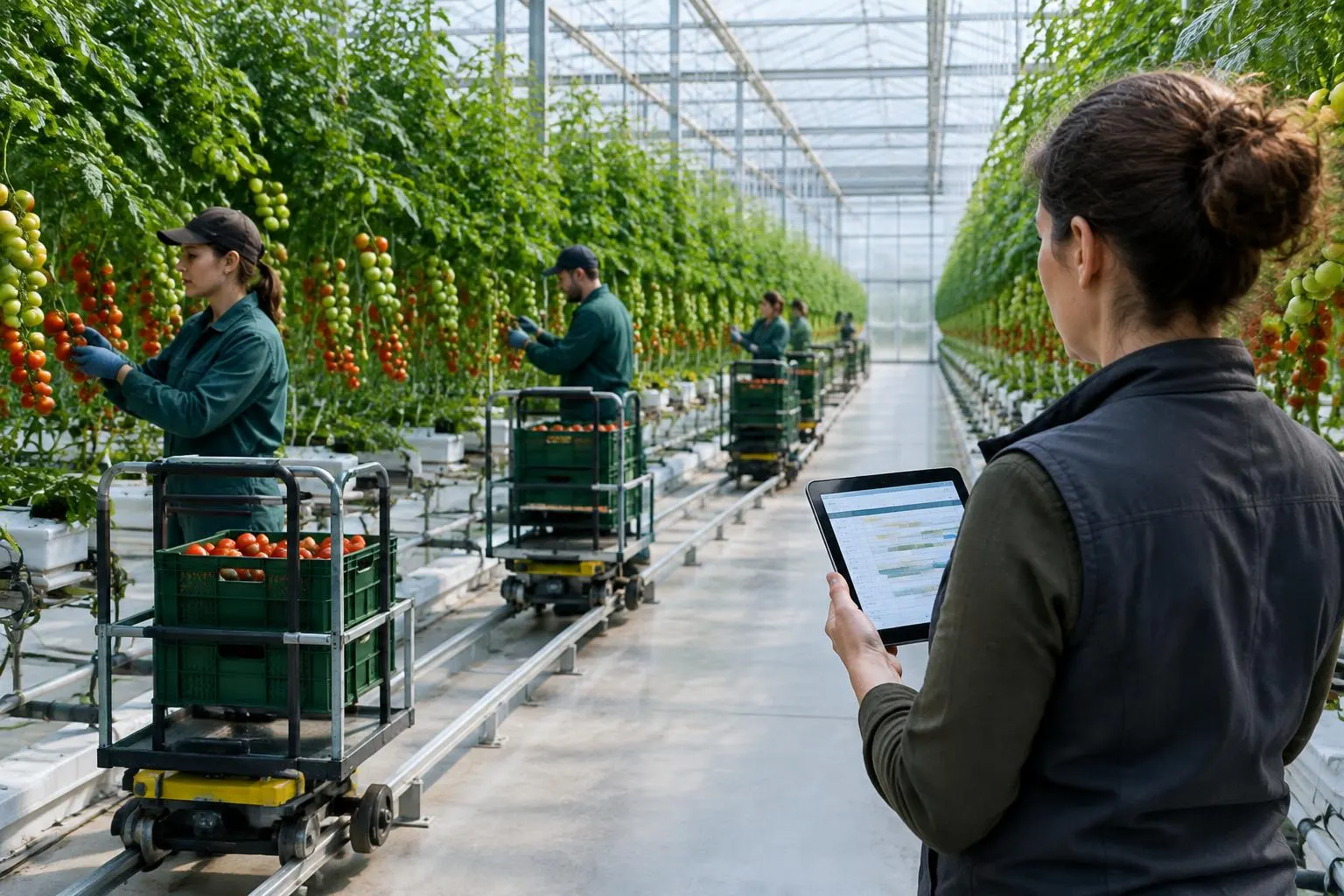
Equipment such as pipe-rail trolleys, internal transport, grading or packing lines may reduce minutes per task. Ask each supplier to state the task-time assumption behind any labour claim, and enter the reduced time only after it is evidenced.
Where does labour fit in the greenhouse budget?
Labour is usually an OPEX line: hours × local wage cost including employer charges, housing or transport where relevant. Labour-saving equipment is CAPEX. Compare both in the CAPEX/OPEX/ROI scenario before deciding.
Is this tool free?
Yes. The calculator and guides are free for buyers, with no subscription or obligation. Assisted specification and supplier matching is available for B2B projects from USD 250,000.
Plan first — help is optional
Plan the project and use the tools for free, with no subscription or obligation. If you want, our human, supplier-neutral team can help define the specification and find suitable suppliers for B2B projects of USD 250,000 or more. You decide whether and whom to select.
Create a greenhouse project brief →Sources and method
- Penn State Extension · Greenhouse production
- UC Davis Postharvest Research and Extension Center
- International Labour Organization · Working time and work organization
The formula is plain arithmetic written by the SeedMatchGroup editorial team. Sources provide context on greenhouse operations, post-harvest handling and working time; they do not supply or endorse the calculator's inputs.