Procurement guide · greenhouse projects
Greenhouse procurement project management: a plan from crop outcome to commissioning
Published: · SeedMatchGroup
Project procurement management for a greenhouse starts with the crop outcome, not with a catalogue. Define what you must produce, when and to which market; turn that into a written user requirement; fix site, water, energy and interface boundaries; then ask every supplier to price the same scope. Compare proposals on technical fit, capacity, delivery, installation, operating cost, maintenance, risk and budget — and keep managing after signature, through commissioning, acceptance and supplier-performance review.
This guide is a planning method, not engineering, legal or financial advice. It contains no yield, savings or ROI claims. Structural loads, electrical design, water rights, permits and tax treatment must be confirmed by qualified local specialists.
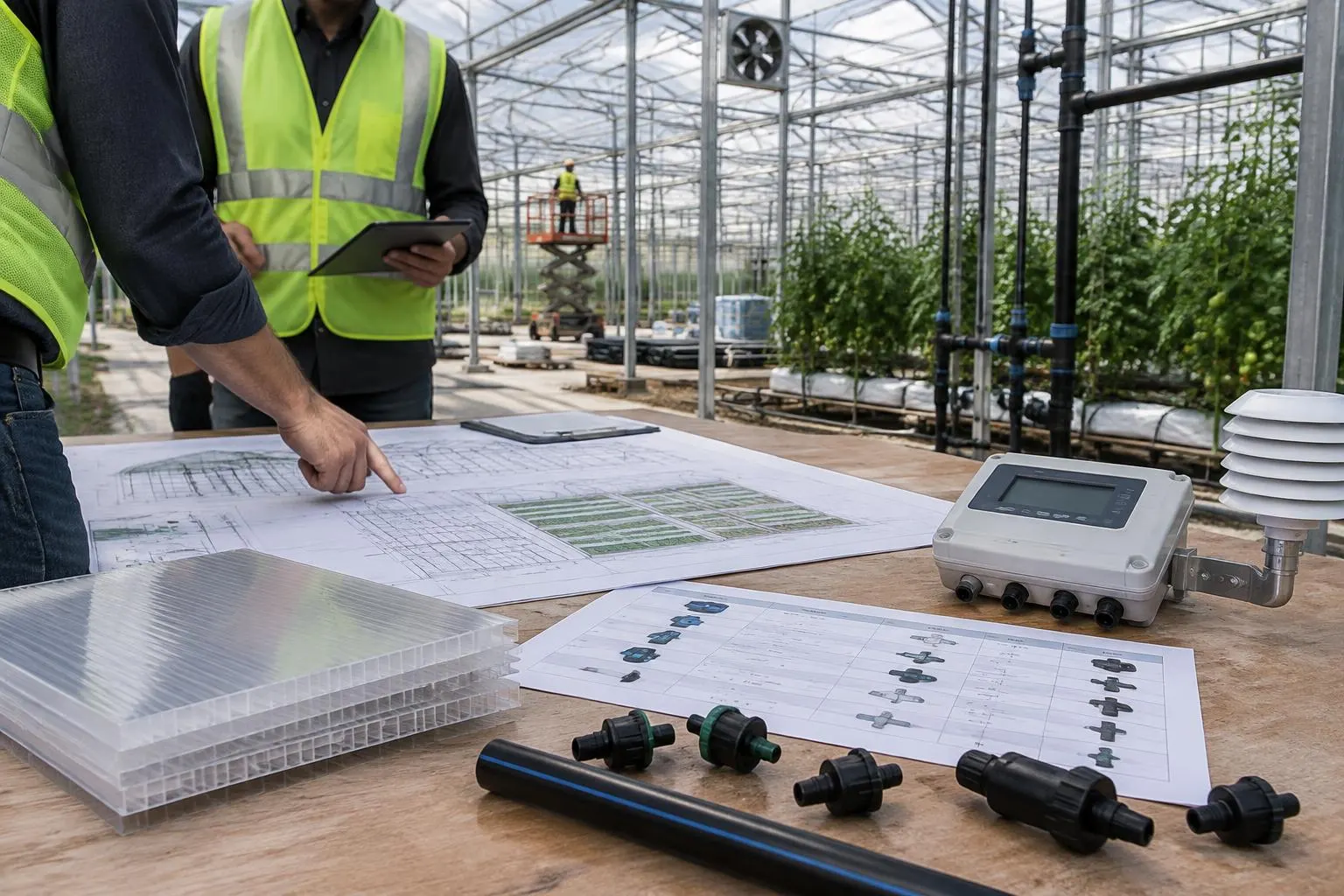
The nine-stage greenhouse procurement plan
The CIPS procurement cycle runs from identifying the need and writing a specification, through sourcing and tendering, to contract and asset management. Applied to protected horticulture, it looks like this: CIPS
1. Define the operational outcome
Write the crop or crop mix, the production window, the quality grade and the buyer or market each harvest serves. “A 4 ha greenhouse” is not an outcome; “year-round truss tomatoes for retail from a defined start date” is. Every later decision is tested against this sentence.
2. Turn it into a user requirement
Record the climate targets the crop needs, the irrigation and fertigation strategy, labour model, automation level, food-safety and packing requirements. Involve the grower, operations, finance and maintenance; CIPS stresses stakeholder input and a clear specification before going to market.
3. Fix the site and boundaries
Collect plot survey, soil and drainage, wind and snow exposure, monthly temperature and radiation data, water source volume and laboratory analysis, power capacity and fuel availability. Penn State Extension highlights water quality, temperature, ventilation and backup power as core greenhouse considerations.
4. Map the technical interfaces
Most disputes happen between packages: gutter heights versus screens and lighting, heating pipes versus crop rails, controller protocols versus sensors and valves, irrigation pump duty versus storage and filtration. Assign each interface to one named party in writing.
5. Build the full budget
Separate CAPEX (structure, cover, climate, irrigation, controls, utilities, civil works, packing, installation, commissioning) from OPEX (energy, water, fertiliser, labour, maintenance, spares, insurance). OECD guidance favours life-cycle cost and performance over purchase price alone.
6. Request comparable quotes
Send the same scope, drawings, assumptions and quote template to each supplier. Ask for exclusions, delivery terms, lead times, installation responsibility, warranties, spare parts and local service in the same format, so differences are visible rather than hidden.
7. Evaluate fit and risk
Score technical fit, capacity, delivery reliability, implementation plan, operating cost, support and commercial risk against weights agreed before bids arrive. A low price with a large exclusion list or no local service is a risk, not a saving.
8. Plan delivery, commissioning and acceptance
Agree milestones, inspection points, site readiness, and measurable acceptance tests: climate control holding setpoints, irrigation uniformity, alarms, backup power transfer and operator training. Payment stages should follow verified milestones.
9. Review performance after handover
The CIPS contract management cycle keeps performance criteria and whole-life cost in view after award. Track response times, defects, spare-part availability and energy or water use against the specification. ISM notes supplier scorecards help reveal risk and improve performance.
One-page greenhouse procurement checklist
Use the same rows for every quote. The middle column is what you can compare across suppliers; the right column is what a qualified local specialist must confirm.
| Package | Compare across quotes | Confirm locally |
|---|---|---|
| Structure and cover | Bay and gutter height, cover type and light transmission data, design loads stated, warranty terms | Wind and snow loads, foundations, building permit |
| Heating, cooling, ventilation | Capacity basis and design conditions, vent area, fans/pad or fogging, controls included | Climate data used, fuel and grid supply, emissions rules |
| Irrigation and fertigation | Emitter and zone layout, dosing units, filtration, storage, recirculation and drainage | Water rights, lab analysis, discharge permits |
| Controls and sensors | Platform, sensor list, alarms, data access, remote support, open or closed protocols | Network coverage, cyber and data obligations |
| Lighting and shading | Screen types and drives, lighting fixtures and loads if specified | Electrical capacity, tariff, light-emission rules |
| Energy and water supply | Connection works, backup generator, tanks and pumps inside or outside scope | Utility approvals, fuel storage, metering |
| Packing and storage | Grading, cold rooms, handling flow, hygiene finishes | Food-safety certification, refrigerant rules |
| Installation and commissioning | Who installs, site supervision, schedule, tests and training included | Labour law, site safety, import and customs |
| Spares, maintenance, support | Spare list priced, response times, local technicians, software updates | Service availability in your region, contract law |
| Commercial terms | Exclusions, incoterms, currency, payment milestones, guarantees | Tax, duties, insurance, financing conditions |
Buyer essentials: sourcing, lead time, financing and the RFQ
Four decisions shape a greenhouse purchase before any quote is signed. Settle each one in writing and carry it into the same RFQ.
Sourcing
Decide whether you buy one turnkey package or separate packages, and how many suppliers you will invite. Shortlist on proven scope, local installation and service, and willingness to quote your template — not on brochures. A shortlist is your decision; no list is an endorsement.
How sourcing support works →Lead time
Ask every supplier to state manufacturing, freight, customs, installation and commissioning time separately, with what each depends on: approved drawings, deposit, site readiness, permits. Plan backwards from your first planting date and keep a buffer; do not treat any supplier date as guaranteed.
Greenhouse tender timeline →Financing
Lenders and investors usually need the same evidence as procurement: scope, full budget, comparable quotes, schedule and an operating case. Prepare it once. SeedMatchGroup is not a lender and does not promise approval; terms come from the financing providers.
Agricultural financing guide →The RFQ
Send one RFQ with the outcome statement, user requirement, site data, interface matrix, quote template, evaluation criteria and requested delivery dates. Identical inputs make lead time, exclusions and price comparable.
Create a greenhouse project brief / RFQ →CAPEX, OPEX and the cost of interfaces
- CAPEX is everything needed to hand over a working greenhouse: design, permits, structure, cover, climate, irrigation, controls, utilities, civil works, packing, freight, installation and commissioning.
- OPEX is the cost of running it: energy × local tariff, water × tariff, fertiliser, labour hours, maintenance, spares, insurance and software. Build a base case and a downside case with dated local prices.
- Interface cost is the hidden third line: rework, delays and change orders when packages do not fit together. A single integrated scope and a named owner for each interface usually costs less to manage than to repair.
- Never compare a quote’s price without its exclusions. Normalise each bid to the same scope before ranking it.
Frequently asked questions
What is project procurement management for a greenhouse?
It is the process of defining what the greenhouse must achieve, specifying it, obtaining comparable supplier proposals, selecting and contracting, then managing delivery, commissioning and supplier performance until the asset runs as intended.
What belongs in a greenhouse procurement management plan?
The outcome statement, user requirement, site and utility data, interface matrix, budget with CAPEX and OPEX, quote template, evaluation criteria and weights, schedule with milestones, acceptance tests and a post-handover performance review.
Should I buy structure, climate and irrigation separately?
You can, but you then own the interfaces between them. Whether you buy one turnkey package or several, write one integrated specification and assign every interface to a named party.
How do I compare greenhouse supplier quotes fairly?
Send the same scope and template to everyone, normalise exclusions, and score technical fit, capacity, delivery, implementation, operating cost, support, risk and price with weights fixed before bids arrive.
What must local specialists confirm?
Structural design loads, foundations, electrical and gas installations, water rights and discharge, permits, food-safety certification, tax and contract law. A comparison table cannot replace these checks.
Is SeedMatchGroup free for buyers?
Yes — free for buyers, always. Our calculators, guides and project brief are free with no obligation and no platform fee to buyers. Suppliers, engineering, freight, equipment and financing are priced separately by the parties providing them.
Free tools for each stage
Free for buyers, always: the tools and guides above carry no obligation and no platform fee to buyers.
- How to choose a greenhouse system by crop, site and climate →
- Compare greenhouse and irrigation supplier quotes with an RFQ scorecard →
- CAPEX–OPEX–ROI scenario calculator →
- Greenhouse project budget planner →
- Greenhouse tender timeline →
For B2B projects of USD 250,000 or more, our human, supplier-neutral team can help you scope requirements and identify and compare suitable manufacturers against your constraints, plan, budget and operating goals. You decide whether and whom to select; any supplier we list is not an endorsement. We do not promise savings, availability, delivery dates, financing approval or outcomes.
Create a greenhouse project brief / RFQ →Sources and editorial note
- CIPS · Procurement and supply cycle
- CIPS · Contract management cycle
- OECD · Reforming Public Procurement
- ISM · Procurement analytics: rethinking the value equation (12 Oct 2026)
- Penn State Extension · Greenhouse production
- Oklahoma State University Extension · Greenhouse structures and coverings
Written by the SeedMatchGroup editorial team on 14 October 2026 from the public sources listed. Sources inform the method; they do not endorse SeedMatchGroup. No customer data, case studies or supplier performance figures are used.