
Commercial greenhouse system selection: climate, water and CAPEX
Content updated:
Content and sources checked on 14 October 2026. Independent crop/engineering review and native-language review are pending; no expert sign-off is claimed. Ask your local adviser to approve crop targets and acceptance tests before procurement.
Define the crop, growing calendar and target market first; then describe the site, wind exposure, water source and quality, energy supply and the temperature and humidity envelope the crop needs through the year. Those facts set the structure, covering, ventilation, cooling, heating, shading, irrigation, fertigation and automation level, and your team's ability to maintain them sets the practical ceiling. Model capital and operating costs with written assumptions and compare options by cost per marketable kg or per cycle, not by price per square metre alone.
Climate data, crop suitability and costs are local. The FAO GAEZ portal gives broad agro-climatic context only; site measurements, local engineers, codes and permits govern the final design.
Illustrated system: the measurement points behind a comparable greenhouse bid
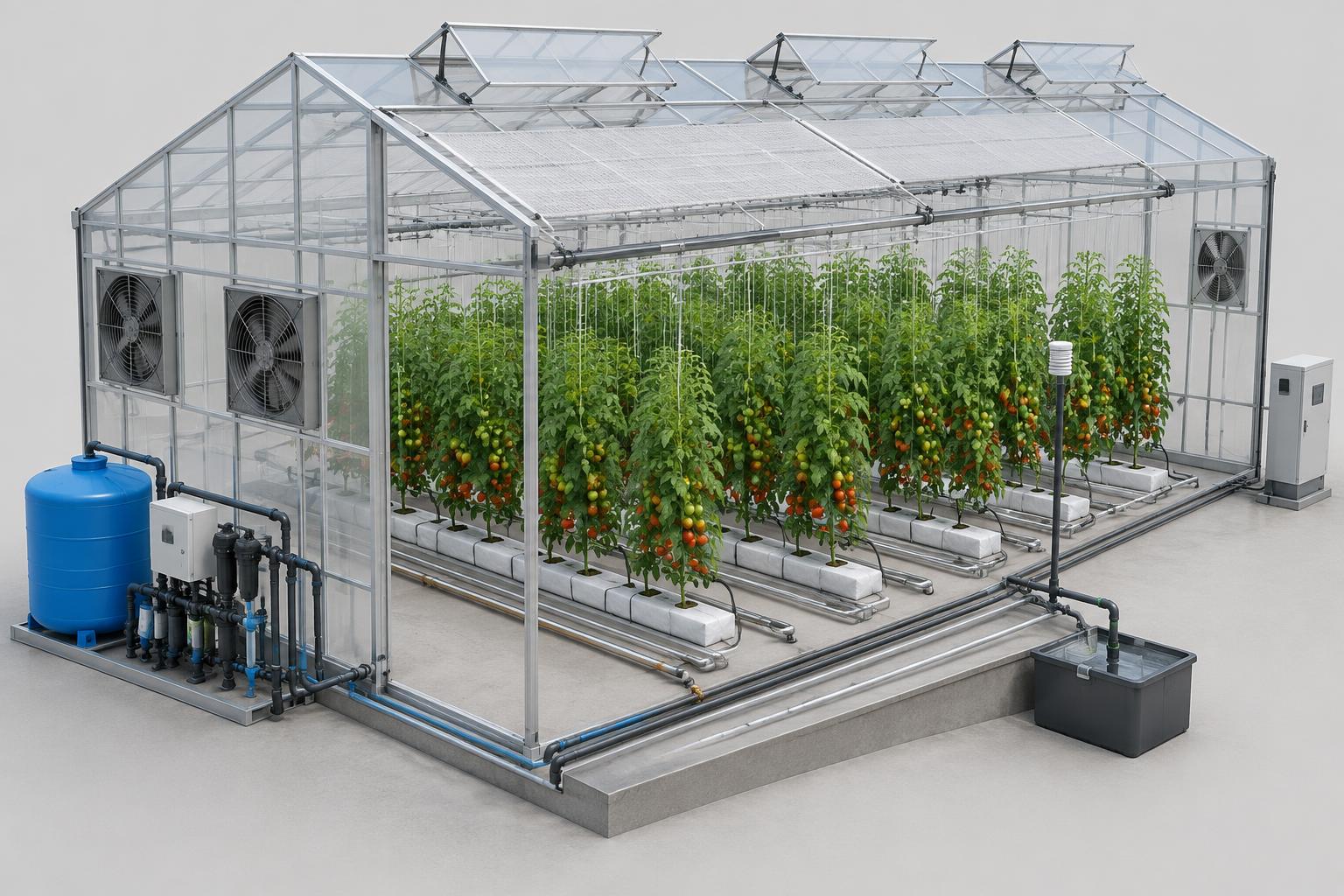
- Roof vents and screen: log outside/inside temperature (°C), relative humidity (%) and screen position against the crop calendar.
- Fans and pipe rails: separate cooling electricity (kWh) from delivered heating energy (kWh thermal); do not compare these as interchangeable units.
- Water tank and dosing skid: record source-water analysis, metered water (m³), fertiliser mass (kg) and operating days; confirm filtration and compatibility with an agronomist.
- Substrate and drain collection: meter applied and collected volumes separately; collected drainage is not automatically safe for reuse.
- Crop-height sensor and control cabinet: specify sensor calibration, alarm tests, data access and who responds to faults.
Your next purchase decision
Choose a scope you can cost and operate: structure, heating/cooling, irrigation/fertigation and controls. Compare the same crop calendar and site constraints in the free scenario tools, then send the documented requirements to SeedMatch for human review.
What should you define before looking at structures?
- Crop, variety type, planting calendar and the months you need to harvest.
- Market and grade requirements: fresh export, local wholesale, retail programme or processing.
- Site: altitude, wind exposure, snow or dust, soil and drainage, access and expansion space.
- Water: source, reliable volume in the peak month and a laboratory water test.
- Energy: grid capacity, fuel availability and price, and any renewable options.
- Team: who will operate, maintain and repair climate, irrigation and control systems.
How do climate and crop needs shape the system?
Compare the crop's required temperature and humidity range by growth stage with local weather across the year. The gap tells you whether natural ventilation is enough, whether you need evaporative or mechanical cooling, how much heating is required, and where shade or screens fit. FAO's GAEZ portal can help frame agro-climatic suitability at regional scale; site weather records and local advisers are needed for design.
Penn State Extension's greenhouse production resources cover how ventilation, temperature and water management interact. A design that cools well but cannot remove humidity, or heats well but has poor air distribution, can still limit marketable output.
How should irrigation, fertigation and automation be scoped?
Size irrigation from the crop's peak daily demand, the planted area and the water test. Penn State's guidance on interpreting irrigation water tests explains why alkalinity, EC and specific ions affect treatment and fertigation choices. Recirculation adds disinfection and monitoring needs.
Choose automation for the decisions your team actually makes every day. More sensors help only if someone reviews the data and the controls can act on it; simple, reliable control that staff can maintain is often better than a complex system nobody services.
How do you compare options fairly?
Build at least two scenarios with the same crop and calendar. For each, list capital cost (structure, climate, irrigation, controls, site works, utilities), annual operating cost (energy, water, labour, inputs, maintenance) and your own expected marketable output range. Divide total annual cost by marketable kg or by cycle to compare.
A cheaper structure that cannot hold the climate your crop needs may cost more per saleable kg. A higher-specification house only pays if your market, crop and team can use its extra control. Write every assumption down so suppliers can respond to the same basis.
A heating, cooling and water implementation checklist
Ask the engineer for winter and summer design conditions, crop-stage targets and hours outside those targets. Heating capacity (kW thermal) is not annual energy (kWh thermal); cooling and pump demand (kW electric) are not their annual electricity (kWh). Use measured or engineered load profiles, not installed capacity × 8,760 by default.
Record heating fuel quantity in its quoted unit and conversion basis, delivered heat efficiency, cooling electricity and cooling-water make-up (m³). Apply the eligible local tariff with currency, date, taxes and fixed/demand charges separately. Do not infer a fuel price from language or a global index.
Separate peak irrigation (L/m²/day, m³/day and available hours) from annual metered m³ and crop operating days. Write whether the water budget includes cooling, cleaning, treatment reject water and drainage. Penn State’s water-test guidance (updated 10 September 2025) calls for interpreting source water together with growing-media results; it does not provide a universal crop recipe.
- Implementation gate: the crop adviser approves seasonal targets, the engineer supplies load/flow calculations, the operator confirms maintenance and outage response, and procurement costs the same included scope. In the CAPEX/OPEX/ROI tool keep climate, irrigation and controls additions distinct from the structure; check fertilizer exclusions and avoid counting the same cost twice.
System selection matrix
Fill in your own facts. The right column shows which system decision each fact drives.
| Project fact | What to document | System decision it drives |
|---|---|---|
| Crop and calendar | Crop, variety type, harvest months, grade | Climate envelope and technology level |
| Site and wind | Exposure, snow/dust, soil, drainage | Structure, foundations, covering |
| Water | Peak-month volume, lab water test | Storage, treatment, irrigation and fertigation design |
| Energy | Grid capacity, fuel type and price | Heating, cooling and control strategy |
| Temperature and humidity gap | Crop needs vs local weather by month | Ventilation, cooling, heating, screens |
| Team and budget | Maintenance skills, capital limit | Automation level and phasing |
System-scoping checklist
- Crop, calendar and market grade written down.
- Site exposure and expansion space documented.
- Laboratory water test and peak water volume available.
- Energy supply and tariff assumptions recorded.
- Two or more scenarios costed on the same assumptions.
- Options compared by cost per marketable kg or cycle.
Frequently asked questions
Which greenhouse type is best?
None is best everywhere. The right system depends on crop, calendar, local climate, water, energy, market and the team's maintenance capability.
Why not compare greenhouses by price per square metre?
Area price ignores climate performance, operating cost and saleable output. Cost per marketable kg or per cycle shows which option fits your project.
Can FAO GAEZ tell me what to build?
No. GAEZ gives regional agro-climatic context. Site weather data, local engineers, codes and crop advisers are needed for design.
How much automation do I need?
Enough to control the decisions that matter for your crop, at a level your team can operate and maintain.
Does the minimum project size apply to planning?
Planning content and tools are free for everyone. Managed supplier outreach typically applies to B2B projects from USD 250,000.
How do I avoid double-counting heating and fertigation costs?
Record heating fuel quantity in its quoted unit and conversion basis, delivered heat efficiency, cooling electricity and cooling-water make-up (m³). Apply the eligible local tariff with currency, date, taxes and fixed/demand charges separately. Do not infer a fuel price from language or a global index.
Related SeedMatch tools
- Commercial greenhouse cost calculator
- Greenhouse operating cost calculator
- Greenhouse ROI and payback sensitivity calculator
- Greenhouse climate calculator
- Greenhouse irrigation planner
- CAPEX/OPEX/ROI scenario — enter your own costs and output
- Water demand and flow — keep peak sizing separate from annual use
- Heating transmission-energy scenario — excludes cooling and ventilation loads
- Commercial greenhouse planning checklist: crop, climate, structure, utilities and automation requirements
- Greenhouse climate-control systems compared: ventilation, cooling, heating and energy trade-offs
- How to evaluate greenhouse irrigation and fertigation suppliers: water quality, crop needs and operating cost
- Low greenhouse marketable yield: diagnose before buying upgrades
- Greenhouse and irrigation bid comparison: a supplier-neutral RFQ scorecard
- Plan a greenhouse project around crop goals: use free calculators and project tools before sourcing suppliers
When the outcome and constraints are defined, our team reviews your project request (free for buyers, typically USD 250,000+ B2B projects) before approaching suitable independent suppliers and organising comparable proposals. Any financing is arranged only through independent third parties.
Start a structured greenhouse project request →Sources
- Penn State Extension — Greenhouse production
- Penn State Extension — Interpreting irrigation water tests
- Penn State Extension — Is irrigation water quality causing yield reductions?
- FAO — Global Agro-Ecological Zones (GAEZ) data portal
Extension guidance is general. Crop-specific targets, local regulations and qualified local advisers take precedence.