
Greenhouse and irrigation bid comparison: a supplier-neutral RFQ scorecard
Content updated:
Content and sources checked on 14 October 2026. Independent crop/engineering review and native-language review are pending; no expert sign-off is claimed. Ask your local adviser to approve crop targets and acceptance tests before procurement.
Compare suppliers only after the crop outcome, site and system scope are written into one RFQ, so every proposal answers the same basis. Then score each proposal on its structural and climate design basis, crop fit, relevant local references, water and energy assumptions, controls, expandability, installation, commissioning, training, spares and service, warranty, acceptance criteria and whole-life cost. Ask every vendor to show design calculations and to state scope, exclusions and any guarantees in writing; a low headline price with large exclusions is not a cheaper project.
A scorecard supports judgement; it does not replace engineering review, local code checks or legal review of contracts. Weightings should reflect your crop, site and risk priorities.

Illustrated system: the measurement points behind a comparable greenhouse bid
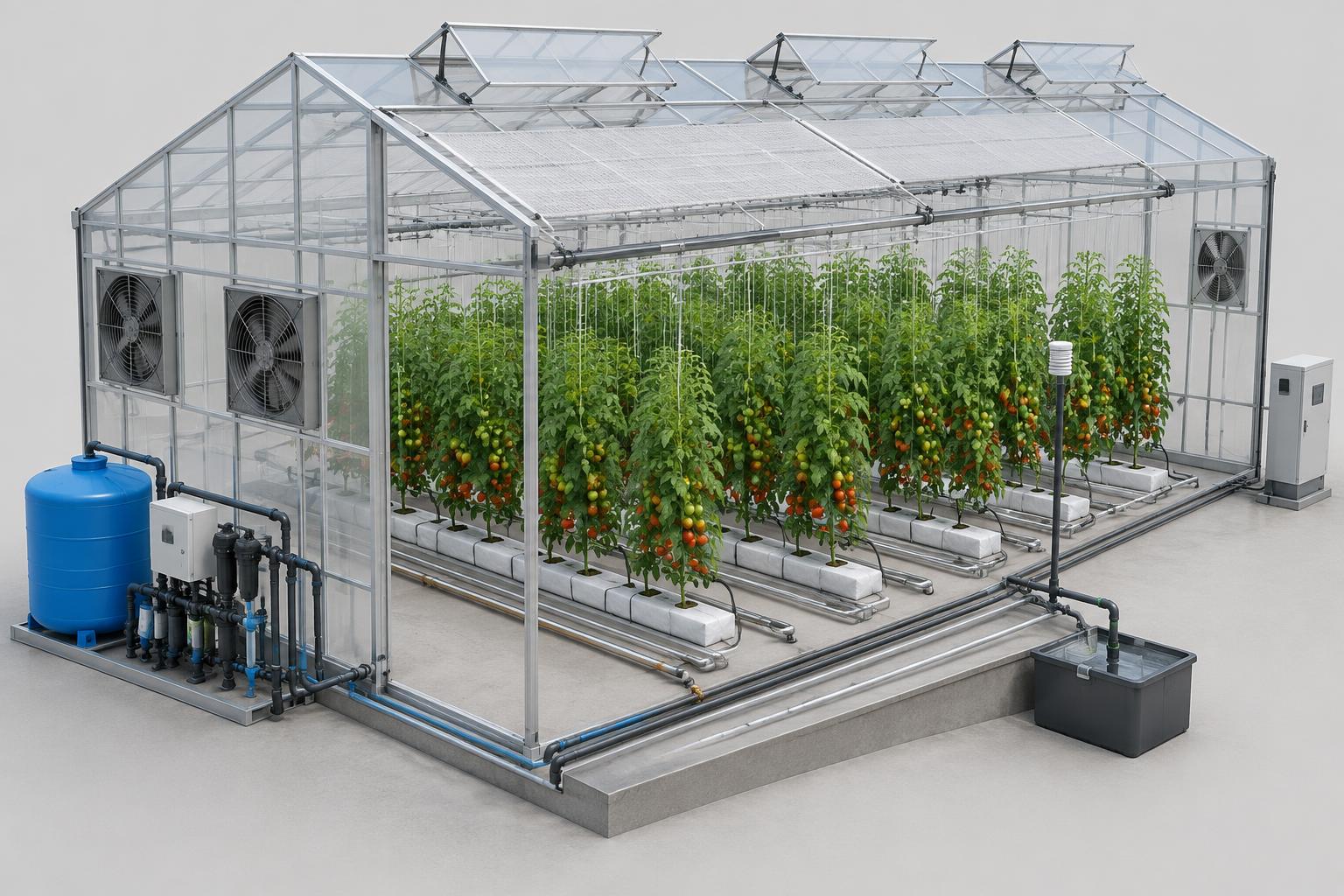
- Roof vents and screen: log outside/inside temperature (°C), relative humidity (%) and screen position against the crop calendar.
- Fans and pipe rails: separate cooling electricity (kWh) from delivered heating energy (kWh thermal); do not compare these as interchangeable units.
- Water tank and dosing skid: record source-water analysis, metered water (m³), fertiliser mass (kg) and operating days; confirm filtration and compatibility with an agronomist.
- Substrate and drain collection: meter applied and collected volumes separately; collected drainage is not automatically safe for reuse.
- Crop-height sensor and control cabinet: specify sensor calibration, alarm tests, data access and who responds to faults.
Your next purchase decision
Decide which proposals are technically comparable before ranking their prices. Mark missing calculations and exclusions as unresolved, reconcile one-off and recurring costs, and route clarification and reference checks through SeedMatch.
Why must proposals answer the same RFQ?
Suppliers price what they think you asked for. Without one written basis — crop, calendar, site loads, water analysis, energy, climate envelope and scope boundaries — proposals differ in what they include, and price comparisons become misleading.
Put the outcome you need and the constraints you have at the front of the RFQ, then the technical scope. That lets suppliers propose integrated solutions while staying comparable.
What should you ask every supplier to show?
- Structural design basis: wind, snow or dust loads and the standard used.
- Climate design basis: outside design conditions, target inside ranges and the cooling, heating and ventilation calculations.
- Irrigation basis: peak demand, water analysis used, filtration and treatment, uniformity assumptions.
- Crop fit and references: comparable crops and climates, with reference checks coordinated through SeedMatch.
- Scope and exclusions: civil works, utilities, freight, duties, installation, supervision.
- Commissioning, training, spares, service response and warranty terms, plus any performance guarantee and how it is measured.
How do you normalize prices?
Put every proposal on the same currency and date, add missing scope at a stated allowance, and separate one-off capital from recurring costs. Add expected energy, water, maintenance and spares over your planning period to compare whole-life cost.
Where a supplier states expected water or energy use, check the assumptions behind it against your own site data. Penn State Extension's guidance on interpreting irrigation water tests is a useful reference when a proposal's treatment design depends on water quality.
What makes acceptance criteria useful?
Acceptance criteria should be measurable at handover: structure completed to drawings, climate system holding set points under defined conditions, irrigation delivering the specified flow and uniformity, controls working with documented alarms, and staff trained. Agree how and when each test is run.
Avoid accepting yield or ROI promises as performance guarantees; they depend on crop management, markets and weather outside the supplier's control. Ask instead for guarantees on things the supplier controls.
Close the evidence gaps before comparing bids
Use one versioned evidence pack: crop/grade and planted m², seasonal climate basis, water report, annual resource quantities, dated tariff/FX assumptions, itemised scope and commissioning protocol. Missing evidence remains unknown; a high score does not make an unverified capacity compliant.
Compare heating in kW thermal/kWh thermal, cooling in kW electric/kWh electric, water in m³ and fertigation inputs in kg on the same period. State inclusions for cooling water, drainage treatment, consumables, subscriptions, spares, freight and site works. Do not add a blanket saving or rush premium.
Implementation gate: agree the written completion milestones, delivery responsibility and handover tests before contract. Confirm flow/pressure at representative emitters, climate performance under agreed outside conditions and alarm/failure behaviour; do not substitute a yield promise for these tests.
- Finance readiness means a reconciled CAPEX/OPEX scope, contingencies justified by identified gaps, cash-flow timing and documented repayment assumptions. SeedMatch is not a lender; third-party financing requires consent and approval and is never guaranteed. Supplier clarification and reference checks stay through the SeedMatch team.
Normalized RFQ scorecard
Score each proposal 0–5 per line and set weightings for your project before opening prices.
| Criterion | Evidence to request | Weight / Supplier A / Supplier B |
|---|---|---|
| Structural and climate design basis | Load and climate calculations, standards | |
| Crop fit and local references | Comparable crops/climates, contactable references | |
| Water and energy assumptions | Water analysis used, demand and energy estimates | |
| Controls and expandability | Control architecture, data access, phase-2 provisions | |
| Installation and commissioning | Plan, supervision, test procedures | |
| Training, spares and service | Training plan, spares list, response times | |
| Warranty and acceptance criteria | Terms, measurable handover tests | |
| Whole-life cost | Capex plus recurring costs over the planning period |
Before you shortlist
- All suppliers received the same RFQ and clarifications.
- Design calculations received from each supplier.
- Scope, exclusions and guarantees confirmed in writing.
- Prices normalized to one currency, date and scope.
- Comparable crop and climate references checked through SeedMatch.
- Acceptance tests agreed before contract.
Frequently asked questions
Should I choose the lowest price?
Only after normalizing scope, exclusions and whole-life cost. A low headline price with large exclusions can cost more overall.
Why ask for design calculations?
They show whether the structure, climate and irrigation design actually match your site loads, climate and crop needs.
Can a supplier guarantee my yield?
Yield depends on management, markets and weather. Seek guarantees on what the supplier controls, such as capacity, uniformity and set-point performance.
How many suppliers should I compare?
Enough to see real alternatives — often three to five qualified proposals on the same RFQ basis.
How does SeedMatch handle supplier comparison?
Buyers define the project first. Our team reviews the request, approaches suitable independent suppliers and organises comparable proposals; buyers are not handed to a single manufacturer.
What should stop a bid from being shortlisted?
Use one versioned evidence pack: crop/grade and planted m², seasonal climate basis, water report, annual resource quantities, dated tariff/FX assumptions, itemised scope and commissioning protocol. Missing evidence remains unknown; a high score does not make an unverified capacity compliant.
Related SeedMatch tools
- Greenhouse bid comparison tool
- Greenhouse supplier comparison guide
- Commercial greenhouse cost calculator
- Greenhouse ROI and payback sensitivity calculator
- CAPEX/OPEX/ROI scenario — enter your own costs and output
- Water demand and flow — keep peak sizing separate from annual use
- Heating transmission-energy scenario — excludes cooling and ventilation loads
- Commercial greenhouse planning checklist: crop, climate, structure, utilities and automation requirements
- Greenhouse climate-control systems compared: ventilation, cooling, heating and energy trade-offs
- How to evaluate greenhouse irrigation and fertigation suppliers: water quality, crop needs and operating cost
- Low greenhouse marketable yield: diagnose before buying upgrades
- Commercial greenhouse system selection: climate, water and CAPEX
- Plan a greenhouse project around crop goals: use free calculators and project tools before sourcing suppliers
When the outcome and constraints are defined, our team reviews your project request (free for buyers, typically USD 250,000+ B2B projects) before approaching suitable independent suppliers and organising comparable proposals. Any financing is arranged only through independent third parties.
Start a structured greenhouse project request →Sources
- Penn State Extension — Greenhouse production
- Penn State Extension — Interpreting irrigation water tests
- Penn State Extension — Is irrigation water quality causing yield reductions?
- FAO — Global Agro-Ecological Zones (GAEZ) data portal
Extension guidance is general. Crop-specific targets, local regulations and qualified local advisers take precedence.