
Agricultural Drone Regulations in Kenya
Authority: Kenya Civil Aviation Authority (KCAA). Governing framework: Civil Aviation (Unmanned Aircraft Systems) Regulations 2020.
Do I need a licence to fly an agricultural drone in Kenya?
Yes. Commercial agricultural flying in Kenya requires a Remote Pilot Licence obtained through a KCAA-approved Remote Pilot Training Organisation, an aircraft registered with KCAA, and an operator approval for the company conducting the operations. Flying a commercially-operated drone without these is an offence under the Civil Aviation (Unmanned Aircraft Systems) Regulations 2020.
Last reviewed
Reference summary for commercial buyers scoping an RFQ. Rules change frequently — always confirm current requirements with the national authority before importing hardware or launching a spray programme.
Who this is for and how sourcing works
This page serves commercial buyers scoping agricultural drone programmes in Kenya. SeedMatchGroup works on serious commercial projects from roughly USD 250,000 upwards — professional growers, project developers, agribusinesses, EPC firms, investors and government programmes. It is not a retail channel for home gardens, hobby greenhouses or small seed packets.
Best for
- Commercial farms and plantations running spray, seeding or scouting at scale
- Agricultural service providers building a contracted spray fleet
- Agribusinesses and cooperatives standardising drone operations across sites
- Project developers adding aerial application to a larger farm plan
Typical project types
- Spray-drone fleets for row crops, orchards and plantations
- Mapping, NDVI and crop-scouting programmes
- Aerial seeding and cover-crop establishment
- Fleet plus training, spares and compliance support
What affects project cost
- Registration, type approval and import clearance under KCAA
- Pilot licensing and training for the operating crew
- Payload class, tank size and battery/charging infrastructure
- Spares, service coverage and local technical support
- Insurance and BVLOS or restricted-airspace permissions
RFQ checklist
- Hectares to be covered per season and crop type
- Application type: spray, spread, seeding or mapping
- Number of aircraft, pilots and operating sites
- Import route and destination port
- Training, service and spare-parts expectations
Supplier matching process
- Submit one private brief — project type, country, area or capacity, crop or use case, stage, budget band and timeline.
- A sourcing specialist reviews the brief and structures it into a comparable RFQ specification.
- Qualified independent suppliers and engineering partners are approached privately against that one specification.
- You receive a like-for-like comparison. Supplier identities stay private until you decide to proceed.
Buyer is not charged
Buyers are not charged to submit a brief, receive a supplier comparison or use the planning tools.
SeedMatchGroup helps buyers compare suppliers and request quotes. SeedMatchGroup is an intermediary: it does not manufacture equipment, produce seed, build projects or provide financing directly. Pricing, specification, warranty and delivery remain the responsibility of the selected independent supplier.
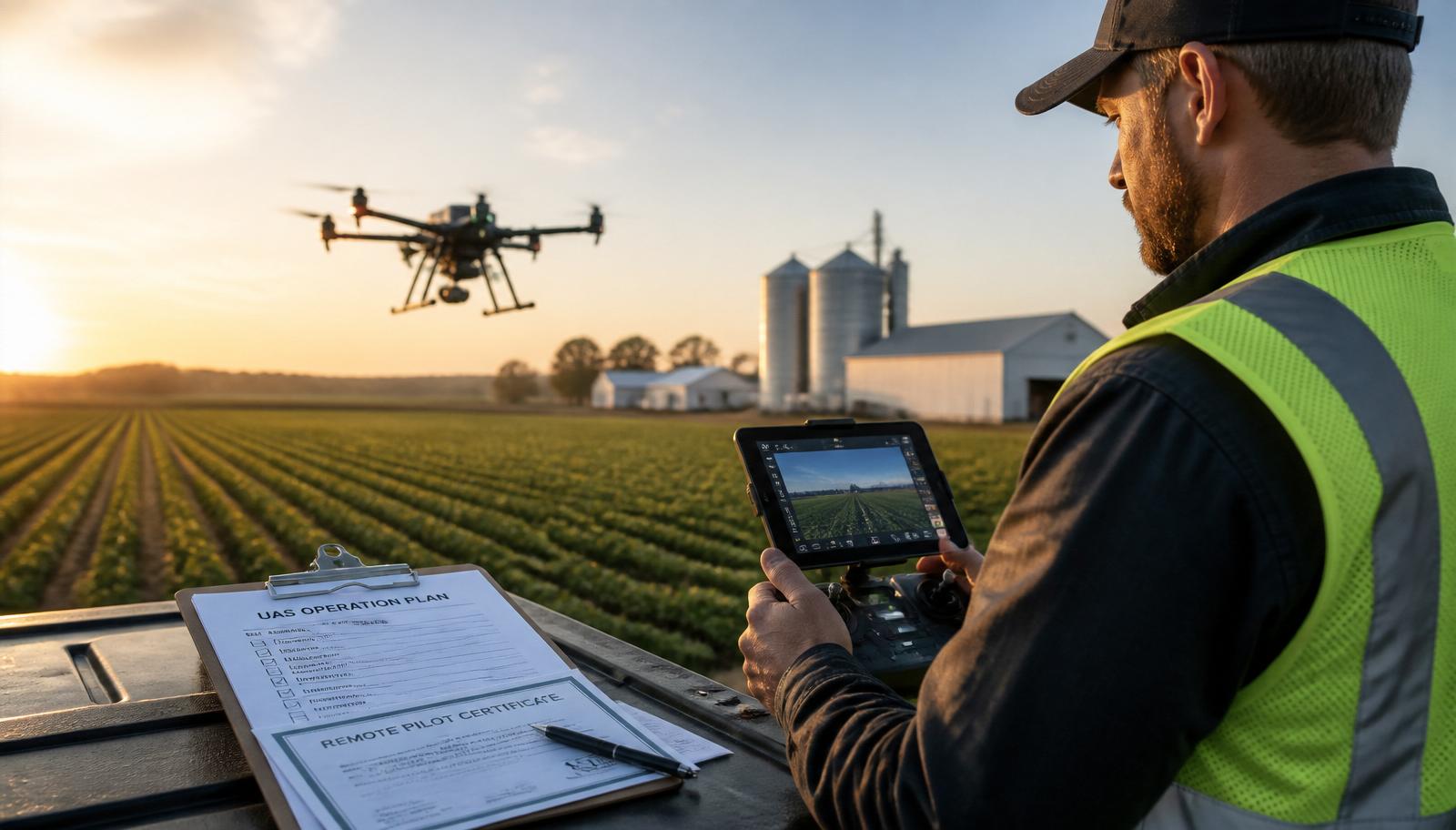
Kenya regulates every unmanned aircraft under the Civil Aviation (Unmanned Aircraft Systems) Regulations 2020, administered by the Kenya Civil Aviation Authority (KCAA). The regulations cover the airframe (registration), the operator (an organisational approval), the pilot (a licence issued after training at a KCAA-approved Remote Pilot Training Organisation) and, for spraying, the chemistry itself through the Pest Control Products Board.
The point most commercial buyers miss is sequencing. In Kenya the authorisation to bring a drone into the country comes before the shipment, not after it. An agricultural drone that arrives at Mombasa or JKIA without a KCAA import authorisation is held at customs, and the operator certificate and pilot licence that make it legal to fly commercially are separate approvals obtained afterwards.
This page is a buyer-oriented reference: what has to be approved, in what order, who issues each approval and which documents each stage consumes. It is not legal advice and it does not replace the KCAA's own published requirements, which change.
KCAA regulatory summary
- Weight classes
- Category A (private ≤25 kg), B (commercial ≤25 kg), C (>25 kg).
- Registration
- UAS Certificate of Registration and Operator Certificate (ROC) from KCAA.
- Pilot licensing
- Remote Pilot Licence from KCAA-approved Remote Pilot Training Organisation (RPTO).
- BVLOS
- Requires KCAA approval; granted for approved spray and mapping operations.
- Spray-drone rules
- PCPB (Pest Control Products Board) chemistry approval; KCAA operational approval; agronomist supervision.
- Import & type approval
- Import permit from KCAA before customs clearance; CA (Communications Authority) type approval.
Key operational rules
- Import permit BEFORE shipment — mandatory
- Max 400 ft AGL, VLOS by default
- 5 km separation from aerodromes without approval
- ROC application at least 90 days before the intended operation; ROC valid 12 months
- Remote Pilot Licence requires a Class 3 medical certificate and is mandatory for Category B and C work
- Third-party liability insurance must be in force for every operation
How to legally operate an agricultural drone in Kenya
The approvals run in sequence. Each stage consumes the output of the one before it, which is why the order matters more than the individual forms.
- 1Confirm the operating category
Category A covers private, non-commercial flight. Category B covers commercial operations — any spraying, seeding, mapping or survey work flown for a farm, a client or a business is Category B. Category C covers aircraft above 25 kg and other special cases, which is where most heavy spray platforms land. The category determines everything downstream, so fix it before ordering hardware.
- 2Obtain KCAA authorisation to import
KCAA authorisation must be in hand before the airframe is shipped. Applications identify the aircraft make, model, serial numbers, mass, intended use and the importing entity. Kenya also runs a security assessment on UAS applicants, so allow for clearance with the relevant government agencies rather than assuming a same-week turnaround.
- 3Clear Communications Authority type approval
The radio, telemetry and RTK links inside the drone are regulated equipment. Communications Authority of Kenya type approval covers the RF equipment; manufacturers can normally supply the test reports and certificates that support the application, so request them at RFQ stage rather than after delivery.
- 4Register the aircraft
Each airframe receives a UAS Certificate of Registration from KCAA and carries its registration marks. Registration is per airframe — a three-drone spray fleet is three registrations, and replacement airframes are registered in their own right.
- 5License the pilots
Remote pilots train at a KCAA-approved Remote Pilot Training Organisation (RPTO) and hold a Remote Pilot Licence. Budget for at least two licensed pilots per active spray fleet: a single-pilot operation stops entirely when that pilot is unavailable, and Kenyan spray windows are short.
- 6Hold an operator certificate
Commercial operations require an organisational approval from KCAA — an operator certificate supported by an operations manual, safety management documentation, maintenance arrangements and named accountable personnel. This is the stage that most often delays projects, because it is a company-level submission rather than a form.
- 7Clear the chemistry with the PCPB
Aerial application in Kenya is a pest-control-products question as much as an aviation one. Products applied by drone must be registered with the Pest Control Products Board for that use, and applications are made under agronomist supervision with records kept per mission.
- 8Coordinate airspace before each campaign
Default operations are within visual line of sight, by day, up to 400 ft AGL, and away from aerodromes without specific approval. BVLOS and controlled-airspace work require KCAA approval per operation, which is routinely granted for well-documented mapping and spray programmes but is never automatic.
KCAA licence and certificate classes
Which approval covers which kind of flying, and how long each one lasts.
| Licence / certificate | Scope | Validity |
|---|---|---|
| RPA Certificate (Category A) | Low-risk operations only: within visual line of sight, up to 400 ft AGL, 50 m lateral separation from uninvolved persons, buildings and objects, UAS up to 25 kg MTOM including payload, in segregated airspace. Not sufficient for commercial agricultural work. | 24 months |
| Student Remote Pilot Licence (SRPL) | Training licence held while completing instruction and examinations at an approved training organisation, before the full Remote Pilot Licence is issued. | Per KCAA licence conditions during training |
| Remote Pilot Licence (RPL) | Mandatory for Category B and Category C operations — i.e. for every commercial agricultural mission, including spraying, spreading, mapping and survey work. Applicants must be at least 18, demonstrate English proficiency, hold a valid Class 3 medical certificate and pass the knowledge test with an authorised instructor's endorsement. | Renewable licence; RPL renewal fee published in the KCAA schedule |
| E-VLOS and B-VLOS ratings | Ratings endorsed on the RPL for extended visual line of sight and beyond visual line of sight operation. B-VLOS work sits in Category C and additionally requires an airworthy, appropriately equipped aircraft and per-operation authorisation. | Endorsed on the underlying RPL |
| RPA Observer Certificate | Held by the observer supporting extended or beyond-line-of-sight operations. Practically relevant for larger spray and mapping blocks. | 24 months |
| Remote Aircraft Operators Certificate (ROC) | Company-level approval required to operate commercially. Applicant must be registered with its principal place of business in Kenya, hold approved manuals, a safety management system and an approved aircraft operator security programme, and pass a defence-ministry security clearance sought by KCAA during processing. | 12 months from issue or renewal |
| Certificate of Airworthiness | Required for Category C aircraft, based on the type certificate issued by the state of design or manufacture. Heavy spray platforms above 25 kg generally fall here. | Per certificate conditions |
KCAA fees and charges
Statutory KCAA fees are set in the Civil Aviation (Regulatory Fees and Charges for Unmanned Aircraft Systems) Regulations, 2020 (Legal Notice No. 4 of 2021). They are the government charges only — pilot training at an approved RPTO, manuals and safety-management consultancy, insurance and airfreight are separately and substantially larger costs. Fees are revised periodically; confirm current figures with KCAA before budgeting.
| Service | Fee (KSh) |
|---|---|
| Issuance of import permit | KSh 3,000 |
| Registration of a UAS (per airframe) | KSh 3,000 |
| Amendment of a certificate of registration | KSh 2,000 |
| Change of ownership | KSh 2,500 |
| Issuance of temporary permit | KSh 20,000 |
| Issue of Certificate of Airworthiness | KSh 5,000 |
| Service | Fee (KSh) |
|---|---|
| Initial issue of ROC | KSh 80,000 |
| Renewal of ROC | KSh 50,000 |
| Amendment of ROC | KSh 5,000 |
| Addition of a UAS to the ROC | KSh 2,000 |
| Inclusion of a new UAS type | KSh 10,000 |
| Approval of manuals | KSh 5,000 |
| Service | Fee (KSh) |
|---|---|
| Issue of Student Remote Pilot Licence (SRPL) | KSh 2,000 |
| Issue of Remote Pilot Licence (RPL) | KSh 4,000 |
| Renewal of RPL | KSh 2,000 |
| SRPL / RPL examinations (each) | KSh 4,000 |
| Repeat examination (partial pass) | KSh 2,000 |
| B-VLOS rating | KSh 2,000 |
| E-VLOS rating | KSh 2,000 |
| RPA Observer Certificate | KSh 2,000 |
| RPA Certificate (Category A operations) | KSh 2,000 |
| Validation of an ICAO contracting-state RPL | KSh 4,000 |
| Service | Fee (KSh) |
|---|---|
| Operation authorisation — Category A | KSh 2,000 |
| Operation authorisation — Category B and C | KSh 2,500 |
| Overflight permit | KSh 10,000 |
| Letter of approval / no objection | KSh 4,000 |
Source: KCAA UAS fees and charges schedule (Legal Notice No. 4 of 2021)
Approval timelines in Kenya
What the rules require, and what to plan for in a real project schedule.
| Stage | Statutory requirement | Practical planning |
|---|---|---|
| Import permit | No published turnaround; permit must exist before the aircraft is imported. | Plan several weeks. Applications are assessed against the importing entity and the intended use, and a security assessment can extend the clock. |
| Communications Authority type approval | Separate regime from KCAA; no aviation deadline applies. | Run it in parallel with the import permit. The gating item is the manufacturer's RF test documentation, so request it at RFQ stage. |
| Aircraft registration | Per airframe, after import authorisation. | Days to weeks once the technical file and ownership documents are complete. |
| Remote Pilot Licence | Minimum age 18, Class 3 medical certificate, knowledge test with instructor endorsement. | Dominated by RPTO course scheduling and the medical — commonly one to three months per pilot cohort, not a same-week process. |
| Remote Aircraft Operators Certificate (ROC) | Application must be made at least 90 days before the intended operation; the certificate is valid for 12 months. | Treat 90 days as the floor. Manuals, the safety management system, the security programme and the defence-ministry security clearance run in series, so six months from a standing start is a safer planning assumption. |
| Operation authorisation | Every operation in Categories A, B and C is authorised by the Authority. | Per-campaign coordination. Build it into the spray calendar rather than treating it as a one-off approval. |
| PCPB product clearance | Products applied aerially must be registered for that use with the Pest Control Products Board. | Fix the product list before the season. Where an export offtaker sets residue limits, their list governs, not the domestic minimum. |
Ongoing operator obligations
Approvals are the entry ticket. These are the duties that continue for as long as the fleet flies.
The operator certificate lapses annually. Renewal is a live compliance exercise against the approved manuals and safety management system, not a formality, and lapsed cover stops commercial flying.
Operating without a third-party risk policy is prohibited. Certificates must be available in authentic form at the operational management location or wherever KCAA specifies.
Flight, maintenance and personnel records are a standing obligation, and spray missions add PCPB-facing product, dose and agronomist records. This is the file that an export auditor asks for.
UAS incidents and accidents are reportable to KCAA. Fold the reporting route into the operations manual so a field crew is not deciding what to do on the day.
Operations stay clear of prohibited, restricted and danger areas and away from aerodromes unless expressly authorised. Category C work is flown under ATC instructions.
The ROC rests on an approved aircraft operator security programme and security obligations that continue after issue — including secure storage of airframes and controlled access to the system.
Imaging devices may not be used to conduct surveillance of, or capture images of, a person without written consent. Relevant wherever a mapping flight line crosses settlements or neighbouring holdings.
Carriage and discharge of goods, including agricultural chemistry, is regulated. Battery airfreight is a separate dangerous-goods question at the import stage.
Documentation pack
What an applicant assembles once and reuses across the KCAA submissions.
- Certificate of incorporation and KRA PIN for the operating entity
- Aircraft technical data: make, model, serial numbers, MTOM, payload type
- Manufacturer RF/telemetry test documentation for CA type approval
- Proof of insurance covering third-party liability for UAS operations
- Operations manual, safety management and maintenance procedures
- Remote pilot licences and RPTO training records for every pilot
- Agronomist details and PCPB product registrations for spray work
- Site, crop and hectarage detail for the intended operating area
Spray drones in Kenya: aviation approval is only half the file
A KCAA-legal drone flown with an unregistered product, or without agronomist supervision, is still an illegal application. Build the file in two columns: the aviation column (registration, licence, operator certificate, airspace) and the agronomy column (PCPB-registered product for the intended use, dose and water volume adapted to ultra-low-volume aerial application, drift management, buffer zones and per-mission records). Export-facing horticulture adds a third consideration — buyer and EU residue requirements are commercially stricter than the local minimum, so the product list is usually driven by the offtaker, not by what is merely permitted.
Importing hardware: what to fix inside the purchase contract
Because import authorisation and type approval precede clearance, the supplier's documentation obligations belong in the contract, not in an email. Specify serial-numbered technical data for the exact airframes shipped, RF test reports, battery transport documentation for lithium airfreight, spares and consumables lists, and a training component delivered to Kenyan pilots. Batteries are the recurring cost most first-time buyers underestimate: they are consumables with a flight-cycle life, and they are the item most likely to be delayed by dangerous-goods airfreight rules.
Buy a fleet or contract a service provider
For a single farm below roughly a few hundred hectares, contracting a licensed Kenyan operator usually beats owning: no operator certificate, no pilot licensing, no import file, no battery fleet. Ownership starts to make sense with sustained hectarage, multiple estates, tight application windows where a contractor's calendar becomes a yield risk, or where mapping and scouting run continuously rather than seasonally. The regulatory burden described on this page is the ownership burden — it is the real difference between the two models.
Where drones sit in a Kenyan project budget
Drone capability is rarely a standalone investment. It sits alongside protected cropping, irrigation and post-harvest capacity in the same capital plan, and lenders assess it as part of that plan rather than as an isolated equipment purchase. Where a drone package is being financed, it is normally folded into an equipment facility or leasing line covering the broader mechanisation scope.
Agricultural drone regulations in Kenya — FAQ
Do I need a licence to fly an agricultural drone in Kenya?
Yes. Commercial agricultural flying in Kenya requires a Remote Pilot Licence obtained through a KCAA-approved Remote Pilot Training Organisation, an aircraft registered with KCAA, and an operator approval for the company conducting the operations. Flying a commercially-operated drone without these is an offence under the Civil Aviation (Unmanned Aircraft Systems) Regulations 2020.
Can I import a spray drone into Kenya without prior approval?
No. KCAA authorisation is required before the aircraft is shipped, and the radio equipment needs Communications Authority type approval. Drones that arrive without the authorisation are detained at customs, and clearing them retrospectively is slower and more expensive than applying first.
Which authority regulates drones in Kenya?
The Kenya Civil Aviation Authority (KCAA) regulates the aircraft, the operator and the pilot under the Civil Aviation (Unmanned Aircraft Systems) Regulations 2020. The Communications Authority of Kenya handles RF type approval, and the Pest Control Products Board governs the products applied in any aerial spraying.
What are the drone categories under Kenya's UAS regulations?
Category A covers private operations, Category B covers commercial operations, and Category C covers heavier aircraft and other special cases. Agricultural work flown for a farm business or for clients falls under commercial rules, and most heavy spray platforms exceed 25 kg.
Is BVLOS flying allowed in Kenya?
Beyond visual line of sight operation is not a default permission. It requires specific KCAA approval tied to the operation, and approvals are granted where the operator can evidence procedures, containment and airspace coordination. Large-hectarage mapping and spray programmes are the usual candidates.
What altitude can agricultural drones fly at in Kenya?
The default ceiling is 400 ft above ground level, within visual line of sight and in daylight, with separation from aerodromes unless specifically approved. Agricultural spraying is flown far below that ceiling anyway; the operative constraints in practice are aerodrome proximity, controlled airspace and line of sight.
Do I need agronomist involvement for drone spraying in Kenya?
Yes. Aerial application is supervised work using products registered with the Pest Control Products Board for that use. Dose, water volume, buffer zones and record-keeping are part of the compliance file, and export-market residue requirements are frequently stricter than the domestic minimum.
How much does drone certification cost in Kenya?
Under the KCAA UAS fees schedule (Legal Notice No. 4 of 2021) the statutory charges include KSh 3,000 for an import permit, KSh 3,000 to register each airframe, KSh 4,000 to issue a Remote Pilot Licence, KSh 80,000 for an initial Remote Aircraft Operators Certificate and KSh 50,000 to renew it, plus KSh 2,500 per Category B or C operation authorisation. Fees are revised periodically, so confirm current figures with KCAA. The larger costs in practice are pilot training at an approved RPTO, the manuals and safety-management work behind the ROC, insurance and battery fleets.
How long does it take to get a drone operator certificate in Kenya?
The regulations require the Remote Aircraft Operators Certificate application to be filed at least 90 days before the intended operation, and the certificate is then valid for 12 months. Treat 90 days as a floor rather than a schedule: the manuals, safety management system, security programme and the defence-ministry security clearance that KCAA seeks during processing run in series, so six months from a standing start is a safer planning assumption for a first-time operator.
Which KCAA licence classes apply to agricultural drones?
Commercial agricultural flying is Category B or C, which requires a Remote Pilot Licence — applicants must be at least 18, demonstrate English proficiency, hold a valid Class 3 medical certificate and pass the knowledge test. Extended and beyond visual line of sight work is flown on E-VLOS or B-VLOS ratings endorsed on that licence, with an RPA Observer Certificate for the supporting observer. The RPA Certificate covers Category A low-risk private flying only and is not sufficient for commercial work. Category C aircraft, which is where most heavy spray platforms sit, also need a Certificate of Airworthiness.
Is it cheaper to hire a licensed drone operator in Kenya?
For most single-estate operations below a few hundred hectares, contracting a licensed Kenyan operator avoids the import file, the operator certificate, pilot licensing and battery replacement entirely. Ownership becomes attractive with sustained hectarage, multiple sites or application windows too tight to depend on a contractor's calendar.
Can drone equipment be included in agricultural project financing?
Yes. Drone packages are normally financed inside a broader equipment or mechanisation facility rather than as a standalone purchase, and are assessed alongside the irrigation, protected-cropping and post-harvest scope in the same capital plan.
Related Kenya resources
Protected cropping scope, structures and climate systems for Kenyan projects.
Institutions, instruments and equipment finance routes active in the Kenyan market.
What to specify when comparing spray platforms, tanks, nozzles and RTK.
NDVI, multispectral and thermal payloads for scouting programmes.
Official references
Related drone sourcing resources
Spraying, seeding, NDVI, thermal, LiDAR and fleet management for Kenya.
Screened global manufacturers and integrators — released only through the RFQ.
Tank capacity, nozzles, swath and chemistry compatibility for compliant spraying.
RGB, multispectral, thermal and LiDAR payloads for crop monitoring.
What to pin down before quotes are requested — including regulatory route.
Indicative fleet, training and service budget before an RFQ is dispatched.
Leasing, working capital and project finance for drone fleets and agri equipment.
One private brief dispatched to qualified manufacturers for Kenya.
Every country regulation page
Compare Kenya against every other jurisdiction we cover — authority, licensing route, spray-drone approvals and import rules.
KCAA · you are here
Agricultural drone RFQ — Kenya
One private brief for drone hardware, payloads, batteries, software and training with Kenya-compliant documentation. A dedicated sourcing specialist opens it to qualified global manufacturers.