
Cornerstone · Commercial Agriculture Infrastructure
The Future of Commercial Agriculture: Why Successful Agricultural Projects Start with Planning, Not Procurement
Why the decisions taken before a supplier is contacted determine yield, cost, bankability and asset life across greenhouses, irrigation, nurseries, packing houses and agricultural infrastructure.
SeedMatchGroup Project Advisory · Published February 2026 · 28 min read
Planning before procurement in commercial agriculture
On commercial agriculture projects, the planning stage — crop plan, climate data, water balance, site engineering, budget and bankability — determines yield, cost and asset life long before a supplier is contacted. Procurement should execute a defined specification, not discover it.
Executive summary
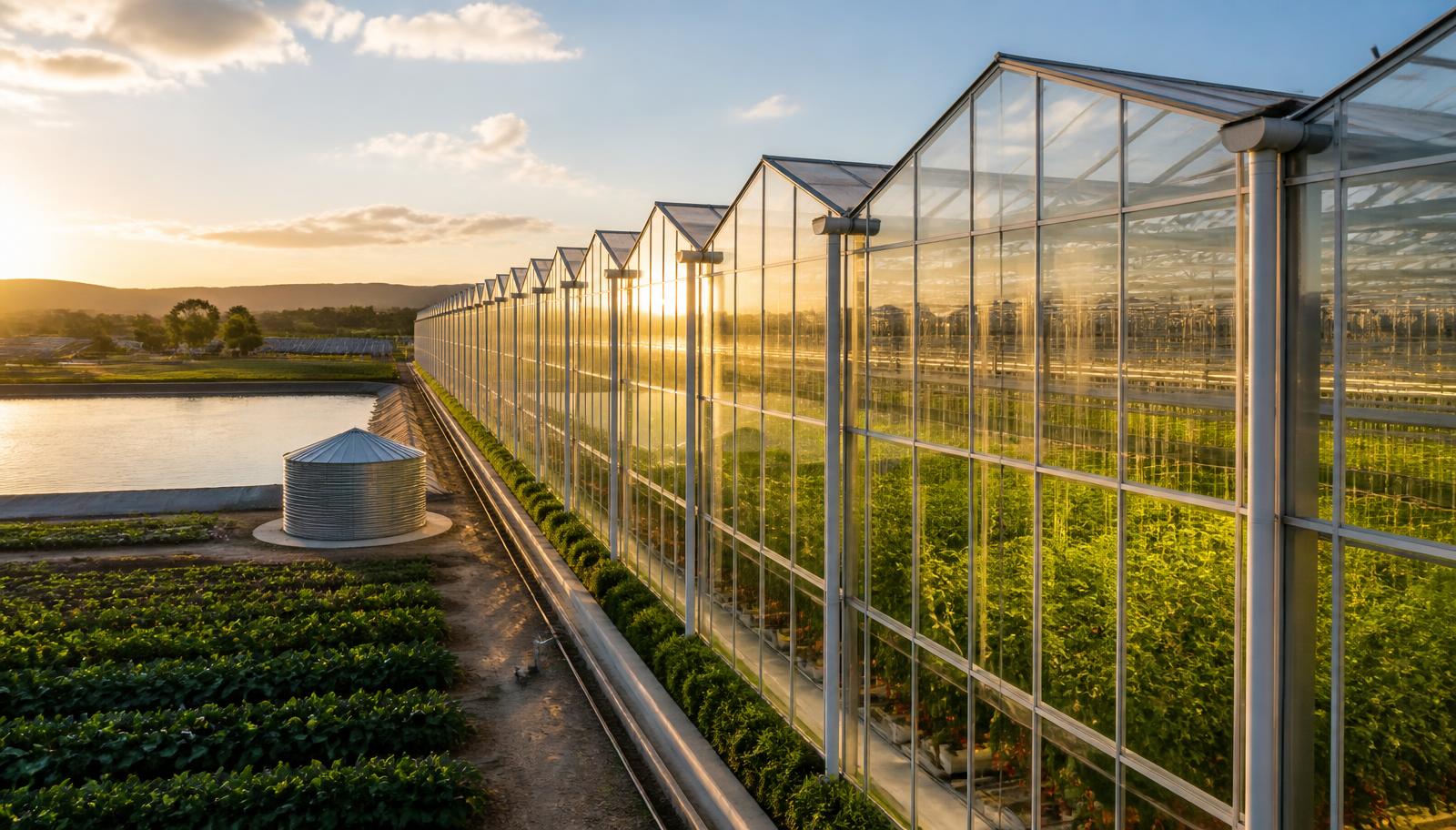
Commercial agriculture has quietly become an infrastructure industry. A modern protected-cultivation facility, a district irrigation scheme, a commercial nursery or a regional packing house is no longer a purchase; it is a capital project with civil works, utilities, process engineering, automation, financing structures, permitting obligations and a multi-decade operating horizon. The organizations building them — private agribusinesses, institutional investors, sovereign food-security programmes, cooperatives and development agencies — are increasingly applying the disciplines used in energy, water and industrial construction.
Yet the dominant purchasing behaviour in the sector has not caught up. A large share of projects still begin with a supplier conversation: a request for a greenhouse quotation, an irrigation package price or a turnkey proposal from a single manufacturer. The technical scope is then reverse-engineered from whatever that supplier happens to sell. This inverts the logic of capital investment, and it is the single most reliable predictor of disappointing returns.
This white paper sets out the alternative. It describes how commercial agriculture projects have evolved from equipment purchasing to integrated development, what a complete infrastructure scope actually contains, how planning decisions propagate through water, energy, climate, automation and post-harvest systems, how lenders evaluate bankability, and how structured, supplier-neutral procurement converts a plan into comparable, defensible offers. It closes with the operating model SeedMatchGroup applies as a buyer-first platform within the Global B2B Group ecosystem.
The argument is simple and, in the authors' experience, uncontroversial among experienced practitioners: successful agricultural projects start with planning, not procurement. What follows is an attempt to describe that planning work in enough operational detail to be useful to the people who have to do it.
Key takeaways
- Most commercial agriculture projects that underperform do so because of planning and sequencing decisions taken before procurement — not because of the equipment that was eventually bought.
- A modern greenhouse, irrigation scheme, nursery or packing house is an integrated system of land, water, energy, structures, climate, automation, post-harvest capacity, logistics and people. Buying any one component in isolation transfers integration risk to the buyer.
- The industry has evolved through five stages: equipment purchasing, greenhouse projects, agricultural infrastructure, integrated agricultural development, and buyer-first commercial agriculture platforms.
- Bankability is engineered, not negotiated. Lenders price the quality of the feasibility work, the water and energy strategy, the off-take evidence and the sponsor's operating capability long before they price the hardware.
- Structured procurement — a single, supplier-neutral scope issued to qualified manufacturers under identical assumptions — produces comparable offers. Fragmented enquiries produce incomparable ones.
- Lifecycle cost, not capital cost, decides project outcomes. Energy, water, labour, maintenance and shrinkage dominate the operating account of every commercial agriculture facility.
- Climate volatility, water scarcity, labour cost and food-security policy are pushing capital toward controlled environment agriculture and integrated post-harvest infrastructure across every region.
- SeedMatchGroup is a buyer-first platform: it helps organizations plan, model, prepare and structure projects before manufacturers, EPC contractors or engineering partners are selected — and it remains supplier-neutral throughout.
Why procurement-first thinking fails
Procurement-first thinking is intuitive because it produces something tangible quickly. A quotation is a document. It has a number on it. It can be shown to a board, compared against another number, and negotiated. Planning, by contrast, produces assumptions, models and specifications — artefacts that feel abstract until the day they are needed. The result is a systematic bias toward starting where the certainty appears to be, rather than where the risk actually is.
The problem is that a quotation is only meaningful relative to a scope, and in most early-stage agricultural projects the scope does not yet exist. What is being compared, therefore, is not price but interpretation. One manufacturer assumes a heating system sized for a mild winter; another assumes a design temperature ten degrees lower. One includes a screen package, thermal buffer and CO₂ dosing; another quotes the bare structure. One assumes municipal water of known quality; another assumes borehole water requiring treatment. The two documents look comparable. They describe different projects.
This is why the classic failure modes in commercial agriculture cluster so tightly around the same causes, regardless of geography or crop. Crop-climate mismatch, because the climate envelope was never modelled against a local weather file. Under-designed irrigation and fertigation, because peak demand was estimated from an annual average. Energy strategies finalised after the structure was fixed, when the tariff exposure could no longer be engineered away. Post-harvest capacity sized for the planting plan rather than the peak harvest week. Financing terms that do not match the crop cycle or the ramp-up curve. Phase one civil works with no provision for phase two.
None of these are equipment failures. In almost every case the hardware performs to specification. The specification was simply wrong for the project, and it was wrong because it was written by the party selling it, at a moment when the buyer had not yet defined what the project needed to achieve.
The equipment is rarely the problem. The assumptions underneath the equipment almost always are.
There is also a cumulative, less visible cost. Poor planning seldom announces itself as a single catastrophic event. It shows up as a slow drag: yields landing below plan because the climate envelope never matched the crop; energy running well above forecast because heating and cooling were reverse-engineered from an off-the-shelf structure; labour costs escalating because the layout was optimised for construction speed rather than daily crop work; water and nutrient costs creeping upward because drainage is not recirculated and conductivity drift is not properly controlled. Individually these are rounding errors. Together they routinely convert a projected four-year payback into an eight- or ten-year one.
Institutional capital has already internalised this. Serious lenders and development finance institutions increasingly require an independent feasibility study, an agronomic review and an integrated technical specification before committing to an agricultural project, irrespective of the reputation of the brands involved. They are not evaluating equipment risk. They are evaluating planning risk.
The evolution of commercial agriculture
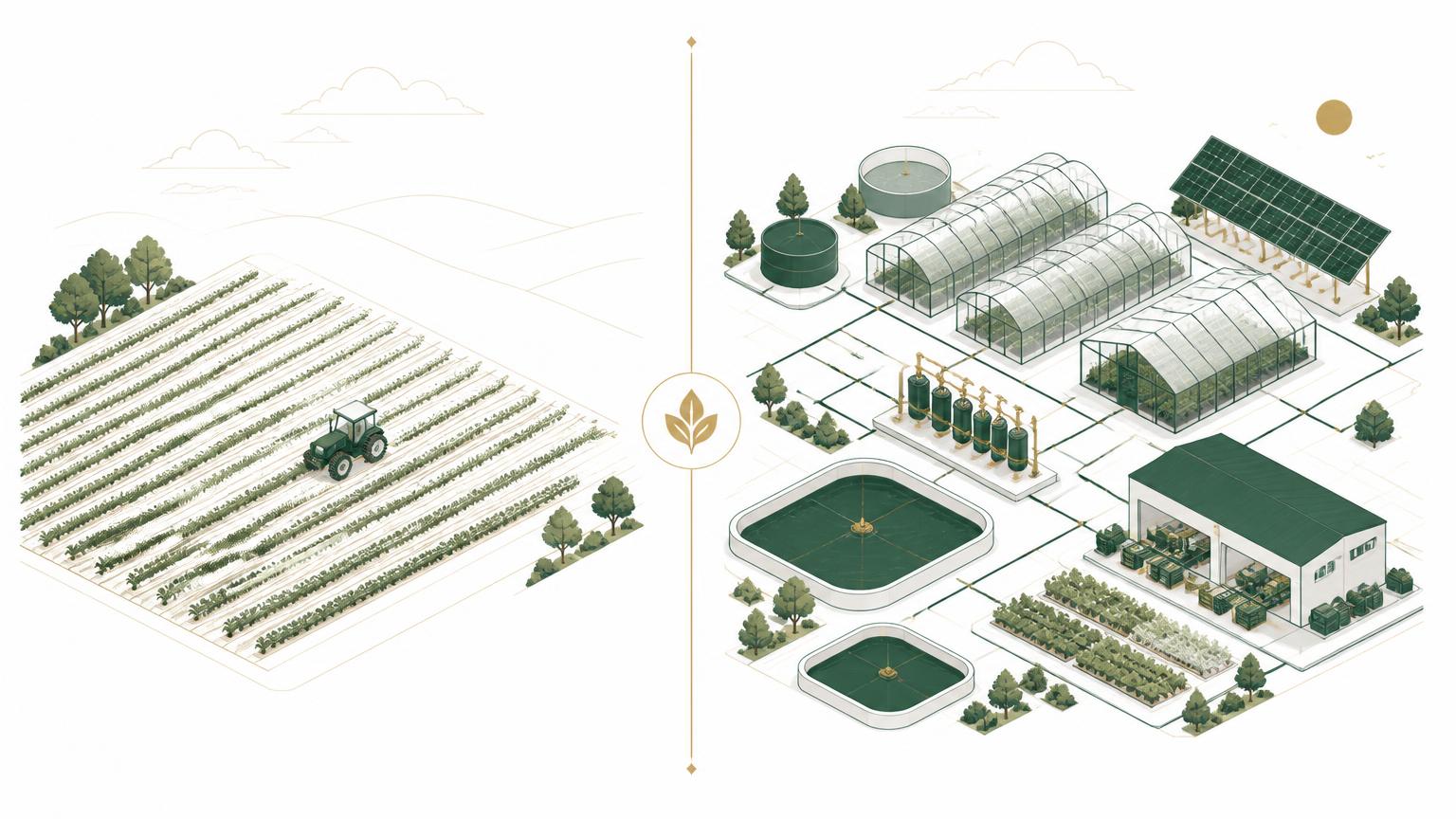
The shift from purchasing to planning is not a matter of taste. It reflects a genuine structural evolution in how agricultural production capacity is created. Five stages describe that evolution, and most organizations can locate themselves — and their suppliers — somewhere along it.
Stage one — agricultural equipment
The original model is transactional. A grower needs a machine, a pump, a tunnel or a set of trays, and buys it. The unit of decision is the product; the unit of comparison is price and durability. The buyer carries all integration responsibility, which is acceptable because there is very little to integrate. This model remains entirely appropriate for replacement and incremental capacity, and it still accounts for the majority of transactions in the sector by volume.
Stage two — greenhouse projects
As protected cultivation spread, the unit of decision became the structure. Buyers began specifying square metres of greenhouse, with climate control and irrigation attached as packages. This was a genuine advance: it introduced design, engineering drawings and commissioning into a sector that had largely operated without them. Its limitation is that the greenhouse was still treated as the project, when in reality it is one subsystem of a production facility. Water supply, energy strategy, labour model, post-harvest capacity and route to market were frequently left outside the scope entirely.
Stage three — commercial agriculture infrastructure
The third stage recognises the facility as infrastructure. Site works, water abstraction and treatment, storage and reservoirs, power supply and backup, internal distribution, buildings, waste handling, access roads and biosecurity all enter the scope. Engineering disciplines multiply: civil, hydraulic, electrical, mechanical, control and agronomic. Capital intensity rises, but so does resilience and asset life. At this stage the project starts to resemble industrial construction, and the tools of industrial construction — feasibility studies, basis of design documents, phased procurement, commissioning protocols — become necessary rather than optional.
Stage four — integrated agricultural development
The fourth stage extends the boundary beyond the fence line. Genetics and propagation, production, harvest logistics, packing, cold chain, processing, distribution and market access are planned as one value chain, because that is how the economics actually behave. A greenhouse that produces excellent fruit and loses a significant share of it between harvest and the customer is not a greenhouse problem; it is a value-chain design problem. Integrated development also brings in workforce planning, training, agronomic support, quality certification and traceability — the operating capability without which the physical asset underperforms.
Stage five — buyer-first commercial agriculture platforms
The fifth stage is organisational rather than technical. Once projects are integrated, the buyer needs a way to plan, model, specify and procure across many disciplines without becoming captive to any single vendor's worldview. That is the function of a buyer-first platform: to hold the knowledge, structure, modelling tools and procurement discipline on the buyer's side of the table, and to engage manufacturers, EPC contractors and engineering firms only once the project is defined well enough to be quoted meaningfully. The platform does not manufacture, does not lend and does not represent suppliers. Its neutrality is what makes its scope documents trustworthy.
| Stage | Unit of decision | Who carries integration risk | Typical failure mode |
|---|---|---|---|
| Agricultural equipment | Product | Buyer | Component mismatch with the existing operation |
| Greenhouse projects | Structure and packages | Buyer, partially the supplier | Utilities and post-harvest excluded from scope |
| Agricultural infrastructure | Facility and utilities | EPC contractor or owner's engineer | Under-modelled water and energy demand |
| Integrated agricultural development | Value chain | Project sponsor and advisors | Market access and operating capability underestimated |
| Buyer-first platform | Project definition | Structured, supplier-neutral scope | Addressed at planning stage rather than after award |
What agricultural infrastructure actually means
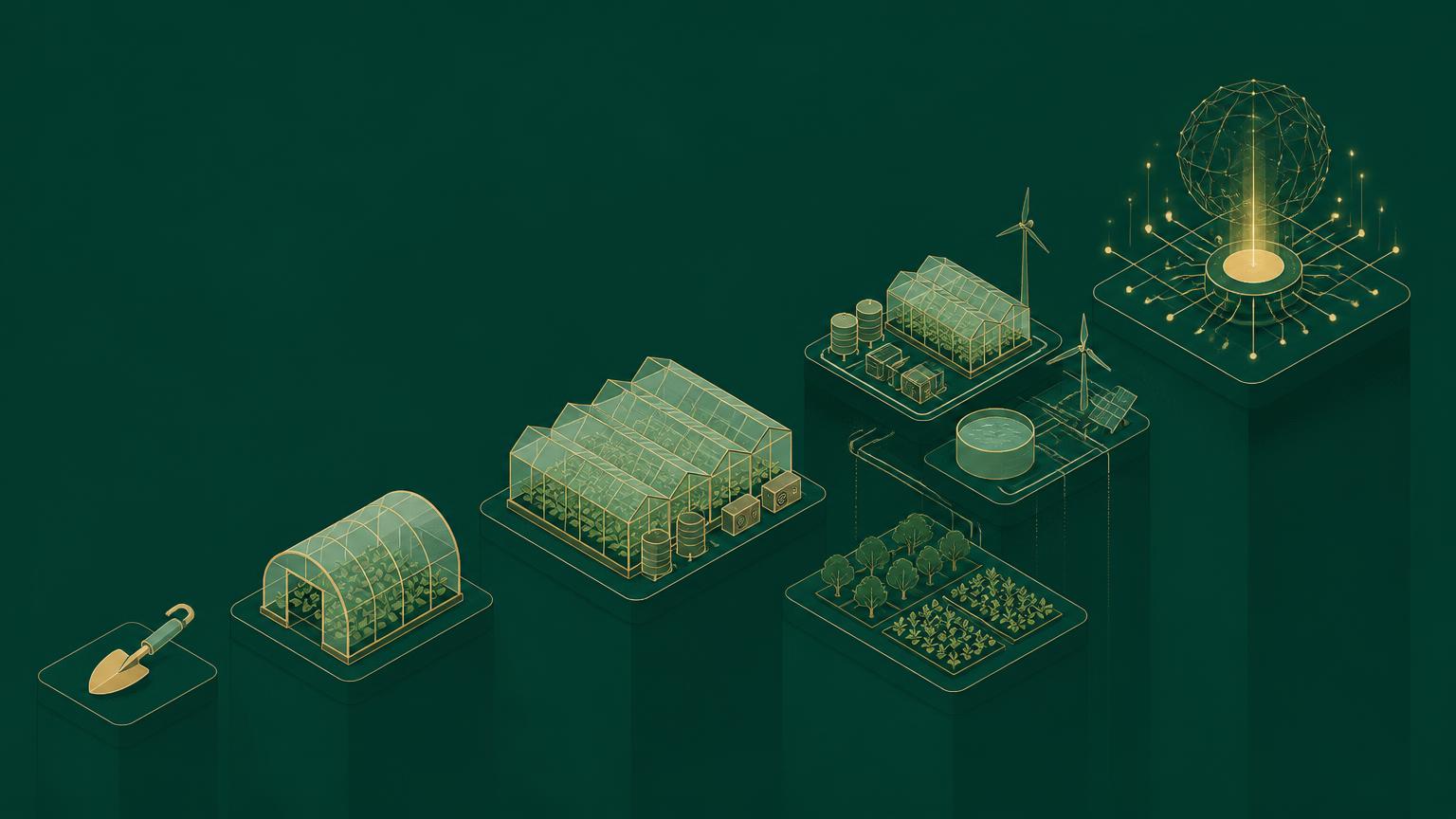
Agricultural infrastructure is a term used loosely in the market, often as a synonym for buildings. In project terms it has a precise meaning: the permanent physical and utility systems that make commercial production possible, repeatable and financeable. A complete scope contains at least ten subsystems, each of which constrains the others.
- Land and site works — topography, drainage, soil bearing capacity, flood risk, orientation, prevailing wind, access, security and expansion reserve.
- Water supply — source, legal abstraction rights, seasonal availability, quality, storage volume, treatment and redundancy.
- Energy — connection capacity, tariff structure, thermal demand, backup generation, renewable integration and storage.
- Structures — greenhouses, shade houses, nursery buildings, packing halls, workshops, offices and staff facilities.
- Climate systems — heating, cooling, ventilation, screening, dehumidification, CO₂ enrichment and supplemental lighting.
- Irrigation and fertigation — pumping, filtration, dosing, distribution, drainage, recirculation and disinfection.
- Automation and controls — climate computers, sensors, actuators, energy management, irrigation control and data platforms.
- Post-harvest capacity — pre-cooling, grading, packing, cold storage, controlled atmosphere and dispatch.
- Logistics — internal handling, loading docks, road access, transport modes and export documentation flows.
- People and systems — organisational design, technical training, agronomic supervision, maintenance regimes, food-safety certification and traceability.
The critical property of this list is that it is not additive. Each subsystem sets boundary conditions for the others. Water quality determines filtration and dosing design, which determines the fertigation head, which determines pumping energy, which affects the electrical connection, which affects the tariff, which affects the operating account and therefore the debt service capacity. A decision taken at the top of that chain in week two of a project will still be shaping cash flow in year twelve.
Definition
Basis of design
A single controlled document that records every design assumption — climate file, crop plan, target yields, water balance, energy demand profile, peak harvest volumes, labour model, expansion provision — against which all engineering and all supplier offers are subsequently checked. In a well-run project it is written before any supplier is contacted, and updated under change control thereafter.
Controlled Environment Agriculture: when climate becomes a design variable
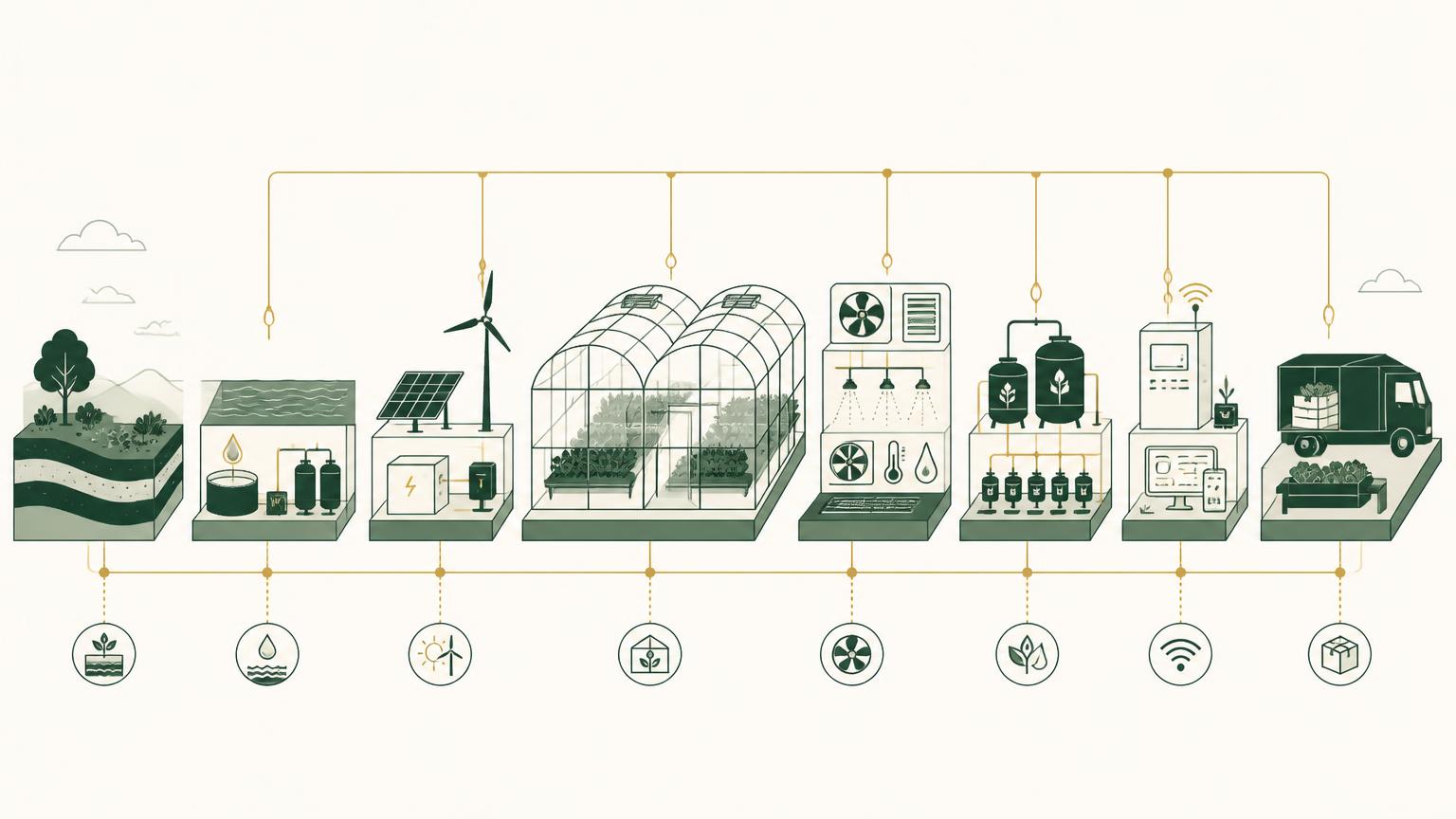
Controlled Environment Agriculture (CEA) covers any production system in which the growing climate is actively managed rather than accepted: high-technology glasshouses, semi-closed and closed greenhouses, plastic structures with active climate control, hydroponic and substrate systems, vertical farms and indoor propagation facilities. The defining characteristic is not the technology but the intent — the grower is buying control over temperature, humidity, radiation, carbon dioxide, airflow and root-zone conditions.
Control is expensive, and it is only worth buying where it converts into value: higher yield per square metre, longer production windows, better quality consistency, reduced water and nutrient use, lower crop-protection intensity, or access to premium and off-season markets. The central planning question in any CEA project is therefore not how advanced the facility should be, but how much control this crop, in this climate, for this market, actually justifies. Answering it requires a climate file, a crop model, a market price curve and an energy price forecast — before a structure type is selected.
Technology level is best treated as a continuum rather than a category. At the lower end, passively ventilated structures with insect netting and drip irrigation deliver modest but reliable gains at low capital and energy cost. In the middle, actively ventilated structures with screens, evaporative cooling, fertigation control and basic automation suit most Mediterranean, subtropical and highland climates. At the upper end, semi-closed glasshouses with full climate computers, thermal storage, dehumidification, CO₂ enrichment and supplemental lighting achieve the highest productivity per square metre and the highest exposure to energy prices.
| Technology level | Best suited to | Principal cost driver | Principal risk |
|---|---|---|---|
| Passive protected structures | Mild climates, robust crops, first-phase projects, cost-sensitive markets | Structure and irrigation | Limited control in heat or humidity extremes |
| Actively ventilated with screens and cooling | Mediterranean, subtropical and highland climates, mid-value crops | Cooling, screens, fertigation | Under-sized cooling in peak radiation weeks |
| High-technology glasshouse | Cold or continental climates, high-value crops, year-round supply contracts | Thermal energy and electricity | Energy price exposure and operator skill |
| Semi-closed and closed systems | Water-scarce regions, biosecure propagation, premium export programmes | Electricity, dehumidification, controls | Complexity outrunning operating capability |
| Vertical and indoor farming | Urban proximity, leafy greens, propagation, research and pharma-grade crops | Electricity and lighting | Unit economics outside a narrow crop set |
Two planning errors recur across CEA projects. The first is specifying a technology level above the operating capability available on site: a semi-closed glasshouse run by a team trained on open-field production will underperform a simpler structure run well. The second is copying a specification from a different latitude. A design that performs in a maritime temperate climate can fail badly in a hot arid one, not because the equipment is inferior but because the climate envelope it was engineered against no longer exists.
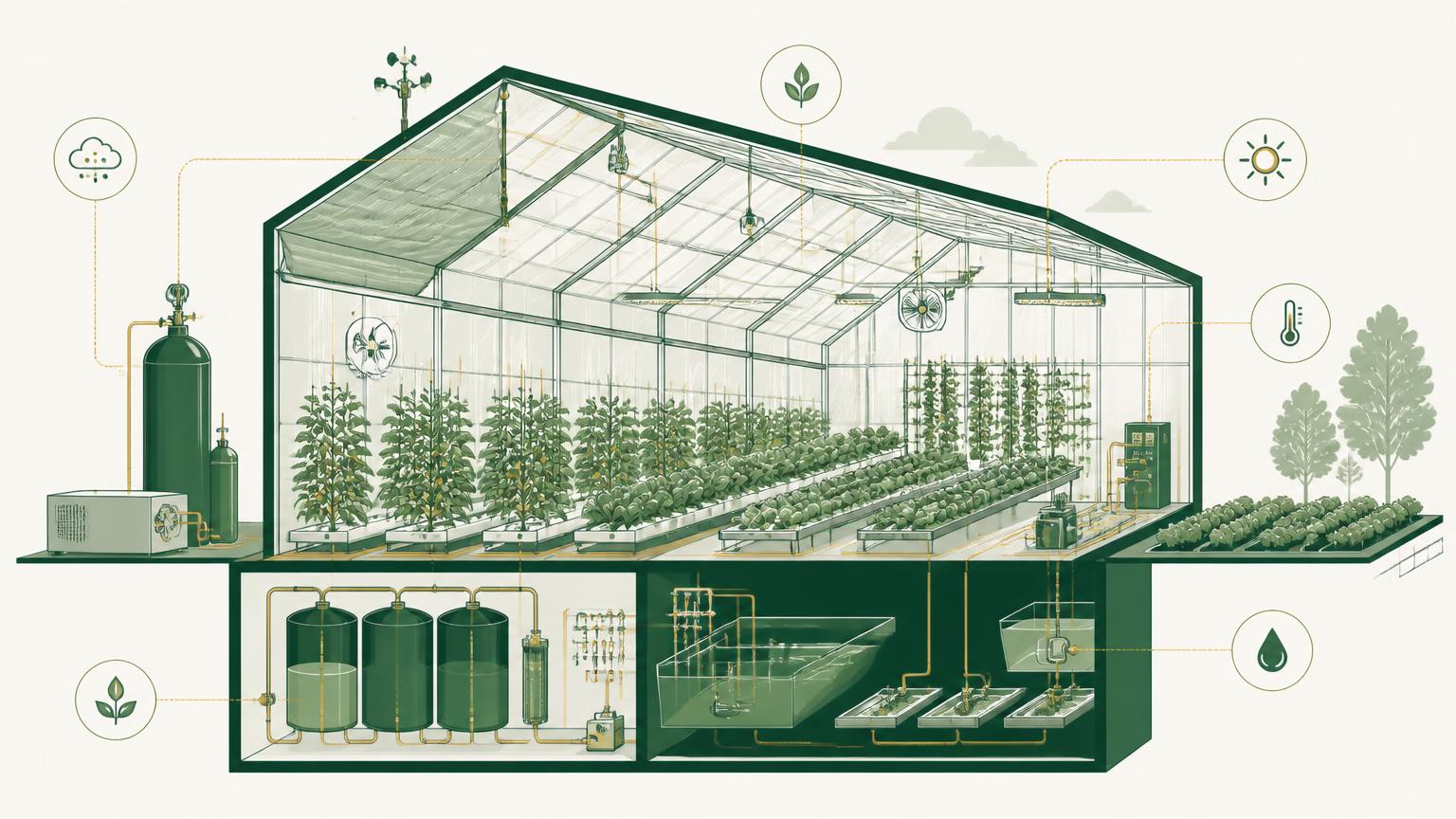
Irrigation and water management: the discipline that decides the project
Water is the subsystem most often treated as a commodity and most often responsible for structural underperformance. In commercial agriculture it is four separate engineering problems: securing a source, establishing quality, delivering peak demand reliably, and managing what returns from the crop.
Source and rights
A water source is only real if it is legally secured, physically reliable in the driest expected season, and of a quality that can be economically corrected. Abstraction licences, aquifer drawdown trends, surface allocation rules, competing municipal demand and desalination or reuse options belong in the feasibility study, not in the construction phase. Projects that discover a water constraint after civil works have started rarely recover the lost value.
Quality and treatment
Salinity, sodium and chloride levels, bicarbonate, iron and manganese, boron, hardness, suspended solids and biological load each drive a different treatment decision — reverse osmosis, acid dosing, oxidation and filtration, sand and disc filtration, ultraviolet or thermal disinfection. Treatment choices then determine energy consumption, consumable cost, brine or backwash disposal and maintenance labour. A full water analysis across seasons is one of the cheapest de-risking actions available to a project sponsor.
Peak demand and storage
Irrigation systems fail on peak days, not average ones. Peak demand in a mature high-wire crop under high radiation can be several multiples of the annual average, and it arrives at the moment the crop is most valuable. Sizing pumps, mains, filtration, mixing capacity and storage against the average is one of the most common and most expensive design errors in the sector. Storage also buys resilience: buffer volume decouples the facility from short interruptions in supply or power.
Drainage, recirculation and nutrient control
In substrate and hydroponic systems, drainage is not waste; it is a controlled fraction of the irrigation strategy. Recirculating it reduces water and fertiliser consumption substantially and is increasingly required by environmental regulation, but it requires disinfection, conductivity and pH management, sodium accumulation monitoring and a disposal route for the eventual bleed. Designing recirculation in from the beginning costs a fraction of retrofitting it later.
Water is not an equipment category. It is a project-management discipline that happens to require equipment.
The same logic applies at scheme scale. Large irrigation projects — pivots, drip networks for open field, district schemes, pumping stations and canal modernisation — succeed or fail on hydraulic modelling, pressure zoning, energy cost per cubic metre delivered, maintenance access and the institutional arrangements for operating the network. Equipment selection is the last decision, not the first.
Nursery development: the most under-specified asset in the value chain
Propagation determines the ceiling of everything downstream. A production facility can only perform to the quality of the plant material entering it, and yet nurseries are routinely treated as an operational detail rather than a designed asset. Commercial nursery projects — vegetable seedling propagation, fruit tree and rootstock nurseries, forestry and restoration nurseries, ornamental production — have their own infrastructure logic.
- Biosecurity as a design constraint: separation distances, controlled entry, insect exclusion, disinfection points, quarantine and mother-stock isolation.
- Environmental precision: germination chambers, hardening areas, misting and fogging, bench or floor heating, and light management for uniform batches.
- Throughput engineering: tray handling, sowing lines, transplanting, grading, spacing and dispatch, all sized to the peak planting calendar rather than the annual total.
- Traceability: batch records from seed lot to delivered plant, increasingly required by buyers, certification schemes and phytosanitary authorities.
- Substrate, water and waste: substrate supply chain, irrigation water quality, drainage capture and reuse, and disposal of spent media.
For integrated projects the strategic question is whether to build propagation capacity or to buy plants. Building gives control over timing, variety, quality and biosecurity, and captures margin; it also adds capital, a distinct technical skill set and a peak-load management problem. Buying is simpler but exposes the production programme to a third party's calendar. Either answer can be correct. What is never correct is deciding by default.
Packing houses and post-harvest infrastructure
Post-harvest is where produced value is either preserved or lost, and it is chronically under-invested relative to production. Losses between harvest and market remain substantial in most emerging-market supply chains, and a large share of them are attributable to the first few hours after harvest — precisely the window that pre-cooling infrastructure exists to address.
A packing house is a process plant. Its design follows product flow: reception and weighing, pre-cooling, storage, sorting and grading, washing or dry cleaning, packing, labelling, palletising, cold dispatch and waste handling. The engineering questions are the same as in any process facility — throughput at peak hour, buffer capacity between stages, hygienic zoning, personnel and material flow separation, refrigeration load, energy recovery and cleaning regimes.
| Design parameter | Common error | Correct basis |
|---|---|---|
| Reception throughput | Annual tonnage divided by working days | Peak harvest day and peak hour arrival profile |
| Pre-cooling capacity | Sized to storage volume | Sized to the heat load of incoming produce within the target pull-down time |
| Cold storage | Single temperature regime | Separate regimes by product and stage, with buffer for market delays |
| Grading lines | Rated speed from the brochure | Effective speed at target quality, including reject handling |
| Dispatch | Number of docks | Vehicle turnaround in the peak dispatch window with cold-chain integrity |
Cold chain deserves particular attention because it crosses organisational boundaries. Temperature integrity maintained perfectly inside the facility and lost during transport delivers no benefit to the buyer's customer. This is the point at which agricultural projects intersect with dedicated cold-chain infrastructure planning, and where specialist input is usually justified.

Agricultural automation and digital transformation
Automation in commercial agriculture is driven by three forces: labour availability and cost, the precision requirements of high-value crops, and the data requirements of buyers, certifiers and lenders. It spans climate and irrigation control, energy management, robotics for handling and harvesting, grading and vision systems, sensing and imaging, and the software layer that turns all of it into decisions.
The planning discipline here is unglamorous but decisive: automation should be specified against a defined operational problem, with an explicit measure of the labour, quality or energy outcome it is expected to deliver, and against the skill base available to maintain it. Facilities that automate faster than their maintenance capability grows accumulate stranded technology — installed systems that are switched off within two seasons because nobody can service them.
Interoperability is a second planning issue. Proprietary controls that cannot exchange data with irrigation, energy or enterprise systems create silos that are expensive to unpick later. Where possible, buyers should require open protocols, documented data schemas, exportable historical data and clear ownership of the data generated by their own facility. These clauses cost nothing at specification stage and are close to impossible to negotiate after award.
The broader digital transformation is procedural rather than technological. Projects that keep their assumptions, drawings, specifications, supplier correspondence, change orders and commissioning records in a single structured environment consistently outperform those that manage them across email threads and spreadsheets — not because the software is clever, but because decisions remain traceable, and traceable decisions are what lenders, auditors and successor management teams need.
Food security, climate resilience and the policy backdrop
Much of the current capital flow into commercial agriculture infrastructure is policy-driven. Governments in water-scarce and import-dependent regions are funding protected cultivation, irrigation modernisation, seed production capacity, storage and processing as strategic assets rather than as commercial ventures alone. Development finance institutions are financing value-chain infrastructure with explicit food-security and employment mandates. Private capital is following, attracted by contracted off-take and inflation-linked staple demand.
Climate volatility reinforces the same direction of travel. Rising heat extremes, less predictable rainfall, aquifer stress and new pest and disease pressures all raise the value of controlled production and of water-efficient irrigation. Resilience, in project terms, is concrete: design margins for higher peak temperatures, redundancy in water and power, storage buffers, diversified crop plans, and structures engineered for updated wind and snow loads rather than historical ones.
For sponsors, the practical implication is that resilience assumptions must be written into the basis of design explicitly. A structure engineered to a thirty-year-old climate norm is a liability that will be discovered by weather, not by an audit.
The project lifecycle and a working decision framework
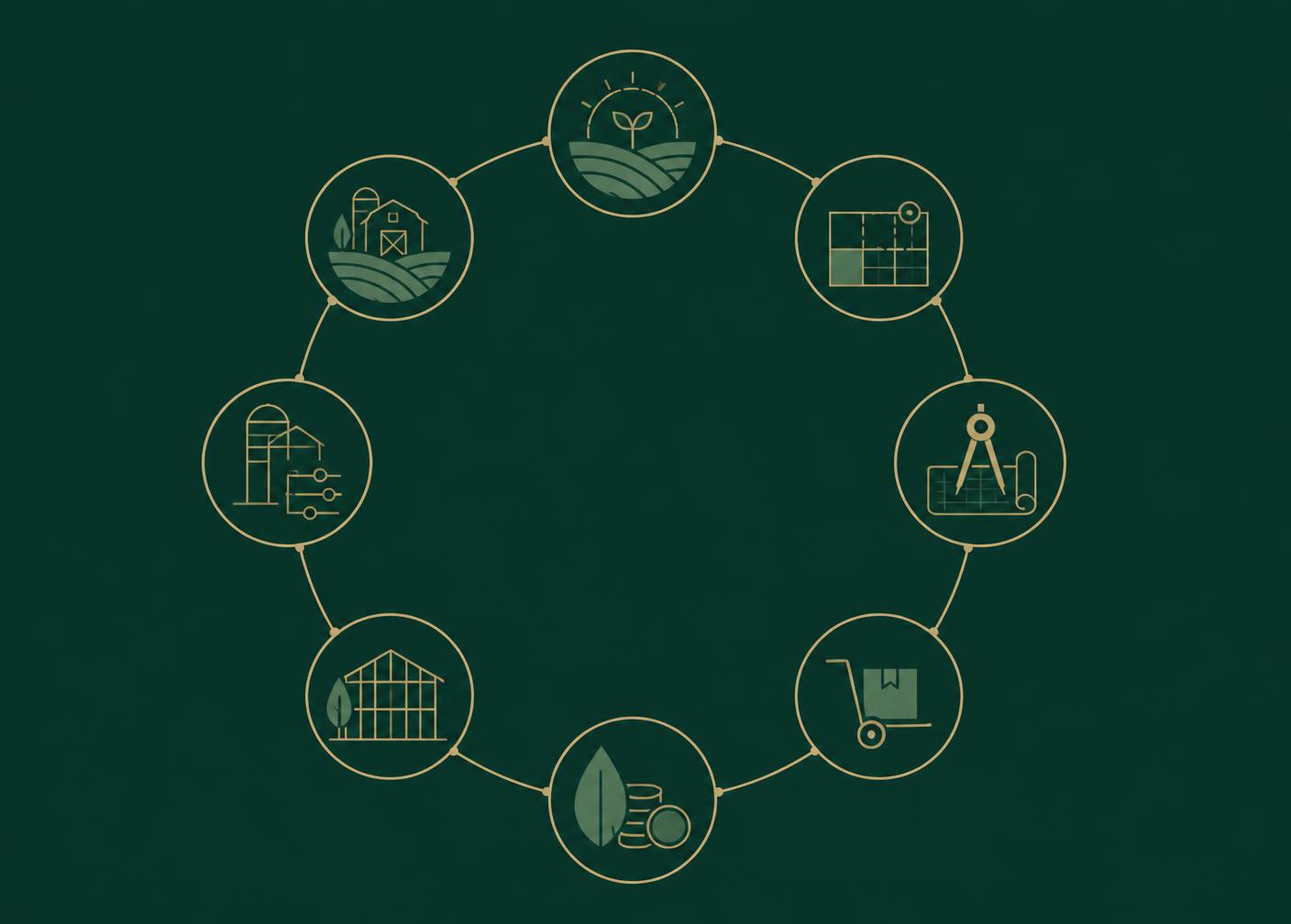
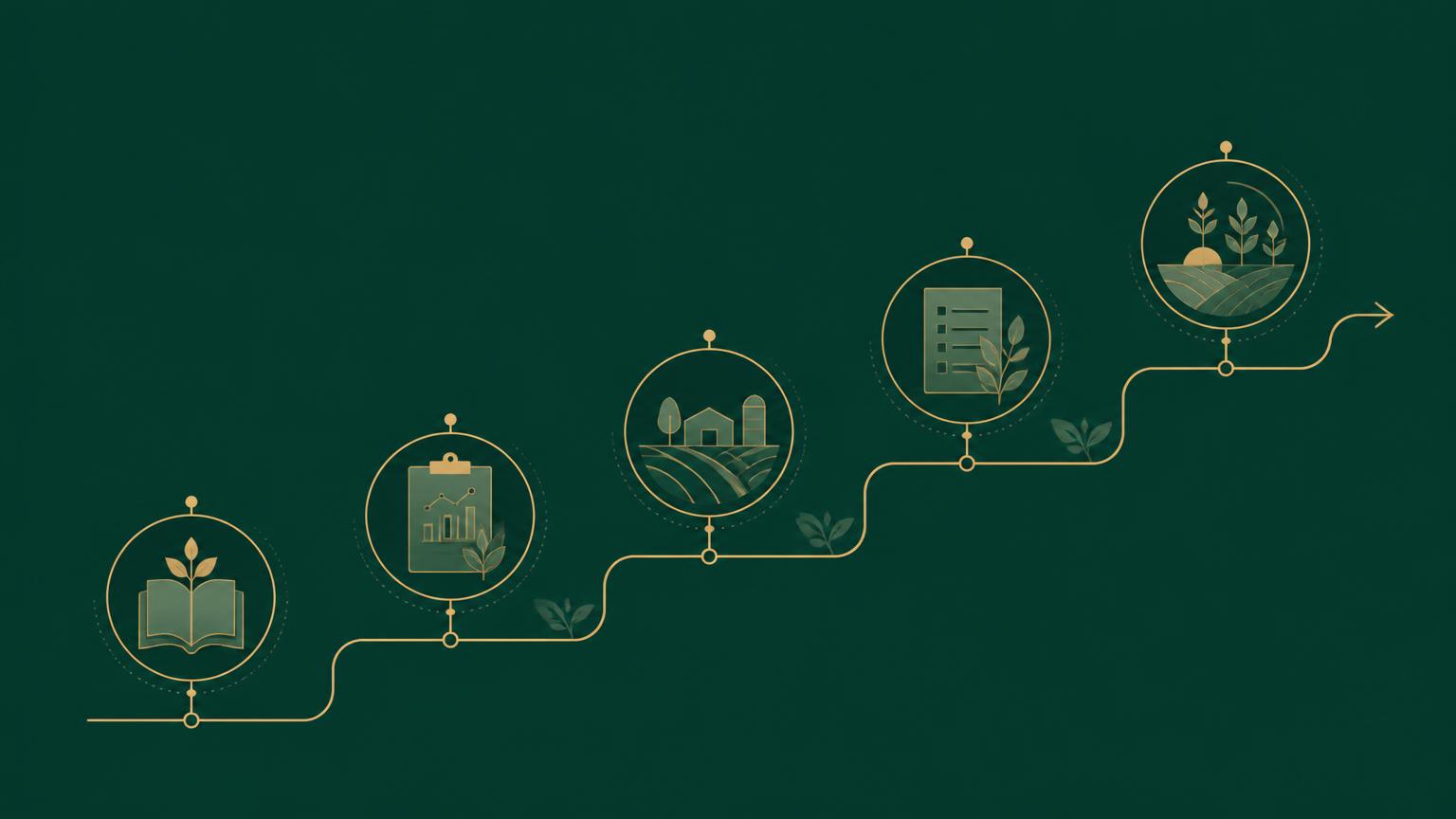
Commercial agriculture projects follow the same lifecycle as other capital projects, and the value of each phase is inversely proportional to its cost. Feasibility and planning consume a small fraction of total budget and determine the majority of the outcome; construction consumes most of the budget and can only execute decisions already made.
- 1Strategic definition — market, product specification, off-take channel, target scale, investment logic and constraints.
- 2Feasibility — site, climate, water, energy, permitting, capital and operating models, sensitivity analysis and go / no-go.
- 3Basis of design — the controlled assumption set that every subsequent decision is tested against.
- 4Concept and preliminary engineering — layouts, subsystem sizing, phasing strategy and expansion provision.
- 5Procurement preparation — technical specification, scope split, evaluation criteria, contract structure and RFQ documentation.
- 6Tender and award — issue to qualified suppliers under identical assumptions; evaluate on lifecycle cost and technical compliance.
- 7Construction and integration — site management, interface control, change management and quality assurance.
- 8Commissioning and ramp-up — performance testing, crop establishment, operator training and defect resolution.
- 9Operations — agronomic management, maintenance regime, energy and water optimisation, quality certification.
- 10Expansion or renewal — phase two executed on provisions engineered during phase one.
A five-question readiness test
Before contacting any manufacturer, a sponsor should be able to answer five questions in writing. Where any answer is missing, the project is not ready to be quoted — and any quotation received will be a guess dressed as a price.
| Question | Evidence required | If unanswered |
|---|---|---|
| What exactly is being produced, for whom, at what specification? | Product spec, target market, indicative pricing, off-take intent | The scope will be written by the supplier |
| Is the water secured, in law and in the dry season, at usable quality? | Rights or licence, seasonal yield data, full water analysis | The highest-severity project risk remains open |
| What is the energy demand profile and tariff exposure? | Thermal and electrical load model, tariff structure, backup strategy | The operating account cannot be modelled |
| What climate envelope must the facility hold, against which weather file? | Local climate data, crop model, target yield curve | Technology level cannot be justified |
| How is the project financed, and does the schedule match the crop cycle? | Capital stack, drawdown plan, working capital for ramp-up | Cash-flow risk through the first production year |
Tools that support this phase
- Project ConfiguratorBuild a structured project definition step by step, with readiness scoring and a shareable report.
- Greenhouse Investment CalculatorModel capital cost, operating cost and payback before committing to a technology level.
- CAPEX CalculatorBreak a project budget into civil, structure, climate, irrigation, energy and post-harvest lines.
- Project Readiness AssessmentScore land, water, energy, permitting, financing and procurement readiness.
Project financing and how bankability is engineered
Financing is frequently treated as a step that follows the technical work. In practice it runs alongside it, because the financing structure shapes the technical scope as much as the reverse. A lender's appetite determines phasing, phasing determines civil provisions, and civil provisions determine capital cost.
Commercial agriculture projects are typically funded from a stack rather than a single source: sponsor equity, senior debt from commercial or development banks, equipment finance or leasing for movable assets, export credit agency cover where imported equipment is involved, grant or concessional funding in food-security and climate programmes, and working capital facilities for the ramp-up period. Each instrument prices different risks and imposes different documentation requirements.
| Instrument | Typically funds | What the provider prices |
|---|---|---|
| Sponsor equity | Early development, feasibility, first-loss capital | Total project risk and management capability |
| Senior project debt | Civil works, structures, fixed infrastructure | Cash-flow certainty, security, sponsor track record |
| Equipment finance and leasing | Climate systems, machinery, packing lines, vehicles | Asset resale value and maintenance regime |
| Export credit cover | Imported equipment packages | Supplier country content and buyer credit risk |
| Concessional and grant funding | Food security, climate adaptation, smallholder linkage | Development impact and measurable outcomes |
| Working capital | Inputs, labour and overheads during ramp-up | Crop cycle length and off-take reliability |
Bankability is not a negotiating outcome; it is a property of the documentation. Financiers evaluate the quality of the feasibility study, the credibility of yield and price assumptions, the security of water and land tenure, the strength of the off-take evidence, the completeness of permitting, the experience of the operating team, the realism of the schedule and the adequacy of contingency. Projects that arrive with these in order are priced differently from projects that arrive with a supplier's quotation and an optimistic spreadsheet.
Lenders do not finance greenhouses. They finance cash flows that a greenhouse happens to produce.
One structural point is worth emphasising for first-time sponsors: the ramp-up period is where projects run out of money. First-year yields are usually below steady state, staff are still learning, and market relationships are immature. Working capital sized for a mature operation is a common and avoidable cause of distress in an otherwise well-built facility.
Financing resources
- Agriculture Financing CenterStructures, documentation requirements and country-level financing routes for agricultural projects.
- Project FinanceHow senior debt, equipment finance, export credit and concessional capital combine in a project stack.
- Guide: Agricultural Project FinanceA practical walkthrough of capital stacks, security packages and lender documentation.
- DSCR CalculatorTest whether projected cash flow supports the debt service a lender is likely to require.
Structured procurement: converting a plan into comparable offers
Once the plan exists, procurement becomes straightforward — which is precisely the point. Structured procurement means issuing one defined scope, based on one set of assumptions, to a shortlist of qualified suppliers, and evaluating their responses against criteria written before the responses arrive.
| Dimension | Procurement-first | Planning-first |
|---|---|---|
| Scope authorship | Written by the supplier being asked to quote | Written by the buyer and issued identically to all bidders |
| Comparability of offers | Offers describe different projects | Offers describe the same project at different prices |
| Risk allocation | Interface and integration risk sits with the buyer by default | Allocated explicitly in the scope split and contract |
| Financing readiness | Documentation assembled reactively for the lender | Feasibility and specification already lender-ready |
| Change orders | Frequent, priced under low buyer leverage | Fewer, governed by change control against the basis of design |
| Lifecycle cost visibility | Capital price dominates the decision | Energy, water, labour and maintenance modelled over asset life |
A well-formed request for quotation in this sector contains, at minimum: project context and location, climate data reference, crop plan and target yields, site conditions and civil interfaces, the technical specification per subsystem, the scope split and interface responsibilities, required standards and certifications, spare parts and service expectations, commissioning and performance criteria, documentation and training requirements, delivery terms and schedule, and the evaluation methodology. Everything on that list narrows the range of interpretation available to a bidder — which is the entire purpose.
Evaluation should be explicit about lifecycle cost. A structure that is cheaper by a modest margin but consumes materially more thermal energy per square metre will be more expensive within a few seasons. Comparing capital price alone is not frugality; it is an incomplete calculation.
Preparing and issuing the request
- RFQ BuilderTurn a defined project into one structured, supplier-neutral request with a document checklist.
- Commercial ProcurementHow scope splits, evaluation criteria and contract structures are handled on commercial-scale projects.
- Project CenterThe planning hub for greenhouse, irrigation, nursery and infrastructure programmes.
- Executive Knowledge CenterCountry intelligence, technical guides and market briefs for project decision-makers.
Operational efficiency and lifecycle cost
The operating account of a commercial agriculture facility is dominated by a small number of lines: energy, water and nutrients, labour, plant material, packaging, maintenance and losses. Capital decisions determine the floor under each of them, and no amount of operational excellence fully recovers a poor design.
Energy is usually first or second by magnitude in any climate-controlled facility. The levers are set at design: insulation and screening strategy, thermal buffering, heat recovery, equipment efficiency, control logic, tariff-aware scheduling and renewable integration. Water and nutrient costs are similarly design-bound, driven by recirculation, drainage control and irrigation precision. Labour productivity is a function of layout, internal transport, automation and training. Maintenance cost is a function of specification quality, spare-parts strategy and access design.
Sponsors should insist on a lifecycle cost model rather than a capital budget alone. Over a twenty-year horizon, operating expenditure typically dwarfs the initial investment, and the projects that endure are those where the two were optimised together rather than sequentially.
Where the industry is heading
Several trends are visible across regions and are likely to define commercial agriculture infrastructure over the next decade.
- Water pricing and allocation become binding constraints in more regions, pushing recirculation, reuse and precision irrigation from good practice into design requirements.
- Energy strategy becomes inseparable from crop strategy, with on-site generation, storage and tariff-aware control decided at the same table as the climate specification.
- Labour scarcity accelerates automation in propagation, harvesting support, grading and packing — with maintenance capability, not capital, as the limiting factor.
- Data and traceability requirements from retailers, certifiers and lenders make structured record-keeping a condition of market access rather than an administrative burden.
- Food-security and climate-adaptation policy continues to underwrite large integrated programmes, favouring sponsors who can present bankable, well-documented projects.
- Procurement professionalises: buyers increasingly separate planning and specification from supply, as energy and water infrastructure did decades ago.
- Value-chain integration deepens, with production, post-harvest, cold chain and logistics planned as a single capacity problem rather than as sequential purchases.
The direction is consistent: the technical content of agricultural projects is rising faster than the average buyer's in-house capacity to specify it. That gap is the reason buyer-first platforms exist.
How SeedMatchGroup supports commercial agriculture buyers
SeedMatchGroup is a human-led platform for organizations developing commercial agriculture projects. It exists to hold the planning, modelling, specification and procurement-preparation work on the buyer's side, so that manufacturers, EPC contractors and engineering firms are engaged against a defined project rather than an open question.
In practice that means a sourcing specialist works with the sponsor through the sequence described in this paper: clarifying the commercial objective, structuring the project definition, modelling capital and operating cost, testing readiness across land, water, energy, permitting and financing, preparing a supplier-neutral technical scope, and issuing one structured request to qualified suppliers under identical assumptions. Proprietary technology supports that work — configuration, modelling, document generation and matching — but the judgement is human, and the accountability sits with the platform rather than with any supplier.
Buyers first: what supplier neutrality means in practice
Supplier neutrality is easy to claim and simple to test. The test is structural: does the party writing your specification earn more if you buy a particular product? SeedMatchGroup does not manufacture equipment, does not represent manufacturers, does not publish supplier directories to buyers and does not expose buyers to direct supplier solicitation. All communication runs through the platform, which is what allows a scope document to be written for the project rather than for a catalogue.
- One point of contact for the buyer across every discipline in the project.
- Specifications written against the basis of design, not against a product range.
- Identical scope issued to every qualified supplier so offers can be compared line by line.
- Confidential handling of project data, volumes, commercial terms and supplier correspondence.
- Support through evaluation, clarification rounds and award, including lifecycle-cost comparison.
This model is unremarkable in energy, water and industrial construction, where owner's engineers and independent advisors are standard practice. Commercial agriculture is arriving at the same conclusion for the same reason: the projects have become too technically dense to specify from the sales side of the table.
The Global B2B Group ecosystem
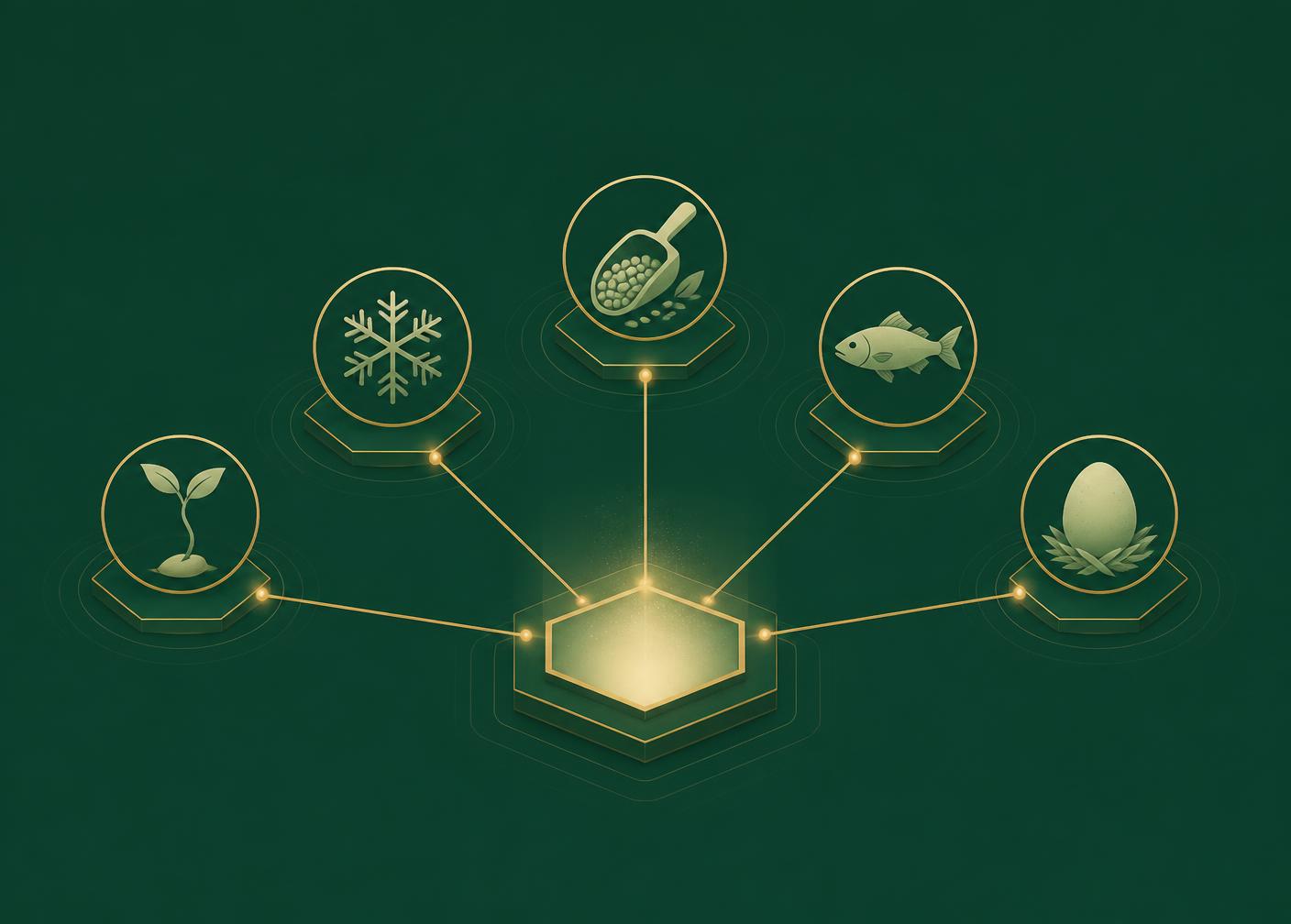
SeedMatchGroup operates within Global B2B Group, a family of buyer-first platforms applying the same planning-before-procurement discipline to adjacent parts of the food and agriculture economy. Integrated projects frequently cross these boundaries — a greenhouse programme with cold storage, an aquaculture facility with feed supply, a poultry operation with hatchery capacity — and the ecosystem exists so that a buyer working on one part of a value chain is not left to improvise the rest.
Sister platforms
- Global B2B GroupThe parent group and the shared buyer-first operating model across all platforms.
- ColdMatch GroupCold chain, refrigeration and temperature-controlled storage infrastructure.
- FishMatch GroupAquaculture systems, hatcheries and fish processing infrastructure.
- HatchMatch GroupPoultry hatchery equipment, incubation systems and production facilities.
- FeedMatch GroupFeed mills, feed processing plants and animal nutrition supply.
Questions decision-makers ask
Does planning-first slow the project down?
It moves time earlier rather than adding it. Projects that define scope before tendering typically run shorter, cleaner tender rounds, fewer clarification cycles and materially fewer change orders during construction. The calendar time recovered during execution usually exceeds the time invested in planning.
We already have a preferred manufacturer. Is this relevant?
Yes, and arguably more so. A defined scope makes a preferred supplier's offer verifiable, gives the buyer a basis for negotiating scope rather than only price, and protects the relationship from the ambiguity that produces disputes during commissioning.
How large does a project need to be to justify this discipline?
The threshold is complexity rather than size. A modest facility with a difficult water source, a demanding climate or an export quality requirement needs planning more than a large project on a simple site. In practice, any project with meaningful civil works, utility connections or post-harvest capacity benefits.
What if the feasibility work says no?
That is a successful outcome. The cheapest project failure is the one identified during feasibility, and experienced sponsors treat a well-argued no-go as a return on the study rather than a loss.
Conclusion
Commercial agriculture is being rebuilt as infrastructure, and infrastructure rewards the disciplines that produced reliable outcomes in energy, water and industrial construction: define the objective, model the system, secure the inputs, write the specification, then buy. The alternative — starting with a quotation and discovering the project afterwards — is not faster. It simply relocates the cost from planning, where it is small and controllable, to operations, where it is large and permanent.
For sponsors, the practical next step is modest: write down the five readiness answers, model the capital and operating case honestly, and refuse to issue an enquiry until the scope describes your project rather than a supplier's catalogue. Everything else in this paper follows from that single decision.
Start here
- Project ConfiguratorDefine scope, phasing and readiness in a structured, saveable format.
- RFQ BuilderIssue one supplier-neutral request to qualified manufacturers.
- Agriculture Financing CenterPrepare a bankable capital structure and documentation set.
- Planning guidesCategory guides for greenhouses, irrigation, nurseries, packing houses and infrastructure.
Frequently asked questions
- Why should a commercial agriculture project start with planning rather than procurement?
- Because a quotation is only meaningful relative to a defined scope. When the scope does not yet exist, suppliers write it for you and each offer reflects different assumptions about climate, water, energy and post-harvest capacity. Planning first produces comparable offers and prevents the design errors that dominate long-term underperformance.
- What does agricultural infrastructure include beyond the greenhouse structure?
- Site and civil works, water source, treatment and storage, energy supply and backup, structures, climate systems, irrigation and fertigation, automation and controls, post-harvest and cold chain capacity, logistics, and the people and systems needed to operate the facility. Each subsystem constrains the others.
- How do lenders decide whether an agricultural project is bankable?
- They price the quality of the documentation: the feasibility study, yield and price assumptions, secured water and land tenure, permitting status, off-take evidence, the experience of the operating team, the schedule and the contingency. Equipment brands matter far less than the credibility of the cash-flow case.
- What is a supplier-neutral RFQ and why does it matter?
- It is a single technical scope, written by or for the buyer, issued to every qualified supplier under identical assumptions. It matters because it converts incomparable proposals into comparable ones, allocates interface risk explicitly and reduces change orders during construction.
- How do I choose the right level of greenhouse technology?
- Match the technology level to the crop, the local climate file, the target market and the operating capability available on site. Higher control delivers higher yield and longer production windows but increases energy exposure and skill requirements. Copying a specification from another latitude is a frequent and costly error.
- Does SeedMatchGroup sell equipment?
- No. SeedMatchGroup is a human-led, supplier-neutral platform that helps buyers plan, model, specify and structure commercial agriculture projects, then manages a structured request to qualified suppliers. It does not manufacture, does not represent suppliers and keeps all communication running through the platform.
How this guidance is produced
We do not manufacture equipment and do not represent a fixed vendor list. Guidance reflects the project, not a catalogue.
Content is prepared and reviewed by sourcing specialists working on live commercial agriculture projects, supported by proprietary technology.
Practice drawn from greenhouse, CEA, irrigation, nursery, packing-house and processing projects across multiple climates and regulatory environments.
Project details stay private. Nothing is published, listed or shared with suppliers without your approval.
Editorial approach and company background: About SeedMatch Group.