
Why Commercial Nursery Root-System Specifications Matter Before Container Procurement
Container procurement shapes root architecture, production operations and transplant readiness. Define inspectable root-system requirements before comparing nursery container offers.
Is an air-pruning container always preferable?
No. Evaluate exposure, crop response, irrigation demands and handling under the intended production conditions. No. Geometry, wall features, drainage and management can produce different root conditions.
Key takeaways
- Why root specifications must come first: Commercial nursery root-system specifications matter before container procurement because containers influence where roots grow, while production practices determine whether that influence produces an acceptable transpl…
- Container geometry changes the risk, not just the footprint: Roots encountering container walls can change direction, including circling or descending.
- Substrate and irrigation belong in the same specification: A container cannot be assessed independently of its substrate.
- Crop duration and transplant method define the target: The appropriate root-system target depends on species, starting material, intended production duration and destination.
- Root quality is also a commercial requirement: Container choices affect bench or ground layout, irrigation infrastructure, substrate filling, movement, cleaning and dispatch.
Why root specifications must come first
Commercial nursery root-system specifications matter before container procurement because containers influence where roots grow, while production practices determine whether that influence produces an acceptable transplant. Geometry, wall features, drainage and exposure can redirect, constrain or prune roots. Substrate and irrigation then affect moisture and aeration; crop duration determines how long roots encounter those boundaries. Buying on nominal volume or unit price alone therefore leaves a critical quality requirement undefined. Specify the intended root condition first, then assess compatible containers and management practices. This does not establish one universally superior container or promise field survival. It makes root architecture, handling requirements and inspection criteria part of the purchasing decision rather than an argument after delivery.
Container geometry changes the risk, not just the footprint
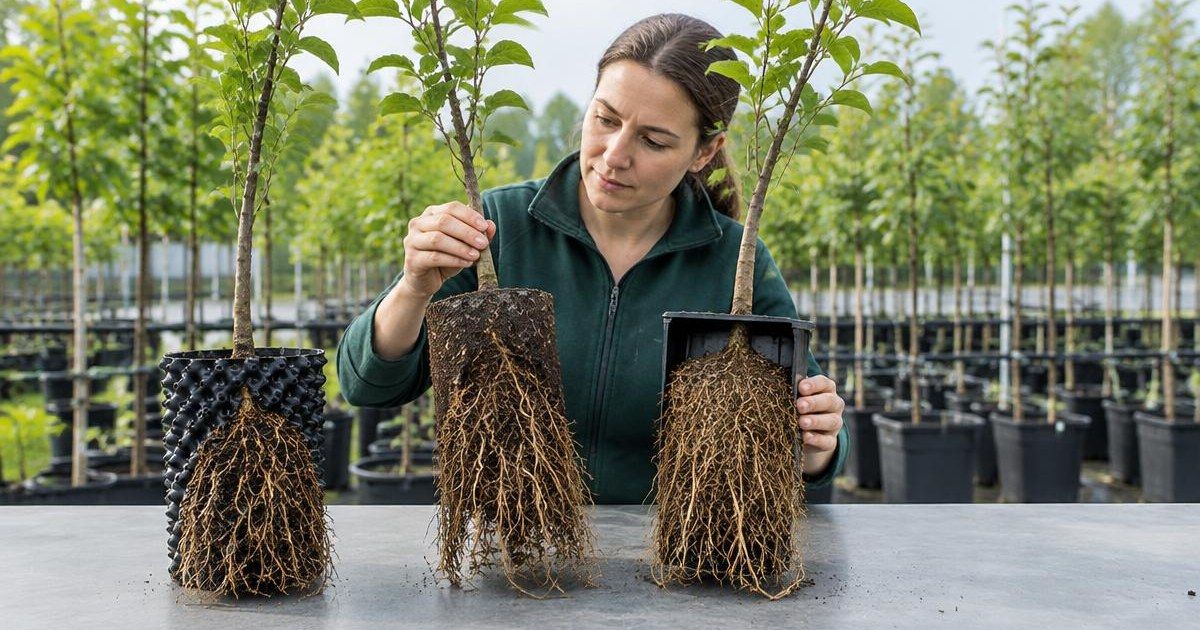
Roots encountering container walls can change direction, including circling or descending. Diameter, depth, taper and internal features influence those pathways, so equal-volume products are not necessarily equivalent production tools. Air-pruning openings work through root-tip exposure to air; their effect depends on how containers are supported, spaced and managed. Openings blocked by adjacent surfaces or growing media cannot be evaluated as though freely exposed. Internal ribs or other guidance features also need evidence under relevant conditions, not acceptance based on appearance alone. The University of Florida IFAS container guidance provides useful context for these distinctions. Ask how each design addresses root deflection and what complementary practices it requires.
Substrate and irrigation belong in the same specification
A container cannot be assessed independently of its substrate. Particle distribution, settling and water retention influence the balance between water availability and aeration within the chosen geometry. Irrigation frequency, application uniformity and drainage determine whether that balance is maintained across a production block. A more exposed root zone may require different irrigation management; that is an operating consideration, not proof of inferiority or superiority. Compare proposed systems using the intended substrate and irrigation method, including edge positions and other potentially uneven conditions. The crop water requirement calculator can support preliminary planning, but it cannot replace nursery-specific measurements of substrate moisture, drainage and application uniformity.
Crop duration and transplant method define the target
The appropriate root-system target depends on species, starting material, intended production duration and destination. Roots may already be deflected before entering the final container, so inspecting only the outer surface at dispatch can miss inherited defects. Longer holding periods also change the relationship between plant size, root occupancy and container constraints. Specify the planned production window and how delayed dispatch will trigger reassessment. Then describe the transplant method: manual removal, mechanical handling, intermediate potting or direct field planting. Root-ball cohesion matters for handling, but a tightly bound ball is not automatically a desirable root system. Any proposed corrective treatment needs species- and stage-appropriate justification, trained execution and subsequent inspection.
Root quality is also a commercial requirement
Container choices affect bench or ground layout, irrigation infrastructure, substrate filling, movement, cleaning and dispatch. A low purchase price can be misleading if the chosen system requires handling equipment or management practices that the nursery has not budgeted or validated. Conversely, an elaborate design has little procurement value if its claimed benefits cannot be demonstrated for the intended crop. Compare total operating implications without assuming savings. Allocate responsibility for incoming plant quality, container conformity, production management and dispatch inspection separately. Link these requirements to the broader commercial nursery design and procurement guide, so container purchasing does not become detached from facility and logistics decisions.
Require evidence that buyers can inspect
Request dimensioned drawings, material specifications, drainage and wall-feature details, and the supplier's stated operating requirements. For root performance, prefer documented nursery observations or trials identifying species, propagation source, substrate, irrigation, container treatment and production duration. Photographs should show sampling context and exposed roots, not only attractive foliage or an intact root-ball exterior. Research, including the Arboriculture & Urban Forestry paper listed below, can inform evaluation but does not certify a proposed supplier's product. Require batch-linked records and distinguish supplier statements from independently observed evidence. Agree inspection methods, sample selection, defect definitions and remedies before purchase, rather than negotiating them around disputed plants.
| Purchase question | Evidence to request | Acceptance language to agree |
|---|---|---|
| Does geometry match the offer? | Drawings and measured samples | Dimensions and features conform to approved tolerances. |
| Is root deflection acceptable? | Agreed destructive root inspection | Defined defect classes remain within contract limits. |
| Does air pruning operate as intended? | Root observations under proposed support and spacing | Exposure conditions match the approved production method. |
| Can plants be handled safely? | Trial removal and transfer using intended equipment | Root-ball integrity meets the agreed handling test. |
| Are lots traceable? | Linked plant, container and production records | Each delivery lot carries required identifiers. |
Use a staged decision framework
First, define crop groups and transplant destinations rather than seeking one container for every plant. Second, screen options against dimensional, infrastructure and handling constraints. Third, compare technically plausible options under representative nursery conditions, using the same recorded inspection approach. Include an initial inspection of starting material so later defects are not automatically attributed to the final container. Fourth, select against agreed root-quality and operational criteria, recording unresolved limitations. Finally, confirm the production and dispatch controls needed to maintain acceptance. Where evidence is incomplete, describe a conditional approval or further evaluation requirement rather than converting uncertainty into a performance claim. Field establishment also depends on planting conditions and aftercare beyond container selection.
Build a practical procurement and traceability checklist
Translate the decision into a purchase specification and quality plan that production staff can actually use. Inspection should include internal root structure where necessary, not merely external appearance. Agree who pays for destructive samples and how inspected material is handled. The checklist should cover:
- Crop identity, propagation source, starting size and incoming root condition.
- Container model, dimensions, features and approved substitutions.
- Substrate specification, irrigation method and relevant production records.
- Potting dates, transfers, root treatments and holding-period changes.
- Lot definitions, sample selection, inspection stages and photographic records.
- Agreed defect categories, measurement methods and acceptance limits.
- Nonconformance segregation, investigation, corrective action and reinspection.
- Dispatch identifiers linking plants, production blocks and inspection results.
Avoid specifications that sound strong but cannot be enforced
“Excellent roots,” “air-pruned quality” and “ready for planting” are not sufficient acceptance criteria. Neither is an absolute prohibition on every bent root without a defined inspection method and defect classification. Avoid treating container volume as a proxy for root quality, transferring trial results across unrelated crops, or accepting supplier photographs without production context. Another common mistake is inspecting only at dispatch, when correction may disrupt delivery plans or compromise plants. Put earlier checks at meaningful production transitions. Keep container manufacturing conformity separate from plant root-system acceptance: a correctly manufactured container can still contain an unacceptable plant, and diagnosing that failure requires production records.
Turn requirements into a reviewable project brief
For a next step, record crop groups, annual quantities, production duration, transplant method, existing infrastructure and the evidence gaps preventing selection. Review nursery projects for project context, then use the RFQ builder to organize requirements and acceptance questions. SeedMatchGroup is a human-led commercial agriculture platform supported by proprietary technology for projects from USD 250,000. It is not a manufacturer, EPC, lender, certification body, open marketplace or direct connector. Supplier outreach happens manually after human review; quotations, timing and outcomes are not guaranteed.
Sources and further reading
These sources provide general technical context and do not endorse SeedMatchGroup: University of Florida IFAS: Containers; Arboriculture & Urban Forestry research, volume 42, issue 1, page 31. Apply published findings only after checking their relevance to the proposed crop and production conditions.
Turn "Why Commercial Nursery Root-System Specifications Matter Before Container Procurement" into your RFQ
Answer a few questions and we will draft a structured RFQ you can review, edit and submit to our independent supplier network.
Frequently asked questions
- Is an air-pruning container always preferable?
- No. Evaluate exposure, crop response, irrigation demands and handling under the intended production conditions.
- Does equal container volume mean equivalent performance?
- No. Geometry, wall features, drainage and management can produce different root conditions.
- When should root inspections happen?
- At agreed stages, including receipt, significant production transitions and dispatch, with reassessment after extended holding.
- Should the contract specify defect limits?
- Yes. Define defects, sampling, measurement and remedies together; avoid unsupported universal thresholds.
- Can acceptable nursery roots guarantee field survival?
- No. Transport, planting, site conditions and aftercare also influence establishment.
Move from reading to sourcing
The pages below carry the commercial detail for this topic — cost ranges, supplier verification, specification checklists and financing routes.