
Commercial Nursery Design and Procurement Guide
Plan a commercial nursery with clear crop requirements, hygienic workflows, comparable supplier quotes, and practical commissioning and acceptance tests.
What should we prepare before requesting commercial nursery quotes?
Prepare crop specifications, weekly demand, propagation schedules, site data, water analyses, utility constraints and acceptance requirements. Flag unknowns so suppliers state assumptions rather than silently designing around them.
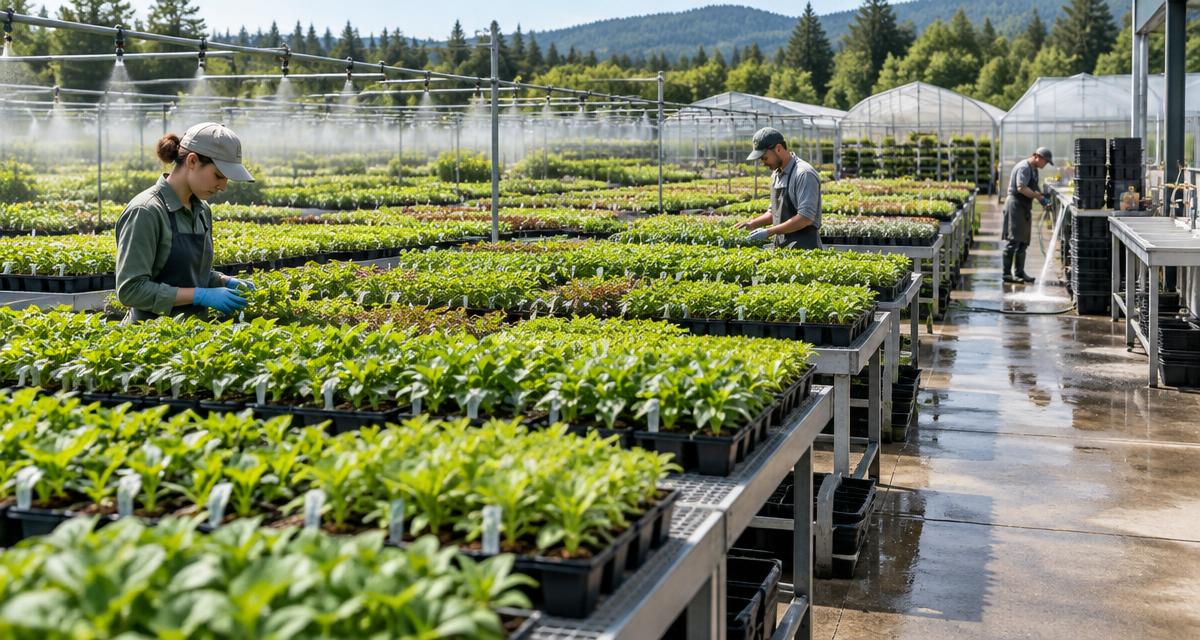
Key takeaways
- 1. Define the market before specifying the nursery: A commercial nursery should be procured around saleable plant specifications, seasonal demand, propagation biology and dispatch requirements—not a greenhouse catalogue.
- 2. Build the propagation schedule and capacity model: Create a rolling crop-by-week schedule covering incoming material, sowing or sticking, germination, rooting, graft healing where relevant, growing-on, hardening, grading and dispatch.
- 3. Zone for hygiene and predictable movement: Map the movement of people, plants, reusable trays, media, water and waste.
- 4. Specify benches, trays and media handling together: Select bench and tray systems against crop biology, root architecture, mechanization plans and worker access.
- 5. Engineer irrigation, mist and climate around crop stages: Irrigation design starts with a tested water source, available flow, pressure, storage and seasonal reliability.
1. Define the market before specifying the nursery
A commercial nursery should be procured around saleable plant specifications, seasonal demand, propagation biology and dispatch requirements—not a greenhouse catalogue. Establish crop groups, weekly delivery volumes, production cycles, hygiene risks and site constraints first. Then translate these inputs into zoned capacity, equipment duties, operating procedures and measurable acceptance criteria before requesting comparable supplier proposals.
Commercial growers, agribusinesses, investors and governments may require vegetable plugs, grafted plants, ornamental liners, forestry seedlings or perennial crop planting material. These are not interchangeable production systems. Confirm customers, destination markets, cultivar rights, planting-material provenance and applicable movement restrictions. Define saleable quality by crop: root development, uniformity, size, plant health and delivery condition. Validate demand assumptions independently before committing capital.
2. Build the propagation schedule and capacity model
Create a rolling crop-by-week schedule covering incoming material, sowing or sticking, germination, rooting, graft healing where relevant, growing-on, hardening, grading and dispatch. Record occupancy at each stage, tray format, spacing changes and locally justified allowances for losses, rework and holding. Design for peak overlapping batches rather than annual output divided evenly across the year. Delayed collections can consume capacity needed for subsequent sowings.
Separate usable crop area from gross building footprint. Aisles, headhouses, quarantine, water treatment, stores and dispatch all consume space. Use the greenhouse size planner to explore area scenarios; its outputs are planning estimates, not engineered capacity guarantees. Test alternative demand peaks, crop mixes and cycle lengths with a qualified agronomist. Confirm expansion phases against land access, utilities and future hygiene boundaries.
3. Zone for hygiene and predictable movement
Map the movement of people, plants, reusable trays, media, water and waste. Separate receiving and inspection from clean propagation, and isolate suspect batches without routing them through production. Provide appropriate handwashing, footwear controls, tool sanitation and controlled visitor access. Hygiene depends on workable procedures and accountable staff, not simply installing a footbath or naming an area clean.
Specify drainage routes, cleanable surfaces, pest exclusion and segregation between dirty returns and sanitized containers. Water recycling can create shared disease pathways, so treatment and monitoring must reflect source-water quality and crop risks. Ask a qualified plant-health adviser to define quarantine, sampling and incident-response procedures. Local authorities should confirm applicable phytosanitary requirements; a nursery layout alone cannot establish regulatory compliance.
4. Specify benches, trays and media handling together
Select bench and tray systems against crop biology, root architecture, mechanization plans and worker access. Compare fixed benches, movable systems and floor production using usable growing area, maintenance access, cleaning practicality and structural requirements. Tray cell geometry, drainage, material durability and compatibility with seeders, fillers and transplanters matter more than nominal cell count alone. Define who owns tooling and replacement-format specifications.
Media procurement should address composition, consistency, storage, contamination control and crop-specific physical and chemical suitability. Design covered receiving, batch identification, mixing or conditioning, filling and spill recovery as one workflow. Protect media from dirty runoff and uncontrolled additions. Verify filler accuracy using the intended media and moisture condition; a demonstration with a different substrate may not establish production suitability.
5. Engineer irrigation, mist and climate around crop stages
Irrigation design starts with a tested water source, available flow, pressure, storage and seasonal reliability. Separate irrigation, fertigation and propagation mist duties where their control requirements differ. Specify filtration, backflow protection, dosing safeguards, drainage and access for maintenance. Use the crop water requirement calculator for planning estimates, then validate peak demand and hydraulic design locally. Mist demand requires separate assessment.
Climate specifications should distinguish germination, rooting, graft healing, growth and hardening. Document external design conditions and crop-specific operating ranges, including humidity and condensation risks. Evaluate ventilation, shading, heating, cooling and controls as an integrated system. Require suppliers to state weather assumptions, sensor locations, control logic and exclusions. No equipment package can guarantee plant quality independently of crop management, utilities and local conditions.
6. Plan grading, traceability, dispatch and labour flow
Translate customer specifications into grading instructions, rejection categories and batch-release authority. Keep grading separate from waste handling, and provide holding space that preserves plant condition without obstructing dispatch. Establish packaging, loading, transport and delivery responsibilities. Specify any required temperature management by crop and journey rather than assuming refrigeration benefits every plant type.
Traceability should connect source material, cultivar, propagation date, media batch, treatments, location changes, inspections and dispatch destination. Test whether staff can retrieve and reconcile those records during a simulated withdrawal. Plan labour around peak sowing, spacing, grading and loading events. Walk representative tasks with operators to expose excessive carrying, awkward reaches, vehicle conflicts and sanitation steps likely to be bypassed under pressure.
7. Confirm utilities and construction interfaces
Obtain site surveys, drainage information, source-water analyses and utility capacity evidence before freezing scope. Define electrical loads, connection responsibilities, controls connectivity, water storage and waste-disposal arrangements. Assess backup needs through the consequences of each failure: interrupted mist, ventilation or heating may require different responses. Specify alarms, escalation ownership and safe restart procedures, rather than treating a generator as a complete resilience plan.
Assign every interface: foundations, structures, irrigation, climate equipment, automation, roads, drainage and commissioning. Identify permits, land-use conditions, worker-safety obligations and restrictions on water abstraction or discharge. Require qualified local engineering, legal, agronomic and regulatory review where applicable. A supplier's standard drawing or remote recommendation does not replace project-specific review or establish that the buyer can legally operate the proposed nursery.
8. Issue a comparable RFQ and evaluate trade-offs
Choose procurement packages according to integration risk and the buyer's project-management capability. Bundled supply may simplify coordination but still needs explicit interfaces and exclusions; separate packages require clear integration ownership. Use the irrigation RFQ tool for water-system scope and the RFQ builder for a structured project brief. Neither replaces technical specifications or professional review.
- Provide crop groups, propagation methods, weekly outputs, stage durations and quality criteria.
- Attach site information, climate assumptions, water analyses and utility constraints.
- Define zones, tray formats, media workflow, automation boundaries and expansion needs.
- Request itemized scope, exclusions, interfaces, deliverables and proposed delivery terms.
- State installation, training, spares, warranty and service-support requirements.
- Require acceptance protocols, documentation, payment milestones and change-control procedures.
| Comparison area | Evidence to request | Buyer decision |
|---|---|---|
| Capacity | Stage-by-stage occupancy calculation | Meets peak mix, not just annual volume |
| Technical fit | Crop assumptions and equipment duties | Suitable across intended production stages |
| Scope completeness | Inclusions, exclusions and interface matrix | Allocates missing work explicitly |
| Operating burden | Labour, utilities and maintenance assumptions | Compatible with local operating capability |
| Commercial terms | Currency, taxes, freight, warranty and payment terms | Comparable delivered and installed scope |
| Acceptance | Test methods and remedy process | Objective basis for sign-off |
Compare compliant offers against the same baseline before considering alternatives. Normalize scope differences and investigate unsupported consumption or staffing assumptions. Evaluate lifecycle implications without inventing savings. The lowest equipment subtotal may exclude installation, utility upgrades or essential controls. Record deviations, clarifications and unresolved risks in a decision log before negotiating the final contract.
9. Contract acceptance tests and prepare the next step
Agree acceptance criteria before purchase, including test conditions, instruments, responsibilities, witness rights and corrective-action procedures. Tests should verify bench movement and load provisions, tray compatibility, filling consistency, irrigation distribution, mist response, dosing safeguards, drainage, alarms and backup changeover. Climate tests must state external conditions and limitations. Use agreed tolerances derived from engineering and agronomic requirements, not generic percentages.
Separate factory checks, site commissioning and crop-cycle validation where appropriate. Require calibrated measurements, operator training, manuals, as-built records and a defects register before relevant sign-off. Common mistakes include procuring capacity without a schedule, sharing dirty and clean routes, overlooking dispatch congestion and accepting untested control integration. Any seasonal testing deferred beyond handover needs documented responsibilities and contractual treatment reviewed by counsel.
SeedMatchGroup is a human-led, supplier-neutral commercial agriculture platform for projects from USD 250,000. It is not a manufacturer, contractor, lender, certification body, open marketplace or automatic connector. Supplier outreach happens after human review; bids, timing, savings and outcomes are not promised. Next, assemble the project brief, identify unresolved evidence and submit a coherent procurement scope. The institutional sources below support planning context and do not endorse SeedMatchGroup.
Sources and further reading
IPPC International Standards for Phytosanitary Measures FAO Good Agricultural Practices for greenhouse vegetable crops
Turn "Commercial Nursery Design and Procurement Guide" into your RFQ
Answer a few questions and we will draft a structured RFQ you can review, edit and submit to our independent supplier network.
Frequently asked questions
- What should we prepare before requesting commercial nursery quotes?
- Prepare crop specifications, weekly demand, propagation schedules, site data, water analyses, utility constraints and acceptance requirements. Flag unknowns so suppliers state assumptions rather than silently designing around them.
- Should we buy a turnkey nursery or separate equipment packages?
- Choose based on integration risk and internal management capability. A bundled contract still requires explicit exclusions; separate packages need assigned responsibility for interfaces, controls integration and commissioning.
- How should we compare nursery suppliers?
- Normalize technical scope, installation, utilities, freight, taxes, training, spares and acceptance obligations. Compare documented suitability and operating requirements, not equipment subtotals or unsupported production claims.
- Can planner results be used as final nursery specifications?
- No. Calculator outputs are planning estimates. Qualified local professionals must validate crop assumptions, structural and hydraulic design, utility duties and applicable legal and regulatory requirements.
- How does SeedMatchGroup handle nursery procurement enquiries?
- SeedMatchGroup supports commercial agriculture projects from USD 250,000 through a human-led, supplier-neutral process. Supplier outreach follows human review, without promises of bids, timing, savings or outcomes.
Move from reading to sourcing
The pages below carry the commercial detail for this topic — cost ranges, supplier verification, specification checklists and financing routes.