
Why Greenhouse Climate Control and Integrated Pest Management Must Be Planned Together
Climate decisions shape pest and disease risk, while IPM measures change greenhouse performance. A shared brief helps buyers evaluate equipment, operating practices and evidence together.
Can climate control replace IPM?
No. It can influence risk, but exclusion, sanitation, scouting, diagnosis and appropriate interventions remain necessary. No. Crop needs, pathogen biology, leaf wetness and beneficial-organism requirements must be considered together.
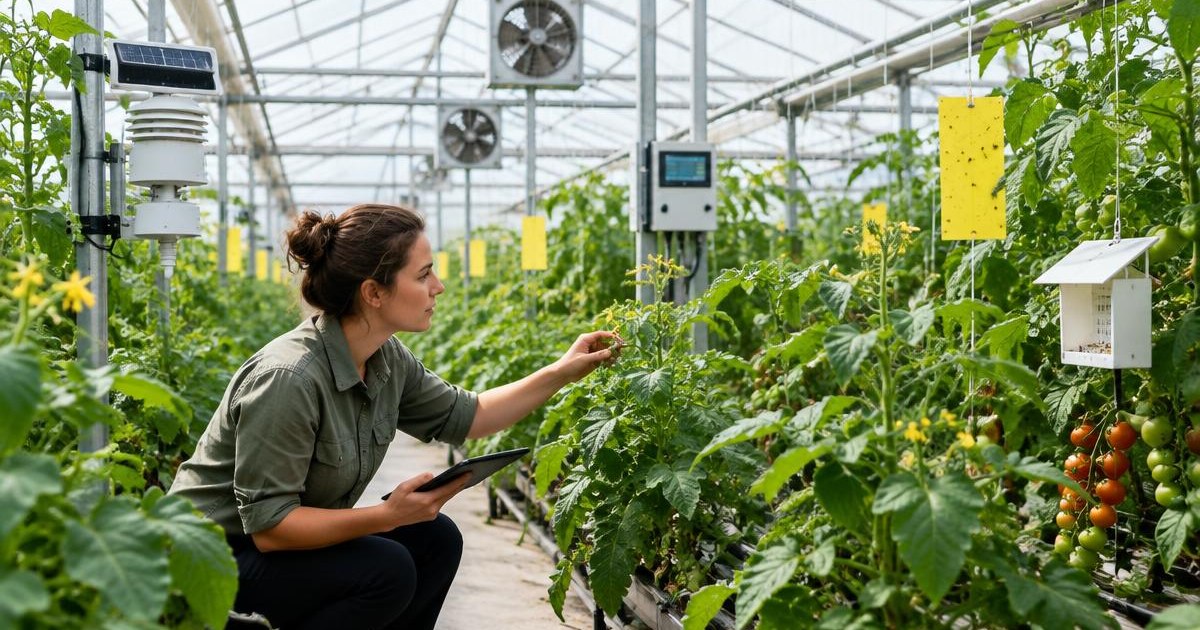
Key takeaways
- Why climate control and IPM are one planning problem: Greenhouse climate control and integrated pest management (IPM) must be planned together because each changes the conditions under which the other works.
- The canopy matters more than a single climate reading: A greenhouse average can conceal the conditions that matter to a pest or pathogen.
- Exclusion changes the ventilation calculation: Screening is a design trade-off, not an accessory to select after fans and vents.
- Irrigation, crop density and sanitation complete the moisture picture: Irrigation timing affects substrate water availability, drainage and the greenhouse moisture load.
- Biological controls need compatible operating conditions: Biological control is part of IPM, not an independent replacement for monitoring.
Why climate control and IPM are one planning problem
Greenhouse climate control and integrated pest management (IPM) must be planned together because each changes the conditions under which the other works. Temperature influences crop growth, pest development and biological-control activity. Humidity, condensation and leaf wetness affect disease risk, while airflow determines how evenly those conditions are distributed. Conversely, insect screens restrict ventilation, crop spacing changes canopy drying, and irrigation decisions alter moisture loads. Separate plans can therefore undermine each other: an exclusion screen may reduce pest entry while increasing overheating or humidity risk if ventilation is not reassessed. One design and operating brief makes these interactions explicit, linking environmental capacity, prevention, monitoring and intervention to the actual crop and location.
The canopy matters more than a single climate reading
A greenhouse average can conceal the conditions that matter to a pest or pathogen. Dense foliage, shaded corners and poorly mixed zones may remain humid when a centrally mounted sensor reports acceptable conditions. Leaf surfaces can also become wet through condensation even without overhead irrigation. Temperature and moisture effects are organism-specific; neither hotter nor drier is a universal route to control. Specify how the project will assess canopy conditions, condensation risk and wetness duration where relevant. Air movement should be evaluated for distribution, not simply installed fan capacity. It can help reduce stagnant pockets, but cannot substitute for moisture removal or appropriate irrigation, and excessive or poorly directed airflow may stress plants.
Exclusion changes the ventilation calculation
Screening is a design trade-off, not an accessory to select after fans and vents. The target pest, screen geometry, open area, installation details and fouling condition influence both exclusion and airflow resistance. Buyers should require ventilation calculations that include the proposed screen rather than relying on unscreened equipment ratings. Doors, service penetrations and damaged edges also matter: a suitable screen cannot compensate for uncontrolled entry routes. In naturally ventilated structures, screen resistance must be considered alongside vent geometry and site conditions. Mechanical ventilation proposals should explain the corresponding pressure and capacity assumptions. Commercial greenhouse design should therefore address exclusion, ventilation and access management as a coordinated system.
Irrigation, crop density and sanitation complete the moisture picture
Irrigation timing affects substrate water availability, drainage and the greenhouse moisture load. Its implications depend on delivery method, crop demand, substrate and drying conditions; a fixed instruction to irrigate at one time is not a substitute for crop-specific management. Overhead application may wet foliage directly, while root-zone delivery still requires attention to leaks, standing water and root-zone conditions. Crop density and training influence air movement, scouting access and how readily foliage dries. Sanitation must fit that layout: staff need practical routes for removing diseased material, cleaning tools and managing residues without carrying contamination through clean production areas. Drainage and cleanable surfaces belong in the brief alongside climate equipment.
Biological controls need compatible operating conditions
Biological control is part of IPM, not an independent replacement for monitoring. Beneficial organisms have requirements for temperature, humidity, food or host availability and release conditions; suitability must be checked for the specific organism, crop and target. Climate changes intended to suppress one problem may reduce beneficial establishment or crop performance. The operating plan should connect scouting observations, beneficial establishment checks and environmental records so staff can distinguish a climate problem from an ineffective intervention. Incoming plants, propagation areas and perimeter vegetation also deserve risk-based inspection. Ask who interprets observations and authorizes adjustments, rather than assuming a sensor platform or biological-control supplier will manage the whole program.
Business value comes from avoiding contradictory purchases
The commercial issue is not simply whether a greenhouse can reach a setpoint. It is whether the combined system supports marketable production, workable labor routines and manageable operating exposure under the stated conditions. A cheaper ventilation package may be unsuitable once screening is included. Additional humidity-control capacity may require energy infrastructure, maintenance and operator skills that were absent from the budget. Conversely, equipment should not be added without evidence of the problem it addresses. Compare capital requirements, energy assumptions, consumables, maintenance, monitoring effort and operational dependencies together. Do not accept a promised yield increase, pesticide reduction or financial return without project-relevant evidence and a clearly defined baseline.
Build one evidence-based decision framework
Start with crop requirements, seasonal weather, water characteristics, production method and documented pest and disease risks. Then describe operating scenarios, including dense mature canopies, humid nights, peak ventilation demand and screen fouling. For each scenario, identify prevention measures, control capacity, monitoring points and staff actions. Request the assumptions behind calculations, equipment performance information at relevant conditions, screen resistance data, sensor locations and calibration procedures. Biological-control proposals need organism-specific suitability information and a monitoring plan. Use the greenhouse climate calculator to support preliminary questions, not as proof that a combined climate–IPM strategy will work. Compare alternatives against the same scenarios and record where further analysis or local agronomic advice is needed.
Compare proposals through observable acceptance criteria
Acceptance should establish what will be inspected, tested or documented, by whom and under which conditions. Agree project-specific criteria before purchase. Where commissioning cannot represent a critical season or crop stage, document that limitation and define the later verification process.
| Interface | Evidence to compare | Acceptance approach |
|---|---|---|
| Screening and ventilation | Screen resistance, vent geometry, fan performance and fouling assumptions | Inspect screen integrity and verify airflow performance against the agreed design basis |
| Humidity and condensation | Moisture-load assumptions, canopy assessment and control sequence | Check sensor coverage and demonstrate responses under specified test conditions |
| Irrigation and sanitation | Delivery layout, drainage, cleaning access and work routes | Inspect leaks, drainage behavior and safe access for cleaning and removal |
| Monitoring and biological controls | Scouting method, organism requirements and responsibility matrix | Confirm records, trained personnel and escalation procedures are in place |
| Controls and failures | Alarm logic, manual overrides and contingency procedures | Test agreed alarms and demonstrate operator response without endangering crops |
Practical checklist for a coordinated brief
A usable brief connects design assumptions to daily work. Before requesting comparable proposals, check that it covers these items and assigns responsibility for keeping them current.
- Identify the crop, growth stages, density and locally relevant pest and disease risks.
- Define crop-specific climate requirements without treating them as universal targets.
- Include screens, crop development and moisture loads in capacity assumptions.
- Map sensors, scouting routes, irrigation zones and sanitation access.
- Check biological-control compatibility with anticipated operating conditions.
- Set crop- and risk-appropriate action criteria, decision owners and escalation routes.
- Agree commissioning evidence, training, maintenance and seasonal verification responsibilities.
Common mistakes create gaps between design and operation
Avoid treating relative humidity alone as a disease forecast, specifying circulation fans as though they remove water, or assuming finer screening is always the best overall choice. Another mistake is measuring conditions only above the crop while overlooking the canopy. Operational gaps are equally important: increasing plant density without revisiting airflow, releasing beneficials without checking suitability, or recording pest counts without linking them to actions. Shared records should make climate changes, irrigation events, scouting results and interventions traceable. IPM decisions should follow diagnosis and locally appropriate expert guidance, not an automatic response to any insect sighting. No equipment package makes sanitation, inspection or trained judgment unnecessary.
Buyer next step: turn interfaces into procurement requirements
Develop the shared brief through the greenhouse project planner, then carry its assumptions, evidence requests and acceptance criteria into the greenhouse RFQ builder. Ask bidders to identify exclusions and dependencies explicitly. SeedMatchGroup is a human-led commercial agriculture platform supported by proprietary technology for projects from USD 250,000. Supplier outreach happens manually after human review; quotations, timing and outcomes are not guaranteed. The buyer remains responsible for appointing qualified advisers and agreeing contractual performance obligations. The immediate objective is a comparable, reviewable scope—not an unsupported promise of pest-free production.
Sources and further reading
For general technical context, see FAO greenhouse guidance and USDA NIFA Integrated Pest Management resources. These public resources do not endorse SeedMatchGroup or establish project-specific performance.
Apply this guide with SeedMatchGroup's live tools
These are working planning and procurement tools, not illustrative examples. Enter project evidence, retain every assumption with the output and obtain professional validation before procurement.
- Greenhouse Climate Calculator — Open the tool and carry its documented assumptions into this guide's decision.
- Greenhouse Problem Diagnosis — Open the tool and carry its documented assumptions into this guide's decision.
- Greenhouse RFQ Builder — Open the tool and carry its documented assumptions into this guide's decision.
The real SeedMatchGroup service process
- 1. The buyer, project owner, investor or procurement team submits the commercial agriculture requirement.
- 2. A sourcing specialist reviews the evidence and prepares or clarifies the project brief. Nothing is sent to suppliers when the form is submitted.
- 3. Only after crop, country, budget, project scale and the required packages are understood does SeedMatchGroup search manually for suitable independent suppliers.
- 4. SeedMatchGroup coordinates follow-up and any appropriate introductions. Supplier identities and direct contact details are not published; communication remains coordinated through SeedMatchGroup.
How RFQ allocation actually works
An RFQ is not posted to an open marketplace or automatically broadcast. Allocation is a human decision after project review.
- Commercial eligibility is generally from USD 250,000, with an identifiable buyer, lawful purpose and enough information for responsible review.
- Allocation may consider scope, crop, country, budget, timeline, technical fit, export capability, supplier capacity, geography, compliance risk, conflicts, completeness and current request volume.
- SeedMatchGroup may clarify, narrow or split a scope, pause outreach, decline a request or stop the process. Allocation is not certification, endorsement, ranking or warranty.
- No minimum quote count, supplier participation, response time, price, availability, financing, introduction, award or transaction is guaranteed. The buyer remains responsible for final selection and due diligence.
Turn "Why Greenhouse Climate Control and Integrated Pest Management Must Be Planned Together" into your RFQ
Answer a few questions and we will draft a structured RFQ you can review, edit and submit to our independent supplier network.
Frequently asked questions
- Can climate control replace IPM?
- No. It can influence risk, but exclusion, sanitation, scouting, diagnosis and appropriate interventions remain necessary.
- Is lower humidity always better?
- No. Crop needs, pathogen biology, leaf wetness and beneficial-organism requirements must be considered together.
- Should insect screens be selected first?
- Select screening and ventilation together, using target-pest requirements and documented airflow resistance.
- What should monitoring combine?
- Relevant canopy conditions, irrigation events, pest and disease observations, beneficial establishment and recorded management actions.
- Who should own the combined plan?
- Name an accountable operating lead, supported by climate-design and crop-protection expertise, with clear escalation responsibilities.
Move from reading to sourcing
The pages below carry the commercial detail for this topic — cost ranges, supplier verification, specification checklists and financing routes.