
Commercial Irrigation Calculator Guide: Crop Water Demand, System Flow and Fertigation
Commercial irrigation calculators turn ETo, Kc, rainfall and efficiency into peak flow, storage and fertigation numbers a supplier can quote against. This guide explains the formulas, the inputs that move them, what the outputs cannot tell you, and how to turn them into a structured RFQ.
What is the formula for crop water requirement?
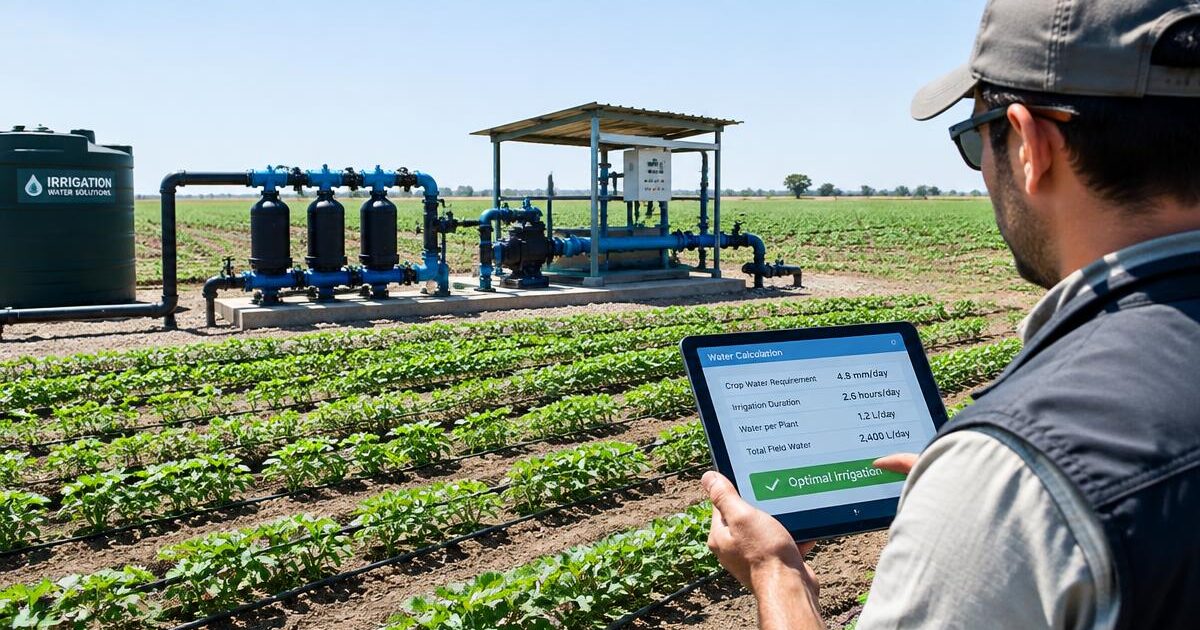
ETc = Kc × ETo, where ETo is reference evapotranspiration for local climate conditions and Kc is the crop coefficient for the current growth stage. Effective rainfall is then subtracted to get net requirement, and system efficiency is applied to get gross irrigation depth.
Key takeaways
- Direct answer: what a commercial irrigation calculator tells you: A commercial irrigation calculator converts reference evapotranspiration (ETo), a crop coefficient (Kc) and effective rainfall into a crop water requirement (ETc), then applies system efficiency to produce a gross irrig…
- The core formula: ETo, Kc and ETc: Reference evapotranspiration (ETo) describes the water loss from a well-watered reference grass surface under local climate conditions, expressed in millimetres per day.
- Effective rainfall and net requirement: Not all rainfall reaches the root zone usefully.
- Application efficiency and gross depth: No irrigation system delivers 100% of the water it draws to the root zone.
- Converting millimetres to cubic metres and system flow: Irrigation depth in millimetres converts to volume using one constant: 1 mm of water applied over 1 hectare equals 10 cubic metres.
Direct answer: what a commercial irrigation calculator tells you
A commercial irrigation calculator converts reference evapotranspiration (ETo), a crop coefficient (Kc) and effective rainfall into a crop water requirement (ETc), then applies system efficiency to produce a gross irrigation depth in millimetres. That depth, multiplied by irrigated area, becomes a peak daily volume and a seasonal volume in cubic metres, which in turn size design pump flow, water storage and — once a fertilizer programme is layered on — fertigation injection rates. The output is a planning basis, not a hydraulic design: it tells a buyer roughly how much water and flow a project needs, which is enough to brief a supplier, but it cannot substitute for water-source testing, pipe-network hydraulics or a licensed abstraction study.
The core formula: ETo, Kc and ETc
Reference evapotranspiration (ETo) describes the water loss from a well-watered reference grass surface under local climate conditions, expressed in millimetres per day. It is derived from temperature, humidity, wind and solar radiation using a standard method such as the FAO Penman-Monteith equation described in FAO Irrigation and Drainage Paper 56. A crop coefficient (Kc) adjusts ETo for a specific crop and growth stage: Kc is low during establishment, rises through development, peaks mid-season, and falls again late season as the canopy matures and senesces. Multiplying the two gives crop evapotranspiration: ETc = Kc × ETo. This is the theoretical water the crop will use on a given day under the assumed climate; it is a demand figure, not yet an irrigation instruction.
Effective rainfall and net requirement
Not all rainfall reaches the root zone usefully. Effective rainfall is the portion of precipitation that infiltrates and is available to the crop, after runoff, deep percolation and evaporation losses are excluded. Subtracting effective rainfall from ETc gives the net irrigation requirement: the depth that must come from the irrigation system rather than the sky. Buyers scoping a project in a region with a defined wet season often underestimate how much this subtraction shifts seasonal volume; a calculator that lets effective rainfall vary by month, rather than using a single flat figure, produces a materially more realistic seasonal number.
Application efficiency and gross depth
No irrigation system delivers 100% of the water it draws to the root zone. Application efficiency accounts for losses from evaporation, wind drift, non-uniform distribution, leaks and deep percolation beyond the root zone. Dividing net requirement by system efficiency gives the gross irrigation depth the system must actually deliver. Well-maintained drip systems typically run in the 85–92% range, micro-sprinklers and centre pivots commonly fall between 75–85%, and surface or flood irrigation is often only 50–65% efficient. These are general planning ranges, not guarantees for any specific installation — actual efficiency depends on filtration condition, pressure regulation, emitter uniformity and maintenance discipline.
Converting millimetres to cubic metres and system flow
Irrigation depth in millimetres converts to volume using one constant: 1 mm of water applied over 1 hectare equals 10 cubic metres. A gross depth of 5 mm/day over 20 ha is therefore 5 × 20 × 10 = 1,000 m³/day. Dividing that peak daily volume by the number of hours the system actually pumps each day gives the design flow rate in cubic metres per hour, which converts to litres per second by multiplying by 1,000 and dividing by 3,600. This design flow — not the seasonal total — is the number that sizes the pump, mainline diameter, filtration bank and electrical or solar power connection, because equipment must handle the peak instantaneous demand, not an average.
Peak demand versus seasonal volume
Seasonal volume and peak daily volume answer different procurement questions. Seasonal volume, summed or averaged across the irrigation season, determines whether a water right, well yield or reservoir is large enough to carry the crop through the year, and it drives the annual water cost line in a project budget. Peak daily volume — typically occurring at mid-season when Kc and ETo are both highest — drives the capital cost of pumps, filtration, mainline pipework and power supply. A project can have ample seasonal water availability and still be undersized on peak-day infrastructure if the calculator or the buyer conflates the two. The crop water requirement calculator separates them explicitly for this reason, reporting ETc, net and gross depth, peak daily volume, seasonal volume, storage volume and design flow as distinct figures.
Shift scheduling and storage autonomy
Few commercial systems irrigate the full area simultaneously; pumping is usually split into shifts across irrigation zones or blocks to keep mainline size and pump cost manageable. Pumping hours per day is therefore an input, not a constant — a system pumping 16 hours a day needs roughly half the flow rate of one pumping 8 hours a day for the same daily volume, at the cost of a larger mainline or more irrigation sets. Storage autonomy, expressed in days, buffers against water-source interruptions, pump downtime or tariff timing; multiplying peak daily volume by the desired autonomy gives a first-pass reservoir or tank sizing figure, before accounting for evaporation losses or intake constraints on open storage.
Water source capacity as a hard constraint
A calculator can produce a design flow and seasonal volume, but it cannot confirm that a well, river abstraction or municipal connection can actually deliver them. Licensed abstraction volumes, pump test or aquifer yield data, and seasonal flow records for surface sources are a separate evidence requirement. A project sized correctly on paper but constrained by a source permit well below the calculated seasonal volume is not ready for supplier quotation; the gap between demand and confirmed source capacity should be resolved, or at minimum disclosed, before a specification goes out.
Fertigation inputs the calculator chain needs
Once irrigation volume and flow are established, fertigation sizing uses the same water flow as its base input, combined with target nutrient concentrations (commonly expressed in ppm or mmol/L of nitrogen, phosphorus, potassium and secondary elements), the fertilizer products selected, and the injector's dosing range. The fertigation calculator takes design flow, target concentration and fertilizer analysis to estimate stock-tank dilution ratios and injector flow rates. It assumes the irrigation water chemistry — pH, alkalinity, calcium, magnesium and bicarbonate — is already known; source water carries nutrients and buffering capacity of its own, and skipping that step risks precipitation in stock tanks or an inaccurate nutrient delivery estimate, regardless of how precise the flow-rate arithmetic is.
ROI of drip irrigation: what the comparison actually measures
A drip-versus-flood or drip-versus-sprinkler return comparison generally weighs higher capital cost and filtration/maintenance overhead against water savings from higher application efficiency, potential yield or quality improvement from more uniform and controllable delivery, and labour or energy savings from automation. The drip irrigation ROI calculator structures that comparison using the efficiency and flow figures generated upstream, but it works from assumptions the buyer supplies — local water cost, labour rates, expected efficiency gain — rather than invented benchmarks, and the result is only as reliable as those inputs.
What irrigation calculators cannot tell you
Calculators built around ETo, Kc and efficiency constants answer sizing and scoping questions; they do not answer design or feasibility questions that require site-specific evidence. They cannot tell a buyer whether the water source is chemically or biologically suitable for drip emitters or the crop in question — that requires laboratory water analysis. They cannot produce a hydraulic design: pipe diameters, friction losses, pressure zones, valve sequencing and pump curve matching require engineering calculation against the actual network layout, elevation changes and emitter specifications, not a flat flow-rate estimate. They cannot confirm permit or abstraction limits, soil infiltration and water-holding behaviour, or how a specific emitter or filtration product will perform under the site's particulate load. Treat calculator output as the starting brief for those studies, not a replacement for them.
Comparing calculator approaches
| Question | What a calculator estimates | What still requires site-specific study |
|---|---|---|
| How much water does the crop need? | ETc from ETo × Kc, less effective rainfall | Local, multi-year ETo and rainfall records |
| How much must the system deliver? | Gross depth via application efficiency | Measured emitter uniformity and system losses |
| What flow must equipment handle? | Peak daily volume ÷ pumping hours | Pipe network hydraulics and pressure losses |
| Is there enough water for the season? | Seasonal volume estimate | Licensed abstraction or source yield confirmation |
| What fertigation rates are needed? | Dilution and injector flow from target ppm | Source water chemistry and compatibility testing |
| Is drip worth the extra capital cost? | Simple payback from assumed savings | Verified local water, labour and energy costs |
A practical checklist before requesting quotes
- Confirm ETo source and whether it is a long-term average or a single peak-month reading.
- Use a growth-stage Kc appropriate to the irrigation month being scoped, not a single season-long value.
- Apply monthly, not flat, effective rainfall if the climate has a defined wet season.
- Match application efficiency to the irrigation method actually proposed, not an optimistic default.
- Separate peak daily volume from seasonal volume and size pumps and mainline on the peak figure.
- Confirm pumping hours and shift plan before quoting flow rate, since it changes the design flow directly.
- Check that a confirmed or licensed water source can deliver the calculated seasonal volume.
- Obtain water chemistry results before finalising fertigation injector and stock-tank specifications.
- Record every assumption (ETo, Kc, efficiency, rainfall, pumping hours) so a supplier can see what the number depends on.
Common mistakes buyers make with irrigation numbers
The most frequent error is treating seasonal volume as the only output that matters and under-sizing the pump and mainline for peak-day demand. A close second is applying a single Kc value for the whole season instead of stepping it through growth stages, which distorts the peak-month figure the equipment actually has to handle. Buyers also commonly use a textbook efficiency figure for drip irrigation without adjusting for site conditions such as poor filtration or long lateral runs, producing an optimistic gross-depth number. On the water-quality side, a common mistake is proceeding to fertigation design before source water chemistry is known, which can create blockage or precipitation problems a flow-rate calculation would never flag. Finally, treating a calculator's output as a finished design — rather than as the demand and flow basis for a hydraulic and water-quality study — leads to specifications that look complete but omit the information a supplier needs to quote responsibly.
Turning calculator outputs into an irrigation RFQ
Once ETc, gross depth, peak daily volume, seasonal volume, design flow and storage are established, those figures become the technical backbone of a request for quotation: the area, crop, growth-stage demand, source type and confirmed or assumed capacity, target design flow, storage requirement, and fertigation targets if applicable. Recording the assumptions behind each number — which ETo dataset, which efficiency range, which effective rainfall approach — lets a reviewer and, later, a supplier see exactly what the figures depend on and what still needs confirming. The project budget calculator can carry the resulting cost bands into a wider project view, and the agricultural tools directory lists the related calculators — greenhouse, climate and energy, fertigation — that typically feed into the same irrigation brief.
How SeedMatchGroup helps once the numbers are ready
SeedMatchGroup's planning calculators, including the crop water requirement and fertigation tools above, are supplier-neutral and free to use; they do not send anything to any supplier. When a project is ready to move forward, the figures can be carried into the RFQ builder to produce a single structured specification. Submitting an RFQ does not alert or contact any supplier automatically: a sourcing specialist reviews the brief first, and may come back to ask for missing details — water source confirmation, land documentation, budget range or timeline — before anything proceeds. If and when the brief is ready, SeedMatchGroup decides, at its discretion, whether and to which relevant suppliers to allocate it, considering factors such as project scope, crop, country, budget, timeline, technical fit and export capability. Supplier identities are kept private throughout, and all communication runs through SeedMatchGroup so that proposals can be compared on a normalized scope rather than mismatched assumptions. This service is intended for genuine commercial projects, generally from USD 250,000. There is no guaranteed number of quotes, no guaranteed response time, no guaranteed price, and no guarantee of financing or award — the structured agricultural project workflow describes how planning, costing, RFQ review and proposal comparison fit together, and projects that include a greenhouse component may also want to review the commercial greenhouse cost guide and the platform's terms before submitting a request.
Sources and further reading
FAO Irrigation and Drainage Paper 56 — Crop Evapotranspiration sets out the Penman-Monteith reference evapotranspiration method and crop coefficient approach referenced throughout this guide. FAO CROPWAT is FAO's software for calculating crop water requirements and irrigation scheduling from climate and crop data. Neither resource endorses SeedMatchGroup.
Turn "Commercial Irrigation Calculator Guide: Crop Water Demand, System Flow and Fertigation" into your RFQ
Answer a few questions and we will draft a structured RFQ you can review, edit and submit to our independent supplier network.
Frequently asked questions
- What is the formula for crop water requirement?
- ETc = Kc × ETo, where ETo is reference evapotranspiration for local climate conditions and Kc is the crop coefficient for the current growth stage. Effective rainfall is then subtracted to get net requirement, and system efficiency is applied to get gross irrigation depth.
- How do I convert irrigation depth in millimetres to a volume in cubic metres?
- One millimetre of water applied over one hectare equals 10 cubic metres. Multiply the gross depth in mm by the area in hectares, then by 10, to get the volume.
- Why does peak daily demand matter more than seasonal volume for equipment sizing?
- Seasonal volume sizes the water source and storage. Peak daily volume, divided by daily pumping hours, sizes the pump, mainline, filtration and power connection — the figures that drive capital equipment cost.
- Can an irrigation calculator replace a hydraulic design or water test?
- No. Calculators based on ETo, Kc and efficiency constants produce a demand and flow planning basis. Pipe-network hydraulics, pressure losses and water-quality suitability require site-specific engineering calculation and laboratory analysis.
- Does submitting irrigation calculator results through an RFQ guarantee supplier quotes?
- No. A sourcing specialist reviews every submitted RFQ before any supplier outreach and may request missing information. Allocation to suppliers is discretionary, and there is no guaranteed number of quotes, response time, price or outcome.
Move from reading to sourcing
The pages below carry the commercial detail for this topic — cost ranges, supplier verification, specification checklists and financing routes.