
Commercial Greenhouse Planning and Cost: A Step-by-Step Guide for Investors
Planning a commercial greenhouse means working through site, climate, crop choice, structure type, climate control, irrigation and energy systems in a defined order before any supplier is approached. This guide walks through each decision, explains qualitatively what drives CAPEX and OPEX, and shows how to turn a planning-stage concept into a structured RFQ.
What is the first decision in planning a commercial greenhouse?
Site and climate analysis comes first — temperature range, solar radiation, wind, snow loading, humidity and water availability — because every later decision, including crop choice and structure type, depends on it.
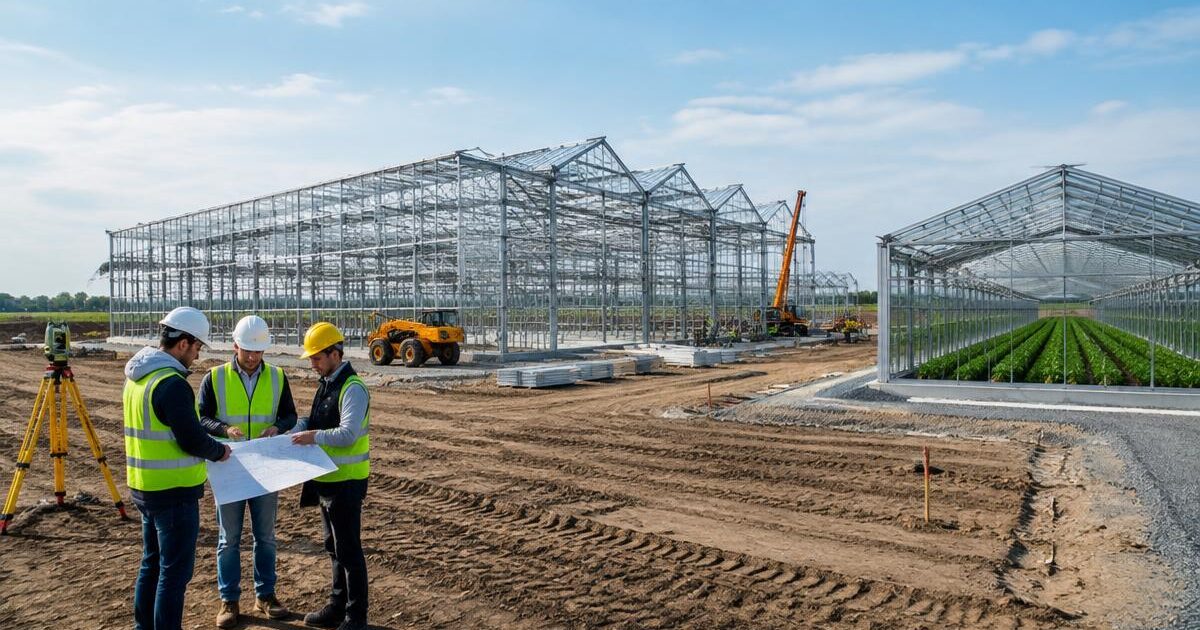
Key takeaways
- Why sequencing matters more than any single decision: A commercial greenhouse project fails or succeeds less on any single component choice than on the order in which decisions are made.
- Site and climate analysis: Site selection and climate analysis set the ceiling and floor for everything that follows.
- Crop choice and its environmental requirements: Crop choice should follow site and climate analysis, not precede it, because different crops tolerate different climate excursions, light levels and growing-season lengths.
- Structure types: tunnel, polycarbonate and glass or Venlo: Structure type is the first major decision that converts site and crop requirements into a physical building, and the three broad categories — tunnel (high or low, single or multi-span), rigid polycarbonate-clad structu…
- Climate control strategy: Climate control covers heating, cooling, ventilation and screening, and the appropriate combination depends on the climate data and crop requirements established earlier.
Planning a commercial greenhouse means working through a fixed sequence of decisions — site and climate, crop choice, structure type, climate control strategy, irrigation and fertigation design, and energy strategy — before a single supplier conversation takes place, because each later decision depends on the ones before it. There is no universal cost per square metre that applies across climates and crops, no guaranteed timeline, and no shortcut that skips site and crop analysis; the scope and budget for any given project depend entirely on the site, the crop plan and the specifications a buyer is prepared to put in writing.
Why sequencing matters more than any single decision
A commercial greenhouse project fails or succeeds less on any single component choice than on the order in which decisions are made. Choosing a structure type before confirming the site's wind and snow loading, or selecting a crop before confirming the available energy source, routinely produces designs that have to be reworked once real constraints surface. The sequence that tends to hold up under scrutiny is: understand the site and climate first, confirm the crop and its environmental requirements second, select a structure type that can deliver that environment third, then design climate control, irrigation and energy systems around the structure and crop together. Working backward from a structure a buyer has already seen elsewhere, without first confirming it suits the site and crop, is one of the most common and costly planning mistakes in commercial greenhouse projects.
Site and climate analysis
Site selection and climate analysis set the ceiling and floor for everything that follows. Relevant factors include local temperature range across the year, solar radiation levels, prevailing wind direction and speed, snow loading expectations, humidity patterns, water availability and quality, soil or substrate conditions if ground-based growing is planned, access for construction and ongoing logistics, and the regulatory and zoning status of the land. A site with strong solar radiation and mild winters supports a lower-energy design than a site with long, dark winters and heavy snow load, and that difference cascades into structure type, glazing choice, heating capacity and ultimately budget. Climate data should come from a recognised meteorological source covering a multi-year period, not a single season, since one unusually mild or harsh year can distort planning assumptions. Where water availability or quality is uncertain, this should be investigated early, because irrigation and fertigation design — and in some cases crop choice itself — depend on a confirmed water source.
Crop choice and its environmental requirements
Crop choice should follow site and climate analysis, not precede it, because different crops tolerate different climate excursions, light levels and growing-season lengths. A crop with a narrow optimal temperature band and high light requirements will demand a different climate control and supplemental lighting strategy than a hardier crop tolerant of wider swings. Market demand, target markets, labour availability and the buyer's own experience with a given crop all matter, but the environmental requirements of the chosen crop should be confirmed against the site's actual climate data before structure and systems are specified, not assumed from general crop literature. Where a buyer is considering more than one crop, it is worth comparing their environmental requirements against site climate data side by side, since the easiest crop to grow in one climate is not necessarily the easiest in another.
Structure types: tunnel, polycarbonate and glass or Venlo
Structure type is the first major decision that converts site and crop requirements into a physical building, and the three broad categories — tunnel (high or low, single or multi-span), rigid polycarbonate-clad structures, and glass or Venlo-style structures — differ in light transmission, insulation, structural cost, expected service life and suitability for automation. Tunnel structures are typically the lowest-cost entry point and can suit mild climates or crops tolerant of wider climate variation, but they generally offer less insulation and lower wind and snow load capacity than rigid-clad alternatives, and this varies by specific design and cladding film. Polycarbonate-clad structures generally offer better insulation and durability than single-layer film and a middle position on cost, with performance depending heavily on panel thickness, UV coating and frame design. Glass or Venlo-style structures typically offer the highest light transmission and the longest expected structural service life, and are generally associated with higher capital cost and greater suitability for high levels of automation and climate control integration, though exact figures depend on the specific design, glazing specification and supplier. None of these categories has a fixed price or a universally correct answer; the right choice depends on climate, crop, budget and the level of automation the project ultimately requires, and should be confirmed against supplier proposals rather than general assumptions.
Climate control strategy
Climate control covers heating, cooling, ventilation and screening, and the appropriate combination depends on the climate data and crop requirements established earlier. Heating options range from simple direct systems to centralised boiler and distribution networks, and the choice interacts closely with the energy strategy discussed below. Cooling and ventilation may rely on natural ventilation, mechanical fans, pad-and-fan evaporative cooling, or a combination, depending on climate and crop tolerance for humidity and temperature swings. Energy and shade screens affect both climate stability and energy consumption, and screen specification should be matched to the crop's light requirements and the site's solar radiation profile rather than selected generically. A climate control strategy that is proportionate to the site's actual climate variability — rather than over-specified for conditions that rarely occur or under-specified for conditions that occur more often than assumed — is one of the more reliable ways to avoid both wasted capital and recurring operational shortfalls.
Irrigation and fertigation design
Irrigation and fertigation systems need to be sized to the confirmed crop plan and the water source identified during site analysis, covering water source and storage, filtration, distribution (drip, ebb-and-flow or other methods depending on crop and growing method), and fertigation injection and monitoring equipment. Water quality should be tested rather than assumed, since source water composition affects filtration and fertigation equipment selection and, in some cases, crop suitability itself. The crop water requirement calculator and fertigation calculator can help establish planning-level demand and injection assumptions once crop and water-quality basics are confirmed, but they produce planning estimates, not engineering specifications, and do not replace a water test or a qualified irrigation design review.
Energy strategy
Energy strategy covers the heating and cooling fuel source, any supplemental lighting plan, and how climate control, irrigation and automation systems draw on the available power supply. The appropriate energy strategy depends heavily on local energy availability and cost, the climate control approach chosen, and whether supplemental lighting is part of the crop plan; these are site- and project-specific decisions rather than default choices. Energy infrastructure — grid capacity, available fuel sources, and any renewable or combined-heat-and-power options under consideration — should be confirmed with local utilities or qualified engineers early in planning, since energy capacity constraints discovered late in a project are a common cause of redesign and delay.
CAPEX and OPEX drivers
Capital expenditure is driven qualitatively by structure type and size, climate control equipment specification, irrigation and fertigation system scope, energy infrastructure (including any supplemental lighting), site preparation and foundation work, and the level of automation specified. Operating expenditure is driven qualitatively by energy consumption (closely tied to climate control strategy and local climate), labour requirements (which vary with crop and automation level), water and fertigation inputs, and ongoing maintenance of structure, climate and irrigation systems. Because these drivers vary enormously by climate, crop, structure type and site, there is no universal CAPEX or OPEX figure that applies across projects; the commercial greenhouse cost overview explains how published benchmark ranges are compiled for different structure types and scopes, and the project budget calculator can help structure a planning-level budget once the decisions above have been made. Both tools produce planning estimates, not quotations, and actual cost depends on supplier proposals against a final written specification.
From concept to RFQ
Once site, crop, structure type, climate control strategy, irrigation and fertigation design, and energy strategy have been worked through in sequence, the resulting decisions should be converted into a written specification before any supplier is contacted. A specification that leaves these decisions ambiguous forces suppliers to guess or to quote on self-selected assumptions, which makes quotations difficult to compare on a like-for-like basis. The specification should state the site location and available climate data, the confirmed crop plan, the structure type under consideration (or the criteria for selecting between options), the climate control approach, irrigation and fertigation requirements, energy infrastructure and constraints, and the level of automation sought. The commercial greenhouse RFQ template and the RFQ builder provide a starting structure for organising this information, but the planning sequence described above should be substantially complete before either tool is used, since an RFQ built on an unresolved crop or structure decision tends to produce inconsistent supplier responses.
How SeedMatchGroup helps
Once a planning-stage concept has been worked through — site and climate, crop, structure type, climate control, irrigation and fertigation, and energy strategy — planning calculators and the commercial greenhouse cost benchmark can help structure a realistic budget range before any supplier is approached. The specification is then carried into a structured RFQ describing the site, crop plan, structure and systems requirements, following the same structured process described on the agricultural project workflow page. Nothing is sent to suppliers on submission: a sourcing specialist reviews every brief manually and may come back for missing details, such as an unresolved crop decision or incomplete site data, before anything proceeds further. Allocation to suppliers is manual and discretionary, considering scope, crop, country, budget, timeline, technical fit and export capability where relevant; there is no automatic matching. Supplier identities are kept private and all communication runs through SeedMatchGroup. Where multiple proposals are returned, they are normalised onto the same scope before being compared, since greenhouse quotations are especially prone to differing assumptions about structure type, climate control and automation level. Commercial projects are generally considered from USD 250,000. There is no guaranteed number of quotations, no guaranteed response time, no guaranteed price, no guaranteed financing and no guaranteed award; full allocation terms are set out in the terms of use.
Sources and further reading
For general factual context on greenhouse structures and protected-agriculture infrastructure, see FAO, Good Agricultural Practices for Greenhouse Vegetable Crops and Penn State Extension. These public resources do not endorse SeedMatchGroup.
Turn "Commercial Greenhouse Planning and Cost: A Step-by-Step Guide for Investors" into your RFQ
Answer a few questions and we will draft a structured RFQ you can review, edit and submit to our independent supplier network.
Frequently asked questions
- What is the first decision in planning a commercial greenhouse?
- Site and climate analysis comes first — temperature range, solar radiation, wind, snow loading, humidity and water availability — because every later decision, including crop choice and structure type, depends on it.
- Should I choose the crop or the structure type first?
- Crop choice should follow site and climate analysis and should be confirmed before structure type, since different crops tolerate different climate excursions, light levels and growing conditions that the structure must be able to deliver.
- What is the difference between tunnel, polycarbonate and glass or Venlo structures?
- They differ in light transmission, insulation, structural cost, expected service life and suitability for automation. Tunnels are typically the lowest-cost entry point, polycarbonate sits in a middle position on insulation and cost, and glass or Venlo structures typically offer the highest light transmission and automation suitability, generally at higher capital cost. Exact figures depend on the specific design and supplier.
- Is there a standard cost per square metre for a commercial greenhouse?
- No. Cost depends on structure type, climate control specification, irrigation and fertigation scope, energy infrastructure and automation level. The commercial greenhouse cost overview explains how published benchmark ranges are built, and the project budget calculator can help structure a planning-level budget.
- What should I prepare before writing an RFQ for a commercial greenhouse?
- A written specification covering site location and climate data, the confirmed crop plan, structure type or selection criteria, climate control approach, irrigation and fertigation requirements, energy infrastructure and the level of automation sought, before contacting any supplier.
Move from reading to sourcing
The pages below carry the commercial detail for this topic — cost ranges, supplier verification, specification checklists and financing routes.