
Fertigation Calculator: Tank, Ratio & Daily Dose.
Size stock tanks, set injector ratios and convert a target ppm concentration into daily product mass and injection flow for drip and greenhouse fertigation. Supplier-neutral scoping tool.
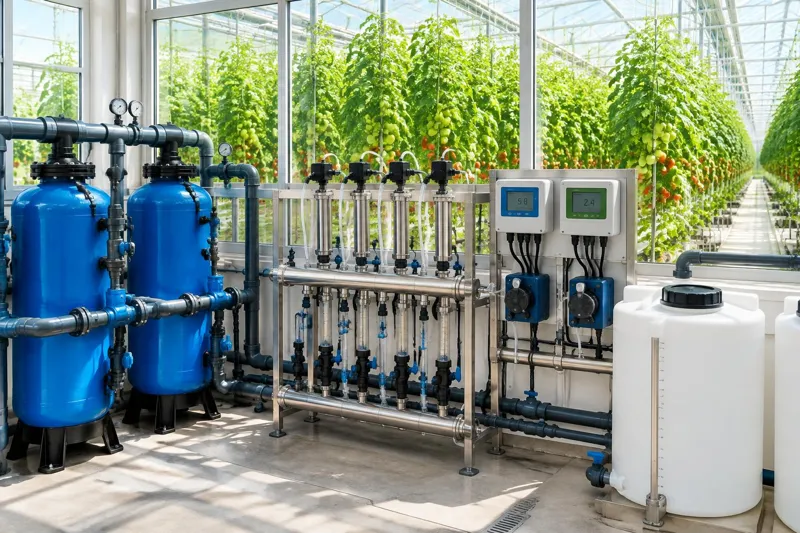
How do you calculate a fertigation stock solution and injection rate?
Fertigation dosing sets the target nutrient concentration in the final solution, then works back to the stock tank concentration factor and the injector ratio required at the irrigation flow rate, checked against EC and pH targets.
- Injection rate (L/h) = irrigation flow (m³/h) × 1,000 ÷ dilution ratio.
- Stock tanks are typically 1:100 or 1:200 concentrate.
- Keep calcium separate from phosphate and sulphate stocks to avoid precipitation.
- Target EC for most greenhouse vegetables is 1.8–3.0 mS/cm at the dripper.
Estimate only — not a quotation. Outputs are indicative planning ranges based on the values you enter and typical commercial benchmarks. Real pricing, specifications and lead times vary by country, site conditions and supplier, and are confirmed only in written offers collected through a private RFQ.
System inputs
Loads illustrative inputs, not a validated crop recipe — replace both with your agronomist's figures
Sets the planning CAPEX band per hectare
Drives treatment scope and its cost uplift
Peak-season gross depth
Nutrient element in the emitter line
e.g. urea 46, potassium nitrate 13 N
Initial 500 is hypothetical; enter a dated delivered product quotation
1–365 whole days at the entered daily rate; use separate stage calculations when dosing varies
CAPEX bands are planning ranges for polyhouse / tunnel fertigation including the head station, dosing and in-field distribution — not quotations. Standard filtration and acid dosing for bicarbonate control.
No calculated concentration establishes safe solubility or compatibility. Check the specific product datasheet, water analysis, mixing sequence and lowest tank temperature with your agronomist. Annual quantities repeat the entered daily rate over your operating days, not an automatically modelled crop cycle.
Turn this estimate into a project brief
Send these figures to the fertigation equipment RFQ. Your inputs and results are attached to the private brief for specialist review before supplier outreach.
Buying more than once? Save these project details to your buyer profile so your site, crop, budget and timeline are pre-filled on every future request.
Indicative only. Not financial advice, not agronomic advice, not engineering design. Final numbers require supplier, agronomist, engineer and local regulatory review.
Turn this estimate into a qualified project
SeedMatchGroup is a supplier-neutral, human-led platform. We do not manufacture or resell equipment — we help buyers specify the project, review relevant suppliers privately and compare the written offers received. Supplier participation and timing are not guaranteed.
Send these numbers to the RFQ Builder
The numbers below were calculated with SeedMatchGroup's Fertigation Calculator. Indicative — the specialist will confirm scope before contacting suppliers.
27 inputs · assumptions · results
Who this is for and how sourcing works
This page serves commercial buyers scoping fertigation systems. SeedMatchGroup works on serious commercial projects from roughly USD 250,000 upwards — professional growers, project developers, agribusinesses, EPC firms, investors and government programmes. It is not a retail channel for home gardens, hobby greenhouses or small seed packets.
Best for
- Greenhouse and open-field projects specifying a dosing head unit
- Growers converting from manual fertilizer application to injected fertigation
- EPC firms and consultants sizing tanks, injectors and controls before tender
- Buyers comparing dosing units, filtration and EC/pH control on equal terms
Typical project types
- Drip fertigation for open-field vegetables, orchards and row crops
- Greenhouse hydroponic and substrate fertigation with EC/pH control
- Multi-zone dosing across separate valves or blocks
- Retrofit of an existing irrigation head with injection and filtration
What affects project cost
- Peak irrigation flow and the resulting injection flow in L/h
- Number of independently dosed zones and channels
- Stock tank count and volume — calcium must be separated from sulphates and phosphates
- EC/pH control, sensors, redundancy and remote monitoring
- Source-water quality, filtration and acid dosing requirements
RFQ checklist
- Irrigated area, crop and peak daily application depth
- Injection flow, injector ratio and number of channels
- Stock tank volumes and days of autonomy
- Water analysis and target EC/pH
- Controller, automation and remote-monitoring requirement
Supplier matching process
- Submit one private brief — project type, country, area or capacity, crop or use case, stage, budget band and timeline.
- A sourcing specialist reviews the brief and structures it into a comparable RFQ specification.
- Qualified independent suppliers and engineering partners are approached privately against that one specification.
- You receive a like-for-like comparison. Supplier identities stay private until you decide to proceed.
Buyer is not charged
Buyers are not charged to submit a brief, receive a supplier comparison or use the planning tools.
SeedMatchGroup helps buyers compare suppliers and request quotes. SeedMatchGroup is an intermediary: it does not manufacture equipment, produce seed, build projects or provide financing directly. Pricing, specification, warranty and delivery remain the responsibility of the selected independent supplier.
Frequently asked questions
No. Enter your actual operating days per year. This tool multiplies the entered daily product mass by those days and your price per tonne. If dosing changes by crop stage, calculate each stage separately and add the costs; repeating peak demand across all days is only a constant-rate scenario, not a crop recommendation. The initial price is a hypothetical example, not a local quotation.
Daily irrigation volume (area × application depth) is multiplied by the target nutrient concentration in the emitter line (ppm = g/m³). The result is the mass of nutrient element that must be dissolved each day, before conversion to product weight using the fertilizer's nutrient percentage.
Common commercial ratios are 1:100 and 1:200. A higher dilution ratio means a smaller injection flow but a more concentrated — and less soluble-safe — stock tank. The calculator shows the resulting stock concentration so you can check it against the fertilizer's solubility limit.
Tank autonomy sets refill labour and mixing frequency. Most commercial projects size tanks for 2–7 days of peak demand so operators are not mixing solution during every irrigation cycle.
No. It is a hydraulic and dosing scoping tool. Final recipes must reflect source-water analysis, target EC/pH, crop stage and antagonism between ions.
Take the daily nutrient mass, divide by the stock concentration your injector ratio implies, then multiply by the number of days of autonomy you want between mixes. Most commercial projects size 2–7 days of peak demand and then check the resulting concentration against the fertilizer's solubility limit at the coldest expected tank temperature.
Target concentration is set by crop, growth stage and irrigation frequency, not by the calculator. What the calculator answers is the consequence: how many kg/day of product that target implies, how concentrated the stock must be and what injection flow in L/h the pump has to deliver. Fix the agronomic target with your agronomist, then size the hardware here.
1:200 halves the injection flow, so the injector and its metering range are smaller, but the stock tank must be twice as concentrated and is more likely to hit a solubility or precipitation limit. 1:100 is the safer default for high-EC recipes and hard source water; 1:200 suits larger blocks where injection flow would otherwise be impractical.
Calcium reacts with sulphates and phosphates and will precipitate if concentrated together. Standard commercial practice is tank A for calcium nitrate, tank B for phosphates and sulphates, and a separate acid tank for pH control. Size each tank from its own daily mass — a single-tank layout only works with pre-blended, compatibility-tested products.
Injection flow in L/h, number and volume of stock tanks, injector ratio, peak irrigation flow, water analysis, EC/pH control requirement and the number of independently dosed zones. That set is enough for suppliers to quote comparable dosing units, filtration and controls instead of guessing your scope.
As a planning band, open-field drip fertigation runs roughly USD 400–1,500 per hectare for the head and distribution, polyhouse systems USD 2,000–6,000, high-tech greenhouse systems with EC/pH control USD 8,000–20,000, and recirculating hydroponic systems USD 20,000–45,000. Hard, brackish or recycled source water adds treatment on top. Set the system type and water quality above and the calculator returns the band for your own area, alongside the fertilizer cost per hectare per year from your volumes and price.
Yes, separately. Equipment appears as a CAPEX planning band per hectare driven by system class and water treatment. Fertilizer appears as annual tonnage and cost per hectare, derived from your area, application depth, target concentration, product nutrient content, operating days and the price per tonne you enter. The initial price is hypothetical; replace it with your dated delivered quotation.
How should energy and financing volatility change my plan?
Size the system on engineering loads first, then test running costs and financing against price swings. Use one shared stress case across tools: energy +24% and fertilizer +31% (World Bank 2026 vs 2025 index outlook, 28 April 2026), with water unchanged unless your utility confirms a change. These are index movements, not local prices or forecasts for your site.
- Ask bidders to quote energy use (kWh, m³ gas) and nutrient quantities, not just equipment price, so you can reprice them locally.
- Lenders usually review cash flow under higher costs; prepare the stressed case before applying. Financing is never guaranteed.
- If costs are the main pressure, compare retrofitting existing houses with expanding or building new before committing capital.
Turning this estimate into a request? The irrigation and fertigation request builder lists what changes a quote — system type, filtration, dosing and drain-water scope — and opens a pre-filled request that our team reviews before any supplier is contacted.
Understanding the values
What each choice in this calculator means, and how the options differ in practice.
- Water quality
- Source water EC, pH and alkalinity decide how much acid and correction the recipe needs. Two sites with the same crop can need very different dosing.
- Crop stage
- Nutrient demand changes from establishment to fruiting. A single recipe for the whole season either starves the peak or wastes fertiliser early.
- Concentration vs proportion
- Stock solutions are mixed by concentration, then injected by proportion. Confusing the two is the most common dosing error — the calculator keeps them separate.
Illustrative project summary
1 ha multi-span tomato house
A new commercial entrant builds a first multi-span block with fertigation, insect screens and a basic climate computer.
1 ha · Multi-span polyhouse · Tomatoes
Indicative full greenhouse project CAPEX
USD 575K – USD 1.56M
Illustration only, not a real project or quotation. This is the structure, equipment and site-works budget for the example greenhouse, not the price of this calculator’s individual system, seeds or inputs, and not a result calculated from your entries. Excludes land, permits, packhouse, financing costs and working capital.
Based on the published commercial greenhouse cost benchmark. Written offers require a private project review; commercial projects start from USD 250K.
What can change the result?
This is a preliminary planning estimate based on the values you entered. The variables below usually move the outcome most, and should be confirmed with an agronomist, engineer and supplier offers before final design.
- Crop and cultivar — water, climate and support requirements differ per crop
- Growing system (soil, substrate, hydroponic) and plant density
- Water quality and treatment needs (EC, pH, iron, hardness, pathogens)
- Fertigation strategy, dosing accuracy and drain recirculation
- Automation, sensors and climate-computer control level
Questions this calculator answers
Typical buyer and investor searches this tool is built for, including the markets where we run the most commercial projects.
- fertigation head station sizing and cost per hectare for a commercial project
- fertigation head station sizing and cost for a 2-hectare project — India
- fertigation head station sizing and cost: indicative planning ranges — Kenya
- fertigation head station sizing and cost benchmarks for investors — Saudi Arabia
- fertigation head station sizing and cost under local market conditions — Mexico
- fertigation head station sizing and cost — what to specify in a supplier RFQ
Method and decision path
How to use this result in a commercial project
Use the result to test scope and compare scenarios. It is not a design, agronomic prescription, financing offer or supplier quotation.
1. Enter site evidence
Replace defaults with measured area, climate, water, energy, crop and commercial assumptions.
2. Test scenarios
Change one assumption at a time and record the effect on capacity, cost, demand or return.
3. Validate the duty
Ask the relevant agronomist, engineer or financial adviser to check the inputs and constraints.
4. Prepare a private RFQ
Carry the confirmed scope into a human-reviewed brief so written offers can be compared on the same basis.
Final specifications, performance, prices, supplier participation and timing depend on the site and written supplier responses; none is guaranteed by this calculator.
Tell us five things and we route your brief
These fields decide which specialist and which suppliers see your request. Nothing is submitted here — your answers are carried into the private RFQ.
The USD 250K project threshold applies to capital projects. Recurring fertilizer programmes are reviewed by shipment size, annual volume and sourcing fit.
A sourcing specialist shortlists reviewed providers for your scope and returns comparable offers. Supplier details stay with us — all communication runs through SeedMatchGroup.
Estimate only: these figures are indicative planning numbers, not a quotation. Final pricing, specifications and lead times come from supplier offers after your brief is reviewed.
Plan the project around the numbers
A calculator output is a starting point. Pair it with the planning guides below to align timeline, irrigation, budget and risk before you launch an RFQ.
One private brief, specialist review, private supplier research and a like-for-like comparison.
Spec gaps, MOQ, delivery, Incoterms and evidence labels for seeds, greenhouses, irrigation, fertilizers and produce.
Month-by-month schedule from concept to first harvest across 9 stages.
Design principles for drip, pivot, fertigation and filtration on commercial projects.
How CAPEX, working capital and operating cost drive the project business case.
The ten most expensive planning and procurement pitfalls — and how to avoid them.
Procurement answers behind these numbers
A model output only holds if the scope, contract route and delivery terms match the assumptions. These reference answers cover the commercial decisions that move the figure.
- Turnkey EPC vs separate equipment packages
- What belongs in a greenhouse equipment specification
- Normal payment milestones in equipment contracts
- Which Incoterms to use for greenhouse and irrigation equipment
- How long a commercial greenhouse takes from order to handover
- What is normally the owner's scope on a greenhouse project
Move fertigation system & soluble fertilizers into a structured RFQ
Editorial · not a sales pitchCalculator outputs are indicative. When your numbers stabilise, a supplier-neutral RFQ turns those estimates into a consistent brief for comparing the written offers that participating suppliers provide.
The facts a complete, supplier-neutral request on this topic includes. Use it as a checklist before submitting.
- Irrigated area, block layout and topography/elevation change
- Crop, spacing and peak daily water requirement (mm/day or m³/day)
- Water source (borehole, canal, reservoir, municipal) with yield and analysis
- System type: drip, sprinkler, pivot, micro-sprinkler, fertigation
- Required flow (m³/h), pressure and number of zones/shifts
- Power availability: grid, generator or solar pumping
- Automation and control level required
- Water analysis report and borehole test results
- Field/plot map with dimensions and elevation
Opens the RFQ Builder scoped as an irrigation package so suppliers quote hydraulics, filtration and dosing consistently. You stay in control — nothing is submitted until you review and confirm.
Free to submit · supplier-neutral · reviewed by a specialist before any supplier is contacted.
Running these numbers for a client project?
Agronomists, greenhouse and irrigation consultants use this calculator for feasibility, then hand the project to us for supplier shortlisting, RFQ preparation and quote comparison. You stay client-facing and we work through you.
Your client relationship stays with you — we work through you and never contact your client unless you ask.
Indicative only
- This tool is indicative only.
- It is not financial advice.
- It is not agronomic advice.
- It is not engineering design.
- Final numbers require supplier, agronomist, engineer and local regulatory review.
SeedMatch Group is an independent agricultural project sourcing and RFQ platform. We are not a farm, seed producer, fertilizer manufacturer, irrigation manufacturer, greenhouse builder, EPC contractor, lender or financial advisor. Supplier and project partner outreach is handled only after a commercial project brief is reviewed.
Supplier and manufacturer content is provided for research, transparency and discovery only. Buyers submit one project or RFQ to SeedMatch Group; our team validates and organises it, manages any suitable supplier or manufacturer outreach, and presents the responses through SeedMatch. There is no public directory of company identities, automatic matching, direct messaging or direct buyer-supplier contact.