
How to Plan Agricultural Water Storage for Irrigation Resilience
Build a defensible irrigation storage plan by verifying demand, testing source reliability, defining usable capacity and setting measurable procurement and acceptance requirements.
How many days of irrigation should storage cover?
Derive coverage from credible supply interruptions, crop priorities, peak demand and refill opportunities; there is no universal duration. No. It tests seasonal adequacy but misses the timing of inflows, demand peaks and outages.
Key takeaways
- 1. Start with a verified water balance: Plan agricultural water storage by calculating irrigation demand, mapping dependable incoming supply and sizing usable capacity to cover the resulting deficits through a defined disruption or dry period.
- 2. Assemble the required inputs: Build one planning dataset, recording the owner, date, units and confidence level for each input.
- 3. Verify peak demand and seasonal demand separately: Use FAO Paper 56's reference evapotranspiration and crop-coefficient framework to estimate crop evapotranspiration, with locally appropriate inputs and adjustments.
- 4. Match storage to the source availability profile: Model storage through time: closing volume equals opening volume plus inflow minus withdrawals and losses.
- 5. Decide treatment and blending before final sizing: Sample each source under representative conditions, including seasonal variation where possible.
1. Start with a verified water balance
Plan agricultural water storage by calculating irrigation demand, mapping dependable incoming supply and sizing usable capacity to cover the resulting deficits through a defined disruption or dry period. Then check whether water quality, pumping capacity, site conditions and operating rules make that volume deliverable. Do not begin with a tank catalogue or reservoir footprint. The first decision gate is explicit: agree which crops and areas must remain supplied, for how long, and under what restrictions. Storage cannot correct a persistent seasonal supply deficit unless surplus water is available earlier to fill it.
2. Assemble the required inputs
Build one planning dataset, recording the owner, date, units and confidence level for each input. Separate measured evidence from assumptions requiring verification. Collect source and demand data over matching time intervals; monthly totals can conceal short interruptions or peak irrigation windows. Resolve material gaps before committing to capacity or equipment.
- Crop areas, planting dates, growth stages, rooting conditions and irrigation priorities.
- Local weather, reference evapotranspiration, rainfall and soil-water information.
- Irrigation efficiency, operating hours, flow requirements and delivery pressure.
- Source flow records, abstraction permissions, seasonal restrictions and outage history.
- Water analyses, treatment requirements and process water consumption.
- Survey, ground conditions, drainage routes, power availability and expansion constraints.
3. Verify peak demand and seasonal demand separately
Use FAO Paper 56's reference evapotranspiration and crop-coefficient framework to estimate crop evapotranspiration, with locally appropriate inputs and adjustments. Convert this into an irrigation requirement using effective rainfall and the soil-water balance, rather than treating evapotranspiration as a direct pumping target. Account for application efficiency when estimating gross delivery, and add justified operational demands without double-counting losses. Check estimates against meter readings, irrigation records and observed crop conditions where available. The crop water requirement calculator can organise a preliminary estimate. Seasonal demand tests overall supply adequacy; peak daily demand and permitted operating hours determine delivery flow. Validate both before selecting pumps or storage.
4. Match storage to the source availability profile
Model storage through time: closing volume equals opening volume plus inflow minus withdrawals and losses. Use daily or finer intervals where interruptions, pumping windows or irrigation cycles matter. Test a credible dry-period sequence, a source outage and restricted abstraction, including realistic starting levels and refill opportunities. Do not assume a licensed abstraction limit is continuously available yield. Verify surface-water seasonality, borehole performance or contracted deliveries against relevant records. Define nominal volume separately from usable volume: exclude inaccessible water below the operating outlet, any sediment allowance and required operating limits. Keep emergency reserve distinct from routine drawdown, and account for reservoir evaporation and seepage where relevant. Use the irrigation storage calculator for scenario comparison, then require engineering validation before procurement.
5. Decide treatment and blending before final sizing
Sample each source under representative conditions, including seasonal variation where possible. Assess suitability for the crop, soil, irrigation equipment and any applicable hygiene requirements. Salinity, suspended solids and biological fouling may require different responses; storage alone does not make unsuitable water acceptable. Establish whether treatment belongs before storage, after storage or at both points, allowing for backwash, reject streams and downtime. For blending, evaluate constituent concentrations and source variability, not merely the proportion of two nominal flows. Confirm chemical compatibility and nutrient-management implications. The agricultural water treatment guide can support scoping. Gate: demonstrate acceptable delivered quality throughout the intended operating range.
6. Compare open reservoirs and closed tanks against the site
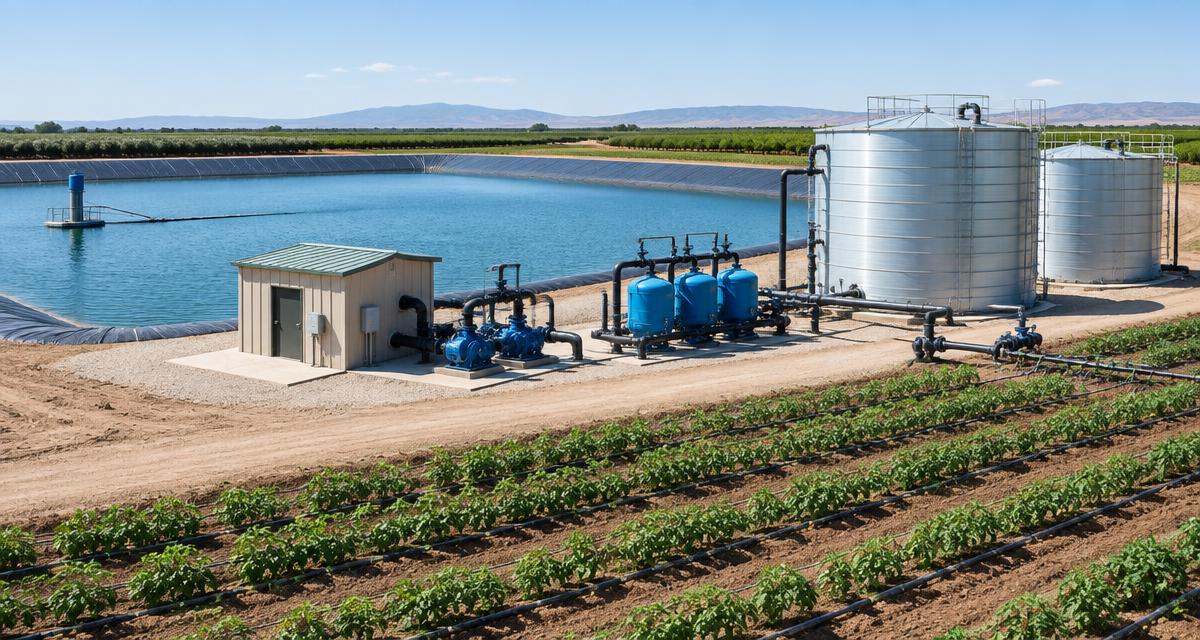
Neither format is universally preferable. Compare land take, ground conditions, structural requirements, source-water quality, maintenance access and the consequences of leakage or failure. Open reservoirs introduce exposure and earthworks considerations; closed tanks require suitable foundations, access, ventilation and maintainable connections. Covers may reduce exposure but introduce their own structural and maintenance requirements. Include lifecycle operation and eventual expansion in the evaluation. Obtain site-specific engineering and clarify permits rather than selecting solely on nominal capacity.
| Criterion | Open reservoir considerations | Closed tank considerations | Acceptance evidence |
|---|---|---|---|
| Capacity | Surveyed shape and operating elevations | Geometry and operating levels | Verified usable volume between agreed limits |
| Containment | Embankments, liner, seepage control | Foundation, shell, joints and connections | Documented inspections and specified integrity tests |
| Water quality | Sunlight, runoff, wildlife and sediment | Inlet quality, cover integrity and turnover | Sampling confirms agreed delivery limits |
| Maintenance | Sediment removal and liner access | Isolation, cleaning and safe access | Demonstrated maintenance and isolation provisions |
7. Design algae, biosecurity, safety and drainage controls
Limit avoidable nutrient entry, contaminated runoff and wildlife access. Provide inspection, sampling and cleaning arrangements; do not assume a cover eliminates biological risk. Assess filtration, turnover and any treatment response against actual water quality. Address drowning, falls, electrical hazards and unauthorised access through suitable barriers and operating procedures. Tank entry may require confined-space controls and must not be routine informal maintenance. Design overflow and emergency drainage for credible inflows, control failures and applicable storm criteria, with safe discharge routes and erosion protection. Keep contaminated drainage from clean storage. Reservoir embankments and downstream consequences require competent assessment, including any applicable dam-safety obligations.
8. Instrument the system and plan redundancy
Measure storage level, source inflow and irrigation outflow; monitor pressure and relevant quality indicators at useful locations. Specify calibration, data retention and alarm ownership, not simply a dashboard. Set high-level, low-level and pump-protection limits, and verify what happens during sensor, communications or power failure. Decide which failures require standby pumps, alternative power, isolated storage compartments or an alternative source. Redundancy should follow the agreed service requirement rather than adding duplicate equipment indiscriminately. For staged expansion, reserve land, foundation space, pipe corridors and electrical capacity where justified. Check that each stage can operate safely and that later connections will not disable essential irrigation.
9. Procure against a measurable acceptance plan
Issue a performance brief with verified inputs, uncertainty ranges, drawings, water-quality limits, usable capacity, flow and pressure requirements, and operating scenarios. Define responsibility for civil works, treatment, controls, permits and integration. Request clear exclusions and assumptions so offers can be compared on equivalent scope through an irrigation RFQ. Before award, agree how capacity, containment, pumping duty, alarms, interlocks and treatment performance will be demonstrated. Acceptance should include instrument checks, witnessed operating tests, safe overflow verification where practicable, and reviewed as-built records. Specify training, maintenance instructions, spare parts and defect-resolution responsibilities. Distinguish commissioning tests from longer-term performance that needs monitoring under representative demand and source conditions.
10. Avoid common mistakes and choose the next step
Common mistakes include sizing from annual averages, counting all nominal volume as available, assuming unrestricted refill, and ignoring treatment losses or restricted pumping hours. Another is buying storage before confirming geotechnical conditions, permissions and a safe overflow route. Return unresolved assumptions to the relevant decision gate rather than hiding them in an arbitrary capacity allowance. Next, prepare a brief identifying evidence, remaining investigations and acceptance criteria. SeedMatchGroup is a human-led commercial agriculture platform supported by proprietary technology for projects from USD 250,000. Supplier outreach happens manually after human review; the platform is not an open marketplace or direct connector and does not guarantee supplier quotations, timing or outcomes.
Sources and further reading
These sources provide general irrigation-planning context, not site-specific design approval or endorsement of SeedMatchGroup. USDA NRCS, National Engineering Handbook, Part 652, Irrigation Guide: https://www.nrcs.usda.gov/sites/default/files/2022-11/WA-Irrigation-Guide_4.pdf. FAO, Crop Evapotranspiration, Irrigation and Drainage Paper 56: https://www.fao.org/4/X0490E/X0490E00.htm.
Apply this guide with SeedMatchGroup's live tools
These are working planning and procurement tools, not illustrative examples. Enter project evidence, retain every assumption with the output and obtain professional validation before procurement.
- Crop Water Requirement Calculator — Open the tool and carry its documented assumptions into this guide's decision.
- Greenhouse Water Storage Calculator — Open the tool and carry its documented assumptions into this guide's decision.
- Irrigation RFQ — Open the tool and carry its documented assumptions into this guide's decision.
The real SeedMatchGroup service process
- 1. The buyer, project owner, investor or procurement team submits the commercial agriculture requirement.
- 2. A sourcing specialist reviews the evidence and prepares or clarifies the project brief. Nothing is sent to suppliers when the form is submitted.
- 3. Only after crop, country, budget, project scale and the required packages are understood does SeedMatchGroup search manually for suitable independent suppliers.
- 4. SeedMatchGroup coordinates follow-up and any appropriate introductions. Supplier identities and direct contact details are not published; communication remains coordinated through SeedMatchGroup.
How RFQ allocation actually works
An RFQ is not posted to an open marketplace or automatically broadcast. Allocation is a human decision after project review.
- Commercial eligibility is generally from USD 250,000, with an identifiable buyer, lawful purpose and enough information for responsible review.
- Allocation may consider scope, crop, country, budget, timeline, technical fit, export capability, supplier capacity, geography, compliance risk, conflicts, completeness and current request volume.
- SeedMatchGroup may clarify, narrow or split a scope, pause outreach, decline a request or stop the process. Allocation is not certification, endorsement, ranking or warranty.
- No minimum quote count, supplier participation, response time, price, availability, financing, introduction, award or transaction is guaranteed. The buyer remains responsible for final selection and due diligence.
Turn "How to Plan Agricultural Water Storage for Irrigation Resilience" into your RFQ
Answer a few questions and we will draft a structured RFQ you can review, edit and submit to our independent supplier network.
Frequently asked questions
- How many days of irrigation should storage cover?
- Derive coverage from credible supply interruptions, crop priorities, peak demand and refill opportunities; there is no universal duration.
- Can annual water demand determine storage size?
- No. It tests seasonal adequacy but misses the timing of inflows, demand peaks and outages.
- Does a closed tank eliminate algae?
- No. Limiting light can help, but incoming water, nutrients, cleanliness and operating conditions still matter.
- Should emergency reserve count as usable storage?
- Record it separately: it may be physically accessible but unavailable for routine irrigation under the operating plan.
- Can capacity be added later?
- Yes, if the initial design protects expansion space, connection points, hydraulic capacity and safe continuity of operation.
Move from reading to sourcing
The pages below carry the commercial detail for this topic — cost ranges, supplier verification, specification checklists and financing routes.