
How to Build a Spare-Parts and Maintenance Plan for Greenhouse and Irrigation Systems
Build an asset-based plan that connects failure consequences, verified replacement parts, inventory rules and maintenance tasks to clear ownership and procurement decisions.
Should every asset have a stocked spare?
No. Stock decisions should reflect failure consequences, recovery time, redundancy and verified replacement availability. Sometimes, after documented compatibility review and approval of relevant technical, safety and warranty implications.
Key takeaways
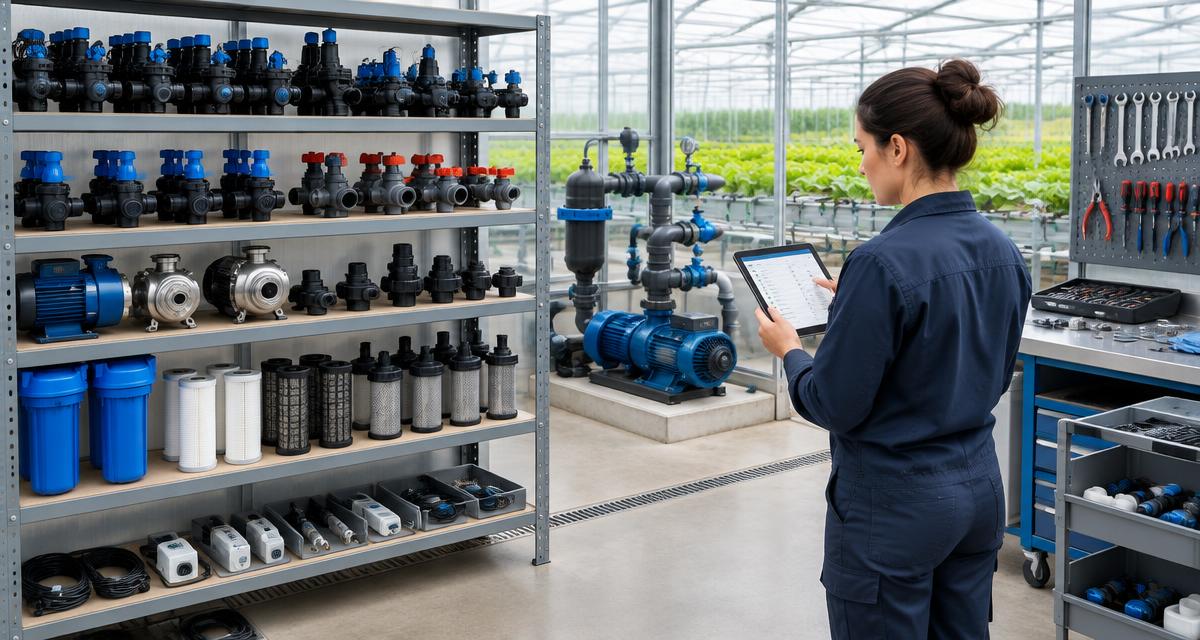
- Start with assets, consequences and recovery requirements: Build the plan by identifying every maintainable asset, assessing what happens when it fails, confirming compatible replacements, and assigning maintenance tasks and stock rules.
- Gather inputs and establish the asset hierarchy: Use a hierarchy such as site → greenhouse block or irrigation zone → system → asset → maintainable component.
- Rank criticality by failure effects: Assess failure modes, not just equipment names.
- Distinguish OEM requirements from qualified alternatives: Specify replacement parts by function and verified characteristics, not appearance.
- Separate commissioning spares from operating stock: Commissioning spares support installation checks, flushing, startup faults and initial adjustments.
Start with assets, consequences and recovery requirements
Build the plan by identifying every maintainable asset, assessing what happens when it fails, confirming compatible replacements, and assigning maintenance tasks and stock rules. Prioritize failures that threaten people, crop conditions, water delivery or nutrient control. Then compare the operation’s tolerable downtime with the complete replacement process—not just supplier dispatch time. The first decision gate is practical: can the operation safely continue until repair or replacement is complete? If not, consider stocked parts, installed redundancy, an approved contingency procedure or a combination. Record the decision and its owner.
Gather inputs and establish the asset hierarchy
Use a hierarchy such as site → greenhouse block or irrigation zone → system → asset → maintainable component. A fertigation system might contain dosing pumps, valves, probes and controllers, each with a unique identifier. Link shared equipment to every zone it serves; otherwise, its importance can be understated. Use agricultural planning tools to organize project inputs, but maintain one controlled equipment register. Before selecting stock, gather the following evidence and identify any missing information.
- Approved drawings, equipment schedules and as-built revisions.
- OEM manuals, bills of materials, serial numbers and warranty terms.
- Operating hours, seasonal demand, water characteristics and environmental exposure.
- Failure history, existing inventory and maintenance records.
- Supplier availability, service arrangements and storage requirements.
- Staff capabilities, isolation procedures and acceptable service interruptions.
Rank criticality by failure effects
Assess failure modes, not just equipment names. A valve stuck open has different consequences from one stuck closed. Record effects on safety, crop exposure, irrigation uniformity, dosing accuracy and connected systems. Consider detectability, redundancy and the ability to isolate a fault. Do not assume two pumps provide resilience if they share vulnerable power or controls. Use a documented ranking method and review high-consequence failures with operations and technical staff. The next gate is whether each critical failure has a credible detection method and recovery route; unresolved cases require engineering review.
Distinguish OEM requirements from qualified alternatives
Specify replacement parts by function and verified characteristics, not appearance. OEM parts may be necessary for proprietary interfaces, software compatibility, warranty conditions or defined safety requirements. Generic alternatives can be appropriate when material, dimensions, duty, connections and performance are demonstrably suitable. Require technical approval before substitution and receiving inspection before release to stock. The following comparison makes those acceptance decisions explicit.
| Part category | Comparison needed | Acceptance evidence |
|---|---|---|
| Pump seals and wetted components | Dimensions, pressure, temperature and chemical compatibility | Approved specification and traceable identification |
| Motors and drives | Duty, electrical ratings, protection and control interface | Technical review and commissioning checks |
| Valves and actuators | Flow characteristics, connections and fail position | Datasheet match and functional test |
| Sensors and probes | Range, accuracy, output and process compatibility | Compatibility review and calibration verification |
| Controllers and modules | Hardware revision, firmware, licensing and backups | Approved configuration and tested restoration procedure |
Separate commissioning spares from operating stock
Commissioning spares support installation checks, flushing, startup faults and initial adjustments. Operating stock supports recurring maintenance and failures after handover. Keep separate lists and replenish consumed commissioning items before operations accepts responsibility. Do not treat leftover installation materials as a validated spare-parts package. For each item, obtain a dated lead-time statement covering availability, manufacture where applicable, shipping and delivery conditions. Add internal approval, receiving, configuration and installation requirements to the recovery assessment. If replacement exceeds tolerable downtime, revisit stock or redundancy rather than relying on an unverified expedite option.
Set minimum and maximum inventory from demand and risk
For regularly consumed parts, set the reorder point from expected demand during replenishment lead time plus a justified safety allowance. Set the maximum to cover the chosen ordering cycle without creating excessive expiry or obsolescence exposure. Base purchasing decisions on inventory position: usable stock plus confirmed incoming quantities, less committed demand. For rare but critical failures, consumption averages alone are inadequate; evaluate consequence, redundancy, repairability and commonality across assets. Document assumptions where history is limited. Keep quarantined, expired and unverified parts out of available-stock totals, and review parameters when demand or lead times change.
Preserve parts so stored inventory remains usable
Assign storage locations and preservation requirements from manufacturer instructions. Protect electronics from moisture and electrostatic damage; protect seals, elastomers and packaged components from unsuitable heat, light and contamination. Track shelf-life limits where applicable and use earliest-expiry-first issuing. Label parts with identifiers, compatible assets, condition and inspection status. Maintain repairable assemblies separately from serviceable stock. For stored rotating equipment, batteries or other items needing periodic attention, create preservation work orders rather than assuming unopened means ready. Verify condition before issue, particularly after prolonged storage or a storage-environment incident.
Combine preventive tasks with condition-based checks
Translate manuals and operating risks into tasks with a method, frequency or trigger, acceptance limit and corrective action. Preventive work may include filter servicing, lubrication, connection checks and seasonal inspections where applicable. Condition-based work can use pressure differential, flow, motor current, leakage, vibration or climate-response trends. Establish a sound baseline before interpreting changes. For sensors, distinguish cleaning, functional verification and calibration. Record reference equipment, its calibration status, as-found and as-left readings, and approved tolerances. Investigate out-of-tolerance readings for process impact. Set intervals from manufacturer guidance, exposure and observed drift, with additional checks after relevant repairs.
Make CMMS records actionable and assign ownership
Whether using a computerized maintenance management system or a controlled interim register, link assets, parts and work orders through stable identifiers. Capture failure symptoms, cause where established, downtime, labor, parts used, measurements and follow-up actions. Attach current manuals, drawings, settings and restoration backups with revision control. Operators report abnormalities; maintenance plans and executes authorized work; stores controls stock; purchasing verifies commercial terms; and the technical owner approves substitutions and limits. Assign one accountable plan owner. Electrical, pressure and chemical work must follow applicable isolation procedures and be performed by competent, authorized personnel.
Give suppliers an RFQ schedule tied to decision gates
Issue an RFQ package containing asset references, part specifications, quantities, substitution rules, required documentation and delivery destination. Ask suppliers to distinguish stock availability from estimated replenishment lead time and identify quotation validity, exclusions and repair options. Set project-specific dates for questions, technical clarification, quotation review, approval, ordering, delivery and acceptance; do not substitute assumed durations for confirmed commitments. Use the irrigation RFQ route for irrigation requirements and the RFQ builder to organize the broader package. Release purchasing only after technical acceptance and commercial review, with unresolved deviations clearly recorded.
Avoid common mistakes and review obsolescence annually
Common mistakes include stocking by purchase price instead of failure consequence, accepting look-alike parts, overlooking shared utilities and retaining obsolete controller spares without compatible software. Another is scheduling maintenance without allowing safe access or operational isolation. At least annually, reconcile physical inventory, failure history, actual replenishment experience and maintenance effectiveness. Ask suppliers about discontinued products, supported replacements and repair capability. Review firmware, licenses and backup restoration alongside hardware. Remove superseded parameters from active documents, but retain history. Significant failures, expansion or operating changes should trigger an earlier review.
Take the next step with a reviewed equipment package
Start with one critical system and validate its asset records, recovery decisions, spare specifications and maintenance tasks before expanding site-wide. Greenhouse projects can organize their next planning step through the greenhouse project center. SeedMatchGroup is a human-led commercial agriculture platform supported by proprietary technology for projects from USD 250,000. Supplier outreach occurs manually after human review; it is not an open marketplace or a manufacturer, EPC or lender. Submission does not guarantee supplier quotations, timing or outcomes.
Sources and further reading
These references provide general greenhouse and irrigation management context, not equipment-specific acceptance criteria or endorsement of SeedMatchGroup. Use current OEM documentation for individual assets: UMass Extension Greenhouse Best Management Practices Manual and ASABE Irrigation Systems Management reference manual.
Apply this guide with SeedMatchGroup's live tools
These are working planning and procurement tools, not illustrative examples. Enter project evidence, retain every assumption with the output and obtain professional validation before procurement.
- Greenhouse Compatibility Planner — Open the tool and carry its documented assumptions into this guide's decision.
- Fertigation Calculator — Open the tool and carry its documented assumptions into this guide's decision.
- Private RFQ Builder — Open the tool and carry its documented assumptions into this guide's decision.
The real SeedMatchGroup service process
- 1. The buyer, project owner, investor or procurement team submits the commercial agriculture requirement.
- 2. A sourcing specialist reviews the evidence and prepares or clarifies the project brief. Nothing is sent to suppliers when the form is submitted.
- 3. Only after crop, country, budget, project scale and the required packages are understood does SeedMatchGroup search manually for suitable independent suppliers.
- 4. SeedMatchGroup coordinates follow-up and any appropriate introductions. Supplier identities and direct contact details are not published; communication remains coordinated through SeedMatchGroup.
How RFQ allocation actually works
An RFQ is not posted to an open marketplace or automatically broadcast. Allocation is a human decision after project review.
- Commercial eligibility is generally from USD 250,000, with an identifiable buyer, lawful purpose and enough information for responsible review.
- Allocation may consider scope, crop, country, budget, timeline, technical fit, export capability, supplier capacity, geography, compliance risk, conflicts, completeness and current request volume.
- SeedMatchGroup may clarify, narrow or split a scope, pause outreach, decline a request or stop the process. Allocation is not certification, endorsement, ranking or warranty.
- No minimum quote count, supplier participation, response time, price, availability, financing, introduction, award or transaction is guaranteed. The buyer remains responsible for final selection and due diligence.
Turn "How to Build a Spare-Parts and Maintenance Plan for Greenhouse and Irrigation Systems" into your RFQ
Answer a few questions and we will draft a structured RFQ you can review, edit and submit to our independent supplier network.
Frequently asked questions
- Should every asset have a stocked spare?
- No. Stock decisions should reflect failure consequences, recovery time, redundancy and verified replacement availability.
- Can generic parts replace OEM parts?
- Sometimes, after documented compatibility review and approval of relevant technical, safety and warranty implications.
- How much safety stock is enough?
- There is no universal quantity. Use demand variability, replenishment uncertainty and the consequences of running out.
- Is a CMMS essential at startup?
- A controlled register can work initially if identifiers, ownership, work history and stock movements remain reliable.
- When should calibration intervals change?
- Review them when drift, exposure, manufacturer guidance or process risk indicates the existing interval is unsuitable.
Move from reading to sourcing
The pages below carry the commercial detail for this topic — cost ranges, supplier verification, specification checklists and financing routes.