
India Polyhouse Hybrid Vegetable Seed Procurement: Seeds Act Labelling, Import Permits and Supplier RFQ
A procurement guide for commercial polyhouse and net-house growers, FPOs and agribusinesses sourcing hybrid capsicum, cucumber and tomato seed in India: labelling and dealer-licensing basics under the Seeds Act framework, import permits through plant quarantine, disease-resistance specification and a supplier RFQ checklist.
What law governs seed labelling and dealer licensing in India?
The Seeds Act, 1966 and the Seeds (Control) Order, 1983 provide the labelling and dealer-licensing framework, administered largely at the state level. Confirm current requirements with your state agriculture department before ordering.
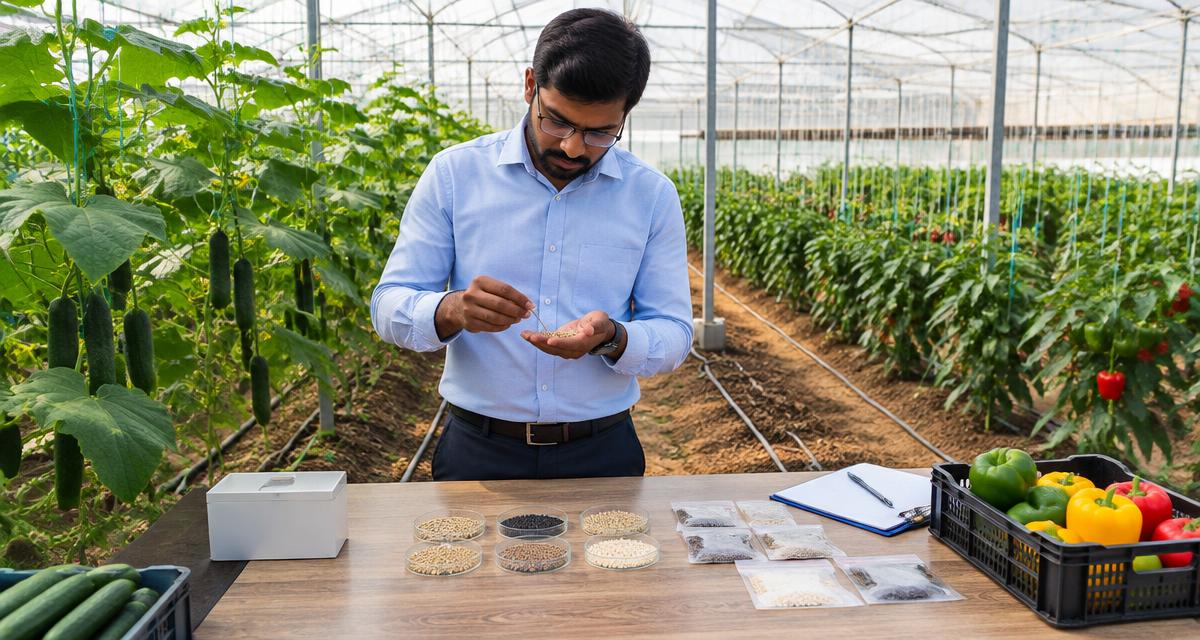
Key takeaways
- Short answer: Procuring hybrid vegetable seed for a commercial polyhouse or net-house in India works best as a written specification, not a phone call to a familiar dealer.
- Who this guide is for: This guide is written for commercial polyhouse and net-house growers, Farmer Producer Organisations (FPOs), agribusiness investors and nursery managers in India who are sourcing hybrid vegetable seed — typically capsicu…
- The legal frame, stated carefully: Seed procurement in India sits inside a layered legal framework, and the details vary by state and change over time, so treat the following as an orientation rather than a final answer.
- Climate zones, cropping seasons and polyhouse heat: India's protected-cultivation calendar does not map neatly onto open-field kharif and rabi seasons, because a polyhouse or net-house changes the microclimate the crop actually experiences.
- Disease pressure and specifying resistance with ISF codes: Protected cultivation changes disease pressure compared with open-field production: humidity can run higher, and some pathogens that are less severe outdoors become limiting factors under cover.
Short answer
Procuring hybrid vegetable seed for a commercial polyhouse or net-house in India works best as a written specification, not a phone call to a familiar dealer. Confirm the legal basics first — seed labelling and dealer licensing sit under the Seeds Act, 1966 and the Seeds (Control) Order, 1983, administered largely at state level, while any imported seed lot needs an import permit under the Plant Quarantine (Regulation of Import into India) Order, 2003, issued through the Directorate of Plant Protection, Quarantine & Storage (DPPQS). Define your disease-resistance requirements using recognised ISF terminology rather than marketing claims, confirm whether you need a parthenocarpic cucumber type for off-season or net-house production, fix lot documentation (germination, purity, lot number, test date) before payment, and size quantities from your actual nursery and transplanting plan rather than a rounded-up guess. Always confirm current licensing and import procedures with your state agriculture department and DPPQS before committing, since rules and the authorities administering them can change.
Who this guide is for
This guide is written for commercial polyhouse and net-house growers, Farmer Producer Organisations (FPOs), agribusiness investors and nursery managers in India who are sourcing hybrid vegetable seed — typically capsicum/bell pepper, cucumber and tomato — for protected cultivation. It assumes the structure itself is already planned or built; if you are still working through structure and fertigation budgeting, see our separate guides on polyhouse cost in India and polyhouse fertigation projects in India. This guide focuses specifically on the seed and variety procurement decision and the compliance steps around it, not on structure, climate control or fertigation equipment.
The legal frame, stated carefully
Seed procurement in India sits inside a layered legal framework, and the details vary by state and change over time, so treat the following as an orientation rather than a final answer. The Seeds Act, 1966 and the Seeds (Control) Order, 1983 govern seed labelling requirements and dealer licensing; in practice, dealer licensing is administered by state agriculture departments, and label content (variety name, lot number, germination percentage, purity, date of test and dealer details) is the main buyer-facing protection this framework provides. The Protection of Plant Varieties and Farmers' Rights (PPV&FR) Act, 2001, administered by the PPV&FR Authority, governs variety registration and breeder rights, which matters when you are evaluating whether a hybrid is registered and who holds rights to it. If any part of your seed supply is imported, the Plant Quarantine (Regulation of Import into India) Order, 2003 requires an import permit issued through DPPQS, along with phytosanitary certification from the exporting country and, in many cases, post-entry quarantine inspection. None of this guide constitutes legal advice: before issuing a purchase order, confirm current licensing, labelling and import procedures directly with your state agriculture department and with DPPQS, since procedures, fees and designated authorities can change and vary by state and by crop.
Climate zones, cropping seasons and polyhouse heat
India's protected-cultivation calendar does not map neatly onto open-field kharif and rabi seasons, because a polyhouse or net-house changes the microclimate the crop actually experiences. Many commercial polyhouse growers use the structure to extend capsicum, cucumber and tomato production into periods when open-field crops would fail — but the same structure can trap heat during peak summer, especially in naturally ventilated low-cost polyhouses without adequate shade or fan-pad cooling. When you brief a seed supplier, state your actual planting windows and the expected in-house temperature range during each one, not just the regional season name, because variety heat tolerance and fruit-set behaviour under high temperature differ by hybrid. If you are unsure how your structure behaves across the year, the crop water requirement calculator and fertigation calculator can help frame irrigation-side planning once the cropping calendar is fixed, though they do not replace an in-house temperature log.
Disease pressure and specifying resistance with ISF codes
Protected cultivation changes disease pressure compared with open-field production: humidity can run higher, and some pathogens that are less severe outdoors become limiting factors under cover. Common pressures growers cite for polyhouse tomato, capsicum and cucumber in India include tomato leaf curl virus (ToLCV, transmitted by whitefly), powdery mildew, and root-knot and other plant-parasitic nematodes, among others depending on region and prior cropping history. Rather than accepting a supplier's general claim of "resistant" or "tolerant," ask for the resistance declaration in the standardised terminology published by the International Seed Federation (ISF), which distinguishes high resistance (HR) from intermediate resistance (IR) against named pathogens, and ask the supplier to confirm which pathogen races or strains are covered. Resistance reduces risk; it does not replace sanitation, vector (whitefly) management or an integrated pest management plan, and a resistant variety can still show symptoms under very high disease pressure or against an uncovered strain.
Parthenocarpic cucumber as a variety-type requirement
If you are growing cucumber under net-house or polyhouse conditions without reliable pollinator access, or you want to avoid the fruit deformation that can follow poor pollination, parthenocarpic cucumber hybrids (which set seedless fruit without pollination) are worth stating explicitly as a variety-type requirement in your RFQ, rather than assuming any greenhouse cucumber hybrid will behave the same way. Ask the supplier to confirm that the specific hybrid offered is parthenocarpic (not simply gynoecious), what pollination management it still requires if any, and what fruit-quality and shelf-life data exists for your target market segment.
Lot documentation: what every seed lot should carry
Before you pay for seed, require documentation for the specific lot being supplied, not generic variety literature. At minimum, ask for: the lot number, variety name, germination percentage and the date that germination test was conducted, physical and genetic purity figures, any seed treatment applied, and the dealer or company label required under the Seeds (Control) Order framework. If any portion of the order is imported, also request the phytosanitary certificate and confirmation of the import permit reference. Keep this documentation on file against the planting block it was used for — it is the basis for any quality claim if germination or trueness-to-type later falls short of what was represented.
Sizing quantities from the nursery plan
Seed quantity should come from your actual nursery and transplanting plan, not a rounded-up estimate. Start from the planted area and plant population per hectare or per polyhouse bay, add expected nursery losses, and apply the lot's stated germination rate plus a safety margin agreed with your nursery operator. The seed rate calculator can help structure this arithmetic as a planning estimate; treat its output as a starting point to verify against your nursery's own historical germination and establishment records, not as a final order quantity.
Delivery timing against the transplanting date
Work backward from the planned transplanting date through nursery raising time to the required seed delivery date, and build in a margin for customs clearance if any portion of the order is imported. State the required delivery window in the RFQ itself, along with what happens if a lot is delayed or substituted — which alternate hybrid, if any, is pre-agreed, and how much notice you require.
INR vs USD pricing and import terms
Domestically produced hybrid seed is typically quoted and invoiced in INR, while imported seed lines may be quoted in USD or another foreign currency with INR conversion and customs duty added separately. State in your RFQ which currency you expect quotations in, whether the quoted price is ex-works, delivered, or inclusive of import duty and clearance, and who is responsible for the import permit application and phytosanitary documentation. Comparing quotes on a like-for-like landed-cost basis, rather than comparing a domestic ex-works INR price against a foreign ex-works USD price, avoids an apples-to-oranges comparison at decision time.
Comparison table: what to ask every seed supplier
| Requirement | What the buyer states | What the supplier must confirm |
|---|---|---|
| Variety fit | Crop, market/fruit specification, planting window, in-house temperature range | Proposed hybrid(s) and agronomic notes for that window |
| Resistance | Pathogens of concern (e.g. ToLCV, powdery mildew, nematodes) | ISF HR/IR codes per pathogen, races/strains covered |
| Variety type | Parthenocarpic requirement for net-house cucumber, if applicable | Confirmation of parthenocarpic type vs gynoecious only |
| Lot documentation | Documentation required before payment | Lot number, germination %, test date, purity, treatment |
| Legal status | Confirmation requested on registration and labelling | PPV&FR registration status where relevant; compliant label |
| Import compliance | Request for import permit and phytosanitary certificate if imported | Permit reference, phytosanitary certificate, DPPQS clearance basis |
| Quantity | Area, plant population, nursery loss assumptions | Packaging sizes and quantities matching the order |
| Delivery | Required delivery date against transplanting plan | Lead time, logistics plan, substitution policy |
| Pricing | Currency and Incoterm expected in the quotation | INR/USD basis, duty and clearance responsibility |
Common mistakes
- Accepting a resistance claim without asking for the ISF code and pathogen/strain it refers to.
- Treating any greenhouse cucumber hybrid as parthenocarpic without confirming it in writing.
- Buying seed without lot-specific germination and purity documentation.
- Assuming an imported lot can clear without a valid import permit and phytosanitary certificate — confirm requirements with DPPQS and your state agriculture department before ordering.
- Comparing an INR ex-works quote against a USD landed-cost quote as if they were equivalent.
- Sizing seed quantity from a rough area estimate instead of the nursery plan and historical germination performance.
Next step
Set out your variety fit, resistance requirements, lot-documentation standard and delivery window using our vegetable seed RFQ checklist, then turn it into a structured request with the RFQ builder. If you are still finalising the wider polyhouse project alongside seed sourcing, the project configurator helps assemble that scope, and our greenhouse seed supply plan guide covers resistance specification and lot documentation in more depth for any protected-cultivation project, not only in India. For background on structure and fertigation planning specific to India, see polyhouse cost in India, polyhouse fertigation projects in India and greenhouses in India; if seed-purchase financing is a constraint, see seed distributor financing in India. The fertigation calculator and crop water requirement calculator can help frame irrigation planning once variety and cropping calendar are confirmed. For projects from USD 250,000, SeedMatchGroup is a human-led commercial agriculture platform supported by proprietary technology. A sourcing specialist reviews every brief before any manual supplier outreach. SeedMatchGroup is not a manufacturer, seed company, engineering contractor, lender, certification body or open marketplace, and it does not guarantee quotations, timing, prices or project outcomes.
Sources and further reading
Independent context on Indian seed and plant-health regulation: SeedNet India, Department of Agriculture & Farmers Welfare; Protection of Plant Varieties and Farmers' Rights Authority; Directorate of Plant Protection, Quarantine & Storage. Independent terminology for disease-resistance claims: International Seed Federation, disease resistance terminology. Industry reading on protected-cultivation variety development: Rijk Zwaan news. These resources do not endorse SeedMatchGroup, and SeedMatchGroup has no affiliation with them.
Turn "India Polyhouse Hybrid Vegetable Seed Procurement: Seeds Act Labelling, Import Permits and Supplier RFQ" into your RFQ
Answer a few questions and we will draft a structured RFQ you can review, edit and submit to our independent supplier network.
Frequently asked questions
- What law governs seed labelling and dealer licensing in India?
- The Seeds Act, 1966 and the Seeds (Control) Order, 1983 provide the labelling and dealer-licensing framework, administered largely at the state level. Confirm current requirements with your state agriculture department before ordering.
- Do I need an import permit to bring hybrid vegetable seed into India?
- Imported seed generally requires an import permit under the Plant Quarantine (Regulation of Import into India) Order, 2003, issued through the Directorate of Plant Protection, Quarantine & Storage (DPPQS), along with phytosanitary certification. Confirm the current procedure with DPPQS before committing to an import.
- What does HR and IR mean on a seed supplier's resistance claim?
- These are International Seed Federation (ISF) terms for high resistance (HR) and intermediate resistance (IR) to a named pathogen. Ask suppliers to quote resistance using these codes and to specify which pathogen races or strains are covered.
- Is a parthenocarpic cucumber hybrid the same as a gynoecious one?
- No. Parthenocarpic hybrids set fruit without pollination, which suits net-house or polyhouse production without reliable pollinators; gynoecious simply means mostly female flowering. Ask the supplier to confirm parthenocarpic type explicitly if that is what your production system needs.
- Can SeedMatchGroup guarantee seed availability or pricing for an Indian polyhouse project?
- No. SeedMatchGroup reviews eligible briefs from USD 250,000 and handles supplier outreach manually, but it does not guarantee quotations, availability, pricing, timing or outcomes.
Move from reading to sourcing
The pages below carry the commercial detail for this topic — cost ranges, supplier verification, specification checklists and financing routes.