
Agricultural Project Feasibility and Infrastructure Planning Guide
Assess agricultural project feasibility, infrastructure scope, delivery risks and financing readiness before committing capital or requesting supplier bids.
What should feasibility establish first?
Whether demand, site rights, utilities and operating capability support a credible investment case before detailed equipment procurement. No. Quotations inform costs and scope but do not independently validate market demand, permits, production assumptions or financing.
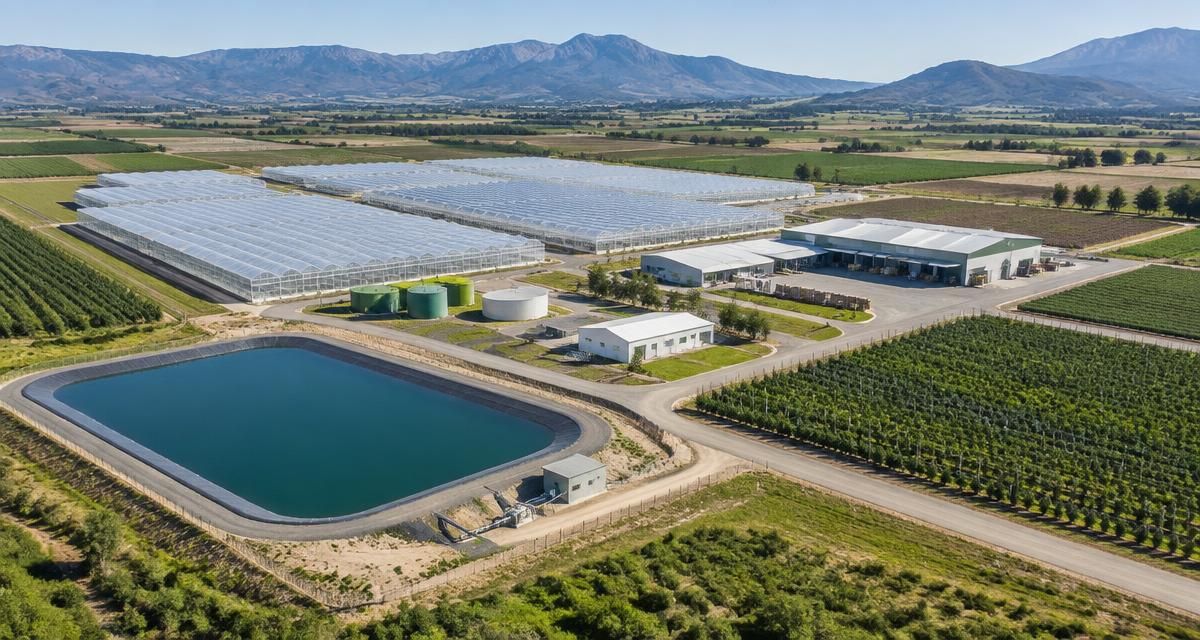
## 1. Direct answer: establish feasibility before procurement An agricultural project is ready for procurement when its investment case, site rights, permitting path, market route, production assumptions, utility capacity and funding requirements form one coherent, evidenced plan. Equipment selection comes after these foundations, not before them. A supplier quotation alone cannot establish commercial or technical feasibility. Use feasibility work to decide whether to proceed, redesign, phase or stop. Separate verified facts from estimates, unresolved dependencies and sponsor preferences. Assign each assumption an owner, supporting evidence and a review date. The agricultural project overview can help frame the project before detailed specification begins. This guide applies to commercial crop projects; specialist legal, engineering, agronomic and financial review should match the jurisdiction and proposed operating model.
## 2. Define the investment thesis and decision framework State why this project should earn an acceptable return: customer demand, production advantage, logistics access, supply reliability or another testable proposition. Define the sponsor’s investment horizon, capital constraints, operating capability and return criteria without treating aspirational yields or selling prices as established facts. Compare alternatives against the same demand assumptions and financial boundaries. Include a do-not-proceed option and distinguish essential infrastructure from discretionary upgrades. | Option | Potential rationale | Evidence needed | Principal exposure | |---|---|---|---| | Upgrade an existing operation | Reuse suitable assets | Condition survey and capacity checks | Hidden defects and operating disruption | | Develop a new site | Configure around production needs | Land, permits and utility feasibility | Enabling works and approval delays | | Phase development | Limit initial capital exposure | Standalone phase economics and expansion plan | Duplicate works and constrained interfaces | | Defer investment | Preserve capital pending evidence | Defined information gaps and reassessment triggers | Lost timing or market access | Select the option that remains credible under downside conditions, not merely the one with the highest headline forecast.
## 3. Verify the site, infrastructure and permits Confirm ownership or enforceable tenure, permitted land use, access rights and restrictions before committing to permanent works. Investigate topography, drainage, geotechnical conditions, flood exposure, contamination concerns, ecological constraints and neighboring land uses. Site suitability is specific to the crop, structure and operating method. Build a permit register covering applicable planning, construction, water abstraction, discharge, environmental, worker welfare, food handling and utility approvals. Record the authority, application requirements, dependencies, responsible party and current status. Do not assume a land title confers water rights or that an equipment supplier handles local approvals. Validate road access, telecommunications, logistics space, drainage discharge routes and utility connection conditions. Obtain written positions where possible; an informal indication of available power is not a confirmed connection offer.
## 4. Connect market route to crop and production planning Specify the intended buyer segments, product grades, packaging, delivery frequency, sales channels and payment terms. Distinguish customer interest from enforceable purchase commitments. Check competing supply, seasonal price exposure, rejection rules, transport requirements and the cost of reaching the customer. Build the crop plan backward from saleable output. Document varieties, planting cycles, establishment periods, expected grading losses, disease controls, labor requirements and postharvest handling. Explain the evidence supporting yield and quality assumptions and whether it comes from comparable conditions. Choose production technology only after matching climate, crop physiology, management capacity and market specifications. Model ramp-up, learning effects and production interruptions rather than assuming immediate steady-state output. Identify who supplies planting material, inputs, technical support and operating supervision. Confirm whether cold storage, packing or processing is necessary to make the market route viable.
## 5. Reconcile water and energy balances Prepare a water balance by operating period and peak demand condition. Include crop use, irrigation losses, treatment losses, cleaning, cooling and other relevant consumption. Reconcile demand against legally accessible supply, seasonal reliability, storage, treatment capacity and distribution constraints. Test source quality against crop and equipment requirements, and define disposal arrangements for reject water and effluent. Prepare an energy balance covering connected loads, simultaneous demand, operating hours, seasonal patterns and critical equipment. Distinguish electrical capacity from energy consumption and identify any thermal demand separately. Verify tariffs, connection works, backup requirements and fuel logistics. Document what happens during outages: which loads remain operational, how long storage or backup supports them, and what production losses are plausible. Have qualified specialists validate sizing assumptions. Neither annual averages nor equipment nameplate ratings alone demonstrate an adequate utility system.
## 6. Establish CAPEX, OPEX and cash-flow boundaries Use a scope-based capital estimate with dated assumptions, quantities, exclusions and confidence levels. Separate supplier equipment prices from total installed project cost. Review commercial greenhouse cost considerations where protected cropping forms part of the plan, while retaining project-specific engineering and quotations. CAPEX boundaries should explicitly address land-related expenditure, investigations, design, permits, civil works, structures, equipment, utilities, logistics, installation, commissioning, training and initial spares. Identify taxes, duties, owner costs, contingency and financing costs separately. Apply accounting treatment with professional advice rather than assuming every startup expense is capital expenditure. OPEX should cover labor, inputs, utilities, maintenance, replacements, insurance, compliance, logistics, sales costs and administration. Model working capital from inventory, receivables and payment terms. Show cash needs through construction, ramp-up and stable operation, and test combined downside scenarios without double-counting contingency or reserves.
## 7. Define package interfaces and delivery strategy Create a responsibility matrix for every package boundary. Typical interfaces include civil foundations and structures, irrigation and water treatment, electrical supply and controls, climate systems and growing equipment, and harvesting and cold-chain facilities. Name who designs, supplies, installs, connects, tests and accepts each interface. Choose between integrated delivery and separately procured packages according to owner capability, scope maturity, local execution needs and risk allocation. Integrated contracting can simplify coordination but does not remove the need to scrutinize exclusions. Multiple packages can offer flexibility while increasing the owner’s integration burden. Issue consistent specifications, site data and commercial schedules. Compare bids on compliant scope, lifecycle implications, delivery conditions, warranties, service access and acceptance criteria—not price alone. Define commissioning inputs, test methods, operator training and handover documents before award. Allocate schedule dependencies and review change-control procedures.
## 8. Build the risk register and financing decision gates Maintain a live risk register covering market, agronomy, construction, utilities, staffing, regulation, counterparties, currency and funding. Record causes, consequences, evidence, mitigation, residual exposure, triggers and owners. Link material risks to schedule and cash-flow sensitivities rather than assigning unsupported numerical precision. Financing readiness requires more than a positive forecast. Assemble sponsor information, ownership structure, site rights, approvals status, technical studies, cost evidence, customer documentation, implementation contracts and operating plans. Requirements depend on the prospective capital provider; debt availability and acceptable terms must not be assumed. Use explicit gates: - Concept gate: credible investment thesis, market route and fatal-flaw screening. - Feasibility gate: validated site, production, utility and downside assumptions. - Procurement gate: coordinated scope, comparable bid documents and funding strategy. - Commitment gate: acceptable contracts, approvals, capital availability and residual risk. - Operating gate: completed tests, trained staff and documented handover. Record conditional approvals and unresolved items rather than labeling an incomplete gate as passed.
## 9. Check readiness, avoid common mistakes and act Before requesting firm proposals, confirm: - Site control and approval responsibilities are documented. - Market assumptions and crop plans share the same output basis. - Water and energy balances address peaks and interruptions. - CAPEX, OPEX and working-capital boundaries are consistent. - Interfaces, exclusions and acceptance criteria have named owners. - Financing gaps and decision-gate conditions are visible. Common mistakes include using vendor capacity as a yield forecast, comparing equipment-only and installed prices, omitting owner costs, and ordering before utility or permit dependencies are resolved. Another is allocating integration risk to a party without the authority or resources to manage it. Next, close fatal gaps, commission targeted specialist reviews and prepare a controlled procurement brief. Use agricultural tools to organize inputs and the RFQ builder to structure requirements. SeedMatchGroup is human-led and supplier-neutral, serving projects from USD 250,000. It is not a lender, manufacturer, contractor, certifier or open marketplace, and never guarantees offers or results. Buyers retain responsibility for due diligence, appointments, approvals and investment decisions.
## 10. Sources and further reading For sector context, consult the World Bank agriculture overview and IFC agribusiness and forestry. These sources provide background, not project-specific feasibility validation or financing commitments. Before approving procurement, update the evidence register, retest material assumptions and document the decision authority for each package. Treat unresolved land, water, market, permitting or operating-capability issues as explicit conditions, not footnotes. This final review supports a defensible proceed, redesign, phase or stop decision. These sources do not endorse SeedMatchGroup.
Turn "Agricultural Project Feasibility and Infrastructure Planning Guide" into your RFQ
Answer a few questions and we will draft a structured RFQ you can review, edit and submit to our independent supplier network.
Frequently asked questions
- What should feasibility establish first?
- Whether demand, site rights, utilities and operating capability support a credible investment case before detailed equipment procurement.
- Can supplier quotations replace a feasibility study?
- No. Quotations inform costs and scope but do not independently validate market demand, permits, production assumptions or financing.
- When should firm RFQs be issued?
- Once site conditions, performance requirements, package boundaries and acceptance criteria are sufficiently defined for comparable bids.
- Is contingency the same as working capital?
- No. Contingency addresses specified uncertainty; working capital funds operating timing gaps such as inventory and customer receivables.
- Does SeedMatchGroup provide finance or guarantee outcomes?
- No. SeedMatchGroup is not a lender and never guarantees offers or results; funding requires separate assessment and agreement.
Move from reading to sourcing
The pages below carry the commercial detail for this topic — cost ranges, supplier verification, specification checklists and financing routes.