
Commercial Drip Irrigation System Buyer's Guide: How to Specify, Compare and Buy for Commercial Farms
A practical guide for commercial growers on how to specify, compare, and buy drip irrigation systems for large-scale farms. Learn to define project requirements for an accurate drip irrigation quote.
What is the minimum project size SeedMatchGroup handles for drip irrigation?
We specialize in commercial and industrial-scale agricultural projects. For drip irrigation systems, our platform is best suited for projects with a minimum value of around USD 250,000.
Key takeaways
- What Are the Core Components of a Commercial Drip Irrigation System?: A commercial drip irrigation system consists of a head control unit, conveyance network, and distribution components working in unison.
- How Do You Define Your Project Requirements for a Drip Irrigation Quote?: To get an accurate and comparable drip irrigation quote, you must provide potential suppliers with a detailed technical brief outlining your farm's specific conditions and operational goals.
- What Are the Main Drip Irrigation System Cost Factors?: The primary cost drivers for a commercial drip irrigation system are the complexity of the head control unit, the total length and diameter of piping, and the farm's topography.
- How Should You Compare Proposals from Drip Irrigation Suppliers?: You should compare proposals based on engineering specifications and performance metrics, not just the total price or brand names listed.
- What’s the Difference Between Drip Tape and Dripline for Large Farms?: Drip tape is a thin-walled product ideal for annual crops and short-term use, while heavy-wall dripline is a rigid, durable pipe designed for multi-season use in perennial crops or orchards.
Procuring a drip irrigation system for a commercial farm is a significant capital investment that directly impacts crop yield, resource efficiency, and long-term profitability. Unlike smaller, pre-packaged kits, a commercial-scale system is a complex engineering project tailored to your specific topography, water source, soil, and crop. Getting the specification right from the start is crucial to receiving comparable proposals from suppliers and ensuring the system performs as intended for years to come.
This guide provides a framework for farm managers, investors, and agribusiness procurement teams to navigate the process. We will cover how to define your technical requirements, understand key cost factors, and compare quotes from commercial drip irrigation suppliers to make an informed purchasing decision. The focus is on practical steps to de-risk your investment and secure a system that delivers water and nutrients with precision and reliability.
What Are the Core Components of a Commercial Drip Irrigation System?
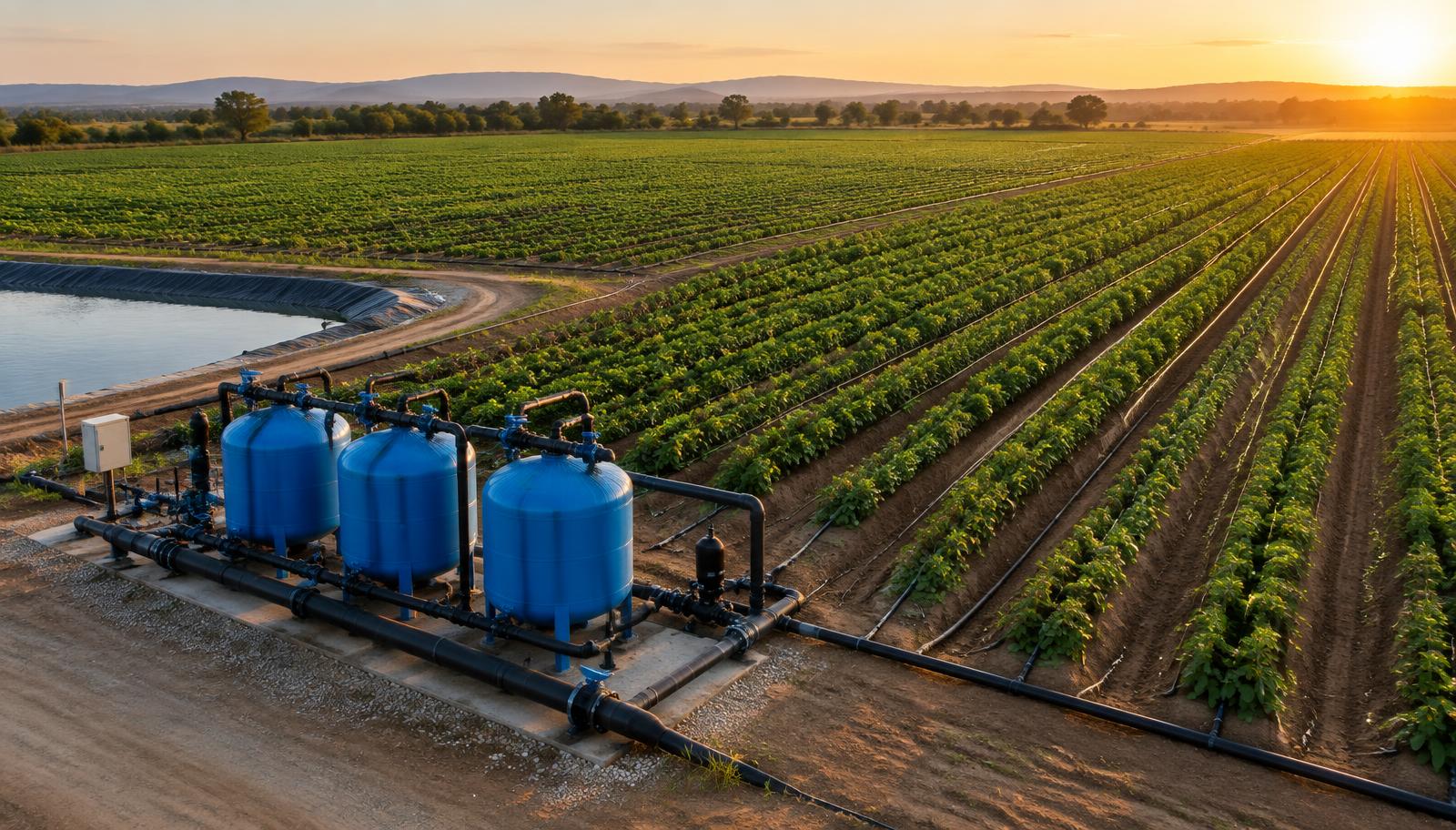
A commercial drip irrigation system consists of a head control unit, conveyance network, and distribution components working in unison. The main parts are the pump station, filtration units, mainlines/sub-mains, and the drip laterals with their emitters.
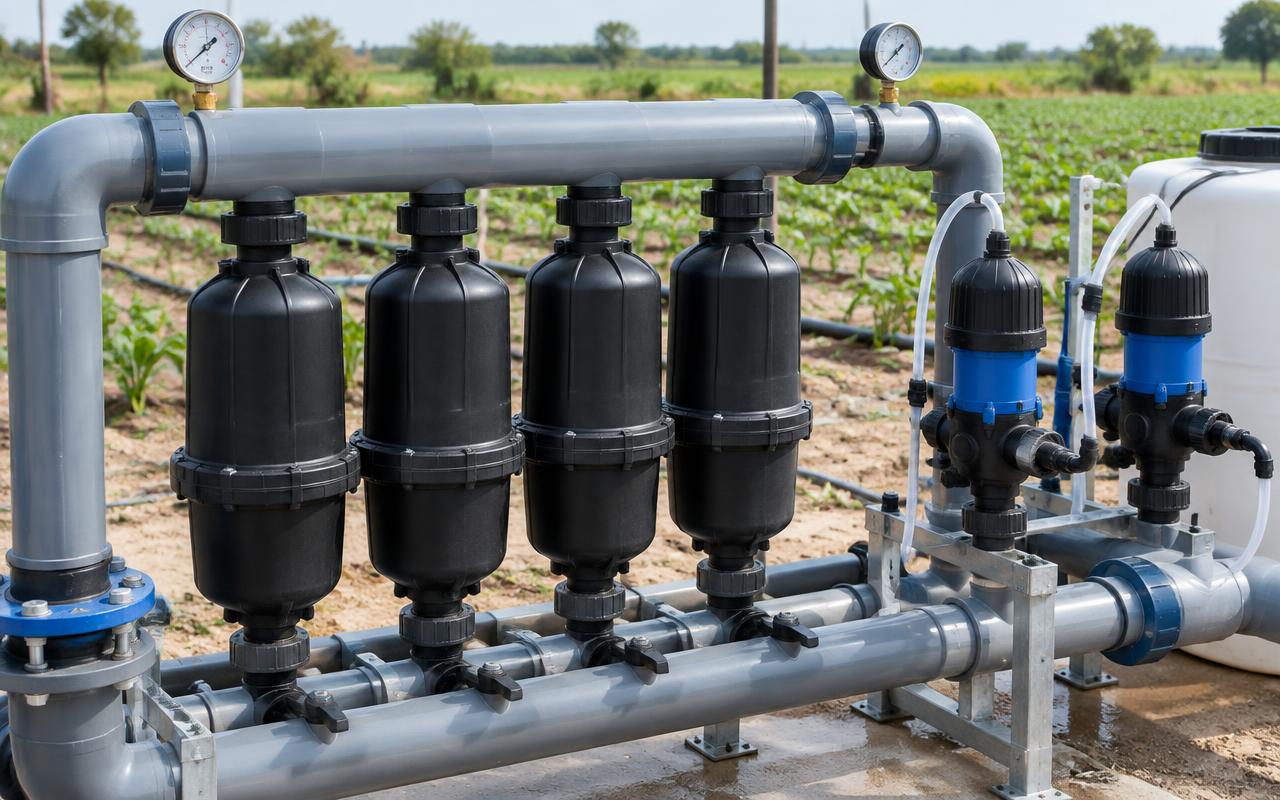
The system begins at the water source with a pump, which provides the necessary pressure and flow rate to operate the entire network. From the pump, water passes through a critical filtration station to remove sand, silt, and organic matter that could clog the emitters. Next, a network of large-diameter mainline and sub-main pipes conveys the clean water to different irrigation blocks across the farm. Finally, smaller-diameter polyethylene laterals, or driplines, branch off from the sub-mains, delivering water directly to the plant root zone through precisely spaced emitters.
How Do You Define Your Project Requirements for a Drip Irrigation Quote?
To get an accurate and comparable drip irrigation quote, you must provide potential suppliers with a detailed technical brief outlining your farm's specific conditions and operational goals. This brief should include detailed maps, water quality analysis, soil data, and specific crop parameters.
A comprehensive scope of work is the foundation of a successful procurement process. Without it, suppliers are forced to make assumptions, leading to proposals that are difficult to compare and may not be suitable for your needs. A well-defined brief empowers you to control the design parameters and ensures that all bidders are quoting on the same basis. Use the following checklist as a starting point for compiling your project data before you request an irrigation quote.
### Drip Irrigation Specification Checklist: - Farm Layout & Topography: - Provide a high-resolution topographical map (e.g., CAD, KML, or shapefile) showing field boundaries, elevations, and total area (in hectares) to be irrigated. - Note the location of the water source(s), power source, and any existing infrastructure or obstacles. - Specify row direction and length, and plant spacing. - Water Source Analysis: - Identify the source: river, borehole, reservoir, or municipal supply. - Provide a complete water quality analysis report, including pH, EC (Electrical Conductivity), and levels of suspended solids (TSS in ppm or mg/L), calcium, magnesium, iron, and manganese. - State the available flow rate (m³/hour) and any restrictions on water abstraction. - Soil Characteristics: - Specify the soil type (e.g., sand, clay, loam) and provide soil analysis data if available. - Note the soil's infiltration rate, as this influences the selection of emitter flow rates to prevent runoff. - Crop Details: - State the crop type(s) and their peak daily water requirement (mm/day). - Define the required root zone depth for irrigation. - Specify the intended application: surface drip or subsurface drip irrigation (SDI). - Operational & Automation Requirements: - Define the desired irrigation schedule (number of hours per day the system can run). - Specify the number and size of irrigation zones or 'shifts' for system operation. - Detail requirements for automation, remote control, and integration with a fertigation system. - Power Source: - Describe the available power source for the pump station: grid electricity (voltage, phase), diesel generator, or solar power.
What Are the Main Drip Irrigation System Cost Factors?
The primary cost drivers for a commercial drip irrigation system are the complexity of the head control unit, the total length and diameter of piping, and the farm's topography. The quality and type of components, particularly the pump, filtration system, and driplines, significantly influence both the upfront investment and long-term operational costs.
Breaking it down further, the pump station cost varies based on the required flow and pressure, which are dictated by farm size, elevation changes, and friction loss in the pipes. Filtration costs escalate with poorer water quality; a high sediment load may necessitate a complex sand media filter setup, which is more expensive than simpler screen or disc filters. The largest material cost is often the PVC or HDPE mainlines and sub-mains, which are priced by diameter and length. Finally, the choice between single-season drip tape and heavy-wall dripline for multi-year use creates a significant cost differential in the distribution part of the system.
How Should You Compare Proposals from Drip Irrigation Suppliers?
You should compare proposals based on engineering specifications and performance metrics, not just the total price or brand names listed. Create a comparison sheet to evaluate key design choices side-by-side, ensuring each proposal meets the minimum technical requirements outlined in your brief.
A low initial quote may hide compromises in design that lead to higher operational costs or system failure. For example, an undersized pump will struggle to deliver adequate pressure, while inadequate filtration will lead to chronic emitter clogging. Focus on comparing the hydraulic design, the level of filtration proposed (in microns), the class and diameter of pipes, and the uniformity coefficient (CU) or emission uniformity (EU) the system is designed to achieve. A reputable commercial drip irrigation supplier will provide detailed design calculations to support their component choices.
| Specification Element | Proposal A (Lower Price) | Proposal B (Higher Price) | Key Question for Supplier |
|---|---|---|---|
| Pump Type & Size | Standard centrifugal pump, borderline on HP. | Higher-efficiency pump with a stated safety margin on head. | What is the calculated total dynamic head (TDH)? |
| Filtration Level | Manual disc filter, 130 micron. | Automatic backflush sand media + secondary disc filter, 130 micron. | Is this filtration sufficient for my water quality report? |
| Mainline Material | Lower pressure class PVC. | Higher pressure class HDPE. | What is the maximum system pressure and velocity in the mainline? |
| Dripline Type | Thin-wall drip tape (1-2 seasons). | Heavy-wall pressure-compensating dripline (5-10+ years). | What is the expected lifespan and replacement cost of the laterals? |
| Automation | Manual valves for each block. | Solenoid valves with a central controller. | What is the labor requirement to operate this system daily? |
| Design Uniformity | Not specified. | Stated design Emission Uniformity (EU). | Can you provide the hydraulic calculations and design report? |
What’s the Difference Between Drip Tape and Dripline for Large Farms?
Drip tape is a thin-walled product ideal for annual crops and short-term use, while heavy-wall dripline is a rigid, durable pipe designed for multi-season use in perennial crops or orchards. The choice depends on your crop, cultivation practices, and long-term investment strategy.
Drip tape offers a lower initial cost, making it suitable for vegetable growers who may dispose of it after each harvest. However, its thin walls make it susceptible to mechanical and insect damage. Heavy-wall dripline, often with pressure-compensating (PC) emitters, represents a higher upfront investment but provides a much longer operational life, improved durability, and better irrigation uniformity, especially on sloping terrain. It is the standard for permanent plantings like vineyards, orchards, and plantations.
| Feature | Drip Tape | Heavy-Wall Dripline |
|---|---|---|
| Wall Thickness | Thin (e.g., 4 to 25 mil / 0.1 to 0.65 mm) | Thick (e.g., 35 to 47 mil / 0.9 to 1.2 mm) |
| Typical Lifespan | 1-3 seasons | 5-15+ years |
| Emitter Type | Non-pressure compensating (NPC) is common | Pressure compensating (PC) available and common |
| Clogging Resistance | Generally lower due to simpler emitter flow paths | Higher, especially with PC emitters' self-flushing mechanisms |
| Installation | Can be installed on surface or shallowly buried | Can be installed on surface or as Subsurface Drip Irrigation (SDI) |
| Cost Profile | Lower initial material cost; recurring replacement cost | Higher initial material cost; lower long-term replacement cost |
| Typical Application | Annual row crops (vegetables, strawberries) | Perennial crops (orchards, vineyards, sugarcane, alfalfa) |
Why Is the Pump and Filtration Station So Critical?
The pump and filtration station is the heart of a commercial drip irrigation system, and its proper design is non-negotiable for system longevity and performance. An undersized pump or inadequate filtration leads to poor water distribution and eventual system failure from widespread emitter clogging.
The pump must be sized by a qualified engineer to provide the correct flow rate and pressure to overcome all elevation changes (static head) and pipe friction losses (dynamic head) across the entire farm, with a safety margin. The filtration system must be specified based on a scientific water analysis. For surface water with high organic and inorganic loads, a primary sand media filter followed by a secondary screen or disc filter is standard practice. For cleaner borehole water, a disc or screen filter may suffice. Under-specifying filtration to save on upfront cost is a false economy that will lead to significant expenses in labor for flushing, reduced yields from non-uniform watering, and eventual replacement of clogged driplines. For complex water sources, a dedicated water treatment solution may be necessary.
How Does Fertigation Integrate with a Drip Irrigation System?
Fertigation, the injection of soluble fertilizers into the irrigation water, must be planned during the initial system design. This requires selecting an appropriate fertilizer injector and ensuring all downstream components are resistant to chemicals.
The most common methods for commercial fertigation are Venturi injectors and electric or water-powered dosing pumps (chemical injection pumps). Venturi injectors are simple and have no moving parts but create a pressure drop in the system, which must be accounted for in the main pump's sizing. Dosing pumps are more precise, operate against system pressure without causing a pressure loss, and are easily automated. Integrating a fertigation system requires careful placement of the injection point before the filter to ensure good mixing and to prevent unfiltered fertilizer from clogging emitters. It also requires an effective backflow prevention device to protect the water source from contamination.
Ready to source a commercial drip irrigation system for your project? [Start a drip irrigation request](/irrigation-rfq): a SeedMatch sourcing specialist reviews your brief and, where available, requests comparable proposals.
Turn "Commercial Drip Irrigation System Buyer's Guide: How to Specify, Compare and Buy for Commercial Farms" into your RFQ
Answer a few questions and we will draft a structured RFQ you can review, edit and submit to our independent supplier network.
Frequently asked questions
- What is the minimum project size SeedMatchGroup handles for drip irrigation?
- We specialize in commercial and industrial-scale agricultural projects. For drip irrigation systems, our platform is best suited for projects with a minimum value of around USD 250,000.
- How important is pressure regulation in a large-scale drip system?
- Pressure regulation is critical for ensuring irrigation uniformity. In large or undulating fields, pressure can vary significantly from the start to the end of a dripline. Pressure-compensating (PC) emitters are one solution. For systems with significant elevation changes, pressure-regulating valves may also be needed for different irrigation blocks to ensure all emitters deliver a consistent flow rate.
- Can I use solar power for my commercial drip irrigation pump?
- Yes, solar-powered pumping is a viable and increasingly common solution for commercial drip irrigation, especially in off-grid locations. The system design must carefully match the solar array's output and the pump's power curve with the irrigation system's daily water and pressure requirements. This often involves incorporating a storage reservoir to irrigate when solar power is unavailable.
- What maintenance is required for a commercial drip irrigation system?
- Regular maintenance includes cleaning filters (manually or automatically), flushing mainlines and laterals periodically to remove accumulated sediment, checking system pressure, and inspecting for leaks or animal damage. For fertigation systems, regular calibration of injectors and cleaning of tanks is also necessary.
- What is a 'hydraulic design' and why do I need it?
- A hydraulic design is a set of engineering calculations that determines the appropriate pipe sizes, pump specifications, and system layout to deliver water to every plant at the desired flow rate and pressure. It is the technical blueprint for your irrigation system, ensuring high water distribution uniformity. Insist on receiving a full hydraulic design report with any serious proposal.
- What does Emission Uniformity (EU) mean when comparing drip irrigation quotes?
- Emission Uniformity (EU) is a percentage that measures how evenly water is applied across an entire irrigation zone. A higher EU indicates a well-designed system where most plants receive the same amount of water. When comparing quotes, a proposal that states and documents its design EU is demonstrating a superior hydraulic design.
Move from reading to sourcing
The pages below carry the commercial detail for this topic — cost ranges, supplier verification, specification checklists and financing routes.