
How to Expand Greenhouse Capacity Without Disrupting Current Production
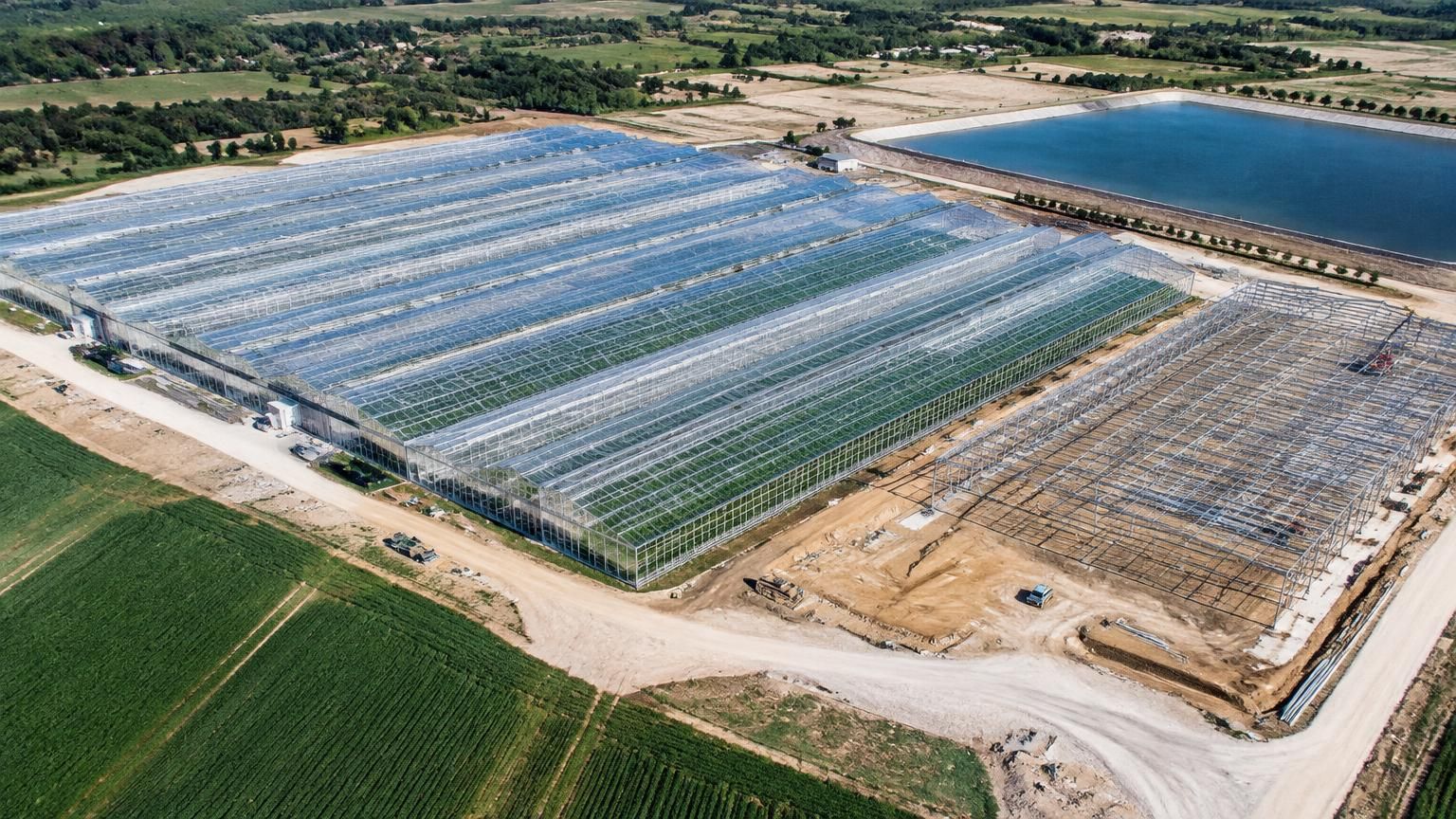
Estimate expansion ROIPhasing, shared utilities, water and power capacity checks, and incremental ROI for operators adding hectares or bays next to a running greenhouse.
Should the expansion use the same structure type?
Not necessarily. Matching it simplifies operations and spares, but a different type may suit a different crop or climate target. Compare both on lifecycle cost. Often a shared system — water, power, heating or packing capacity — rather than the structure itself. Check those first.
Key takeaways
- Check shared capacity first: Incremental margin per year = new area m² × expected marketable kg/m² × net price per kg − extra operating cost.
- Phase around the crop: Incremental margin per year = new area m² × expected marketable kg/m² × net price per kg − extra operating cost.
- Incremental ROI — the honest version: Incremental margin per year = new area m² × expected marketable kg/m² × net price per kg − extra operating cost.
- Who decides what: Build a capital-cost scenario with the [greenhouse and irrigation cost calculator](/greenhouse-irrigation-cost-calculator): use your own unit prices and allowances, without assuming savings or ROI.
- Mistakes to avoid: Build a capital-cost scenario with the [greenhouse and irrigation cost calculator](/greenhouse-irrigation-cost-calculator): use your own unit prices and allowances, without assuming savings or ROI.
*Prepared by the SeedMatchGroup editorial team from the cited FAO publications and standard planning arithmetic. It is planning guidance for commercial operators, not an engineering or agronomic sign-off.*
Short answer: expand in phases that match your crop calendar, confirm that water, power, heating and packing capacity can serve the new area before signing for the structure, and judge the project on its incremental return — the extra margin from the new area minus its full extra cost — not on the farm's average return.
Check shared capacity first
| Shared system | Question to answer | Evidence |
|---|---|---|
| Water source and storage | Can it meet peak demand for old + new area? | Peak daily requirement (FAO-56 method), well or supply permits, storage volume |
| Water treatment and fertigation | Can existing units handle the extra flow? | Rated flow vs peak flow |
| Power | Is grid connection and switchgear sufficient? | Utility capacity letter, load list |
| Heating / cooling | Can plant be extended or is a new unit needed? | Rated output vs calculated load |
| Packing and cold storage | Can the packhouse handle the extra volume at peak? | Throughput per hour, cold-room capacity |
| Labour and logistics | Can teams and paths serve the new layout? | Labour plan, path and loading layout |
Phase around the crop
- Build the new bay alongside the running one, separated by a temporary wall, so climate and hygiene in production are protected.
- Schedule tie-ins (water mains, power, heating loops) between crop cycles.
- Commission and test the new area before it receives plants.
- Keep biosecurity: separate access and cleaning for construction teams.
Incremental ROI — the honest version
Incremental margin per year = new area m² × expected marketable kg/m² × net price per kg − extra operating cost. Simple payback = incremental capital cost ÷ incremental margin per year. Include shared-system upgrades in the incremental capital cost and use a conservative yield for the first cycles in a new structure. Use the expansion ROI calculator to test scenarios.
Who decides what
| Decision-maker | Main question | What they should bring |
|---|---|---|
| Owner / investor | Does the upgrade or expansion pay back under realistic assumptions? | Target return, financing limits, risk appetite |
| Operations / head grower | Where are we losing marketable yield, water or labour today? | Yield, grade-out, labour and climate records by block |
| Engineer / technical manager | Can the structure, power, water and controls carry the change? | Drawings, structure age, electrical capacity, water quality tests |
| Purchasing | Are we comparing like-for-like scopes? | A written scope, required outputs and warranty terms |
| Consultant / agronomist | Is the bottleneck real, and what else could explain it? | Independent review of the data before suppliers are asked to quote |
Mistakes to avoid
- Pricing only the structure and forgetting utilities and packing.
- Assuming new-area yield equals your best block from day one.
- Tie-ins during peak harvest.
- Comparing quotes with different scopes — see how to compare proposals.
Sources
- FAO (1998). *Crop evapotranspiration — Irrigation and Drainage Paper 56.* Online
- FAO (2013). *Good Agricultural Practices for greenhouse vegetable crops.* PDF
Build a capital-cost scenario with the greenhouse and irrigation cost calculator: use your own unit prices and allowances, without assuming savings or ROI. Ready to scope it? Use the greenhouse expansion and upgrade request — it is free for buyers and is reviewed by a SeedMatchGroup sourcing specialist. Projects start from USD 250K. Smaller or single-item purchases are better served by a local dealer.
Turn "How to Expand Greenhouse Capacity Without Disrupting Current Production" into your RFQ
Answer a few questions and we will draft a structured RFQ you can review, edit and submit to our independent supplier network.
Frequently asked questions
- Should the expansion use the same structure type?
- Not necessarily. Matching it simplifies operations and spares, but a different type may suit a different crop or climate target. Compare both on lifecycle cost.
- What usually limits an expansion?
- Often a shared system — water, power, heating or packing capacity — rather than the structure itself. Check those first.
- How does SeedMatchGroup handle a requirement like "How to Expand Greenhouse Capacity Without Disrupting Current Production"?
- A buyer submits one private brief through the RFQ builder. Phasing, shared utilities, water and power capacity checks, and incremental ROI for operators adding hectares or bays next to a running greenhouse. A dedicated sourcing specialist normalises it into a single technical specification, issues it to qualified international manufacturers, integrators and EPC contractors, and returns offers that can be compared line by line on the same scope, lead time and delivery terms.
- What size of project does the platform serve?
- SeedMatchGroup works on commercial agricultural projects from USD 250K upward — greenhouses, irrigation and fertigation, seed processing and production facilities, nurseries, packhouses, cold chain, water treatment, agricultural solar and related infrastructure. Smaller retail or hobby requirements are outside the platform's scope.
Move from reading to sourcing
The pages below carry the commercial detail for this topic — cost ranges, supplier verification, specification checklists and financing routes.