
Kenya Greenhouse Automation and Fertigation Control RFQ: Climate Computers, Dosing and Service for Export Horticulture
How to write a greenhouse automation and fertigation control RFQ for Kenyan export horticulture: climate computers, dosing units, power backup, water quality, local service and the questions that separate serious suppliers from the rest.
What should a greenhouse automation RFQ in Kenya cover beyond price?
Control objectives for your altitude and rainy seasons, a full actuator and dosing schedule, water-quality test results, a written power-outage and offline-control plan, data export for buyer traceability, and local service response time and spare-parts location.
Key takeaways
- Short answer: A greenhouse automation and fertigation control RFQ for Kenya should specify the climate and irrigation decisions the system must support, the sensors and dosing hardware needed to support them, how the system behaves d…
- Who this guide is for: This guide is written for commercial flower and vegetable growers around Naivasha, Nakuru, Thika, the Mount Kenya region and other established horticultural clusters, as well as investors, project developers and farm ma…
- Local context: why Kenyan conditions shape the RFQ: Kenya's main horticultural export zones sit at altitude, which brings a climate pattern that differs from lowland tropical greenhouse markets: cool nights with a real risk of condensation and foliar disease, strong dayt…
- Step 1: Define the control and dosing objectives before naming hardware: Start by writing down, crop by crop and season by season, the climate and fertigation outcomes you need: target temperature and humidity or vapour pressure deficit ranges, how aggressively night condensation must be man…
- Step 2: List every actuator, dosing point and interface: Build a complete schedule of what the climate computer and dosing unit must operate: roof and side vents, screens, fans or pad-and-fan cooling, heating if used, CO2 dosing where relevant, lighting groups for supplementa…
Short answer
A greenhouse automation and fertigation control RFQ for Kenya should specify the climate and irrigation decisions the system must support, the sensors and dosing hardware needed to support them, how the system behaves during a power outage or a connectivity drop, what water quality it must tolerate, and what local service and spare-parts support the supplier commits to after handover. This is a procurement specification, not a cost guide; treat any number a supplier gives you before you have written these points down as a placeholder, not a quotation. Kenyan growers producing flowers, vegetables or herbs for export markets face a specific combination of highland climate swings, variable grid power, and buyer-side traceability requirements, and the RFQ should reflect that combination rather than a generic template written for a different climate.
Who this guide is for
This guide is written for commercial flower and vegetable growers around Naivasha, Nakuru, Thika, the Mount Kenya region and other established horticultural clusters, as well as investors, project developers and farm managers preparing a new greenhouse block, an automation retrofit of an existing structure, or a fertigation upgrade ahead of an export-market audit. It assumes the greenhouse structure itself, and possibly the irrigation network, are being procured separately or already exist, and that you are now defining the control and dosing layer that ties climate management and nutrient delivery together. For background on structure selection, see our guide on greenhouses in Kenya and on greenhouse drip irrigation in Kenya. If you are exploring financing routes for the wider project, the Kenya financing hub and the broader Kenya country solutions overview are useful starting points.
Local context: why Kenyan conditions shape the RFQ
Kenya's main horticultural export zones sit at altitude, which brings a climate pattern that differs from lowland tropical greenhouse markets: cool nights with a real risk of condensation and foliar disease, strong daytime radiation, and two distinct rainy seasons that change both humidity load and water availability. A climate-control specification written for a humid lowland site, or copied from a temperate-climate supplier's standard offer, will often be mismatched to these swings. Grid power from KPLC, generated in large part through KenGen's hydro, geothermal and other sources, is generally improving in reliability but still experiences localised outages, particularly during storms or maintenance windows; any automation or dosing RFQ for Kenya should treat backup power as a design requirement, not an optional extra. Source water is commonly drawn from boreholes or nearby lakes such as Naivasha, and both sources can carry mineral loads, sediment or seasonal variability that affect dosing equipment and filtration choices, so water testing belongs in the RFQ before equipment is specified. Export growers also operate under oversight from the Agriculture and Food Authority's Horticultural Crops Directorate and under phytosanitary requirements enforced by the Kenya Plant Health Inspectorate Service (KEPHIS); buyers in the EU, UK and Gulf markets increasingly expect digital or at least auditable records of irrigation, fertigation and climate events as part of traceability and due-diligence programmes, which is a strong argument for a control system that can log and export this data reliably. Imported electrical control panels, sensors and dosing equipment should also meet the relevant Kenya Bureau of Standards (KEBS) requirements for electrical goods entering the country; ask suppliers to confirm compliance and documentation rather than assuming it.
Step 1: Define the control and dosing objectives before naming hardware
Start by writing down, crop by crop and season by season, the climate and fertigation outcomes you need: target temperature and humidity or vapour pressure deficit ranges, how aggressively night condensation must be managed, how many independent irrigation zones and nutrient recipes you run, and how peak solar radiation days versus cool rainy-season days should change dosing and ventilation behaviour. Use the greenhouse climate calculator and the fertigation calculator to rehearse these assumptions before you write the RFQ; their outputs are planning estimates, not a design, and should be verified locally with your own climate data and water analysis. Ask each prospective supplier to explain, in their proposal, which control strategy they recommend for your specific altitude, rainfall pattern and crop mix rather than quoting a generic package.
Step 2: List every actuator, dosing point and interface
Build a complete schedule of what the climate computer and dosing unit must operate: roof and side vents, screens, fans or pad-and-fan cooling, heating if used, CO2 dosing where relevant, lighting groups for supplemental light, and every irrigation and fertigation valve or zone. For each item, record who supplies it, the signal type or protocol expected, and who is responsible for wiring, panel space and on-site testing. If the fertigation dosing unit is sourced from a different supplier than the climate computer, require a written interface description covering what each system sends and receives, and what happens if communication between them fails. This single step prevents the common Kenyan-project dispute where the structure contractor assumes the controls supplier will wire the motors and the controls supplier assumes the opposite.
Step 3: Specify sensors, water quality testing and dosing architecture
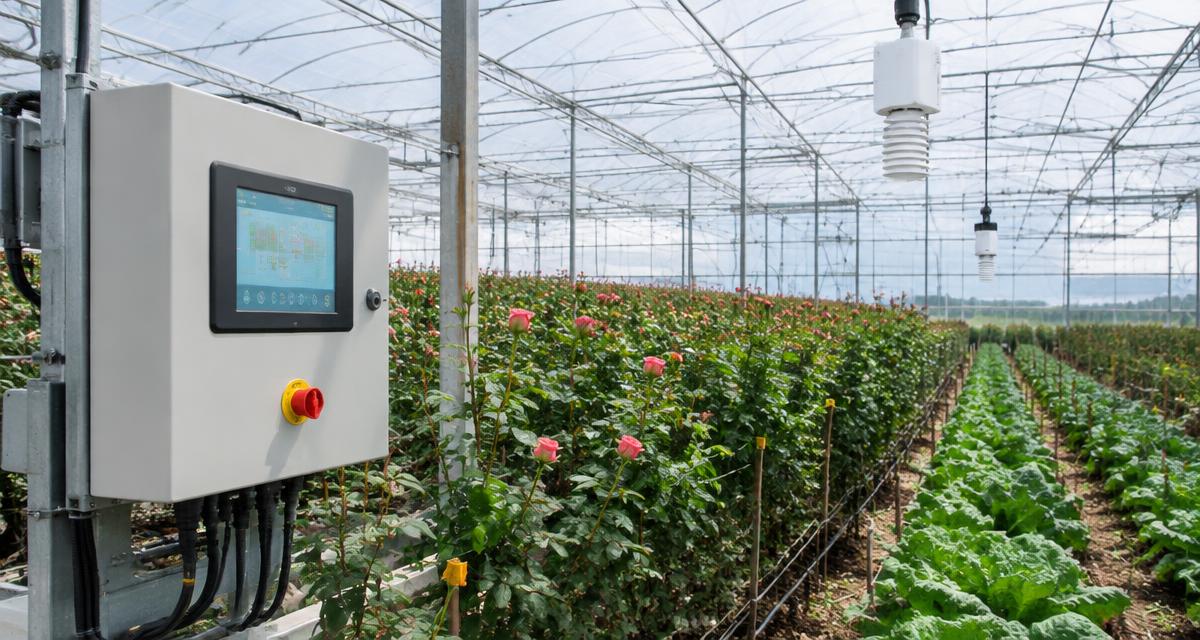
List the sensors needed to run the strategy from Step 1: air temperature and humidity per compartment, an outside weather station, substrate or soil moisture and EC where used, drain EC and volume if you recirculate, and flow and pressure sensors across the fertigation network. Require a laboratory water analysis of your borehole or lake source, covering at minimum pH, EC, alkalinity, major ions, sodium, chloride, iron and manganese, before the dosing unit is finally specified; mineral-rich or sediment-heavy water common in parts of the Rift Valley can clog injectors and foul sensors if filtration and dosing are not matched to it. Ask each supplier to state sensor accuracy, recommended calibration interval and how a failed sensor is detected and alarmed, and to confirm the number of simultaneous nutrient recipes the dosing unit can run and how stock tanks are separated.
Step 4: Require a written power-resilience and offline-control plan
Because grid reliability varies by location and season in Kenya, the RFQ should require each supplier to describe, in writing, what happens to climate control and fertigation dosing during a power interruption: which functions continue on backup power or battery, which safely shut down, how long any backup supply lasts, and how the system resumes and re-synchronises once power returns. Ask whether the proposal assumes a generator, inverter or uninterruptible power supply is provided by you, by them, or is not included at all; this is one of the most common gaps between a cheap proposal and a workable one. Separately, ask how the control system behaves if mobile or internet connectivity drops: local control and safety alarms should continue to function without a live connection to any cloud dashboard.
Step 5: Set data, traceability and remote-access requirements
Given export buyer due-diligence and the record-keeping expectations that accompany AFA and KEPHIS compliance, specify that the climate and fertigation system must log irrigation events, nutrient dosing, and key climate parameters in a format you can export and retain, and that you, not only the supplier, own that data. Ask whether exported records can be produced in a format usable for buyer audits or certification reviews. For remote access and any mobile app or dashboard, require role-based accounts, unique credentials and a stated update and support policy; do not accept shared logins as a long-term arrangement. For background on structuring this kind of sensor and data specification in more general terms, see our guide on greenhouse climate control IoT RFQs and our overview of greenhouse automation sensor systems.
Step 6: Compare proposals on one scope table
Send every supplier the same scope table and treat blank answers as exclusions until clarified in writing.
| Scope item | What to ask every supplier | Red flag in a proposal |
|---|---|---|
| Climate strategy | Strategy proposed for your altitude, rainy seasons and cool-night risk | Generic package with no site-specific logic |
| Fertigation dosing | Number of simultaneous recipes, tank separation, injection method matched to your water test | Dosing design proposed before water analysis is reviewed |
| Power resilience | What continues on backup power, who supplies generator/UPS/inverter | Power backup not mentioned or assumed to be "existing" |
| Offline behaviour | Local control and alarms continue without internet | Control loop fully dependent on a cloud connection |
| Water quality handling | Filtration and injector choice matched to borehole/lake test results | No water test requested before quoting dosing hardware |
| Data and traceability | Export format, retention period, buyer-audit usability | Data locked into a proprietary dashboard with no export |
| Local service | Response time from a Kenya-based or regional office, spare-parts stock location | Support only by remote call centre abroad |
| Commissioning | Named test list and witnessed acceptance | "Startup included" with no test list |
Step 7: Define commissioning, acceptance and training
Acceptance should be a documented list of tests, not simply a handover date. Require point-to-point checks of every sensor and actuator, a dosing accuracy test against the stated nutrient recipe, an alarm test that includes a simulated power and connectivity failure, and handover of as-built drawings, setpoint backups, user accounts and operator training records in a language your farm team works in (commonly English or Kiswahili). Where you have both export and local-market blocks on the same farm, verify that the acceptance tests cover each block's specific recipe and climate target rather than a single average test.
Step 8: Confirm local service, spares and the real cost basis
Ask each supplier directly where their nearest service technician and spare-parts stock are located relative to your farm, what their guaranteed or typical response time is for a dosing-pump or controller failure during the growing season, and whether critical spares (injector pumps, sensors, control boards) are held in Kenya or must be imported on failure. A system with excellent specifications but no local support can leave a crop unprotected for weeks while parts clear customs. Treat any budget figures you receive at this stage as planning estimates; verify them locally with import duty, installation and commissioning costs included, and use the greenhouse TCO calculator to test how recurring service, spares and energy costs affect the total cost of ownership before committing.
Common mistakes
- Specifying a climate computer and dosing unit before testing the borehole or lake water source.
- Leaving power-outage behaviour undefined and discovering the gap during the first long outage.
- Comparing purchase price alone while ignoring local service response time and spare-parts location.
- Assuming export-buyer traceability requirements will be met by a dashboard that cannot export records.
- Accepting "commissioning included" without a written list of acceptance tests.
- Treating cost estimates from early conversations as firm quotations rather than planning estimates.
Next step
Write down your climate and fertigation objectives, actuator and dosing schedule, water test results and power-resilience requirements first, then turn them into a structured request using the greenhouse RFQ, the fertigation RFQ or the general RFQ builder. For projects from USD 250,000, SeedMatchGroup is a human-led commercial agriculture platform supported by proprietary technology. A sourcing specialist reviews every brief before any manual supplier outreach. SeedMatchGroup is not a manufacturer, seed company, engineering contractor, lender, certification body or open marketplace, and it does not guarantee quotations, timing, prices or project outcomes.
Sources and further reading
Official and independent context: Kenya Plant Health Inspectorate Service (KEPHIS); Agriculture and Food Authority, Horticultural Crops Directorate; Kenya Bureau of Standards (KEBS); FAO, Good Agricultural Practices for greenhouse vegetable crops. Industry reading on greenhouse design questions: Netafim greenhouse blog. These resources do not endorse SeedMatchGroup, and SeedMatchGroup has no affiliation with them.
Turn "Kenya Greenhouse Automation and Fertigation Control RFQ: Climate Computers, Dosing and Service for Export Horticulture" into your RFQ
Answer a few questions and we will draft a structured RFQ you can review, edit and submit to our independent supplier network.
Frequently asked questions
- What should a greenhouse automation RFQ in Kenya cover beyond price?
- Control objectives for your altitude and rainy seasons, a full actuator and dosing schedule, water-quality test results, a written power-outage and offline-control plan, data export for buyer traceability, and local service response time and spare-parts location.
- Why does power backup matter so much for a Kenyan greenhouse control RFQ?
- Grid reliability from KPLC varies by location and season, so the RFQ should require suppliers to state in writing what continues on backup power, who supplies any generator or UPS, and how the system behaves during and after an outage.
- Should borehole or lake water be tested before specifying a fertigation dosing unit?
- Yes. Mineral content, sediment and seasonal variability in Kenyan borehole and lake water can affect filtration and injector choice, so a laboratory water analysis should come before the dosing design is finalised.
- How does export compliance affect the control system specification?
- Buyers and bodies such as AFA's Horticultural Crops Directorate and KEPHIS increasingly expect traceable irrigation and fertigation records, so the RFQ should require data logging that you can export in an audit-usable format, not only a proprietary dashboard.
- Can SeedMatchGroup guarantee quotations for a Kenya greenhouse automation project?
- No. SeedMatchGroup reviews eligible briefs from USD 250,000 and manages supplier outreach manually through a sourcing specialist, but it does not guarantee quotations, pricing, timing or outcomes.
Move from reading to sourcing
The pages below carry the commercial detail for this topic — cost ranges, supplier verification, specification checklists and financing routes.