
Greenhouse Climate Control and IoT RFQ: Sensors, Controls, Data Integration and Service Scope
How to write a greenhouse climate-control and IoT request for quotation that suppliers can price on the same basis: control objectives, sensor network, actuator interfaces, data ownership, cybersecurity, commissioning and long-term service.
What should a greenhouse climate-control RFQ include?
Control objectives per crop phase, an actuator and interface schedule, sensor requirements, data ownership and export terms, cybersecurity rules, commissioning tests and the service scope after handover.
Key takeaways
- Short answer: A greenhouse climate-control and IoT RFQ should describe what the control system must achieve and prove, not which brand of computer to buy.
- Who this guide is for: This guide is written for commercial growers, agribusiness investors, project managers and public programmes procuring a new greenhouse, an extension or a control retrofit.
- Step 1: Define control objectives before hardware: Start with the decisions the system has to support.
- Step 2: List every actuator and interface: A climate computer is only as useful as the equipment it can command.
- Step 3: Specify the sensor network by purpose: Specify sensors by the decision they inform, then ask suppliers to propose quantities and locations.
Short answer
A greenhouse climate-control and IoT RFQ should describe what the control system must achieve and prove, not which brand of computer to buy. State the crop and climate objectives, the equipment the controller must operate, the sensors and data you expect, who owns and can export that data, the security and connectivity rules, how commissioning will be accepted, and what service the supplier must provide for years after handover. When those items are written down, proposals become comparable; when they are missing, each supplier quotes a different system and the cheapest bid usually hides the largest gaps.
Who this guide is for
This guide is written for commercial growers, agribusiness investors, project managers and public programmes procuring a new greenhouse, an extension or a control retrofit. It assumes the greenhouse structure, heating, cooling, screens and irrigation are being procured separately or as packages, and that the climate computer has to tie them together. It does not replace a horticultural adviser or a controls engineer; it helps you brief them and the suppliers consistently.
Step 1: Define control objectives before hardware
Start with the decisions the system has to support. For each crop and growth phase, record the target ranges you intend to manage—air temperature, humidity or vapour pressure deficit, CO2, light integral, root-zone moisture—and how strictly they must be held. Note your site climate extremes and whether the main risk is overheating, condensation, cold nights or energy cost. Ask suppliers to explain which control strategies they propose for those conditions (for example, ventilation versus fogging, screen sequences, humidity control priority) and what operator inputs each strategy needs. The greenhouse climate calculator helps you rehearse heating, cooling and ventilation assumptions before writing targets, but its outputs are planning estimates, not a design.
Step 2: List every actuator and interface
A climate computer is only as useful as the equipment it can command. Build an actuator schedule listing vents, screens, fans, pad-and-fan or fogging, heating loops, boilers or heat pumps, CO2 dosing, lighting groups, irrigation and fertigation units, and alarms. For each item, state who supplies it, the signal type or protocol expected, and who is responsible for wiring, panel space and testing. Many disputes arise because the structure supplier assumes the controls supplier will wire motors while the controls supplier assumes the opposite. If fertigation is procured from a different supplier, require an agreed interface description—what the climate computer sends, what the fertigation unit reports back, and what happens on communication loss.
Step 3: Specify the sensor network by purpose
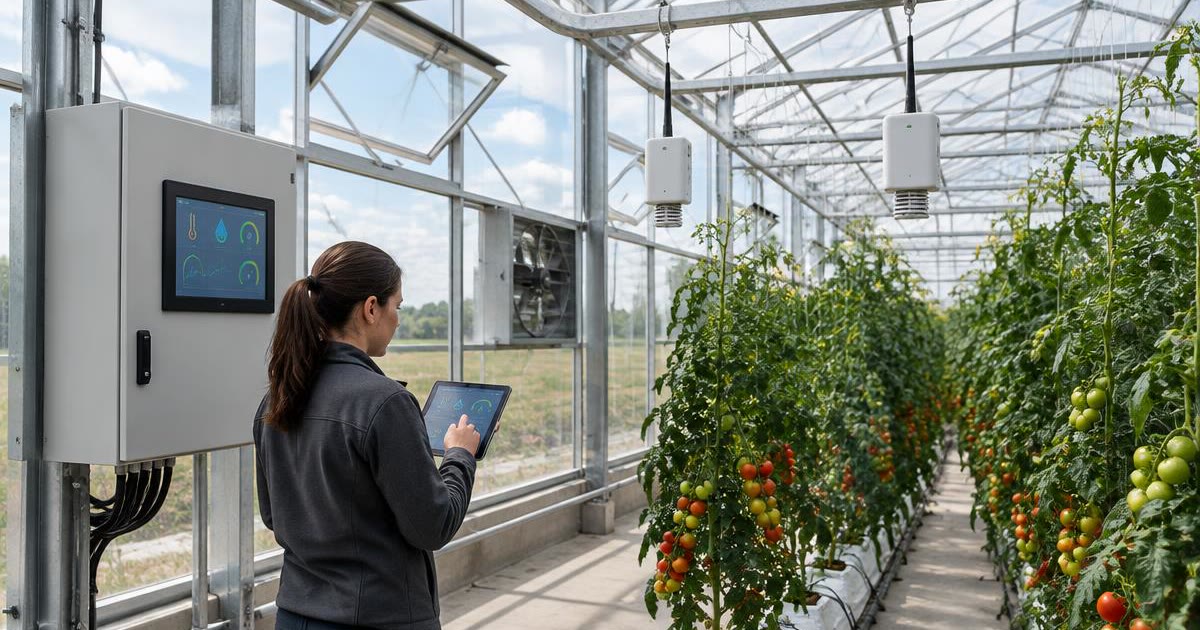
Specify sensors by the decision they inform, then ask suppliers to propose quantities and locations. Typical groups include measuring boxes for temperature and humidity within each compartment, outside weather stations (temperature, humidity, radiation, wind, rain), CO2 sensors, pipe and water temperatures, substrate or soil moisture and EC, drain measurements, and energy meters. Ask for measurement range, stated accuracy, recommended calibration interval, mounting height relative to the crop and how a failed sensor is detected. Wireless IoT sensors can reduce cabling but introduce battery replacement, signal coverage and gateway questions; require a coverage survey or a clear statement of the assumptions behind the proposed layout.
Step 4: Write down data ownership and integration rules
Modern controllers generate valuable operating history. The RFQ should state that the buyer owns the data, that it can be exported in documented, non-proprietary formats at no additional licence cost, and how long the system retains history locally and in any cloud service. If you plan to connect a farm-management, energy or labour system, list it and ask whether the proposal includes a documented API, data dictionary and test environment. Ask what functions stop working if a subscription lapses. Clear integration terms protect future flexibility more than any single hardware choice.
Step 5: Set connectivity and cybersecurity requirements
Remote access is convenient and a real risk. Require role-based user accounts, unique credentials, multifactor authentication for remote access, encrypted connections, update and patch policies, and an audit log of setpoint changes. Ask how the system behaves when the internet connection fails: local control must continue safely with alarms. Ask suppliers to describe their vulnerability-handling process and the support period for firmware updates. Public frameworks such as the NIST Cybersecurity Framework provide neutral language for these requirements without tying you to a vendor.
Step 6: Compare proposals on one scope matrix
Ask each supplier to answer the same matrix, and treat blanks as exclusions until clarified.
| Scope item | What to ask every supplier | Red flag in a proposal |
|---|---|---|
| Control strategy | Strategies proposed per climate risk and crop phase | Generic feature list without site logic |
| Actuator interfaces | Signal/protocol, wiring and panel responsibility per item | "By others" without a named party |
| Sensors | Quantity, location, accuracy, calibration interval | Quantities only, no placement or calibration |
| Data | Ownership, export format, retention, API documentation | Export only through paid add-ons |
| Security | Accounts, MFA, encryption, update support period | Shared passwords or undefined update policy |
| Offline behaviour | Local control and alarms without internet | Cloud-dependent control loops |
| Commissioning | Test list, witness points, acceptance records | "Startup included" without tests |
| Training and service | Operator training, response times, spare parts, remote support terms | Service described only as "available" |
Step 7: Define commissioning and acceptance
Acceptance should be a list of tests, not a date. Include point-to-point checks of every input and output, sensor readings compared with a calibrated reference, alarm tests including communication loss and power failure, verification of each control strategy under real or simulated conditions, and handover of as-built drawings, I/O lists, setpoint backups, user accounts and training records. Agree who witnesses each test and how open items are recorded and closed. Seasonal verification—checking behaviour in the first hot and first cold periods—is often worth a separate milestone.
Step 8: Price the whole life, not only the cabinet
Control proposals differ widely in recurring costs: software subscriptions, cloud fees, sensor replacement and calibration, battery changes, service visits and upgrades. Ask for these items over a stated period with assumptions visible. Use the greenhouse TCO calculator and the greenhouse ROI calculator to test how operating costs and energy assumptions affect the project case; treat any results as indicative until verified with quotations and local energy prices. Do not expect a supplier to guarantee yield or energy savings unless they are willing to contract to measurable terms.
Common mistakes
- Buying a controller before the actuator schedule and interfaces are agreed.
- Accepting sensor quantities without placement, accuracy and calibration commitments.
- Leaving data export, API access and subscription dependencies undefined.
- Allowing remote access without account, update and logging rules.
- Treating "commissioning included" as an acceptance test.
- Comparing purchase prices while ignoring recurring software and service costs.
Next step
Draft the control objectives, actuator schedule and data requirements first, then turn them into a structured request with the greenhouse RFQ or the RFQ builder. If you are still defining the facility itself, the project configurator helps assemble the wider scope. For projects from USD 250,000, SeedMatchGroup is a human-led commercial agriculture platform supported by proprietary technology. A sourcing specialist reviews every brief before any manual supplier outreach. SeedMatchGroup is not a manufacturer, seed company, engineering contractor, lender, certification body or open marketplace, and it does not guarantee quotations, timing, prices or project outcomes.
Sources and further reading
Independent context: NIST Cybersecurity Framework; FAO, Good Agricultural Practices for greenhouse vegetable crops. Industry reading on early greenhouse design questions: Netafim greenhouse blog. These resources do not endorse SeedMatchGroup, and SeedMatchGroup has no affiliation with them.
Turn "Greenhouse Climate Control and IoT RFQ: Sensors, Controls, Data Integration and Service Scope" into your RFQ
Answer a few questions and we will draft a structured RFQ you can review, edit and submit to our independent supplier network.
Frequently asked questions
- What should a greenhouse climate-control RFQ include?
- Control objectives per crop phase, an actuator and interface schedule, sensor requirements, data ownership and export terms, cybersecurity rules, commissioning tests and the service scope after handover.
- Should I specify a controller brand?
- Usually not at RFQ stage. Specify required functions, interfaces and acceptance tests so different suppliers can propose comparable solutions.
- Are wireless IoT sensors better than wired sensors?
- Neither is universally better. Wireless reduces cabling but adds battery, coverage and gateway requirements; ask for a coverage basis and maintenance plan.
- Who should own greenhouse climate data?
- The buyer should own it and be able to export it in documented formats without extra licence fees; write this into the RFQ and contract.
- Can SeedMatchGroup guarantee climate-control quotations?
- No. SeedMatchGroup reviews eligible briefs from USD 250,000 and handles supplier outreach manually, but it does not guarantee quotations, pricing, timing or outcomes.
Move from reading to sourcing
The pages below carry the commercial detail for this topic — cost ranges, supplier verification, specification checklists and financing routes.