
UAE Greenhouse Cooling and Climate Automation RFQ: Pad-and-Fan, Fogging, Water Use and Control Scope
How to write a UAE greenhouse cooling and climate-automation RFQ that suppliers can price on the same basis: cooling approach, water quality for pads and foggers, dust and filtration, control scope, commissioning in peak summer and service.
Does pad-and-fan cooling work well in the UAE?
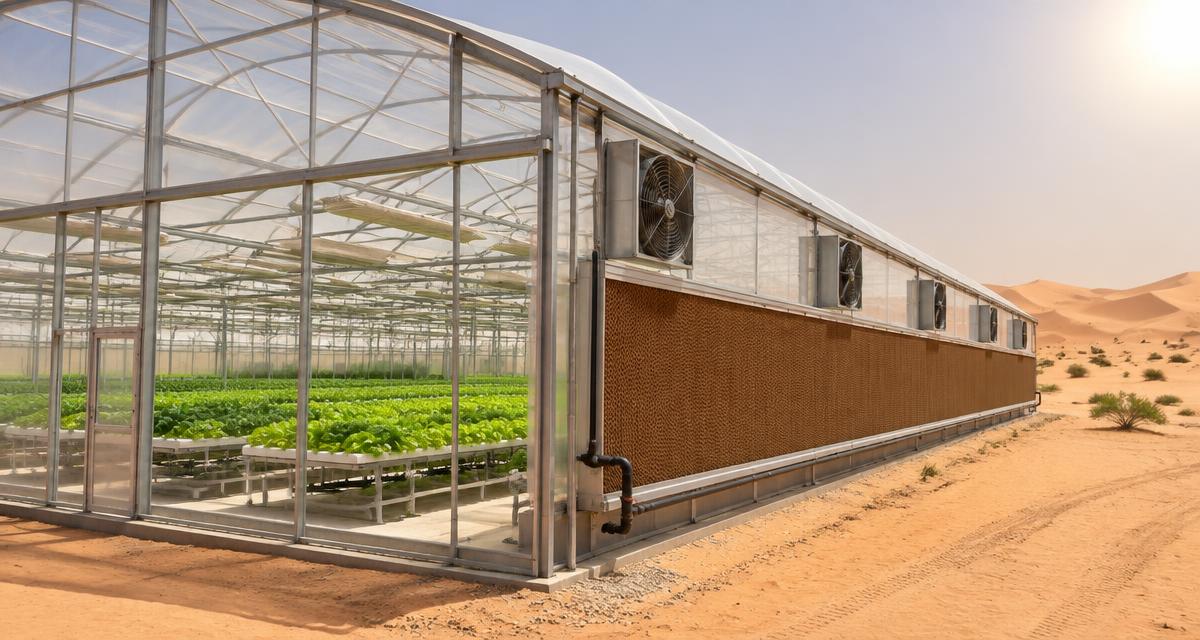
It can, but its effectiveness depends heavily on humidity: coastal sites with high humidity get less cooling benefit from evaporative systems than drier inland sites. Ask suppliers to design and justify pad sizing against your specific site's dry-bulb and wet-bulb conditions rather than a generic regional figure.
Key takeaways
- Short answer: A UAE greenhouse cooling and climate-automation RFQ should name the cooling approach you want suppliers to price against, state the water quality and volume available for that approach, describe the dust and filtration…
- Who this guide is for: This guide is for commercial growers, investors, project managers and public-sector buyers in the UAE who are procuring greenhouse cooling and climate-control automation for a new facility, an expansion or a retrofit of…
- Local context to put in the RFQ, qualitatively: UAE sites differ enough in climate that the RFQ should describe the specific location rather than relying on a generic "UAE" label.
- Compare cooling approaches as RFQ questions, not as a single choice: Rather than asking suppliers for "the best cooling system," ask each one to answer the same set of questions about the approach they propose, so that the trade-offs are visible rather than hidden behind a brand name.
- Sensor and control scope to specify: Climate automation should be specified by what it must achieve and report, not by a controller brand.
Short answer
A UAE greenhouse cooling and climate-automation RFQ should name the cooling approach you want suppliers to price against, state the water quality and volume available for that approach, describe the dust and filtration conditions on site, and set out the control, commissioning and service scope the supplier must deliver. UAE summers combine very high air temperatures with high coastal humidity for much of the year and drier heat inland, which limits how far evaporative cooling alone can take a crop and pushes many commercial projects toward hybrid or mechanical-assisted strategies. Writing these constraints into the RFQ, rather than leaving them for the supplier to assume, is what makes proposals comparable and keeps the eventual system matched to the actual site climate.
Who this guide is for
This guide is for commercial growers, investors, project managers and public-sector buyers in the UAE who are procuring greenhouse cooling and climate-control automation for a new facility, an expansion or a retrofit of an underperforming structure. It assumes the greenhouse structure, screens, irrigation and energy supply are being procured separately or as part of a wider package, and that cooling and climate automation are being specified as a defined scope within that package. It does not replace a horticultural adviser, mechanical engineer or controls specialist; it helps you brief them and your suppliers on a consistent basis so that quotations can be compared fairly.
Local context to put in the RFQ, qualitatively
UAE sites differ enough in climate that the RFQ should describe the specific location rather than relying on a generic "UAE" label. Coastal sites in Abu Dhabi, Dubai, Sharjah and the other emirates often combine high temperature with high relative humidity for extended periods, particularly in summer, which reduces the cooling effect that pad-and-fan or fogging systems can deliver because evaporative cooling depends on a dry-bulb to wet-bulb gap that narrows as humidity rises. Inland and desert sites tend to run hotter and drier, where evaporative cooling is more effective but dust and sand loading on filters, pads and sensors is a bigger operational issue. State in the RFQ which pattern applies to your site, and ask suppliers to confirm their proposed cooling approach was selected with that pattern in mind rather than a standard regional assumption.
Water for cooling is a second local constraint worth stating explicitly. Much of the UAE depends on desalinated water, with brackish groundwater available in some inland locations; neither is automatically suitable for continuous use in pad-and-fan or high-pressure fogging systems without a stated water-quality basis, because mineral content, hardness and any treatment chemistry affect pad clogging, nozzle fouling and scale build-up on cooling surfaces over time. Rather than asking the RFQ to solve water chemistry, require suppliers to state the water-quality assumptions behind their design and the treatment they expect you to provide upstream of their equipment. Dust and sand are a third local factor: ask suppliers how their intake filtration, pad protection and sensor housings are designed for a dusty environment, and how often those components need cleaning or replacement under local conditions.
Energy availability and backup power are part of the same local picture. Cooling and climate-control loads in the UAE run for long hours across much of the year, so the RFQ should state the electrical supply capacity at the site, whether backup generation or uninterruptible power is required for the control loop and critical pumps, and how the proposed cooling approach is expected to behave during a power interruption in peak summer. At the federal level, the Ministry of Climate Change and Environment (MOCCAE) sets national agricultural and environmental policy; in Abu Dhabi, the Abu Dhabi Agriculture and Food Safety Authority (ADAFSA) is the relevant local authority for agricultural licensing and support. Confirm current requirements directly with the applicable authority for your emirate before finalising scope, since requirements can differ by emirate and by project type.
Compare cooling approaches as RFQ questions, not as a single choice
Rather than asking suppliers for "the best cooling system," ask each one to answer the same set of questions about the approach they propose, so that the trade-offs are visible rather than hidden behind a brand name.
- Pad-and-fan evaporative cooling: Ask what dry-bulb and wet-bulb design conditions the pad sizing is based on, how the proposal accounts for the humidity pattern at your site, what water quality it assumes, and how pad life and cleaning frequency are expected to behave locally.
- High-pressure fogging: Ask what droplet size and water-treatment standard the nozzles require to avoid fouling, how the system avoids leaf wetness or disease risk for your crop, and what happens to cooling performance as ambient humidity rises during the day.
- Mechanical or hybrid cooling: Ask what share of cooling load the mechanical component is expected to carry during the most humid summer periods, how it is sequenced with evaporative stages, and what the incremental energy use is expected to be compared with evaporative-only cooling.
- Semi-closed or closed greenhouse concepts: Ask what ventilation, dehumidification and CO2 strategy is proposed, how the concept performs during grid interruptions, and what additional commissioning and training this concept requires compared with an open or naturally ventilated structure.
For every approach, ask the supplier to state the assumptions behind any cooling performance claim and to confirm in writing which conditions (season, time of day, humidity band) the claim applies to, rather than quoting a single average figure.
Sensor and control scope to specify
Climate automation should be specified by what it must achieve and report, not by a controller brand. List the measurements you require: internal air temperature and humidity or vapour pressure deficit by compartment, outside weather conditions including humidity and wind, CO2 where relevant, pad or fogging water pressure and flow, and energy consumption of major cooling loads. State who owns the data, how it can be exported, and what happens to control if connectivity or a subscription lapses. Ask how the controller sequences cooling stages (screens, vents, pad-and-fan, fogging, mechanical assist) and how it is expected to behave during a dust storm, a humidity spike or a power interruption. For a fuller specification approach to climate controllers and IoT integration, see our guide on greenhouse climate control and IoT RFQ scope, which applies beyond the UAE but covers the same questions in more depth.
Water treatment for cooling, as an RFQ item
Water treatment for cooling equipment is frequently left undefined until problems appear in the first hot season. The RFQ should ask each supplier to state the water-quality range their pads, nozzles and heat-exchange surfaces are designed for, what pre-treatment (filtration, softening or other conditioning) they assume is in place before water reaches their equipment, and who is responsible for supplying and maintaining that pre-treatment. If you intend to use desalinated or brackish water, say so in the RFQ and ask for a written statement of any additional treatment the supplier recommends and its expected effect on pad or nozzle life. The crop water requirement calculator can help frame overall water demand across irrigation and cooling, but treat its output as a planning estimate to confirm locally; cooling-water quality still needs a dedicated assessment rather than being inferred from irrigation figures.
Commissioning in peak season
A cooling system that is commissioned in a mild month can still fail its first real test in peak summer. Ask suppliers to include a peak-season verification step in the commissioning plan, where cooling performance, humidity control and power behaviour are checked under conditions close to the worst case the site will see. Define acceptance criteria as a list of tests rather than a date: pad or nozzle performance checks, sensor accuracy against a calibrated reference, control-sequence tests across the full range of cooling stages, and a documented response to a simulated power interruption. Agree who witnesses each test, how results are recorded, and how any shortfall against the stated design basis is resolved before final payment.
Service and spares after handover
Cooling equipment that runs for long hours across most of the year wears components faster than equivalent systems in milder climates. The RFQ should ask each supplier to state the expected service interval for pads, nozzles, filters and pumps under local conditions, what spare parts are recommended to hold on site, the lead time to obtain further spares, and the response time for emergency service during peak summer. Ask whether local service technicians are available in the UAE or whether support depends on remote diagnosis and occasional visits from elsewhere, since a cooling failure during a heat event can affect the crop within hours.
One scope comparison table
Send the same table to every supplier and treat blank cells as exclusions until the supplier confirms otherwise in writing.
| Scope item | What to ask every supplier | Red flag in a proposal |
|---|---|---|
| Cooling approach | Design basis (dry-bulb/wet-bulb or equivalent) and how it matches your site humidity pattern | A single approach offered with no site-specific justification |
| Water quality | Water-quality range assumed, pre-treatment required, who supplies it | No water-quality assumption stated |
| Dust and filtration | Intake filtration design, pad protection, cleaning frequency for local dust | Standard filtration with no reference to local dust loading |
| Sensors and control | Measurements, data ownership, export format, behaviour during dust or power events | Features listed without site-specific control logic |
| Energy and backup | Power draw of cooling loads, backup/UPS scope, behaviour on grid interruption | Energy use omitted or backup responsibility undefined |
| Commissioning | Peak-season verification tests and acceptance criteria | "Startup included" with no listed tests |
| Service and spares | Local service availability, spare-parts list, response times | Service described only as "available on request" |
Supplier questions worth asking directly
- Which of our site's conditions (coastal humidity or inland dry heat and dust) did you design this proposal for, and what would you change if the site profile were different?
- What water quality does your system require, and what happens to performance and component life if that quality is not met?
- How does your proposed system perform during a multi-day humidity spike, and what is the fallback if evaporative cooling cannot hold target conditions?
- What is your commissioning plan for verifying performance in peak summer rather than only at handover?
- Who provides service and spare parts locally, and what is your response time during a cooling failure in summer?
Common mistakes
- Asking for "the best cooling system" instead of specifying the site's humidity, dust and water conditions and letting suppliers respond to them.
- Accepting an evaporative-cooling performance claim without the humidity conditions it was calculated for.
- Leaving cooling-water quality and pre-treatment responsibility undefined until pads or nozzles start failing.
- Treating standard filtration as adequate without checking it against local dust conditions.
- Commissioning only in a mild month and discovering gaps in the first real heat event.
- Comparing purchase prices without comparing local service availability and spare-parts lead time.
Planning-level cost notes
Costs for greenhouse cooling and climate-automation packages in the UAE vary widely with structure type, cooling approach, control scope and site conditions, and any figure quoted here would be an estimate rather than a project number. Treat early budget figures, whether expressed in AED or USD, as planning estimates to verify with local suppliers and your own site conditions, not as a quotation. The greenhouse cooling calculator, greenhouse climate calculator and greenhouse lifecycle cost calculator can help frame assumptions before you approach suppliers, but their outputs are indicative only.
Next step
If you are still defining the wider facility, our guides on greenhouses in the UAE and controlled environment agriculture in the UAE cover the broader project context, and the drip irrigation in the UAE guide covers the related irrigation scope. If financing is part of the plan, see agricultural import finance in the UAE. Once the cooling approach, water basis and control scope are written down, turn them into a structured request with the greenhouse RFQ or the RFQ builder. For projects from USD 250,000, SeedMatchGroup is a human-led commercial agriculture platform supported by proprietary technology. A sourcing specialist reviews every brief before any manual supplier outreach. SeedMatchGroup is not a manufacturer, seed company, engineering contractor, lender, certification body or open marketplace, and it does not guarantee quotations, timing, prices or project outcomes.
Sources and further reading
Official context: UAE Ministry of Climate Change and Environment (MOCCAE); Abu Dhabi Agriculture and Food Safety Authority (ADAFSA); FAO, Good Agricultural Practices for greenhouse vegetable crops. Industry reading on greenhouse climate and cooling questions: Priva horticulture blog. These resources do not endorse SeedMatchGroup, and SeedMatchGroup has no affiliation with them.
Turn "UAE Greenhouse Cooling and Climate Automation RFQ: Pad-and-Fan, Fogging, Water Use and Control Scope" into your RFQ
Answer a few questions and we will draft a structured RFQ you can review, edit and submit to our independent supplier network.
Frequently asked questions
- Does pad-and-fan cooling work well in the UAE?
- It can, but its effectiveness depends heavily on humidity: coastal sites with high humidity get less cooling benefit from evaporative systems than drier inland sites. Ask suppliers to design and justify pad sizing against your specific site's dry-bulb and wet-bulb conditions rather than a generic regional figure.
- What water quality do I need for fogging or pad-and-fan systems in the UAE?
- It depends on the equipment and whether you plan to use desalinated or brackish water. Ask each supplier to state the water-quality range their system is designed for and what pre-treatment they assume, rather than assuming any available water source is automatically suitable.
- Should I specify a single cooling technology in the RFQ?
- Usually not. Describe your site's humidity pattern, dust conditions and water quality, and ask suppliers to propose and justify the cooling approach they recommend, so that different technologies can be compared on the same basis.
- When should a UAE greenhouse cooling system be commissioned?
- Commissioning should include a peak-season verification step, not only a handover test in a mild month. Ask suppliers to include acceptance tests under conditions close to the worst case your site will experience in summer.
- Can SeedMatchGroup guarantee greenhouse cooling quotations in the UAE?
- No. SeedMatchGroup reviews eligible briefs from USD 250,000 and handles supplier outreach manually, but it does not guarantee quotations, pricing, timing or project outcomes.
Move from reading to sourcing
The pages below carry the commercial detail for this topic — cost ranges, supplier verification, specification checklists and financing routes.