
Greenhouse Cooling System Costs: Pad-and-Fan, Fogging and Ventilation — What Drives the Price
There is no single published price for a greenhouse cooling system. This guide explains, without quoting a figure we cannot stand behind, what actually drives the cost of pad-and-fan, high-pressure fogging and natural ventilation systems — design climate, airflow rate, pad area, fan count, water supply and quality, electricity tariff, controls, shading and ongoing operating costs — and how to size a defensible scope before asking suppliers to quote.
What does a greenhouse cooling system cost?
There is no reliable single figure. Cost depends on design climate, target inside temperature, airflow rate, pad area or fogging specification, fan count, water supply and quality, and electricity tariff. The only published reference is that climate control, heating and screens together represent roughly 10–20% of structure CAPEX, and that figure covers heating as well as cooling.
Key takeaways
- Why there is no single cooling price to quote: Cooling cost scales with heat load, and heat load is a function of climate, cover material, shading strategy and target inside temperature — none of which are the same from one project to the next.
- What is actually published, and what it does not tell you: The published [commercial greenhouse cost](/commercial-greenhouse-cost) overview breaks CAPEX down by sub-system as a share of total structure cost.
- Comparison: cooling and ventilation strategies, and what drives their cost: The table below compares the three broad cooling and ventilation strategies referenced in SeedMatchGroup's planning tools by the factors that drive their cost and performance — not by price, since none of these strategi…
- Cost driver one: design climate and target inside temperature: The single largest lever on cooling cost is the gap between the outside design condition — not the annual average, but the peak design dry-bulb temperature and relative humidity for the site — and the inside temperature…
- Cost driver two: airflow rate and air changes per hour: Airflow is typically specified either as a volumetric rate per square metre of floor area or as air changes per hour relative to the house volume.
There is no reliable published price range for a commercial greenhouse cooling system, and any number quoted without a defined scope should be treated with suspicion. Cooling cost depends on the design climate at the site, the airflow rate required to hold a target inside temperature, the cooling pad area and fan count that airflow implies, water supply and water quality, local electricity tariffs, the sophistication of the control system, and how much shading or screening is already built into the structure. SeedMatchGroup does not publish a standalone cooling price because the published greenhouse cost benchmark only breaks the CAPEX down by sub-system share, not by cooling technology; the only figure SeedMatchGroup can point to with any confidence is that climate control, heating and screens together represent roughly 10–20% of structure CAPEX across the technology tiers in the published commercial greenhouse cost table — and that figure covers heating as well as cooling, so it cannot be read as a cooling-only number.
Why there is no single cooling price to quote
Cooling cost scales with heat load, and heat load is a function of climate, cover material, shading strategy and target inside temperature — none of which are the same from one project to the next. A 2-hectare house in a dry, hot climate with a demanding 28°C inside target carries a sensible heat load that can be several times larger than the same structure in a cooler, more humid climate with a less aggressive target. Because the heat load drives the required airflow, and the airflow drives fan count and pad area, two greenhouses of identical floor area can require entirely different cooling installations. Any price quoted before these variables are fixed is, at best, a guess, and at worst, a number designed to win attention rather than describe a real system. This is also why this guide does not state a price per square metre or a total project figure for cooling: doing so without a defined climate, airflow target and strategy would be misleading rather than informative.
What is actually published, and what it does not tell you
The published commercial greenhouse cost overview breaks CAPEX down by sub-system as a share of total structure cost. In that breakdown, climate control, heating and screens together account for roughly 10–20% of structure CAPEX, with a typical cost-per-square-metre range from mid-tech to high-tech installations reflecting design outside temperature and control tier as the biggest swing factor. That figure is a SeedMatchGroup indicative share drawn from the published benchmark table, not a cooling-specific quotation, and it bundles heating equipment, cooling equipment and thermal or shade screens into a single band. A project in a cold continental climate may spend most of that share on heating and insulation screens with comparatively little on cooling; a project in a hot arid climate may invert that allocation entirely toward pad-and-fan or fogging hardware, water treatment and shading. Reading the 10–20% figure as a cooling-only number, or extrapolating a per-square-metre cooling price from it, would misstate what the benchmark actually measures.
Comparison: cooling and ventilation strategies, and what drives their cost
The table below compares the three broad cooling and ventilation strategies referenced in SeedMatchGroup's planning tools by the factors that drive their cost and performance — not by price, since none of these strategies has a fixed cost outside a defined scope.
| Strategy | Works best when | Primary cost drivers | Typical limitation |
|---|---|---|---|
| Natural ventilation + shading | Outside design temperature stays below roughly 30°C; moderate heat load | Vent area relative to floor area, shade screen specification, actuator and control count | Limited cooling capacity in hot or still-air conditions; depends on wind and stack effect |
| High-pressure fogging + ventilation | Mixed climates with workable roof ventilation; moderate-to-high humidity tolerance | Fog line length and nozzle count, water filtration and pressure pump capacity, roof vent area | Limited evaporative gain in humid climates; fine water quality and filtration requirements |
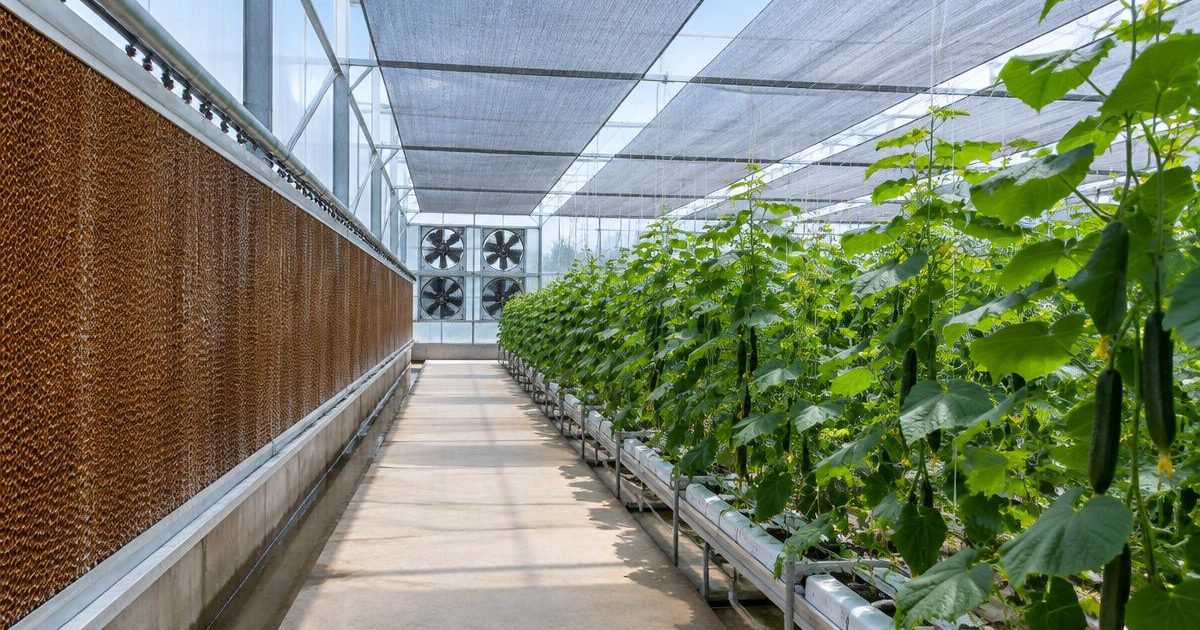
| Pad-and-fan (evaporative) | Hot, dry climates where wet-bulb depression is large | Pad face area, exhaust fan count and static pressure, water reservoir and bleed-off, closed-side construction | Evaporative capacity drops sharply as outside humidity rises; constant water and pad maintenance demand |
Cost driver one: design climate and target inside temperature
The single largest lever on cooling cost is the gap between the outside design condition — not the annual average, but the peak design dry-bulb temperature and relative humidity for the site — and the inside temperature the crop requires. A smaller allowable temperature rise between inlet and exhaust air multiplies the airflow requirement, and airflow is the variable that drives almost everything downstream: fan count, pad area, duct or vent sizing, and installed electrical load. Humidity matters as much as temperature for evaporative strategies, because the achievable cooling from a pad or fog system depends on the wet-bulb depression — the gap between dry-bulb and wet-bulb temperature — which shrinks in humid climates and can make evaporative cooling largely ineffective regardless of how much hardware is installed.
Cost driver two: airflow rate and air changes per hour
Airflow is typically specified either as a volumetric rate per square metre of floor area or as air changes per hour relative to the house volume. A higher design airflow rate directly increases the number and size of exhaust fans, the duct or opening area needed to move that air without excessive static pressure loss, and the installed electrical load. Airflow requirements are not arbitrary: they should be derived from the sensible heat load calculation for the specific site and cover material, not copied from a different project's specification, because a structure with higher cover transmission or less shading can require a materially different airflow rate to hold the same inside temperature.
Cost driver three: cooling pad area and fan count
For pad-and-fan systems, pad face area is sized to keep air velocity through the pad within the range the pad media is rated for; undersizing the pad area for a given airflow increases pressure loss and reduces cooling effectiveness, while oversizing adds cost without proportional benefit. Fan count follows directly from total airflow divided by the rated capacity of each fan at its actual working static pressure, which is influenced by insect screening, duct runs and house layout. Both pad area and fan count scale with the airflow decisions above, so an error in the airflow calculation propagates directly into equipment count and cost.
Cost driver four: water supply and water quality
Evaporative cooling consumes water continuously during operation, and the water supply must cover both the evaporated volume and the bleed-off needed to manage mineral concentration in recirculating pad systems. Water quality has a direct cost implication: high mineral content water scales pad media faster, requires more frequent bleed-off and media replacement, and may need pre-treatment before it reaches the cooling system. Fogging systems are typically more sensitive to water quality than pad systems because fine nozzles clog readily with particulate or scale, which pushes filtration and water-treatment requirements — and their cost — higher than a buyer might initially expect.
Cost driver five: electricity tariff and installed power
Fan and pump power is a direct function of total airflow and pressure, and the annual running cost of that installed power depends on the local electricity tariff and the number of hours per year the system runs at meaningful duty. A site with a high electricity tariff and a long cooling season faces a materially different total cost of ownership than an identical installation in a location with cheap power and a short cooling season, even though the capital cost of the equipment itself may be similar. This is an operating expense consideration as much as a capital one, and it belongs in the same budget conversation as the equipment itself.
Cost driver six: controls, shading and screens
A climate computer that sequences ventilation, cooling and screening automatically against sensors costs more than a manually staged system, but it typically reduces energy waste and protects crop consistency, which matters most where the crop has a narrow tolerance band. Shade and thermal screens interact directly with cooling load: a well-specified shading strategy reduces the sensible heat load the cooling system must remove in the first place, which can lower both the capital cost of fans and pads and the ongoing electricity and water cost of running them. Decisions about control sophistication and screen specification should therefore be made before cooling equipment is sized, not after, because they change the load the equipment needs to handle.
Operating costs, not just capital cost
A cooling system's total cost of ownership includes water consumption, electricity consumption, pad or fog nozzle maintenance and replacement, and labour for routine upkeep, in addition to the installed equipment cost. Evaporative systems in particular carry a continuous water and maintenance burden that a purely capital-focused comparison between suppliers can miss entirely. When comparing quotations, buyers should ask for both the installed cost and an estimate of annual operating cost at the design airflow and local electricity tariff, since a lower capital price with materially higher running costs may not be the better long-term choice.
Use the calculators
The Greenhouse Cooling & Ventilation Calculator takes your covered area, peak solar radiation, outside design temperature and humidity, target inside temperature, shading and cover transmission, and your intended strategy — natural ventilation, fogging, pad-and-fan or semi-closed — and returns a sensible heat load, required airflow, indicative fan count, pad area where relevant, evaporative water use, installed cooling power and estimated annual electricity cost at your tariff. The Pad-and-Fan Sizing Calculator goes deeper on evaporative design specifically: enter floor area, design airflow per square metre, outside dry-bulb and wet-bulb temperature, pad saturation efficiency, fan capacity and pad face velocity, and it returns total exhaust airflow, the number of fans required, cooling pad face area, the air temperature leaving the pad, and hourly and daily pad evaporation. Both tools are planning instruments, not engineering design and not a quotation; they exist to help a buyer arrive at a defensible scope — airflow, fan count, pad area, water demand and installed power — before approaching suppliers, so that quotations received back can be compared against the same numbers rather than against vague verbal assumptions.
Checklist before requesting cooling quotations
Confirm the peak outside design temperature and relative humidity for the specific site, not a regional average. Define the target inside temperature and the crop's tolerance for excursions above it. Decide on a cooling and ventilation strategy — natural, fogging, pad-and-fan or semi-closed — appropriate to the climate, then run the airflow and equipment sizing through the calculators above. Confirm water supply volume and get a water quality analysis before specifying pad or fog equipment. Establish the local electricity tariff and expected annual cooling hours to estimate operating cost alongside capital cost. Decide on shading and screen specification before finalising fan and pad sizing, since shading changes the load. Write all of this into a single scope document so every supplier quotes against the same numbers.
Common mistakes
Asking for a cooling system price before defining the design climate, target temperature and strategy, which forces suppliers to guess or quote conservatively. Copying an airflow rate or fan count from a different project without recalculating for local climate, cover transmission and shading. Specifying pad-and-fan for a humid climate where the achievable wet-bulb depression is too small to deliver meaningful cooling. Ignoring water quality until after pad or fog equipment has been ordered, then discovering scaling or clogging problems in operation. Comparing capital cost across supplier quotations without also comparing estimated annual water and electricity cost at the same design conditions. Finalising fan and pad sizing before shading and screen decisions are locked, which often forces expensive rework.
How SeedMatchGroup helps
Once a cooling and ventilation scope is defined using the calculators above and benchmarked against the published commercial greenhouse cost CAPEX shares, that scope is carried into a structured RFQ describing the design climate, target inside temperature, chosen strategy, airflow, fan count, pad area or fog specification, water supply and quality basis, and electrical tariff assumptions — the same structured process described on the agricultural project workflow page. Nothing is sent to suppliers on submission: a sourcing specialist reviews every brief manually and may come back for missing details, such as an unconfirmed water quality analysis or an unresolved shading decision, before anything proceeds further. Allocation to suppliers is manual and discretionary, considering scope, crop, country, budget, timeline, technical fit and export capability where relevant; there is no automatic matching. Supplier identities are kept private and all communication runs through SeedMatchGroup. Where multiple proposals are returned, they are normalised onto the same airflow, fan count and water-quality basis before being compared, since cooling quotations are especially prone to differing assumptions about design climate and duty hours. Commercial projects are generally considered from USD 250,000. There is no guaranteed number of quotations, no guaranteed response time, no guaranteed price, no guaranteed financing and no guaranteed award; full allocation terms are set out in the terms of use. The RFQ builder, the commercial greenhouse RFQ template and the broader agricultural tools library can help structure the scope document before submission.
Sources and further reading
For general factual context on greenhouse climate control and protected-agriculture infrastructure, see FAO, Good Agricultural Practices for Greenhouse Vegetable Crops and Penn State Extension. These public resources do not endorse SeedMatchGroup.
Turn "Greenhouse Cooling System Costs: Pad-and-Fan, Fogging and Ventilation — What Drives the Price" into your RFQ
Answer a few questions and we will draft a structured RFQ you can review, edit and submit to our independent supplier network.
Frequently asked questions
- What does a greenhouse cooling system cost?
- There is no reliable single figure. Cost depends on design climate, target inside temperature, airflow rate, pad area or fogging specification, fan count, water supply and quality, and electricity tariff. The only published reference is that climate control, heating and screens together represent roughly 10–20% of structure CAPEX, and that figure covers heating as well as cooling.
- Is pad-and-fan or fogging cheaper to install and run?
- It depends on climate. Pad-and-fan performs best and is often more cost-effective in hot, dry climates with a large wet-bulb depression. Fogging suits mixed climates with workable roof ventilation. Neither has a fixed price; both require airflow and water-quality sizing specific to the site.
- Why does humidity matter so much for cooling cost?
- Evaporative cooling, whether pad-and-fan or fogging, can only bring air temperature toward the outside wet-bulb temperature. In humid climates the gap between dry-bulb and wet-bulb temperature is small, so evaporative cooling delivers little benefit regardless of how much equipment is installed, which can make a different strategy more cost-effective.
- What should I calculate before asking suppliers to quote a cooling system?
- Sensible heat load, required airflow, fan count, pad area or fog specification, and evaporative water demand, derived from your actual site climate rather than copied from another project. The greenhouse cooling and pad-and-fan sizing calculators can produce these planning figures before you write the RFQ.
- Does a lower capital price mean a better cooling system?
- Not necessarily. Water, electricity and maintenance costs accumulate over the system's operating life and can outweigh a lower upfront price. Compare estimated annual operating cost at the same design conditions alongside the installed capital cost before deciding between supplier quotations.
Move from reading to sourcing
The pages below carry the commercial detail for this topic — cost ranges, supplier verification, specification checklists and financing routes.