
Protected Agriculture · Project Center
Commercial Greenhouse Project Center
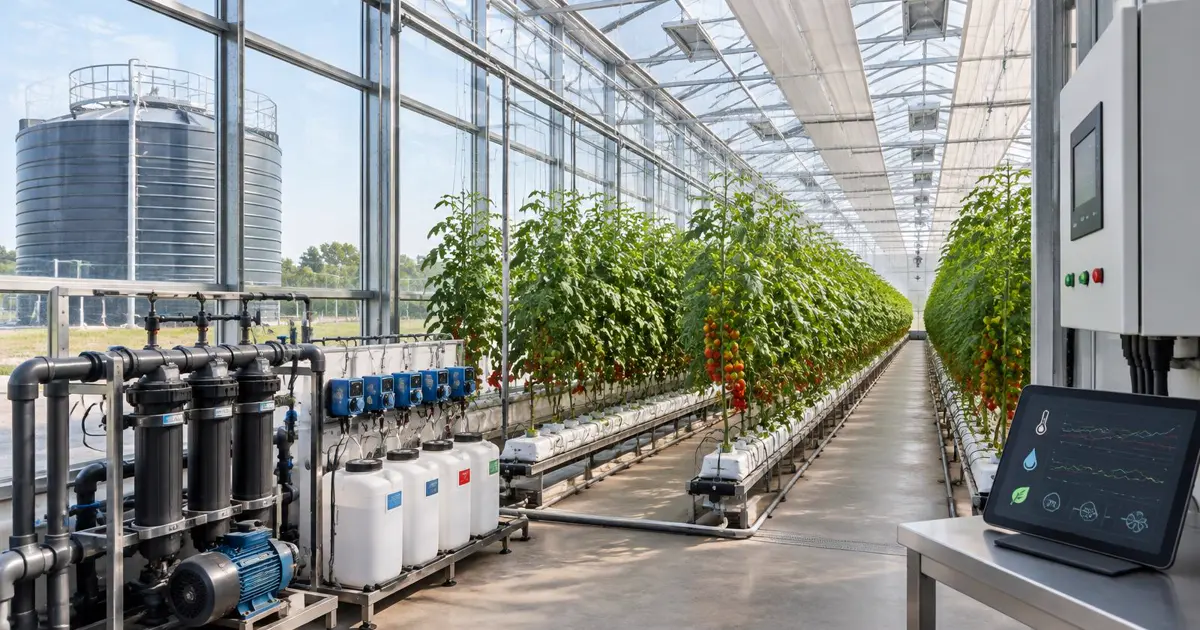
Plan commercial greenhouse design and equipment around your crop, site, growing area, water and energy supply. Compare structure, climate control, irrigation and budget scenarios, then prepare a private project RFQ for review by a sourcing specialist.
- USD 250K+ Projects
- Supplier-Neutral
- Human-Reviewed
- Global Sourcing
Human-led procurement support starts at USD 250,000. Free tools support earlier planning; calculations are not quotations or engineering approval. SeedMatchGroup does not manufacture or hold equipment, and supplier communications remain confidential.
What is the Commercial Greenhouse Project Center?
A planning hub for commercial greenhouse growers, investors and project teams. Start with crop, site, area in m² or hectares, water quality, energy supply and budget. Use the guides and calculators to scope structure, climate control, irrigation and operating costs, then prepare a private RFQ for human review. Planning results are not engineering approvals or supplier quotations.
Straight answers for project buyers
Short, direct answers to the questions commercial growers, developers and EPC contractors ask before issuing an RFQ. A dedicated sourcing specialist — not an automated form — works through your brief with you.
What is included in a turnkey greenhouse project?
A turnkey commercial greenhouse project typically covers the structure and covering, foundations, ventilation, cooling and heating, thermal and shade screens, irrigation and fertigation, water treatment and pumping, hydroponic or substrate systems where used, electrical infrastructure, climate and irrigation automation, freight, installation, commissioning and grower training. Not every supplier delivers every component — many strong manufacturers cover structure and climate only, with irrigation, fertigation and controls sourced separately.
Can SeedMatch source a complete greenhouse project?
Yes. SeedMatch works from your project brief — crop, climate, area, production target and automation level — and identifies suitable international suppliers for the structure and for each system package. You receive comparable offers on a common scope instead of proposals that cannot be compared. Commercial negotiation stays with you; supplier identities and pricing are released through the RFQ workflow.
How do I choose a greenhouse supplier?
Compare suppliers on climate-specific engineering references, structural certification for local wind and snow loads, the systems they actually deliver in-house, spare-parts and service coverage in your country, installation and commissioning responsibility, documentation quality, and payment and delivery terms. A supplier with strong references in your climate zone and crop is usually a lower project risk than the lowest quoted price.
What information is required to quote a greenhouse project?
Suppliers need location and climate extremes, greenhouse area and phasing, crop and production target, water source and water analysis, growing method, required cooling and heating, automation level, energy source, and site conditions. Without this, quotes arrive on different scopes and cannot be compared. The checklist below is the minimum set for a serious commercial RFQ.
The ten planning pillars
Review these ten planning areas against your project's stage, site evidence and procurement scope.
Feasibility, crop-market fit, site selection and design brief before any supplier contact.
Indicative CAPEX by structure type, area and automation level with the CAPEX calculator.
Structure, climate, irrigation, fertigation, screens, lighting and controls scoped as one system.
Prepare evidence and comparison criteria for manufacturers, integrators and EPCs; sourcing is reviewed and managed privately.
Trade finance, project finance, equipment leasing and green credit lines for greenhouse CAPEX.
Record permitting, engineering, procurement and commissioning dependencies; confirm dates with the responsible parties.
Climate, market, technical, supply-chain and financing risks — with a working risk register.
Design phase 1 so phase 2 and 3 plug in without stranded CAPEX or utility bottlenecks.
Energy, water, labour, inputs and depreciation — modelled per m² and per kg of crop.
Compare project returns using your investment, revenue and operating-cost assumptions; no payback is guaranteed.
Decision guides
Neutral comparisons of the choices that most affect CAPEX, OPEX and yield. Use these before writing your specification.
Light transmission, thermal performance, hail resistance and 20-year cost of ownership.
When a high-tech Venlo pays back and when a multi-span tunnel is the right answer.
Roof ventilation, pad-and-fan and fogging compared by climate zone and crop.
Photon efficacy, heat load, CAPEX and electricity cost over a 10-year horizon.
Yield, water use, labour and market fit for tomato, cucumber, pepper and leafy greens.
Channel flow or deep water — commercial leafy-green yield, energy and risk compared.
Fuel cost, CO₂ enrichment, ESG scorecards and green-finance eligibility.
Landed cost, spare parts, service SLA and financing — a neutral sourcing framework.
Entry, Professional and Enterprise automation — matched to crop value and labour cost.
Calculators & templates
Compare indicative planning scenarios using each tool's stated inputs and assumptions, then carry relevant figures into your project brief.
Estimate greenhouse + irrigation CAPEX by area, structure and automation level.
Calculate annual production and revenue from your own yield, area and cost assumptions.
Convert hectares, acres, m², ft², dunams and feddans; estimate planted capacity.
25-year model comparing diesel, grid and solar-hybrid greenhouse energy systems.
Flow, head and power sizing for greenhouse irrigation and fertigation.
Seeding rate, density, sowing window, irrigation demand and budget — per crop.
Turnkey specification, budget and RFQ preset for a commercial tomato greenhouse.
Structure, climate, fertigation and yield model for a cucumber project.
CAPEX, equipment and climate-control breakdowns for a sweet pepper greenhouse project.
Interactive planners
Planning tools for reviewing scope, assumptions and missing evidence before preparing a project request. Outputs require professional validation.
Review existing systems and prepare a phased modernization scope; validate costs and outcomes against site evidence.
Score your project across land, water, energy, off-take, equity and timeline. Structured gap analysis — no yield or IRR promises.
Select planned systems and get integration risks, engineering-review flags, install sequence and RFQ structure. Never a brand recommendation.
Compare upgrade scenarios using explicit investment and operating assumptions; estimates are not verified savings.
Where to go next
Record crop, site, area, systems, budget and schedule for a sourcing specialist to review.
Prepare crop-specific input quantities from agronomist-approved rates, water analysis and product specifications; keep recurring supply separate from equipment CAPEX.
Review country-specific climate, crop, regulatory and financing considerations; confirm requirements locally.
Trade finance, leasing and project finance routes for greenhouse CAPEX.
Step-by-step guide to grants, DFI funding, ECA finance and commercial loans for greenhouse projects.
Market intelligence for greenhouse projects
Recorded daily briefs from official sources and country reports with greenhouse market, structure and procurement sections. Reports are research context, not supplier quotations.
Dated, source-linked updates on greenhouse inputs, climate systems, trade and regulation, with buyer implications.
Typologies, investment drivers and procurement considerations across markets.
High-tech glasshouse market, suppliers' home base and export procurement.
Export horticulture and tunnel greenhouse investment.
Protected horticulture and greenhouse automation.
Food-security greenhouse programmes and cooling-driven design.
Greenhouse expansion, export ambitions and financing context.
Protected cultivation growth and project procurement.
Project scale context
Exact design depends on crop, climate, wind and snow loads, temperature and humidity extremes, water quality, production target, automation level and local infrastructure. The figures below are scale context for scoping an RFQ, not a specification.
| Project size | What typically changes at this scale |
|---|---|
| 1 hectare | Entry commercial scale. Usually single crop, one climate zone, semi-automatic fertigation, natural or fan ventilation depending on climate. |
| 5 hectares | Multi-zone climate control, dedicated fertigation room, dedicated pumping and filtration, packhouse and cold chain become part of scope. |
| 10 hectares | High-tech specification is usually justified: climate computer, thermal screens, recirculating hydroponics, water treatment and disinfection. |
| 20+ hectares | Phased construction, EPC-style contracting, on-site energy, labour housing and logistics infrastructure enter the project plan. |
RFQ readiness — what suppliers need from you
Quotations are only comparable when every supplier answers the same brief. Have these points ready and the first round of offers arrives on one scope. Anything you do not have yet, a sourcing specialist will work through with you.
- Country and project location (nearest town, altitude, port of entry)
- Greenhouse area in m² or hectares, and whether it is phased
- Crop or crops, and production target (kg/m²/year or stems/m²/year)
- Climate data: minimum and maximum outside temperature, humidity, wind, solar radiation
- Water source, available volume and water analysis (EC, pH, sodium, chloride, bicarbonate)
- Growing method: soil, substrate/hydroponic or a mix
- Required automation level: manual, semi-automatic or fully computer-controlled
- Cooling and heating requirement, and available energy source
- Greenfield site or expansion / retrofit of an existing project
- Indicative budget band and target timeline
Related systems in this project cluster
Commercial projects are specified as one package. These pages cover the systems most often quoted alongside this one.
Turnkey project scope: structure, climate, fertigation and commissioning.
Greenhouse climate control systemsCooling, ventilation, heating, humidity, CO₂ and screens.
Irrigation centerDrip lines, filtration, dosing, pumping and irrigation automation.
Fertigation systemsDosing units, EC/pH control and nutrient injection.
Industrial agricultural pumpsBooster and pumping stations, filtration and reservoir design.
Commercial greenhouse costWhat actually drives greenhouse CAPEX per hectare.
Frequently asked questions
A planning hub for commercial greenhouse growers, investors and project teams. Start with crop, site, area in m² or hectares, water quality, energy supply and budget. Use the guides and calculators to scope structure, climate control, irrigation and operating costs, then prepare a private RFQ for human review. Planning results are not engineering approvals or supplier quotations.
SeedMatchGroup does not manufacture or hold greenhouse equipment. A sourcing specialist reviews your project and manages any subsequent supplier communications privately. Available quotations are assessed against your scope; supplier participation, availability and results are not guaranteed.
Commercial growers scaling up, agri-investors evaluating a first greenhouse, EPC contractors packaging turnkey bids, family offices financing protected agriculture, and government or NGO programs designing greenhouse projects for food security or export.
Start with feasibility (crop, climate, market), then CAPEX budgeting, equipment scoping, supplier long-listing, financing readiness checklist, a construction and commissioning timeline, risk register, and a 3–5 year operating cost and ROI model. The RFQ is submitted only after these decisions are stable.
There is no verified universal duration. Site investigations, permits, engineering, financing, equipment lead times and commissioning determine the schedule. Record each dependency and obtain dated commitments from the responsible parties before treating a delivery date as confirmed.
Public planning calculators and guides can be used without signing in. Saving a private project may require an account. Calculation results use the tool's stated inputs and assumptions; they are not supplier quotations, financing approvals or engineering validation.
Financing a commercial greenhouse project
Structures, climate control and fertigation are usually financed as one CAPEX package. Submit the project for a financing review before committing to a supplier.
- Financiación de proyectos agrícolas y de invernadero
- Financiamento de projetos agrícolas e de estufa
- Financement de projets agricoles et de serres
- Finanzierung von Agrar- und Gewächshausprojekten
- Finanziamento di progetti agricoli e serricoli
- Финансирование сельскохозяйственных и тепличных проектов
- تمويل المشاريع الزراعية والبيوت المحمية
- 农业与温室项目融资
SeedMatchGroup is not a lender. Financing is arranged with independent third-party financiers subject to their own approval and terms.
Move commercial greenhouse project center into a structured RFQ
Editorial · not a sales pitchThis page is reference material. When you are ready to convert planning into pricing, a structured RFQ replaces weeks of unstructured email with days of comparable, supplier-neutral offers.
The facts a complete, supplier-neutral request on this topic includes. Use it as a checklist before submitting.
- Covered area (m² or ha), bay/gutter layout preference and target gutter height
- Site location, altitude and design loads (wind, snow, seismic) if known
- Crop and production system (soil, substrate, hydroponic, nursery)
- Covering choice: polyethylene film, polycarbonate or glass — and expected lifetime
- Climate scope: ventilation, screens, heating, cooling/pad-fan, CO₂, controls
- Irrigation/fertigation scope and water source quality
- Target commissioning date, phasing and budget band (USD $250K+)
- Incoterms, destination port/site and who handles civil works and erection
- Site plan or coordinates with plot dimensions
- Soil/water analysis where available
- Any existing concept drawing, BOQ or previous supplier offer
Opens the RFQ Builder pre-scoped as a greenhouse project so suppliers quote structure, covering, climate and irrigation on the same basis. You stay in control — nothing is submitted until you review and confirm.
Free to submit · supplier-neutral · reviewed by a specialist before any supplier is contacted.
What to do next
Most organizations move through these four steps in order. Each one can be started independently, and nothing is shared with suppliers until you approve the scope.
Turn your project scope into one supplier-neutral request qualified manufacturers can price consistently.
Site, water, energy, permits and documentation — the readiness work lenders and EPC contractors expect before quoting.
Debt, leasing, blended and export-credit structures for commercial agriculture CAPEX, assessed alongside the technical scope.
Supplier-neutral guidance on greenhouses, CEA, irrigation, nurseries, packing houses and project finance.
How this guidance is produced
We do not manufacture equipment and do not represent a fixed vendor list. Guidance reflects the project, not a catalogue.
Content is prepared and reviewed by sourcing specialists working on live commercial agriculture projects, supported by proprietary technology.
Practice drawn from greenhouse, CEA, irrigation, nursery, packing-house and processing projects across multiple climates and regulatory environments.
Project details stay private. Nothing is published, listed or shared with suppliers without your approval.
Editorial approach and company background: About SeedMatch Group.
Prefer WhatsApp?
Send a quick message with your project type, crop and country. A sourcing specialist will review it and confirm the next steps; timing depends on the request and available information.
Greenhouse project RFQ
Prepare a private greenhouse project RFQ
A sourcing specialist reviews your scope before any supplier approach. Communications remain private; quotations, supplier participation and availability are not guaranteed.