
Project planning guide
Greenhouse and irrigation projects: calculate the farm before choosing suppliers
Published: · SeedMatchGroup editorial team
Before you ask any greenhouse or irrigation supplier for a price, calculate the farm you actually need: the crop plan and target market, the climate load, peak daily water demand, the fertilizer budget, CAPEX, OPEX and a few downside scenarios. Those numbers become your specification (URS). Only then are supplier quotes comparable, because every bidder prices the same result instead of their own standard package.
All figures in this guide are illustrative assumptions used to show the method. They are not prices, yields or returns for your site. Replace every input with your own data, water analysis, local tariffs and qualified local advice.
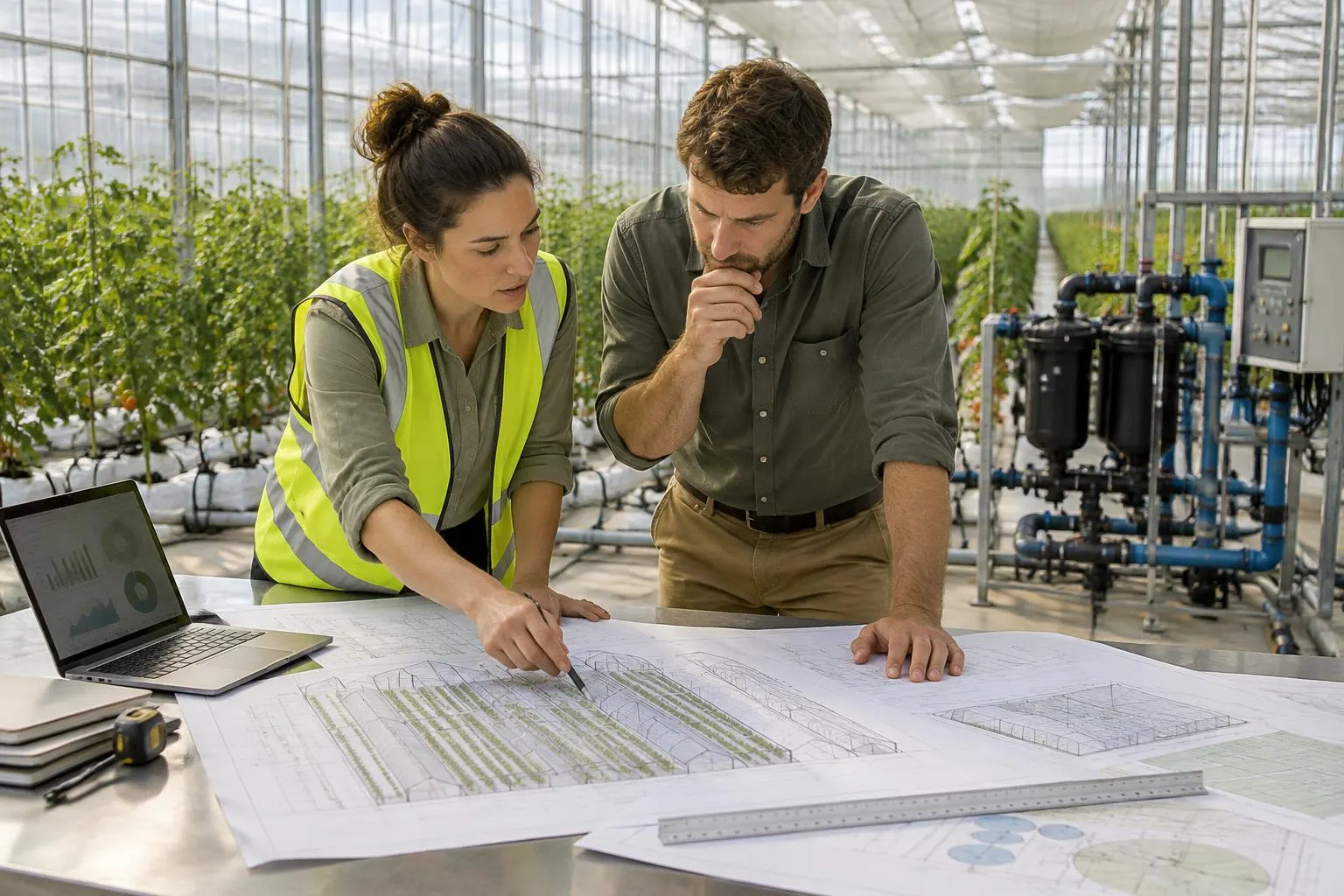
What does “calculate the farm first” mean?
It means defining the agronomic and economic result of the project — what you will grow, for which market, in what climate, with how much water, energy, fertilizer and labour, at what lifetime cost — before choosing a structure, an irrigation design or a manufacturer.
In procurement terms, it is the difference between buying equipment and buying an outcome. A supplier answers the question “what can I sell you?”. A farm calculation answers “what does this project need to work for fifteen or twenty years?”. The second question has to be answered first, otherwise the first one fills the gap.
Why a small planning effort changes lifetime economics
Most decisions that fix a project’s long-term cost are taken early: site orientation, gutter height, ventilation ratio, cooling and heating strategy, water source and treatment, zone sizes, pump duty point and the level of automation. Once steel is ordered and pipes are trenched, changing them is slow and expensive.
Planning time is small compared with the life of the asset. A few weeks spent on water analysis, climate data, crop schedules and cost scenarios cannot guarantee a result, but it removes the most common reasons projects underperform: an undersized cooling system, filtration that does not match the water, a structure chosen for a different climate, or a budget that ignores working capital.
The goal is not the cheapest equipment. It is the right price for the right specification and result. A lower quote that misses the specification is not a saving; a higher quote that adds unneeded features is not quality. You can only tell the difference once the specification exists.
Example roadmap: the project lifecycle stage by stage
SeedMatchGroup works as a procurement and project operating system across this lifecycle. Each stage produces a document the next stage depends on. Supplier vetting appears only at stage 8 — deliberately.
1. Opportunity or problem
Write one paragraph: the market, crop or problem (for example low marketable yield or water scarcity), and what success looks like in measurable terms.
2. Search and shortlist options
List realistic project types — multi-span greenhouse, net house, open-field drip, hydroponics — and discard those that do not fit the climate, market or capital.
3. Discovery and requirements
Collect site data: area, topography, climate records, water source and analysis, power availability, access, permits and labour.
4. Feasibility calculations
Run peak water demand, climate load, fertilizer budget and production assumptions. Use practical calculators, then check them against local data.
5. Budget, ROI and scenarios
Build CAPEX, OPEX, revenue and payback with a base case and at least two downside cases (lower price, lower yield, higher energy).
6. Design, specification and URS
Turn the numbers into a user requirement specification: performance targets, design conditions, interfaces, documentation and acceptance tests.
7. Planning and project management
Define the schedule, responsibilities, decision gates, budget control and who signs off each package.
8. Supplier vetting (only now)
Identify manufacturers whose capability matches the URS: references at similar scale and climate, local service, spares and documentation.
9. Quotation comparison
Compare proposals line by line against the URS — included scope, exclusions, performance guarantees offered by the supplier, lead time and lifecycle cost.
10. Negotiation
Negotiate scope, payment milestones, delivery terms, warranty and acceptance criteria — not only the headline price.
11. Execution support
Track delivery, installation, commissioning and handover against the specification and the acceptance tests.
12. Risk reduction after start-up
Measure actual water, energy and yield against the plan and correct early, while warranty and support are active.
Practical formulas with their assumptions
These are planning formulas, not engineering design. They help you size the question before a specialist sizes the system.
Peak daily water demand
Water (m³/day) = ETc peak (mm/day) × irrigated area (m²) ÷ 1,000
1 mm of water on 1 m² equals 1 litre. ETc comes from crop coefficient × reference evapotranspiration (FAO-56 method) or local greenhouse measurements. Add drainage/leaching fraction for substrate crops.
Gross irrigation requirement
Gross water = Net water ÷ application efficiency
Use the efficiency the supplier will commit to in writing, not a brochure value.
Annual fertilizer budget
Fertilizer cost/year = Σ (nutrient dose kg/ha/season × seasons × area ha × price per kg of product ÷ nutrient content)
Base doses on soil or water analysis and a qualified agronomist’s plan; prices on local quotes.
Annual operating margin (EBITDA)
EBITDA = (marketable output kg × net farm-gate price) − OPEX
Use marketable, not gross, yield, and net price after packing, freight and rejections.
Simple payback
Payback (years) = CAPEX ÷ annual EBITDA
Ignores financing and time value of money; use it only as a first screen.
Lifecycle cost
LCC = CAPEX + Σ OPEXₜ ÷ (1 + r)ᵗ − residual value ÷ (1 + r)ⁿ
r is your discount rate, n the analysis period. Compare suppliers on LCC, not on purchase price alone.
Worked example (illustrative assumptions only)
A hypothetical 2-hectare greenhouse tomato project, used only to show how the formulas connect. None of these values is a benchmark.
| Item | Assumption / result |
|---|---|
| Irrigated area | 20,000 m² |
| Assumed peak ETc | 6 mm/day |
| Peak daily water demand | 6 × 20,000 ÷ 1,000 = 120 m³/day |
| Assumed CAPEX (from a hypothetical specification) | USD 1,200,000 |
| Assumed marketable output × net price | 400,000 kg × USD 0.90 = USD 360,000/year |
| Assumed OPEX | USD 210,000/year |
| EBITDA, base case | 360,000 − 210,000 = USD 150,000/year |
| Simple payback, base case | 1,200,000 ÷ 150,000 = 8.0 years |
| Downside: net price −10% | Revenue 324,000 → EBITDA 114,000 → payback ≈ 10.5 years |
The lesson is in the sensitivity: a 10% lower price moves payback by about 2.5 years in this example. That is why price, yield and energy scenarios belong in the plan before supplier selection, and why a cheaper structure that raises OPEX or lowers marketable yield can cost more over the project life.
Worksheet: fill this in before requesting quotes
Copy these lines into your project file. Every blank is a question a supplier would otherwise answer for you.
- Crop(s), varieties, planting calendar and target market/buyer specification
- Site: area (ha), coordinates, topography, soil type, access and permits status
- Climate: monthly max/min temperature, humidity, radiation, wind and design extremes
- Water: source, available flow (m³/h), storage, full water analysis (EC, pH, bicarbonates, Na, Cl, B, Fe, Mn, TSS)
- Peak daily water demand (m³/day) and number of irrigation zones/shifts
- Energy: grid capacity, tariff, backup power, heating or cooling fuel
- Fertilizer strategy: open or recirculating system, annual budget estimate
- Production assumptions: marketable yield range, net price range, seasons per year
- CAPEX ceiling, OPEX estimate, working capital and financing route
- Required automation level, data/traceability needs and local service expectations
- Acceptance tests: what performance must be demonstrated at handover
Supplier-first versus farm-first procurement
| Topic | Supplier-first | Farm-first |
|---|---|---|
| Who defines the scope | Each supplier, differently | You, in one specification |
| Quote comparability | Low — different packages | High — same requirements |
| Price discussion | Lowest headline price | Right price for the specified result |
| Hidden OPEX | Often discovered after start-up | Estimated in scenarios beforehand |
| Negotiation leverage | Limited, scope is theirs | Stronger, scope and acceptance are yours |
Mistakes to avoid
- Asking for “a price per square metre” before the climate, crop and water are defined.
- Designing irrigation without a recent laboratory water analysis.
- Using gross yield and retail prices in the business case.
- Leaving out working capital, first-season ramp-up and replacement parts.
- Comparing quotes that include different scope, exclusions or warranty terms.
- Choosing automation for its features rather than for the decisions the grower must make.
- Treating a calculator output as a design. It is a planning estimate to be verified.
What is accessible without upfront cost
Our planning guides, calculators and project wizard are free to use, and submitting a project request is free for buyers.
SeedMatchGroup focuses on commercial projects, typically from USD 250,000. A sourcing specialist reviews each brief before any supplier is approached; supplier identities and introductions are handled manually after that review.
Specialist consulting, engineering design or project management beyond this guidance may be scoped separately — we confirm what applies to your project in writing rather than assuming it is included.
Frequently asked questions
Why calculate the farm before choosing suppliers?
Because suppliers can only quote comparable prices against the same requirements. Calculating crop, climate, water, fertilizer and economics first turns your needs into a specification, so you compare like with like and keep control of scope.
What is a URS in a greenhouse or irrigation project?
A user requirement specification: a document stating the performance, design conditions, interfaces, documentation and acceptance tests the project must meet. Suppliers design and price to it; it does not prescribe a brand.
How do I estimate peak irrigation water demand?
Multiply peak crop evapotranspiration in mm/day by the irrigated area in m² and divide by 1,000 to get m³/day, then adjust for application efficiency and drainage. Verify with local data and a qualified designer.
Is the cheapest greenhouse quote usually the best value?
Not necessarily. Compare lifecycle cost and whether the quote meets the specification. A lower price that raises energy use, labour or crop losses can cost more over the project life.
Are SeedMatchGroup tools free?
Yes, the guides, calculators and project wizard are free to use and submitting a project request is free for buyers. Any separately scoped consulting or project-management work is confirmed in writing.
When should supplier vetting start?
After the scope, specification and economics are defined. Vetting earlier tends to let a supplier’s standard package define your project.
Run the numbers with real SeedMatch tools
- Greenhouse project budget planner →
- CAPEX, OPEX and ROI scenario calculator →
- Irrigation water and flow calculator →
- Fertigation calculator →
- Greenhouse configurator (project wizard) →
When your worksheet is filled in, send it as a structured request. A sourcing specialist reviews the scope and economics before any supplier is contacted, and organises comparable proposals where the project fits.
Start a structured greenhouse project request →