
Procurement guide · Greenhouse & agricultural inputs
Buying greenhouse equipment, seeds and fertilizer from China? Define the project before you open a marketplace
Published and reviewed: · SeedMatchGroup
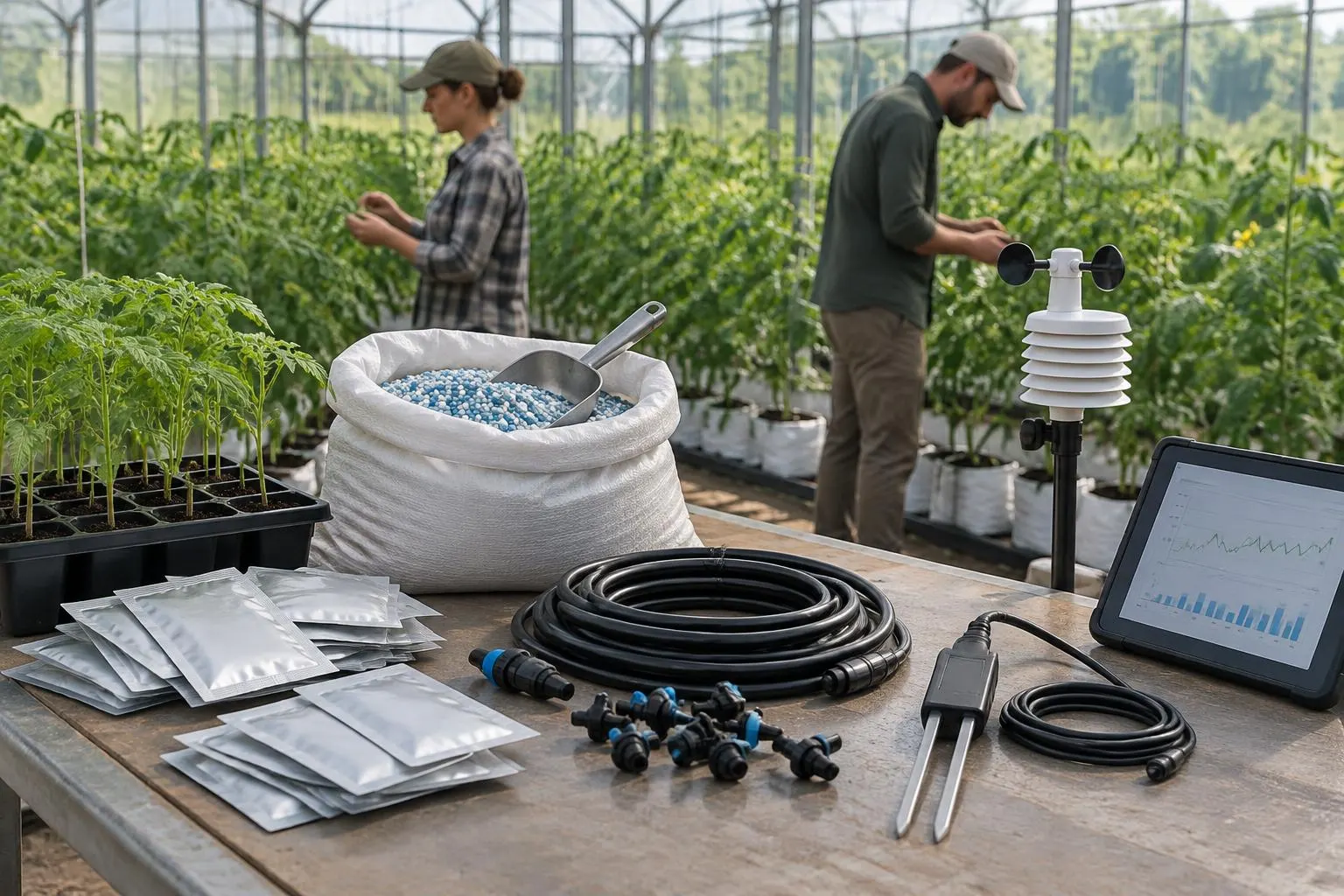
Start with your production plan, not with a supplier search. A greenhouse or open-field project buys many things at once — seeds or young plants, fertilizer, irrigation and fertigation hardware, sensors and controls, structure and climate equipment — and each one only makes sense against the same crop, climate, site, water and production calendar. When those facts are written down first, suppliers on any marketplace can quote against the same requirement, and you can compare total landed and lifecycle cost instead of headline unit prices.
This article is planning guidance, not agronomic, legal or import advice. It does not promise yields, savings or supplier availability. SeedMatchGroup's buyer-side tools are free for buyers with no obligation; suppliers, freight, engineering, installation and financing are paid separately to the parties providing them. Assisted sourcing is offered for projects of USD 250,000 or more.
Why start with SeedMatchGroup before searching for suppliers
Marketplaces are built to help you find products and sellers quickly. What they cannot know is your crop, your target market window, the water you will irrigate with, the power supply on site, or how the drip line, dosing unit, sensors and climate computer must work together. If those are missing, every supplier fills the gaps with its own assumptions — and their quotes stop being comparable.
SeedMatchGroup is designed as the supplier-neutral step before and across those conversations. You can use the free budget planner, CAPEX/OPEX scenario, tender timeline and bid scorecard to turn intentions into a written brief; build a structured RFQ; and, for qualifying projects, ask our team to help shortlist suitable manufacturers and compare their proposals on the same criteria. We can also work alongside listings you have already found on external platforms. You stay in control of whether, and with whom, you contract.
The practical argument is simple: a clear brief takes days, while an order placed against the wrong emitter flow, an unregistered fertilizer, or a seed variety without the right phytosanitary documents can cost a season. Planning first does not slow procurement down; it removes the rework that usually happens later.
Where the major China and Asia sourcing platforms fit
Alibaba.com
Launched in 1999 as Alibaba Group's global B2B marketplace. Alibaba.com describes itself as supporting sourcing plus online transactions, marketing, fulfilment and after-sales services; Alibaba Group itself now describes its focus as AI + Cloud and commerce.
home.alibabagroup.com ↗1688.com
Also launched in 1999, 1688.com is Alibaba's China domestic wholesale marketplace. It is oriented to buyers inside China, so foreign buyers typically rely on agents or intermediaries and must plan export documentation themselves.
home.alibabagroup.com ↗Made-in-China.com
Founded in 1998, Made-in-China.com is a B2B platform for products from Chinese suppliers. Its current site promotes SourcingAI and text and visual product search to help buyers find matching items.
made-in-china.com ↗Global Sources
Hong Kong-based Global Sources began as a trade publication in 1971 and launched its online platform in 1995. It serves sourcing across Asia, combining online sourcing with trade shows (online-to-offline).
globalsources.com ↗DHgate
Founded in 2004 as a cross-border B2B e-commerce platform, DHgate focuses on cross-border wholesale and smaller-lot purchasing, with transaction and logistics services for international buyers.
dhgatewiki.com ↗
These are examples, not an exhaustive list, and each serves a different purpose — global B2B, domestic wholesale, Asia-wide sourcing with fairs, or cross-border wholesale. For a longer history of the same platforms and a general project-procurement workflow, read our companion article: China sourcing platforms and project procurement guide
What to define for each input before asking for a quote
Use this table as the core of an RFQ template. The middle column is what the supplier needs from you; the right column is what you need to check before ordering.
| Input | Define first | Verify before ordering |
|---|---|---|
| Seeds and young plants | Crop and variety type, target market and season, growing system (soil, substrate, hydroponic), required resistances, quantity by sowing date. | Seed lot documentation, germination and purity statements, phytosanitary certificate and the import permit rules of your national plant-protection authority. |
| Fertilizers and nutrients | Fertigation strategy, water analysis, nutrient form (water-soluble, liquid, granular), quantity per cycle, storage conditions. | Product registration and labelling rules in your country, certificate of analysis, solubility and compatibility with your water and dosing equipment. |
| Irrigation and fertigation | Water source, flow and pressure, area and zones, emitter type and spacing, filtration and dosing needs, energy supply. | Hydraulic design assumptions, component standards, spare parts, local installation and service, warranty terms in writing. |
| Sensors, IoT and controls | What decisions the data must support (irrigation, climate, alarms), number of zones, connectivity on site, who will operate it. | Calibration, data ownership and export, local power and network compatibility, software support period, integration with the climate computer. |
| Structure, cover and climate equipment | Climate and wind/snow loads, light, heating/cooling and ventilation needs, expansion plan, local building rules. | Engineering calculations, local permitting fit, delivery and installation scope, interfaces with irrigation and electrical works. |
| Water treatment | Water quality results, required capacity, recirculation or drain-to-waste, discharge rules. | Treatment performance basis, consumables and running cost, maintenance access and local service. |
Before-you-contact-suppliers checklist
- Target outcome written: crop, market, production window and the volume you plan for — as an assumption, not a promise.
- Site facts collected: location, climate, light, land area, access, power and permits.
- Water analysis and source capacity available.
- Growing system chosen (soil, substrate or hydroponic) and its consequences for irrigation, fertigation and controls listed.
- Input list split into packages: seeds/plants, nutrients, irrigation, sensors/controls, structure/climate, water treatment.
- Compliance needs listed per package: phytosanitary, fertilizer registration, electrical and building standards.
- Budget range and funding status recorded, with CAPEX and OPEX separated.
- Timeline with the planting date working backwards to order, shipping, customs and installation.
- Service needs defined: training, spares, remote support, warranty.
- Bid criteria agreed before quotes arrive: scope coverage, technical fit, delivery, total landed cost, lifecycle cost, service and risk.
A simple sourcing workflow for greenhouse and agricultural inputs
1. Plan the production
Agree crop, calendar, growing system and site constraints. Use the budget planner and CAPEX/OPEX scenario to test whether the plan holds together financially.
2. Write the structured RFQ
Turn each package into the same requirement for every supplier, with quantities, standards, delivery terms (Incoterms) and documents required.
3. Discover and shortlist
Search marketplaces, trade fairs and direct manufacturers. For projects of USD 250,000 or more, you can ask SeedMatchGroup to help identify suitable manufacturers.
4. Compare like for like
Normalise quotes into one table: what is included, what is excluded, landed cost to site, operating cost, service and risks. Ask clarifying questions before negotiating price.
5. Verify the supplier
Check business registration, references you can contact, test reports and certificates, and factory or sample checks where justified by order value.
6. Contract, deliver and review
Lock scope, acceptance tests and payment milestones in the contract; track shipping, installation and commissioning; then review supplier performance after the first cycle.
Total sourcing cost, CAPEX/OPEX and realistic production planning
A unit price from a marketplace is only one line of total sourcing cost. Add freight, insurance, duties and taxes, customs clearance, inland transport, installation, commissioning, spares, training and the cost of delays. For inputs bought every season — seeds, fertilizer, substrates — the decisive figure is often operating cost per cycle, not purchase price.
Keep CAPEX (structure, irrigation, controls, treatment) and OPEX (energy, water, nutrients, labour, maintenance) separate in your plan, and test them in our free CAPEX/OPEX scenario tool with your own numbers. Treat any production volume as a planning assumption that depends on crop management, climate and market — no supplier or tool can guarantee it.
Common mistakes and how to reduce the risk
| Mistake | How to reduce the risk |
|---|---|
| Comparing quotes that cover different scopes | Send one RFQ template to everyone and score exclusions explicitly. |
| Buying irrigation before the water analysis | Base filtration, emitters and dosing on measured water quality. |
| Treating seed and fertilizer imports as routine | Check phytosanitary and registration rules before the order, not at the port. |
| Choosing sensors without an operating plan | Define who uses the data, for which decisions, and how it is supported. |
| Ignoring landed and lifecycle cost | Compare cost delivered to site and operating cost per cycle, not FOB price alone. |
| Accepting unverified claims | Ask for documents and contactable references; never rely on a profile badge alone. |
Frequently asked questions
Should I contact China suppliers before writing a project brief?
You can browse at any time, but request quotes after the brief is written. A brief with crop, site, water, capacity, standards and timeline makes supplier answers comparable.
Is SeedMatchGroup a marketplace like Alibaba.com or Made-in-China.com?
No. SeedMatchGroup is a supplier-neutral planning and procurement layer: free buyer tools, structured RFQs, proposal comparison and, for qualifying projects, help identifying suitable manufacturers. Marketplaces remain useful for discovery.
Are SeedMatchGroup's tools free?
Yes. Buyer-facing tools and guides are free for buyers, with no obligation. Equipment, freight, engineering, installation and financing are paid to the parties that provide them.
When is assisted sourcing available?
Assisted B2B sourcing is for projects of USD 250,000 or more. Smaller buyers can still use every free tool and guide.
What should a greenhouse RFQ template include?
Crop and production plan, site and climate data, water analysis, growing system, package-by-package specification, standards and documents, delivery terms, installation and service scope, and the bid criteria you will use.
How do I verify a Chinese supplier of agricultural inputs?
Check registration details, product certificates and test reports, contactable references, and samples or factory checks where the order value justifies it. Confirm import rules for seeds and fertilizers in your country.
Can a better supplier guarantee higher yields?
No. Yield depends on crop management, climate, water, labour and market conditions. Good procurement reduces avoidable risks; it does not guarantee production results.
Free tools to prepare your brief
Free for buyers, with no obligation. Use them with your own figures; results are planning estimates, not quotes.
- Greenhouse project budget planner →
- Greenhouse CAPEX/OPEX/ROI scenario →
- Greenhouse tender timeline →
- Supplier bid comparison scorecard →
- How SeedMatch sourcing works →
- All agricultural tools →
- Structured RFQ builder →
Ready to turn the plan into a comparable request? Create a greenhouse project brief. For projects of USD 250,000 or more, our team can review it and help identify suitable manufacturers; you decide whether and whom to select. A supplier list is not an endorsement.
Create a greenhouse project brief / RFQ →Sources
- Alibaba Group · Alibaba.com business overview
- Alibaba Group · Business overview (AI + Cloud and commerce)
- Made-in-China.com · What is Made-in-China.com?
- Made-in-China.com · Homepage (SourcingAI and product search)
- DHgate · About us
- Global Sources · About us
Platform dates and descriptions come from each platform's own public pages, reviewed on 14 October 2026. Features change; check the current pages before relying on them. SeedMatchGroup is not affiliated with these platforms.