
Procurement guide · sourcing platforms
Alibaba.com, 1688, Made-in-China, Global Sources and DHgate: how to use China sourcing platforms for industrial and agricultural project procurement
Published / Reviewed: · SeedMatchGroup
Should you start a project purchase on a China sourcing platform? Use platforms such as Alibaba.com, 1688.com, Made-in-China.com, Global Sources and DHgate to discover manufacturers and products — but write your own project brief first. Define the business outcome, capacity, technical specification, compliance, budget, timeline, site constraints, service needs and total landed and lifecycle cost; send every shortlisted supplier the same RFQ; then compare responses like-for-like, close the gaps, verify suppliers and keep managing the project through delivery and commissioning.
Reviewed 14 October 2026 against the platforms' own public pages. Platform features change; check each site before relying on a feature. This guide is not legal, customs, engineering or financial advice, and it does not rank or endorse any platform or supplier.
The China and Asia sourcing platform landscape
These five are well-known examples of China and Asia sourcing routes, not a complete list. Note the difference between when a company was founded and when its online platform launched — and that several have moved from directories toward fuller trade support.
Alibaba.com
Launched in 1999 as Alibaba Group's global B2B marketplace. Alibaba.com describes its service today as covering sourcing, online transactions, marketing, fulfillment and after-sales. Alibaba Group itself now describes its focus as AI + Cloud and commerce.
home.alibabagroup.com ↗1688.com
Also launched in 1999, 1688.com is Alibaba's China domestic wholesale marketplace. It is oriented to the domestic market, so overseas buyers should check language, payment and shipping arrangements before relying on it.
home.alibabagroup.com ↗Made-in-China.com
Founded in 1998, Made-in-China.com connects buyers with Chinese manufacturers and exporters. Its site currently promotes SourcingAI and visual and text product search to help buyers locate products and suppliers.
made-in-china.com ↗Global Sources
Global Sources began in 1971 as a trade publication and launched its online trade platform in 1995. It is Hong Kong-based and serves Asian sourcing broadly — not only mainland China — and combines online sourcing with trade shows (online-to-offline).
globalsources.com ↗DHgate
Founded in 2004 as a cross-border B2B e-commerce platform, DHgate serves cross-border wholesale. For engineered project packages, buyers still need their own specification and comparison.
dhgatewiki.com ↗What marketplaces solve — and what they do not
Marketplaces help with
- Discovering product categories, manufacturers and exporters quickly across many regions of China and Asia.
- Seeing indicative product listings, specifications and minimum order quantities.
- Messaging, quotation requests and, on some platforms, transaction, logistics and after-sales services.
- Trade-show and online-to-offline contact routes (Global Sources) and search tools such as SourcingAI (Made-in-China.com).
They cannot replace
- Your own project outcome, capacity target and decision criteria.
- A complete specification of interfaces between packages — structure, power, water, controls, civil works.
- Compliance with the standards, permits and import rules of your country and site.
- Like-for-like comparison of offers that quote different scopes, Incoterms and exclusions.
- Project management after the order: inspection, shipping, installation, commissioning and acceptance.
Before you contact suppliers: a project brief checklist
Write these down in one document. It becomes the core of your RFQ template and the yardstick for every quote.
- Business outcome: what the asset must produce, process or deliver, for which market, from which date.
- Capacity: units per hour or day, hectares, tonnes, cubic metres, peak versus average load.
- Technical specification: performance requirements, materials, tolerances, automation level and preferred standards.
- Compliance: destination-country standards, certifications, electrical and safety codes, permits and import rules.
- Site constraints: plot, foundations, climate, available power, water source and quality, access for containers.
- Budget: CAPEX range, contingency, approval steps and funding timing.
- Timeline: decision date, manufacturing window, shipping, installation and commissioning milestones.
- Service needs: training, spare parts, remote support, local installers and warranty terms you require.
- Total landed and lifecycle cost: freight, insurance, duties, local works, energy, consumables, maintenance and replacement.
A repeatable sourcing workflow
1. Scope the project
Turn the outcome into the brief above and agree internally who decides, on what criteria and with what weighting.
2. Discover suppliers
Use marketplaces, trade shows, associations and referrals to build a long list. Treat listings as leads, not proof of capability.
3. Issue one structured RFQ
Send the same scope, quantities, Incoterms, currency, deadline and response format to every candidate.
4. Compare supplier quotes like-for-like
Normalise scope, exclusions, freight, duties, installation and service; list every gap and ask the same clarification questions.
5. Verify and shortlist
Check business registration, factory evidence, references you can contact, certificates against issuer records, and sample or inspection results.
6. Contract, deliver and accept
Fix milestones, inspection points, payment terms and acceptance tests; track production, shipping, installation and commissioning to sign-off.
For industrial and agricultural projects: procurement as an operating system
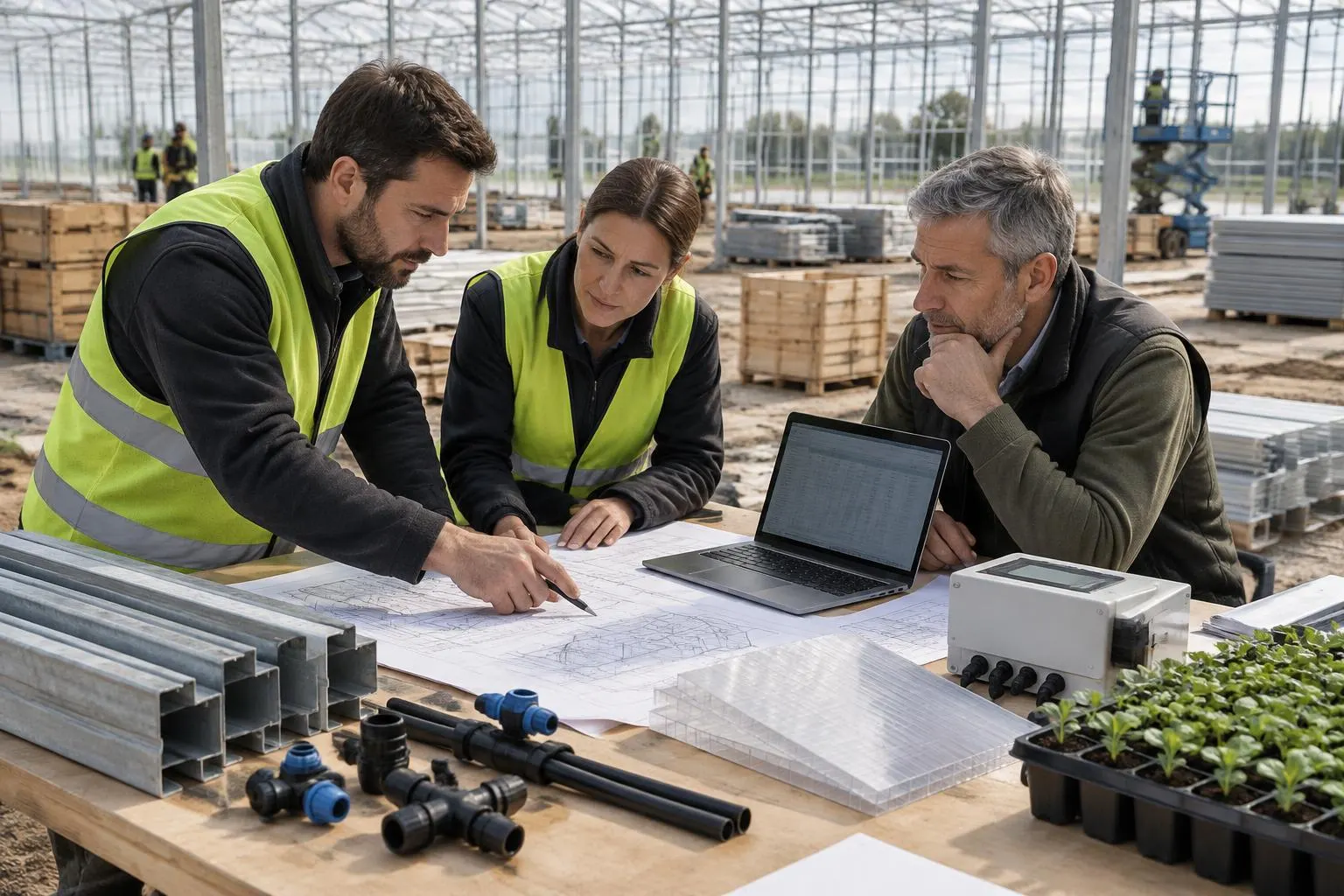
A greenhouse, seed processing line, irrigation network or packhouse is rarely one product. It is several packages — structure, covering, climate, irrigation and fertigation, power, controls and sensors, processing or packing equipment — that must fit one site and one operating plan. Turnkey and engineering solutions can simplify interfaces, but only if the scope boundary is written down.
That is why project procurement works best as an end-to-end process: scoping, RFQ, proposal comparison, sourcing and project management across manufacturing and agriculture, rather than a single search. The brief set before the first supplier conversation decides whether later quotes can be compared at all.
Common buyer mistakes and how to avoid them
| Mistake | Mitigation |
|---|---|
| Asking for a price before defining capacity and scope. | Send a written brief with quantities and performance targets first. |
| Comparing the lowest unit price. | Compare total landed and lifecycle cost, including exclusions and service. |
| Accepting different Incoterms and currencies across quotes. | Fix one Incoterm, currency and validity period in the RFQ. |
| Treating a listing badge as supplier verification. | Verify registration, factory, certificates and references independently. |
| Leaving interfaces between packages undefined. | Assign each interface — foundations, power, water, controls — to a named party. |
Where SeedMatchGroup fits before and across supplier conversations
SeedMatchGroup is a supplier-neutral planning and procurement operating system that sits before and across supplier conversations: project scoping, practical calculators and guides, a structured RFQ, offer comparison, supplier discovery and project tracking.
Once your need is specified, our human team can help you identify and connect with suitable manufacturers — and we use external supplier platforms, including the marketplaces above, where they help. You can also run the whole workflow yourself; you decide whether and whom to select, and no supplier we mention is an endorsement.
Limitations to keep in mind
- No platform or adviser can guarantee supplier quality, price, availability or delivery dates.
- Platform features, fees and protections change; read each platform's current terms.
- Customs, standards and permits are country-specific; confirm them with qualified local specialists.
Frequently asked questions
Is Alibaba.com the same as 1688.com?
No. Both launched in 1999 within Alibaba's businesses, but Alibaba.com is the global B2B marketplace while 1688.com serves China domestic wholesale.
Is Global Sources a mainland China marketplace?
No. Global Sources is Hong Kong-based and serves Asian sourcing broadly, combining an online platform launched in 1995 with trade shows.
How do I compare supplier quotes from different platforms?
Issue one RFQ with fixed scope, quantities, Incoterm and currency, then normalise exclusions, freight, duties, installation and service before comparing totals.
How do I verify a China manufacturer?
Check business registration, factory evidence, certificates against the issuing body, contactable references, and samples or third-party inspection before paying deposits.
Do I have to use SeedMatchGroup to buy from these platforms?
No. You can source directly. Our tools help you define and compare the project; assisted sourcing is optional.
Free tools to prepare your brief and RFQ
Free for buyers, always: these tools and guides carry no obligation and no platform fee to buyers. Supplier, freight, engineering and equipment costs are separate.
- Greenhouse project budget planner →
- CAPEX, OPEX and ROI scenario →
- Greenhouse tender timeline →
- Supplier comparison scorecard →
- How SeedMatchGroup sourcing works →
- All agricultural calculators and tools →
For B2B projects of USD 250,000 or more, our supplier-neutral team can help scope requirements and identify suitable manufacturers. We do not promise savings, availability, delivery dates or outcomes.
Create a project brief / RFQ →Sources and editorial note
- Alibaba Group · Alibaba.com business overview
- Alibaba Group · Business overview (AI + Cloud and commerce)
- Made-in-China.com · What is Made-in-China.com?
- Made-in-China.com · Homepage (SourcingAI and product search)
- DHgate · About us
- Global Sources · About us
Written by the SeedMatchGroup editorial team and reviewed on 14 October 2026 against the platforms' public pages listed. Platform names are trademarks of their owners; no affiliation or endorsement is implied. No case studies or performance figures are used.