
Seed & Nursery Sourcing Service: Quotes, Calculators, Docs
How the seed and nursery sourcing service works, from quote request and seed-rate calculators to germination tests and phytosanitary documentation.
How do I start a seed or nursery sourcing request?
Submit a crop, scale, destination and timeline through the quote request form. A sourcing specialist reviews every request by hand and follows up with clarification questions if anything needed to assess fit is missing before outreach begins.
Key takeaways
- Short answer: Buyers submit crop, scale, destination and timeline through a quote request; a sourcing specialist reviews it before any supplier outreach.
- Starting a seed quote request: The entry point for most seed buyers is the [quote request form](/quote).
- Use the tools before you request a quote: A quote request that already states a defensible seed quantity, rate and quality specification is easier for a supplier to price and easier for a buyer to compare across offers.
- Seed samples and germination testing: Before committing to a lot at commercial scale, most buyers want to see and test the seed itself.
- Phytosanitary and import documentation: Cross-border seed shipments carry documentation requirements that vary by crop, variety status and destination country, and getting these wrong is one of the more common causes of shipment delay at customs.
Short answer
Buyers submit crop, scale, destination and timeline through a quote request; a sourcing specialist reviews it before any supplier outreach. Along the way, calculators size seed rate and germination, samples and ISTA-accredited tests confirm viability, and phytosanitary certificates plus import permits clear the shipment.
Buyers who come to SeedMatchGroup for seed or nursery sourcing are usually trying to solve two problems at once: getting a technically sound specification for what they actually need to plant, and getting that specification in front of suppliers who can realistically fill it. This guide walks through the parts of the site built to help with both — the quote request itself, the seed and oil-crop calculators that turn a planting plan into a defensible specification, the seed samples and germination testing step, the phytosanitary and import documentation that commercial seed shipments require, the nursery project pages for planting-material sourcing, and the national crop yields reference for sanity-checking a production target. None of these tools replace the buyer's own agronomic judgment; they exist to make the request that eventually goes to suppliers clearer and more complete.
Starting a seed quote request
The entry point for most seed buyers is the quote request form. It asks for the information that actually changes what a supplier needs to price: the crop or crops, the scale of the program, the destination country or region, and whatever climate, planting-window or variety-trait requirements the buyer already has in mind. The form also accepts free-text notes, which is where a buyer should put anything the structured fields do not capture — a required disease-resistance package, an existing supplier relationship that should be excluded, a planting deadline that is not flexible, or a destination market's labelling requirement.
Once a buyer submits a quote request, a sourcing specialist reviews it by hand before anything moves further. This review step exists specifically to catch incomplete or ambiguous requests before they go anywhere, because an ambiguous request produces offers that cannot really be compared against each other. Where the request is missing information that materially affects what a supplier would need to quote — quantity, destination, timing, or variety and trait requirements — the specialist follows up with clarification questions rather than passing an incomplete brief forward. Commercial seed and nursery requests are generally considered from a minimum of USD 250,000; smaller requests are typically not a fit for this process.
Outreach to suppliers, once a brief is ready, is manual and discretionary rather than an automated broadcast. SeedMatchGroup's proprietary technology supports the matching and organizing work, but it does not replace the specialist's judgment about which suppliers are a realistic fit for a given crop, country, scale and timeline. Supplier identities are not published and buyer details are not shared openly; communication runs through SeedMatchGroup rather than directly between the two sides until the buyer decides to proceed. None of the number of offers a buyer receives, the prices in those offers, or how quickly suppliers respond is guaranteed — all of that depends on the clarity of the brief, the specifics of the crop and quantity, and which suppliers are available and interested at that moment. Full detail on how outreach and allocation work is set out in the terms of use.
Use the tools before you request a quote
A quote request that already states a defensible seed quantity, rate and quality specification is easier for a supplier to price and easier for a buyer to compare across offers. SeedMatchGroup publishes a set of calculators built for exactly this step, gathered on the Agricultural Tools hub.
The seed rate calculator converts a target plant population into a seeding rate in kg/ha or lb/acre. It works from thousand-seed weight (TSW), germination percentage, assumed field emergence, and purity, and it covers field crops including wheat, maize, soybean, sunflower, rice, cotton, barley, sorghum and canola. Because laboratory germination is measured under ideal conditions, the calculator discounts for field emergence and purity separately from raw germination, which is the distinction that matters when stating a seed rate in a brief rather than just quoting a supplier's label germination figure. The tool also states the effective viability of the lot and lets a buyer send the resulting inputs and results directly into an RFQ.
For oil crops specifically, the oil crop calculators hub has dedicated calculators for sunflower, canola/rapeseed, sesame, safflower and soybean. Each one works from the same kind of inputs — thousand-seed weight, target plant density, germination and field loss — but also carries crop-specific assumptions through to a projected yield and a crushable oil-output estimate, which is relevant when a buyer is sourcing seed for an oil-crop program rather than a grain or forage program.
The germination calculator is built around an actual germination test rather than a supplier's stated figure: a buyer enters the number of seeds tested and the number that germinated, and the calculator returns the germination percentage, the effective viability once purity and an assumed field-emergence factor are applied, and a seed-rate adjustment factor that can be used to scale a baseline sowing rate up when the lot's viability is below 100 percent. This is also the page where the distinction between a quick in-house check and a bankable laboratory result is made explicit: only ISTA-accredited laboratories issue the certificates that are generally required for international trade and import clearance, and this calculator's output is for planning rather than a substitute for that certificate.
Seed samples and germination testing
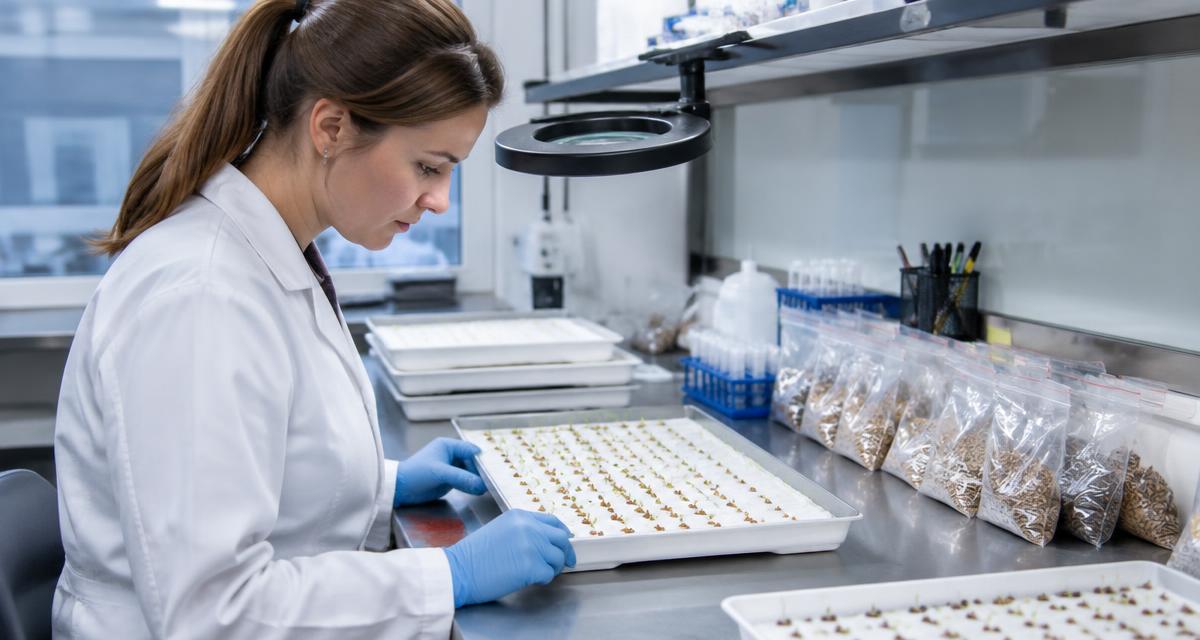
Before committing to a lot at commercial scale, most buyers want to see and test the seed itself. The seed samples page covers that step of the process — requesting a representative sample of the seed lot under consideration, and the germination and purity testing that should be run against it before a larger order is placed. A sample serves two purposes: it lets the buyer physically inspect seed condition, size grading and any visible impurities, and it lets the buyer run or commission a germination test under their own conditions rather than relying solely on a supplier's certificate. Where a buyer needs the test result to be recognized for international trade or import purposes, that test needs to come from an ISTA-accredited laboratory; where it is only for the buyer's own internal decision, an in-house or local lab test against the germination calculator above is usually sufficient for planning.
Phytosanitary and import documentation
Cross-border seed shipments carry documentation requirements that vary by crop, variety status and destination country, and getting these wrong is one of the more common causes of shipment delay at customs. The seed import/export sourcing page covers how this fits into the sourcing process, and seed import requirements by country lays out the kind of destination-specific detail a buyer needs to check — phytosanitary certificates, import permits, and any additional national requirements that apply to the crop and country in question. A buyer preparing a brief should state the destination country clearly and flag any import permit or phytosanitary certificate they already know they will need, since that detail changes which suppliers can realistically fulfill the order within the buyer's timeline. Suppliers vary in which documentation they can provide and how long that documentation typically takes to arrange, so this is a point worth confirming directly rather than assuming it will simply be in place by the time the shipment is ready.
Nursery project pages
Not every buyer is sourcing loose seed; many are sourcing planting material through a nursery or propagation program instead. What is a commercial nursery sets out the building blocks of a nursery operation — propagation systems such as plug trays, container production and tissue culture, and the equipment categories involved in sowing, germination, grafting and hardening. The nursery and propagation facility project page is where a buyer scopes an actual nursery or propagation facility brief — covering the sowing line, germination chamber, grafting hall, mobile benching, irrigation system and climate control a facility needs — before that brief moves into supplier outreach the same way a seed request does. A buyer planning a nursery project should be ready to describe the propagation system they have in mind (plug trays, container, grafting, or tissue culture), the target annual output, the climate conditions at the site, and how the nursery's output feeds into downstream production, since those four points shape almost everything else in the specification.
Checking a production target against national yields
Before a buyer commits to a seed quantity or a production target, it helps to check that target against a public reference point. The national crop yields page compiles FAOSTAT national average yield figures for tomato, cucumber and pepper across a set of markets, plus maize, millet and sweet potato national averages by market, and links each crop and market to the corresponding drip and fertigation guide. These are national averages that blend open-field and greenhouse production together, so they are a country-level benchmark rather than a greenhouse or drip-irrigation yield target — the page is explicit that a greenhouse program should use the greenhouse yield planner instead for a controlled-environment estimate. Used correctly, the national yields page is a quick check against an unrealistic production assumption before that assumption is built into a seed quantity and carried into a supplier brief.
What to prepare before you request a quote
A seed or nursery sourcing request moves faster and produces more comparable offers when the buyer arrives with a few things already decided. The checklist below covers what tends to matter most.
- Crop, species and any required variety, trait or resistance package, stated as specifically as possible.
- Destination country and any import permit or phytosanitary certificate requirement already known.
- Target quantity, stated in consistent units (kg, tonnes, or number of units) rather than left approximate.
- A seed rate and target plant population worked out with the seed rate or oil-crop calculator, rather than a rough guess.
- Minimum acceptable germination and purity, and whether a laboratory certificate will be required.
- Planting window or delivery deadline the shipment must meet, including realistic allowance for transit and customs clearance.
- For nursery or propagation requests: the propagation system in mind, target annual output, and the climate conditions at the site.
- A realistic production target checked against the national crop yields reference or the greenhouse yield planner, rather than an aspirational figure.
Comparison: loose seed sourcing vs nursery/propagation sourcing
| Element | Loose seed sourcing | Nursery / propagation sourcing |
|---|---|---|
| Primary planning tool | Seed rate calculator or oil-crop calculator | Nursery and propagation facility page, propagation-system choice |
| Quality check before order | Seed sample plus germination test | Facility equipment and climate specification review |
| Core documentation | Phytosanitary certificate, import permit | Facility equipment compliance and, where planting material crosses a border, phytosanitary documentation |
| Unit of specification | kg or tonnes of seed, at a stated seed rate | Target annual output of plugs, grafted plants or plantlets |
| Reference check | National crop yields page | Greenhouse yield planner for controlled-environment output |
Common mistakes
Submitting a quote request with a crop named but no quantity, destination or timeline, which leaves the sourcing specialist unable to assess fit without a follow-up round. Quoting a supplier's label germination figure as if it were the effective field viability, instead of running it through the germination calculator with a realistic field-emergence discount. Skipping the sample and germination-test step and ordering directly against a certificate the buyer has not independently checked. Assuming phytosanitary and import documentation will simply be arranged after the order is placed, rather than confirming before outreach which suppliers can provide it and how long it typically takes. Treating a national yield average from the national crop yields page as a greenhouse or drip-irrigation production target, when it mixes open-field and greenhouse data at a country level. Describing a nursery brief only as "seedlings" without stating the propagation system, target output or site climate, which are the details that actually determine facility design. Leaving out a single decision contact on the buyer side, so clarification questions from the sourcing specialist go unanswered or get inconsistent responses.
How SeedMatchGroup helps
Every seed and nursery request that comes through SeedMatchGroup is reviewed by hand by a sourcing specialist before it goes anywhere; proprietary technology supports that review and the supplier-matching process, but it does not replace the specialist's judgment. Supplier outreach is manual and discretionary rather than an automated broadcast to every supplier in a category, and buyer details are not shared openly — supplier identities are not published, and communication runs through SeedMatchGroup throughout the process. Commercial seed and nursery projects are generally considered from a minimum of USD 250,000, and nothing about the number of offers a buyer receives, the prices those offers contain, or how quickly suppliers respond is guaranteed; full detail on how outreach and allocation work is set out in the terms of use. Buyers who have worked through the calculators and the checklist above and are ready to put a complete brief together can start the process through the RFQ builder.
Sources and further reading
For general institutional context on seed testing standards and crop yield statistics, see the International Seed Testing Association and the FAO. These public resources do not endorse SeedMatchGroup.
Tools and next step
- RFQ Builder — submit crop, scale, destination and timeline for specialist review
- Seed RFQ specification — structure a seed-specific request before sourcing
- Seed rate calculator — convert target population, TSW, germination and purity into a seeding rate
- Germination calculator — turn a seed test into germination percentage and adjustment factor
- Seed & nursery project toolkit guide — see where sourcing fits among the other planning tools
Calculator outputs here — seeding rate, germination adjustment, nursery sizing estimates — are planning figures built from the data you enter, not laboratory or supplier results. Project-specific figures, such as a confirmed germination certificate, a landed price or a delivery date, come from accredited labs, supplier quotations and site data gathered during sourcing. SeedMatchGroup reviews briefs for projects from USD 250,000 with a sourcing specialist before manual supplier outreach begins; no quotes, prices or timing are guaranteed in advance.
Turn "Seed & Nursery Sourcing Service: Quotes, Calculators, Docs" into your RFQ
Answer a few questions and we will draft a structured RFQ you can review, edit and submit to our independent supplier network.
Frequently asked questions
- How do I start a seed or nursery sourcing request?
- Submit a crop, scale, destination and timeline through the quote request form. A sourcing specialist reviews every request by hand and follows up with clarification questions if anything needed to assess fit is missing before outreach begins.
- What is the difference between the seed rate calculator and the germination calculator?
- The seed rate calculator works forward from a target plant population, thousand-seed weight, germination, emergence and purity to a seeding rate in kg/ha or lb/acre. The germination calculator works from an actual test — seeds tested versus seeds germinated — to a germination percentage, effective viability and a seed-rate adjustment factor.
- Do I need an ISTA-certified germination test to source seed commercially?
- Only ISTA-accredited laboratories issue the certificates generally required for international trade and import clearance. A sample and an in-house or local germination test are useful for the buyer's own planning, but a bankable certificate for cross-border trade needs to come from an accredited laboratory.
- What documentation does a cross-border seed shipment usually need?
- Requirements vary by crop, variety status and destination country, and typically include a phytosanitary certificate and an import permit. Buyers should check destination-specific requirements and confirm with suppliers which documentation they can provide and how long it typically takes to arrange.
- Is there a minimum project size, and are offers or response times guaranteed?
- Commercial seed and nursery projects are generally considered from a minimum of USD 250,000. The number of supplier offers, the prices in those offers, and response times are not guaranteed; they depend on the clarity of the brief, the specifics of the request, and supplier availability and fit. Full allocation terms are set out in the terms of use.
- What should I prepare before submitting a seed or nursery sourcing request?
- Have the crop and variety preferences, target scale (area or volume), destination country, planting or delivery timeline, and any known certification or documentation requirements ready. A clearer brief lets the sourcing specialist assess fit and ask fewer follow-up questions before outreach.
- Can the service source nursery plant material as well as seed?
- The service covers both seed and nursery sourcing requests. The quote request, documentation and testing steps are similar in structure, though nursery material adds considerations such as plant health certification and transport conditions that seed shipments do not.
Move from reading to sourcing
The pages below carry the commercial detail for this topic — cost ranges, supplier verification, specification checklists and financing routes.