
Irrigation & Fertigation Calculators: From Water Demand to RFQ
Plan a commercial irrigation and fertigation project step by step, from crop water demand and dosing sizing to a supplier-ready RFQ.
What order should I use SeedMatchGroup's irrigation tools in?
Start with the crop water requirement calculator to establish water demand and design flow, then use the drip irrigation ROI calculator to build the business case, the fertigation calculator to size dosing equipment, a crop-specific drip guide to sanity-check the design at block level, and the irrigation water treatment page to confirm filtration needs — then submit the irrigation RFQ with figures carried through from each step.
Key takeaways
- Short answer: Start with the crop water requirement calculator to size pump flow and storage, then use the fertigation calculator to size dosing equipment and stock tanks, and check the drainage/recirculation and water consumption to…
- Step 1: establish water demand with the crop water requirement calculator: The [crop water requirement calculator](/crop-water-requirement-calculator) is the right starting point because every other irrigation decision — pump size, pipe diameter, filtration throughput, storage volume — is size…
- Step 2: build the business case with the drip irrigation ROI calculator: Once water demand is understood, a buyer comparing their current irrigation method against a drip conversion — or deciding whether a new project should be built on drip in the first place — can use the [drip irrigation…
- Step 3: size dosing equipment with the fertigation calculator: With irrigation volumes understood, the [fertigation calculator](/fertigation-calculator) turns a target nutrient concentration into the physical equipment a fertigation system needs.
- Step 4: sanity-check against a crop-specific drip guide: The crop water requirement and fertigation calculators work at the field or farm level; SeedMatchGroup's crop-specific drip guides let a buyer re-run the same logic at the block layout level for a named crop, using the…
Short answer
Start with the crop water requirement calculator to size pump flow and storage, then use the fertigation calculator to size dosing equipment and stock tanks, and check the drainage/recirculation and water consumption tools before moving to the irrigation or fertigation RFQ. Running the calculators in that order keeps the RFQ figures consistent instead of guessed independently.
Most commercial irrigation and fertigation projects fail to get comparable supplier proposals for one simple reason: the buyer goes to suppliers before they have worked out, in their own numbers, what the project actually requires. Water demand, pump flow, fertilizer dosing and filtration needs all depend on each other, and if a buyer has not estimated them in sequence, every supplier approached fills the gaps with a different assumption. SeedMatchGroup's irrigation tools are built to be used in a specific order so that each calculator's output becomes the next one's input, ending with a single irrigation RFQ that states a consistent, defensible scope rather than a collection of guesses.
This guide walks through that sequence: the crop water requirement calculator to establish water demand and pump sizing, the drip irrigation ROI calculator to build the business case for converting to or investing in drip, the fertigation calculator to size dosing equipment and stock tanks, the crop-specific drip and fertigation guides to sanity-check the numbers against a particular crop's layout, the irrigation water treatment page to confirm what the source water implies for filtration and disinfection, and finally the irrigation RFQ, which assembles everything into one requirement a sourcing specialist can take to suppliers.
Step 1: establish water demand with the crop water requirement calculator
The crop water requirement calculator is the right starting point because every other irrigation decision — pump size, pipe diameter, filtration throughput, storage volume — is sized against a water demand figure, and that figure should come from a calculation rather than a guess. The tool works from the standard ETc = ETo × Kc method: it takes a reference evapotranspiration (ETo, in mm/day, which should come from the nearest weather station or agro-meteorological source for the peak month of the season) and multiplies it by a crop coefficient (Kc) that the tool sets by growth stage — initial, development, mid-season peak or late season — since water demand rises as canopy develops and then tapers toward harvest.
From that crop evapotranspiration figure, the calculator deducts effective rainfall (entered as a daily average in mm) to get net irrigation requirement, then divides by the system efficiency the buyer enters — the tool notes typical ranges of roughly 85–92% for well-designed drip, 75–85% for micro-sprinkler or centre pivot, and 50–65% for surface irrigation — to arrive at gross irrigation depth. Multiplying that depth by the irrigated area in hectares gives peak daily volume in cubic metres, and dividing peak daily volume by the planned pumping hours per day gives the design flow in both m³/h and L/s that a pump, mainline and filtration train must be sized against. The tool also outputs a season volume (based on the stated season length), a storage volume (based on the storage autonomy in days the buyer wants to hold), and an indicative water cost using the entered water tariff per cubic metre.
The output that matters most for everything downstream is the design flow and the peak daily volume, because those two numbers are what a drip ROI case, a fertigation dosing plan and a filtration specification all need as a starting point. The calculator is explicit that it is a scoping tool, not a substitute for a licensed abstraction volume, an aquifer yield test or a water-quality analysis, all of which remain necessary before a bankable design is finalised.
Step 2: build the business case with the drip irrigation ROI calculator
Once water demand is understood, a buyer comparing their current irrigation method against a drip conversion — or deciding whether a new project should be built on drip in the first place — can use the drip irrigation ROI calculator to put a structure around that decision. The tool asks for irrigated area, current water use per hectare per year, expected water use under drip per hectare per year, water cost per cubic metre, current fertilizer cost per hectare per year, an expected fertilizer saving percentage under drip, an expected yield uplift percentage, current revenue per hectare per year, the new operating cost drip introduces (energy, filtration, maintenance), and the system CAPEX per hectare.
From those inputs it computes water saved per hectare per year, the dollar value of that water saving, the fertilizer saving, the value of any yield uplift, and nets those against the new operating cost to produce an annual saving per hectare, a total annual saving across the whole area, total CAPEX, a simple (undiscounted) payback period in years, and a five-year net benefit. The tool is direct that yield uplift should be treated as an upper bound to validate with an agronomist rather than a figure to rely on directly, and that system CAPEX scope should be confirmed with suppliers since quotations for 'a drip system' vary in what they actually include — mainline, laterals, emitters, filtration, the fertigation head unit and installation labour are not always bundled the same way by every supplier.
This step matters in the workflow because the water-use inputs for this calculator should be grounded in the same water demand logic established in step one, rather than guessed independently — current water use per hectare should reflect what the existing irrigation method is actually delivering, and the drip water use figure should be consistent with the gross irrigation depth the crop water requirement calculator produced for a drip system's efficiency band.
Step 3: size dosing equipment with the fertigation calculator
With irrigation volumes understood, the fertigation calculator turns a target nutrient concentration into the physical equipment a fertigation system needs. The tool starts from a crop preset (tomato/pepper, cucumber/courgette, leafy greens, strawberry, open-field vegetables, orchard/vineyard, row crops, or other/mixed) that pre-fills a typical daily application depth and target concentration in ppm, both of which the buyer should override with their own agronomist's figures rather than treat as a recommendation. It also asks for a system type — open-field drip fertigation, polyhouse/tunnel fertigation, high-tech greenhouse with EC/pH control, or recirculating/closed hydroponic — and a source-water category (fresh, hard/high bicarbonate, brackish, or recycled/drain water), since water quality changes the treatment scope the fertigation head has to carry.
From irrigated area, application depth and target ppm, the calculator computes daily irrigation volume, the mass of nutrient that must be dissolved per day, and the mass of fertilizer product that implies once the product's nutrient percentage is applied. It then uses the injector dilution ratio (commonly 1:100 or 1:200) and the stock tank autonomy in days to size the stock tank volume and compute the resulting stock concentration in g/L, which should be checked against the fertilizer's solubility limit — the tool flags that a stock strength above roughly 30 kg per 100 L may exceed typical solubility and should be lowered or split across tanks. It also returns the injection flow in L/h the dosing pump has to deliver at the stated irrigation flow, the annual product tonnage and indicative cost at the entered fertilizer price, and — separately from fertilizer cost — a planning CAPEX band per hectare for the chosen system type and water-quality combination, since hard, brackish or recycled source water adds treatment cost that a buyer should budget for explicitly rather than discover from a supplier later.
The output set a buyer needs from this step for an RFQ is: injection flow in L/h, the number and volume of stock tanks, the injector ratio, peak irrigation flow, the water-quality category, the EC/pH control requirement if any, and the number of independently dosed zones — that is a specific enough scope for a fertigation supplier to quote dosing units, filtration and controls rather than guess.
Step 4: sanity-check against a crop-specific drip guide
The crop water requirement and fertigation calculators work at the field or farm level; SeedMatchGroup's crop-specific drip guides let a buyer re-run the same logic at the block layout level for a named crop, using the `CropDripCalculator` tool embedded in pages such as the tomato drip irrigation guide. That calculator takes row and lateral spacing in metres, emitter spacing in centimetres and emitter flow in L/h, together with a peak daily water need in mm/day from the buyer's agronomist, and computes the number of emitters, total system flow with all emitters open, peak daily water volume, the number of irrigation zones the design implies, and pump hours per peak day at the entered pump capacity. A second section inside the same calculator repeats the fertigation logic from step three at the block level — target nitrogen concentration, fertilizer nitrogen content and injection ratio — to give nitrogen per peak day, fertilizer mass per peak day, stock solution volume and stock tank strength.
Running the crop-specific calculator after the field-level calculators is a useful cross-check rather than a duplicate step: if the design flow or pump hours it produces for a specific block layout is wildly different from what the crop water requirement calculator implied for the farm as a whole, that mismatch is worth resolving — usually a sign that row spacing, emitter flow or the assumed irrigation hours need revisiting — before it is written into an RFQ. SeedMatchGroup publishes these guides for a range of crops and countries; the layout logic is the same tool regardless of which crop guide it is embedded in, so a buyer whose crop is not listed can still use the nearest comparable layout as a starting point and adjust row spacing and emitter flow to their own plan.
Step 5: confirm filtration and disinfection needs on the water treatment page
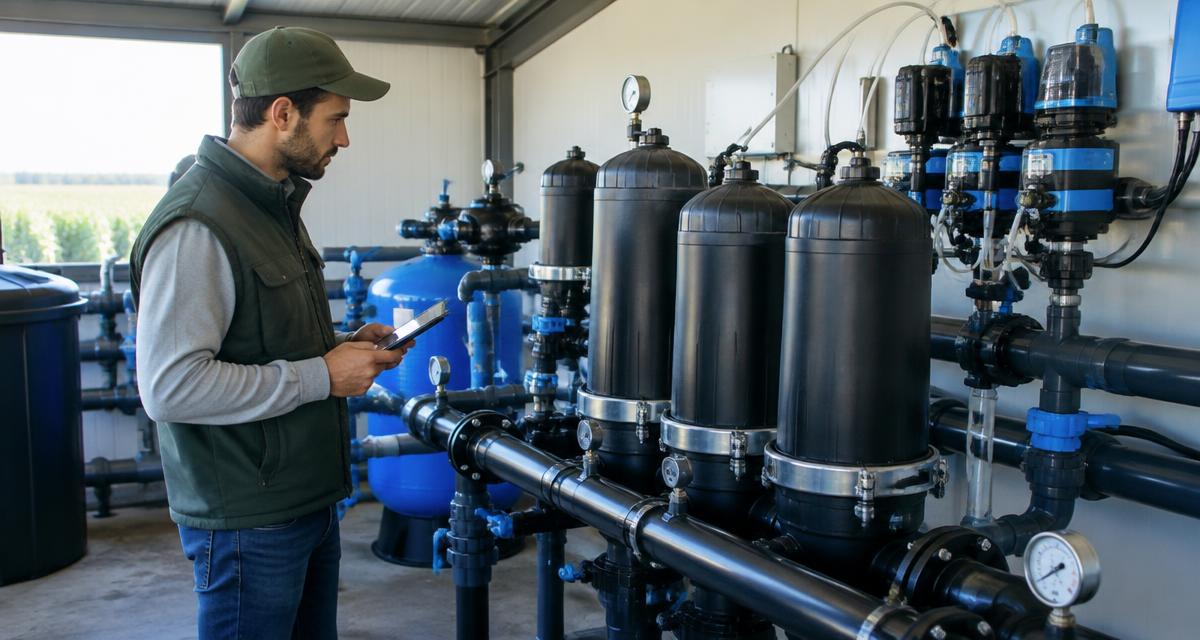
Every number produced so far assumes the source water can actually be delivered through drippers and dosing equipment without fouling them, and that assumption needs to be checked against the real water source rather than left implicit. The irrigation water treatment page sets out the supplier category for filtration and disinfection equipment appropriate to agricultural water sources, covering sand, disc and screen filtration for particulate and organic matter removal, and treatment for issues such as high iron or manganese, high sediment or turbidity, and biological fouling risk — all of which change which filtration train a drip or fertigation system needs upstream of the emitters.
This step should happen before an RFQ is finalised, not after a supplier proposal reveals a filtration problem. The fertigation calculator's water-quality setting (fresh, hard, brackish or recycled) gives a first-pass estimate of the treatment cost uplift, but the water treatment page is where a buyer looks at what equipment category that implies in practice, and where a water analysis — if one is not yet available — should be commissioned before the RFQ goes out.
Step 6: assemble everything into the irrigation RFQ
The irrigation RFQ page is where the outputs from every previous step come together into one requirement. It asks for irrigated area, crop, irrigation method (surface drip, subsurface drip, micro-sprinkler, sprinkler/solid set, centre pivot/linear move, greenhouse fertigation lines, or not yet decided), number of zones or blocks, water source, water quality or analysis status, available flow and pressure, terrain and slope, energy availability, which scope packages should be quoted (field distribution network, emitters, pumping station, filtration, fertigation/dosing unit, water storage, water treatment and disinfection, valves and flow control, solar or energy package, automation and controllers, telemetry, installation and commissioning, and training and agronomy handover), the preferred contracting route (one turnkey contract, split packages across multiple suppliers, supply-only with local installation, or not yet decided), a target start or commissioning date, and any site constraints.
This is exactly the set of inputs the earlier calculators produce: design flow and peak volume from the crop water requirement calculator, the drip-versus-current comparison from the ROI calculator, dosing equipment specifications from the fertigation calculator, a block-level sanity check from the crop drip guide, and a filtration and water-quality scope from the water treatment page. A buyer who fills in the irrigation RFQ with numbers traced back through this sequence is submitting a brief suppliers can price against a defined scope rather than a general description, because the flow, dosing, zone count and treatment requirement are already internally consistent before a single supplier sees the page.
Checklist: the irrigation workflow in order
- Run the crop water requirement calculator to get ETc, gross irrigation depth, peak daily volume and design pump flow.
- Use the drip irrigation ROI calculator to compare current irrigation against a drip conversion using water-use figures consistent with step one.
- Use the fertigation calculator to size stock tanks, injector ratio, injection flow and the fertigation head's planning CAPEX band.
- Cross-check the design at block layout level with a crop-specific drip and fertigation guide such as the tomato drip irrigation guide.
- Review the irrigation water treatment page and commission a water analysis if one does not already exist.
- Submit the consolidated scope through the irrigation RFQ.
Common mistakes
Sending an RFQ before running any calculator, so the irrigated area, flow and dosing figures in the brief are rough guesses rather than numbers traced back to a method. Entering a drip water-use figure in the ROI calculator that is inconsistent with the gross irrigation depth from the crop water requirement calculator, which produces a saving and payback figure that will not survive a supplier's own sizing. Treating the fertigation calculator's crop presets for application depth and target ppm as agronomic recommendations rather than starting values to replace with an agronomist's actual figures for the crop stage. Skipping the water-quality step entirely and assuming 'fresh water' filtration when the actual source is hard, brackish or recycled, which usually surfaces as an unplanned cost once a supplier reviews the water analysis. Running the crop-specific drip guide calculator in isolation from the farm-level crop water requirement calculator and not reconciling a mismatch between block-level and farm-level design flow. Leaving the scope packages section of the irrigation RFQ vague or unchecked, so suppliers are not told clearly whether filtration, dosing, storage, automation or installation are included in what they are pricing.
Use the tools
Each tool in this sequence is free to use and does not require registration: the crop water requirement calculator, the drip irrigation ROI calculator, the fertigation calculator, the tomato drip irrigation guide and SeedMatchGroup's other crop-specific drip guides, and the irrigation water treatment page. Every calculator includes a button to send its results directly into the irrigation RFQ, which carries the figures forward instead of asking the buyer to retype them.
How SeedMatchGroup helps
Once a buyer has worked through this sequence and submitted the irrigation RFQ, a sourcing specialist reviews the brief by hand, checking that the scope is complete and internally consistent before anything is sent further. Proprietary technology supports that review and the matching process, but it does not replace the specialist's judgment. Outreach to suppliers is manual and discretionary rather than an automated broadcast: which irrigation and fertigation manufacturers or integrators are approached for a given brief is a judgment call based on scope, technical fit, country, budget and timeline. Buyer contact details are not shared openly, supplier identities are not published, and all communication runs through SeedMatchGroup. Commercial irrigation and fertigation projects are generally considered from a minimum of USD 250,000; smaller requests are typically not a fit for this process. Nothing about the number of offers a buyer receives, the prices those offers contain, or how quickly suppliers respond is guaranteed — those depend on the clarity and completeness of the brief and on supplier availability and interest at the time. Full detail on how outreach and allocation work is set out in the terms of use. Buyers who have worked through the calculator sequence above and are ready to submit a complete scope can do so directly through the RFQ builder.
Tools and next step
- Crop water requirement calculator — estimate water demand and design flow
- Fertigation calculator — size dosing rate and stock tank volume
- Greenhouse water consumption calculator — check seasonal water volume
- Irrigation RFQ and Fertigation RFQ — turn sized figures into a supplier brief
- Commercial drip irrigation price guide — background on typical system scope
The water demand, dosing and cost figures these calculators produce are planning estimates based on standard engineering relationships, not supplier quotations or guaranteed prices. Numbers specific to one site — pump selection, filtration spec, final cost, lead time — come from supplier quotations and site data gathered during sourcing. SeedMatchGroup reviews RFQs for projects from USD 250,000 with a sourcing specialist before any manual supplier outreach begins; no quotes, prices or delivery timing are guaranteed in advance.
Turn "Irrigation & Fertigation Calculators: From Water Demand to RFQ" into your RFQ
Answer a few questions and we will draft a structured RFQ you can review, edit and submit to our independent supplier network.
Frequently asked questions
- What order should I use SeedMatchGroup's irrigation tools in?
- Start with the crop water requirement calculator to establish water demand and design flow, then use the drip irrigation ROI calculator to build the business case, the fertigation calculator to size dosing equipment, a crop-specific drip guide to sanity-check the design at block level, and the irrigation water treatment page to confirm filtration needs — then submit the irrigation RFQ with figures carried through from each step.
- Do I need to run every calculator, or can I go straight to the RFQ?
- You can submit the irrigation RFQ directly, but a brief built from numbers traced through the crop water requirement, drip ROI and fertigation calculators gives suppliers a defined, internally consistent scope to quote against, which generally produces more comparable proposals than a brief based on rough guesses.
- How does the fertigation calculator relate to the crop-specific drip guides?
- The fertigation calculator works at the field or farm level and sizes stock tanks, injector ratio and injection flow from area, application depth and target concentration. The crop-specific drip guides embed the same dosing logic alongside a block-level drip layout calculation, so a buyer can check a specific block design against the farm-level fertigation numbers.
- Why does water quality matter before I submit an irrigation RFQ?
- Filtration, emitter choice, dosing accuracy and disinfection all depend on the water source's chemistry and particulate load. The fertigation calculator's water-quality setting gives a first-pass treatment cost estimate, and the irrigation water treatment page sets out the equipment category that water quality implies, so the scope sent to suppliers already reflects the real water source rather than a generic assumption.
- Is there a minimum project size for an irrigation and fertigation RFQ, and are offers guaranteed?
- Commercial irrigation and fertigation projects are generally considered from a minimum of USD 250,000. There is no guaranteed number of offers, no guaranteed price and no guaranteed response time; these depend on the completeness of the brief, the project scope and supplier availability and fit at the time.
- Which calculator should I run first if I only know my irrigated area?
- Start with the crop water requirement calculator. It only needs area, crop stage and local evapotranspiration data to produce a design flow and peak volume, which the fertigation calculator and RFQ tools then use as their starting inputs.
- Can I submit an RFQ before running the fertigation calculator?
- You can, but the irrigation RFQ will lack dosing-equipment detail suppliers need to quote a complete fertigation head. Running the fertigation calculator first gives the RFQ an injection flow and stock tank size instead of an open-ended request.
Move from reading to sourcing
The pages below carry the commercial detail for this topic — cost ranges, supplier verification, specification checklists and financing routes.