
Low greenhouse marketable yield: diagnose before buying upgrades
Content updated:
Content and sources checked on 14 October 2026. Independent crop/engineering review and native-language review are pending; no expert sign-off is claimed. Ask your local adviser to approve crop targets and acceptance tests before procurement.
Start by measuring, not buying. Record the crop and variety, planted area, cycle dates and your baseline saleable kg/m², plus grade-outs and their causes. Then check, in order, light and shading, temperature and humidity records, irrigation timing and root-zone moisture, a laboratory water test, nutrient records, air movement, pests and diseases, and pollination. Change one factor at a time, compare it against an unchanged area, and bring in a crop adviser or laboratory whenever the evidence points to nutrition, water quality or plant health.
There is no universal ideal temperature, EC or yield. Targets depend on crop, variety, growth stage, production system and local climate; use crop-specific guidance and local advisers.
Illustrated system: the measurement points behind a comparable greenhouse bid
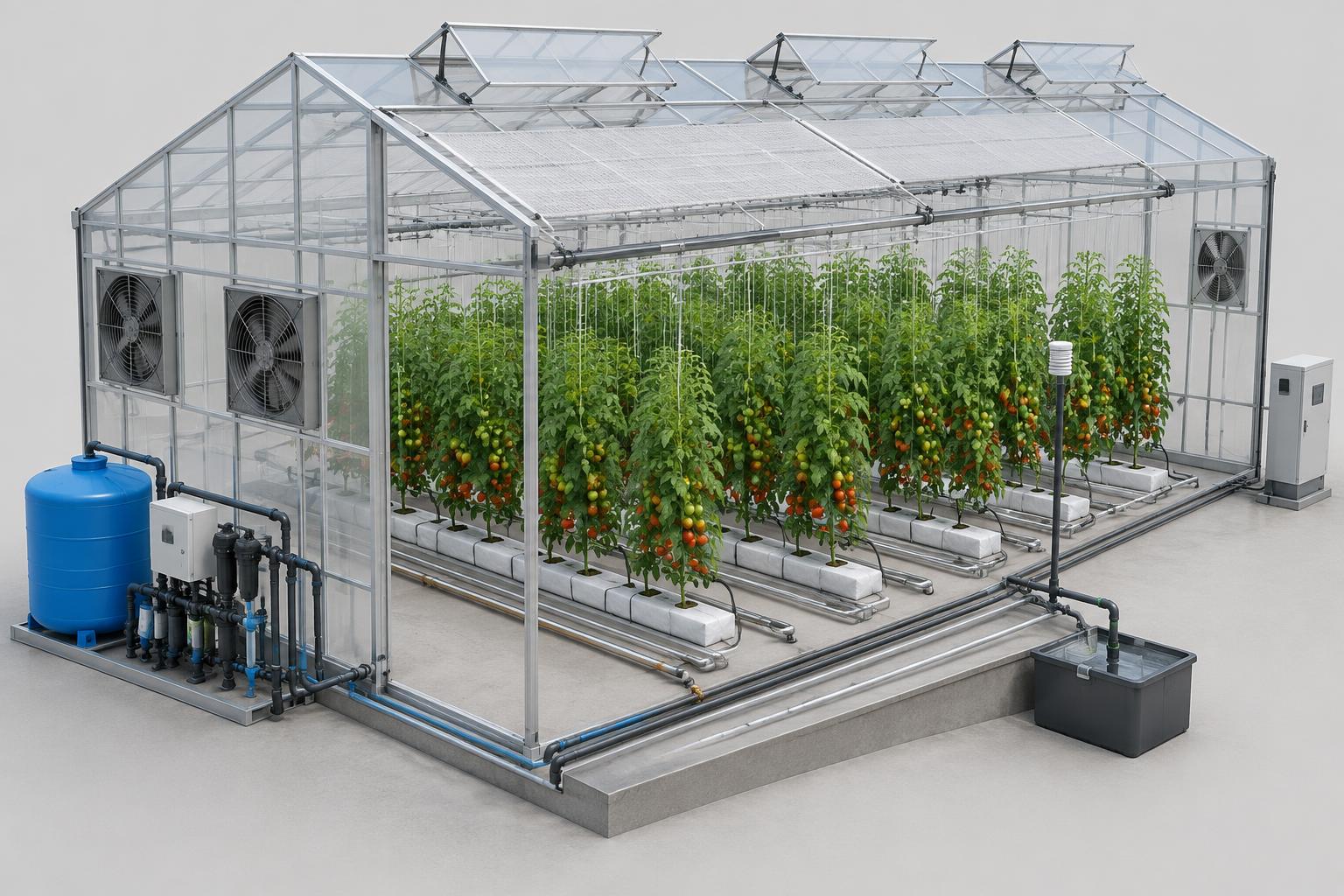
- Roof vents and screen: log outside/inside temperature (°C), relative humidity (%) and screen position against the crop calendar.
- Fans and pipe rails: separate cooling electricity (kWh) from delivered heating energy (kWh thermal); do not compare these as interchangeable units.
- Water tank and dosing skid: record source-water analysis, metered water (m³), fertiliser mass (kg) and operating days; confirm filtration and compatibility with an agronomist.
- Substrate and drain collection: meter applied and collected volumes separately; collected drainage is not automatically safe for reuse.
- Crop-height sensor and control cabinet: specify sensor calibration, alarm tests, data access and who responds to faults.
Your next purchase decision
Decide whether the bottleneck calls for an operating change, a seed/input trial or a capital upgrade. Use measured losses and a comparison trial to define the RFQ; do not buy equipment against an assumed yield increase.
Is the problem total yield or marketable yield?
Total yield is everything harvested; marketable yield is what meets the grade buyers pay for. A crop can produce plenty of kilograms and still lose money if a large share is rejected for size, shape, colour, defects or shelf life.
Write down saleable kg/m² per cycle (or per week for long crops), the rejected share and the main reject reasons. If total yield is close to your expectation but saleable yield is low, look first at quality causes such as climate swings, irrigation stress, pests or handling. If total yield itself is low, look at light, plant density, root health and the growing calendar.
Which records should you collect before changing anything?
- Crop, variety, rootstock if any, planting date, planted area and plant density.
- Weekly harvest by grade, rejected weight and reject reasons.
- Inputs used: water volume, fertiliser recipe changes, energy and labour hours.
- Climate logs at crop height: temperature, humidity, and light or shading changes.
- Irrigation start/stop times, drain or runoff where measured, and root-zone moisture checks.
- Scouting notes for pests, diseases and pollination activity.
How do you isolate the limiting factor?
Compare good and poor areas of the same house before comparing your farm with someone else's. Patterns help: problems along one wall point to light, draughts or condensation; problems at the end of an irrigation line point to pressure or distribution; problems across the whole crop point to water, nutrition, calendar or variety.
Penn State Extension notes that irrigation water quality can reduce yield and that a laboratory water test is the starting point for interpreting pH, alkalinity, EC and specific ions. Test the water source, and where relevant the drain or root zone, before adjusting recipes.
When you have a likely cause, change one thing in a defined area, keep a similar area unchanged, and compare saleable output and quality over a full harvest period.
When should you bring in a crop adviser or laboratory?
Use a laboratory for water, substrate or soil and leaf tissue analysis when nutrition or water quality is suspected. Use a local extension service or plant-health specialist when symptoms could be disease, pests or a disorder; symptoms alone are not a diagnosis. For structural, ventilation or heating limits, an independent engineer can check whether the installed system matches the crop's needs.
Only once the bottleneck is known does it make sense to scope equipment, compare suppliers or model payback.
Connect crop losses to the purchase decision
For tomatoes, peppers or cucumbers, keep crop/variety, growth stage, planted m² and buyer grade separate. For leafy crops, also record harvest count and saleable unit weight. These are measurement categories, not predicted crop yields or resilience ratings.
For the same measured period, calculate marketable kg ÷ planted m², water m³ ÷ marketable kg, and electricity kWh ÷ marketable kg. Keep thermal energy separate. Zero saleable output makes per-kg ratios undefined, not zero. Record crop duration and weather before comparing seasons.
Select seeds and inputs against the observed bottleneck: buyer grade, calendar, documented variety traits, water analysis and local crop advice. Ask for lot/specification evidence and a controlled trial; resistance claims do not guarantee yield or authorize pesticide or fertiliser recipes.
- Implementation gate: attach baseline harvest/grade records, meters and laboratory reports, a one-change trial, its comparison area and a review date to the project brief. Model the measured change in the existing scenario tool; do not turn a trial into a guaranteed ROI.
Diagnosis table: what to check and what it can reveal
Work top to bottom. Each line is a question to answer with your own records, not a target value.
| Area | What to record or test | What it can reveal |
|---|---|---|
| Baseline | Saleable kg/m², grade-outs, reject reasons | Whether the gap is quantity or quality |
| Light and shading | Shade screens, covering condition, plant density | Light-limited growth or uneven areas |
| Temperature and humidity | Day/night logs at crop height, condensation | Stress periods, fruit set or disease-risk windows |
| Irrigation and root zone | Timing, volumes, drain or runoff, moisture | Under- or over-watering, uneven distribution |
| Water and nutrition | Lab water test (pH, alkalinity, EC, ions), recipe history | Water-quality or nutrient constraints |
| Air, pests and pollination | Fan/vent operation, scouting notes, pollination checks | Stagnant zones, pest or disease pressure, poor set |
Before you invest: diagnosis checklist
- Baseline saleable yield and reject reasons recorded for at least one cycle.
- Good and poor areas compared inside the same greenhouse.
- Laboratory water test available and interpreted for this crop.
- Climate logs reviewed for stress periods.
- Adviser or lab consulted for any nutrition or plant-health suspicion.
- One-change trial planned with an unchanged comparison area.
Frequently asked questions
What is the difference between total and marketable yield?
Total yield is all harvested produce; marketable yield is the share that meets buyer grades. Low marketable yield often has quality causes such as climate stress, irrigation problems, pests or handling.
Is there an ideal greenhouse temperature for maximum yield?
No universal value exists. Suitable ranges depend on crop, variety, growth stage, light and production system. Use crop-specific guidance and local advice.
Why test irrigation water if plants look fine?
Penn State Extension explains that water quality issues such as high alkalinity or salts can reduce yield before obvious symptoms. A lab test gives a baseline for recipe decisions.
How long should a trial run?
Long enough to compare saleable output and quality over a representative harvest period, with an unchanged comparison area under the same conditions.
Should I upgrade equipment first?
Not until the bottleneck is identified. Equipment that does not address the limiting factor rarely improves saleable output.
How should I compare resource use when yield changes?
For the same measured period, calculate marketable kg ÷ planted m², water m³ ÷ marketable kg, and electricity kWh ÷ marketable kg. Keep thermal energy separate. Zero saleable output makes per-kg ratios undefined, not zero. Record crop duration and weather before comparing seasons.
Related SeedMatch tools
- Greenhouse problem diagnosis tool
- Yield, quality and resource-efficiency guide with scenario calculator
- Greenhouse climate calculator
- Greenhouse irrigation planner
- CAPEX/OPEX/ROI scenario — enter your own costs and output
- Water demand and flow — keep peak sizing separate from annual use
- Heating transmission-energy scenario — excludes cooling and ventilation loads
- Commercial greenhouse planning checklist: crop, climate, structure, utilities and automation requirements
- Greenhouse climate-control systems compared: ventilation, cooling, heating and energy trade-offs
- How to evaluate greenhouse irrigation and fertigation suppliers: water quality, crop needs and operating cost
- Commercial greenhouse system selection: climate, water and CAPEX
- Greenhouse and irrigation bid comparison: a supplier-neutral RFQ scorecard
- Plan a greenhouse project around crop goals: use free calculators and project tools before sourcing suppliers
When the outcome and constraints are defined, our team reviews your project request (free for buyers, typically USD 250,000+ B2B projects) before approaching suitable independent suppliers and organising comparable proposals. Any financing is arranged only through independent third parties.
Start a structured greenhouse project request →Sources
- Penn State Extension — Greenhouse production
- Penn State Extension — Interpreting irrigation water tests
- Penn State Extension — Is irrigation water quality causing yield reductions?
- FAO — Global Agro-Ecological Zones (GAEZ) data portal
Extension guidance is general. Crop-specific targets, local regulations and qualified local advisers take precedence.