
Greenhouse climate-control systems compared: ventilation, cooling, heating and energy trade-offs
Last reviewed: · SeedMatchGroup editorial team
Written and source-checked by the SeedMatchGroup editorial team. No independent engineering, agronomic or legal sign-off is claimed; worked examples are illustrative and use the stated assumptions only.
Choose climate equipment from your hottest humid week and your coldest night, not from a catalogue. Natural ventilation is the low-energy base for most commercial greenhouses. Fan-and-pad or fog cooling adds evaporative cooling, which works best in dry air and loses effect as outdoor humidity rises. Screens reduce both solar load and night heat loss. The heating system must replace the heat lost through the covering and through air leakage on the design night. The cheapest system to buy is often not the cheapest to run, so ask every supplier to show the method and design conditions behind each capacity.
The figures below come from extension and engineering guidance, or are labelled assumptions. Actual capacities must be designed by a qualified engineer for your site, crop and local codes. Fuel and electricity prices vary by country and contract.
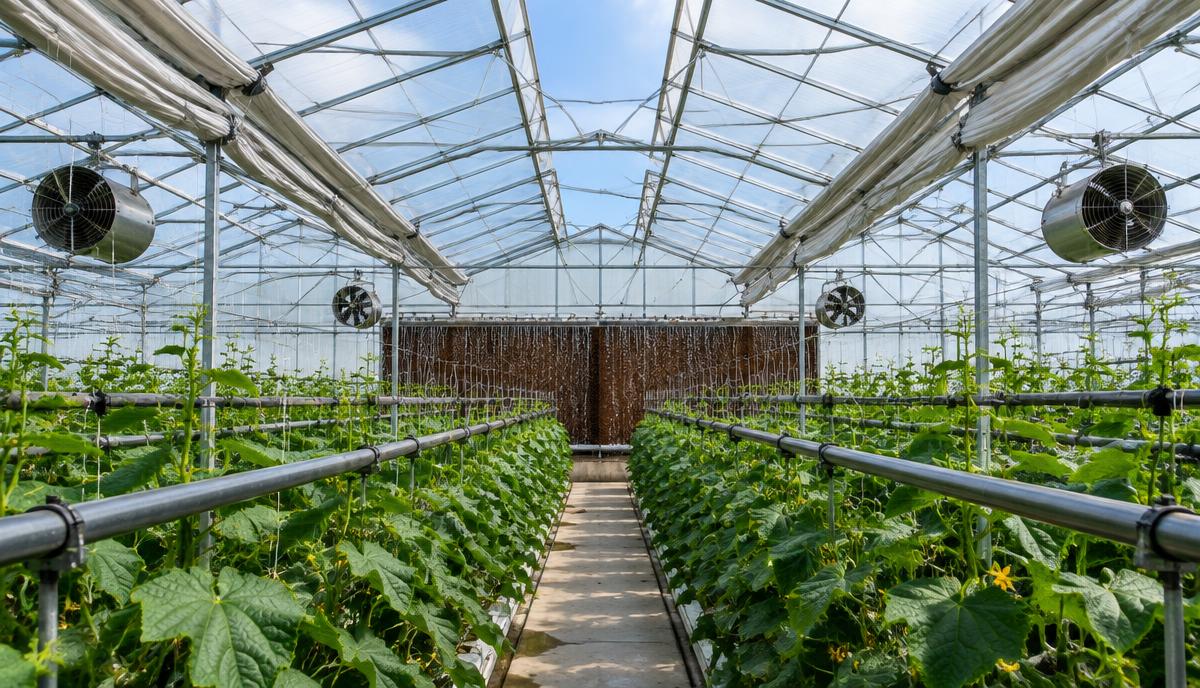
Decision tree: which climate problem are you solving?
- Hot and dry summers: start with natural ventilation and evaporative cooling. Evaporative cooling is most effective in dry climates (UMass Extension).
- Hot and humid summers: expect less from evaporative cooling. UF/IFAS notes its limits in hot, humid climates and that air conditioning or refrigeration is usually too costly to install and run (UF/IFAS CIR1135). Look first at shading, screens, ventilation area and crop or calendar choice.
- Cold winters: the heating design night decides the boiler or heater size. Insulating screens and the covering choice decide how much heat you lose.
- Mild climates with windy sites: well-designed natural ventilation may carry most of the cooling load. In a well-designed greenhouse, a wind of 2–3 mph (about 1 m/s) provides 80% or more of the ventilation (UMass Extension).
- All climates: humidity control at night and in spring and autumn often needs a little heat combined with ventilation. Include this in the energy budget.
Ventilation: natural versus mechanical
Natural ventilation uses roof and side vents. Wind and temperature differences create pressure differences that move the air. It uses little electricity, but it depends on wind, vent area and spacing between houses. Mechanical ventilation uses exhaust fans and inlet louvres. It moves a controlled volume of air in still weather, but every hour of fan operation costs electricity and the fans must be maintained.
For a buyer, the key specification is ventilation capacity at your design summer condition: vent opening area as a share of floor area, or fan airflow per square metre, together with the stated method behind it.
Evaporative cooling: fan-and-pad and fogging
Fan-and-pad systems pull outside air through wet pads on one wall and exhaust it from the opposite wall. UMass Extension says evaporative cooling can cool a greenhouse by 10–20 °F (about 5–11 °C) below the outdoor temperature. Its own example shows how much this depends on humidity: at 90 °F (32 °C) outside, air leaving the pads is about 67 °F (19 °C) at 30% relative humidity, but only about 82 °F (28 °C) at 70% (UMass Extension).
The same source gives a normal design airflow of 8 cfm per square foot of floor area, which is about 146 m³/h per m², adjusted for site conditions. Fogging cools the air with fine droplets inside the house and needs very clean water, usually with treatment. Both systems use water, so add their water demand to the peak-day water calculation.
Heating: how much heat, and where it is lost
The standard first estimate is Q = U × A × ΔT: heat loss equals the heat-transfer coefficient of the covering, multiplied by the covered surface area and by the inside-to-outside temperature difference (Purdue University). The NGMA heat-loss guideline adds infiltration losses (air leakage) to transmission losses and leaves the method of application to the design engineer (NGMA).
Hot-water pipe systems spread heat close to the crop and can use different heat sources, but they cost more to install. Forced-air unit heaters cost less to install but spread heat less evenly. Whichever you choose, combustion must be vented safely and fuel supply and backup must be confirmed. Thermal or energy screens cut night heat loss, but they also affect light and humidity, so their use must be agreed with your agronomist.
Worked example (illustrative): what the covering does to peak heat demand
Assumptions, for illustration only: 1 ha (10,000 m²) of floor area; covered surface (roof plus walls) of 13,000 m²; design night of −2 °C outside and 18 °C inside, so ΔT = 20 K; assumed overall U-value of 6.0 W/m²·K for the single-layer option and 4.0 W/m²·K for the double-layer option. Real U-values must come from the supplier's tested data or engineering tables.
Single layer: 6.0 × 13,000 × 20 = 1,560,000 W ≈ 1.56 MW of transmission loss.
Double layer: 4.0 × 13,000 × 20 = 1,040,000 W ≈ 1.04 MW.
The difference of about 0.52 MW on the design night changes the size of the boiler or heater, the gas or heat connection and, over a season, the fuel bill. Infiltration losses come on top of these figures. The example does not predict your energy use; it shows why the covering, screens and design temperature must be fixed before you compare heating quotes.
What to do and what to avoid
- Do: give every supplier the same design summer condition (temperature and humidity) and design winter night.
- Do: ask for capacities to be calculated with a named method, for example the ANSI/ASAE EP406 practice (ASAE EP406.4).
- Do: compare offers on both investment and expected energy and water use, with the assumptions stated.
- Avoid: comparing cooling systems on 'degrees of cooling' without the outdoor humidity they assume.
- Avoid: buying heating capacity without knowing the covering U-value and infiltration allowance used.
- Avoid: treating screens as optional extras when they change both heating and cooling loads.
Common costly mistakes
- Copying a climate package from a dry region to a humid one and expecting the same evaporative cooling result.
- Undersizing ventilation openings to save on structure cost, which then forces fan operation all summer.
- Ignoring night-time humidity control, which adds heating hours outside the coldest months.
- Sizing the heating system without a backup plan for fuel supply or boiler failure on the coldest night.
- Choosing fog nozzles without water treatment, which leads to clogging and uneven cooling.
Questions to ask suppliers
- Which outdoor design temperature and humidity did you use for cooling, and what inside condition do you expect at that point?
- What U-value and infiltration rate did you assume for heating, and where do these values come from?
- What is the expected electricity use of fans and pumps, and the water use of pads or fog, under the stated assumptions?
- Which climate control strategy is included: vent, screen, heating and humidity set-points, with alarms?
- What maintenance do pads, fog nozzles, fans and boilers need, and which spare parts are included?
- How will cooling and heating capacity be tested and accepted at commissioning?
Summary
- Start from your site's design summer and winter conditions, not from a standard package.
- Natural ventilation and screens set the base. Evaporative cooling helps most in dry air. Heating is sized from heat-loss calculations.
- Check the specification approach in our climate-control systems guide, test energy cost in the climate energy scenario, then send a structured project request with your design conditions.
Climate-control options compared
Qualitative comparison based on the cited extension and engineering guidance. Actual performance depends on site climate, design and operation.
| System | Best fit | Energy and water | Watch-outs |
|---|---|---|---|
| Natural ventilation (roof/side vents) | Most climates; windy, open sites | Low electricity; vent motors only | Depends on wind and vent area; less control in still air |
| Mechanical fan ventilation | Still-air sites, long or closed houses | Electricity for every operating hour | Fan maintenance, noise, power backup |
| Fan-and-pad evaporative cooling | Hot, dry summers | Fan electricity plus pad water | Much less effective in humid air; pad cleaning and water quality |
| High-pressure fogging | Hot, dry climates; humidity support | Pump electricity plus treated water | Needs very clean water; risk of wet foliage |
| Shade and energy screens | All climates | Reduce solar load and night heat loss | Affect light and humidity; need control strategy |
| Hot-water pipe heating | Cold winters, high-value crops | Fuel or heat source; distribution pumps | Higher investment; heat source and backup |
| Forced-air unit heaters | Moderate heating needs | Fuel at the heater | Less even heat; combustion venting |
Climate specification checklist
- Design summer temperature and humidity from local records
- Design winter night temperature from local records
- Crop climate targets agreed with the agronomist
- Covering type and tested U-value requested
- Ventilation area or fan airflow per m² stated with method
- Cooling water demand added to peak-day water budget
- Heating capacity, fuel source and backup confirmed
- Screen, vent, heating and humidity control strategy documented
Frequently asked questions
Which greenhouse cooling system is best for a hot climate?
It depends on humidity. Evaporative cooling with fan-and-pad or fog works best in dry air. Extension tests show it delivers much less when outdoor humidity is high. In hot, humid climates, shading, screens, ventilation area and crop timing usually matter more.
How is greenhouse heating capacity calculated?
The first estimate is Q = U × A × ΔT, transmission loss through the covering, plus infiltration loss from air leakage, calculated for the local design night. A qualified engineer should complete the design with tested U-values.
Is natural ventilation enough for a commercial greenhouse?
In many mild, windy sites it carries most of the load, because wind drives most natural ventilation. In still air, long houses or hot periods, fans or evaporative cooling may also be needed.
Do energy screens pay back?
Screens reduce night heat loss and solar load, but the payback depends on your fuel price, climate and crop. Test it with your own figures in a scenario tool rather than relying on a general claim.
Related SeedMatch tools
- Greenhouse climate load calculator
- Heating and cooling energy scenario
- Greenhouse operating cost calculator
- CAPEX/OPEX/ROI scenario
- Commercial greenhouse planning checklist: crop, climate, structure, utilities and automation requirements
- How to evaluate greenhouse irrigation and fertigation suppliers: water quality, crop needs and operating cost
- Low greenhouse marketable yield: diagnose before buying upgrades
- Commercial greenhouse system selection: climate, water and CAPEX
- Greenhouse and irrigation bid comparison: a supplier-neutral RFQ scorecard
- Plan a greenhouse project around crop goals: use free calculators and project tools before sourcing suppliers
When the outcome and constraints are defined, our team reviews your project request (free for buyers, typically USD 250,000+ B2B projects) before approaching suitable independent suppliers and organising comparable proposals. Any financing is arranged only through independent third parties.
Start a structured greenhouse project request →Sources
- UMass Amherst Extension — Ventilation for Greenhouses
- UMass Amherst Extension — Fan and Pad Evaporative Cooling Systems
- UF/IFAS Extension CIR1135 — Fan and Pad Greenhouse Evaporative Cooling Systems (rev. 2019)
- Purdue University CEA — Calculating Greenhouse Heating Requirements (2019)
- National Greenhouse Manufacturers Association — Heat Loss Guideline
- ANSI/ASAE EP406.4 — Heating, Ventilating and Cooling Greenhouses (hosted by University of Arizona CEAC)
- FAO (2013) — Good Agricultural Practices for greenhouse vegetable crops: principles for Mediterranean climate areas, Plant Production and Protection Paper 217
Extension guidance is general. Crop-specific targets, local regulations and qualified local advisers take precedence.