
Drip Irrigation for Tomato — greenhouse and open-field
A complete drip-irrigation solution for commercial tomato production — pressure-compensated driplines, fertigation heads, filtration, pump duty and controls, sized for indeterminate greenhouse tomato on substrate as well as processing and fresh-market open-field tomato blocks.
Do I need drip-to-slab or soil-grown drip?
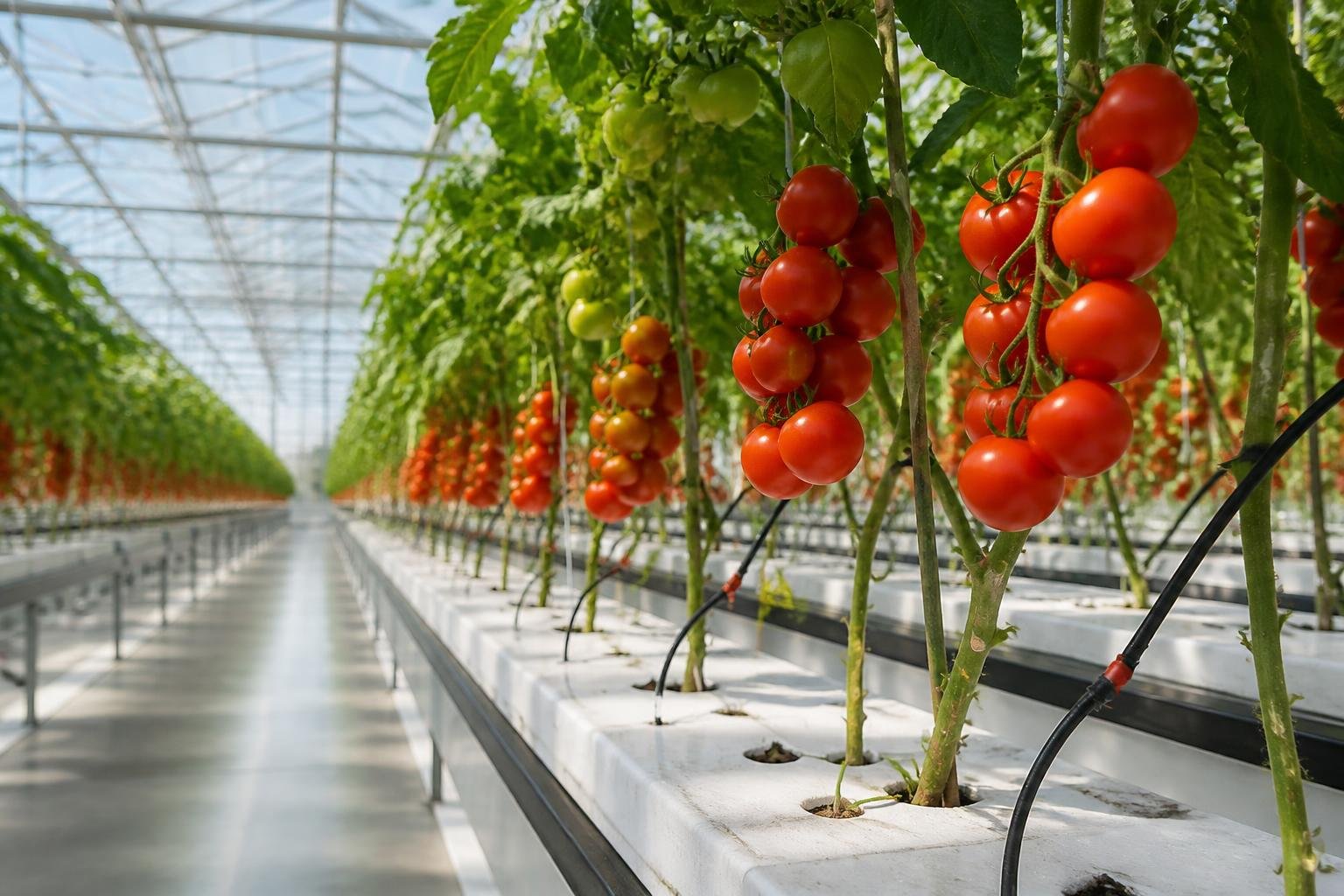
Drip-to-slab with rockwool or coco substrate is standard for high-tech greenhouse tomato with recirculation; soil-grown drip is used for tunnel houses and open-field blocks. Depends on block layout, source-water quality and control level. The RFQ returns firm price ranges from qualified global manufacturers with vendor-neutral specification.
New to drip? Read the guide: what is drip irrigation — components, water and fertilizer efficiency benchmarks, and maintenance.
Typical design envelope
Reference parameters used to open the RFQ. Final values are sized by our engineers against source-water, soil and crop stage.
System components
Thin-wall PC drip tape for seasonal open-field blocks; heavy-wall PC driplines for multi-season and greenhouse installations.
Dosing pumps, mixing tanks and EC/pH probes for balanced N-P-K + micronutrients through the season.
Automatic disc or screen filters plus a hydrocyclone or sand filter where source-water is loaded.
Booster pump with VFD sized to peak block flow and pressure-regulated submains.
Multi-station controller with soil-moisture or ET-based scheduling and remote monitoring.
Why drip for tomato
- Lower water use than furrow irrigation in published trials (see figures below).
- Uniform emitter discharge protects against blossom-end rot and cracking.
- Precise fertigation reduces fertilizer cost per kg of fruit produced.
- Compatible with plastic mulch, black polyethylene and greenhouse substrates.
Published figures for tomato
Results from named studies, not SeedMatchGroup estimates or guarantees. Yields and water use vary with country, climate, variety, greenhouse technology and management. Compare national yields across countries.
| Figure | Published result | Source |
|---|---|---|
| Greenhouse yield | 16.5 kg/m² — tomato in a multi-tunnel greenhouse, Almería, Spain | Torrellas et al., Int. J. Life Cycle Assess. 2012 |
| Water vs furrow | Drip used 22.6% and 19.8% less water and gave 28% and 22% higher yields than furrow (2020, 2021 field trial) | Mukherjee et al., Environ. Process. 2023 |
| Water use efficiency | 250% higher under drip than furrow; yield 2.05% lower under drip (tomato, cucumber and pepper trial) | Pakistan plastic-tunnel trial, SAARC J. Agri. 2014 |
| System price | No published commercial-scale price found. Prices depend on area, water quality, automation and country, and come from supplier offers on the reviewed brief. | Not available |
Tomato drip and fertigation calculator
Enter your own block layout and your agronomist's water and nutrient targets. The starting values are example inputs to replace, not recommendations. Results are planning estimates, not an engineering design or a supplier quotation.
Drip irrigation
Fertigation (nitrogen)
Turn this estimate into a project brief
Send these figures to the fertigation equipment RFQ. Your inputs and results are attached to the private brief for specialist review before supplier outreach.
Buying more than once? Save these project details to your buyer profile so your site, crop, budget and timeline are pre-filled on every future request.
Indicative only. Not financial advice, not agronomic advice, not engineering design. Final numbers require supplier, agronomist, engineer and local regulatory review.
Buyer path
From tomato block details to a drip irrigation request
- 1 · Define
Crop and site details
Define the country, covered or open-field area, growing system (soil or substrate), water source and analysis, and the planting programme.
- 2 · Calculate
Size the critical systems
Use the focused tools below. Results are planning estimates, not engineering designs or supplier quotations.
- 3 · Request
Create one reviewed brief
Add the figures to a private project request. A sourcing specialist reviews it before any relevant supplier is approached.
Recommended calculators
For commercial projects from USD 250K. Supplier participation and response timing depend on scope, country, availability and brief completeness; neither is guaranteed.
FAQ
Drip-to-slab with rockwool or coco substrate is standard for high-tech greenhouse tomato with recirculation; soil-grown drip is used for tunnel houses and open-field blocks.
Depends on block layout, source-water quality and control level. The RFQ returns firm price ranges from qualified global manufacturers with vendor-neutral specification.
General context only — not an offer, quote or recommendation, and not verified for any specific buyer or project. Driplines, fertigation heads, filtration, pumping and installation are all eligible for trade finance and equipment leasing through our readiness checklist. SeedMatchGroup does not offer, arrange, approve or guarantee financing; confirm current eligibility and terms directly with the provider.
Ready to source a tomato drip system?
A dedicated sourcing specialist opens your RFQ to qualified global manufacturers — driplines, fertigation, filtration, pumps and controls — and returns side-by-side offers.