
Drip Irrigation Cost per Hectare: Price Guide & RFQ Steps
Drip irrigation runs USD 1,500-3,500/ha (seasonal tape) or USD 3,000-8,000/ha (permanent, automated). See cost drivers and how to get a specific quote.
How much does commercial drip irrigation cost per hectare?
As an indicative planning range, seasonal thin-wall tape systems typically run USD 1,500–3,500 per hectare and permanent pressure-compensating installations with filtration, fertigation and automation typically run USD 3,000–8,000 per hectare. These are SeedMatchGroup planning ranges, not quotes; actual cost depends on water quality, pumping head, plot geometry, emitter spacing and automation level.
Key takeaways
- Short answer: Commercial drip irrigation is an indicative USD 1,500-3,500 per hectare for seasonal thin-wall tape, or USD 3,000-8,000 per hectare for permanent pressure-compensating systems with filtration, fertigation and automation.
- Direct answer: what commercial drip irrigation costs per hectare: As an indicative planning range — not a quote — commercial drip irrigation generally falls into two bands.
- Why two different bands exist: The gap between the lower and upper end of each range, and between the two bands themselves, is not noise — it reflects genuinely different scopes of work.
- Cost driver: water quality and treatment: Water chemistry and particulate load do more to move installed cost than almost any other single factor, because they determine the filtration train and whether additional water treatment is required before the water ev…
- Cost driver: pumping head and energy supply: The total dynamic head a pump must overcome — static lift from the source, elevation gain across the field, and friction losses through filtration, mainline and dripline — determines pump size, and pump size interacts w…
Short answer
Commercial drip irrigation is an indicative USD 1,500-3,500 per hectare for seasonal thin-wall tape, or USD 3,000-8,000 per hectare for permanent pressure-compensating systems with filtration, fertigation and automation. Where a project lands depends on water quality, pumping head, plot geometry, emitter density and automation level, not area alone.
Direct answer: what commercial drip irrigation costs per hectare
As an indicative planning range — not a quote — commercial drip irrigation generally falls into two bands. Seasonal thin-wall tape systems, typically used for one to three growing seasons on row crops such as tomato, onion, cotton or melon, run roughly USD 1,500–3,500 per hectare. Permanent pressure-compensating installations, built around thicker inline dripline, filtration, fertigation and a degree of automation, and intended for multi-year or permanent-planting use, run roughly USD 3,000–8,000 per hectare. These are SeedMatchGroup indicative planning ranges drawn from the same published range used across our guides; they are not a quote, a price list or an offer, and no single project should be budgeted on the midpoint without first working through the cost drivers below. Within each band, and sometimes beyond it, the final installed cost per hectare is set by water quality, pumping head, plot geometry, emitter spacing and density, the level of automation specified, and the scope of head-works and water treatment — all of which this guide treats qualitatively, because reliable unit prices for pumps, filters and energy vary too much by country, supplier and currency to be stated responsibly in a general guide.
Why two different bands exist
The gap between the lower and upper end of each range, and between the two bands themselves, is not noise — it reflects genuinely different scopes of work. A seasonal tape system is designed to be installed, used for a season or two, and replaced; it generally has lighter-duty filtration, simpler or no automation, and dripline with a thin wall that is not expected to survive multiple years of handling, sun exposure and field operations. A permanent pressure-compensating system is designed to be installed once and operated for many years across varying topography, with dripline engineered to hold flow uniformity across long runs and elevation changes, filtration sized for continuous duty, and typically a fertigation unit and some level of scheduling automation built in from the start. Comparing a quoted price against the wrong band — assuming a tape-system price should apply to a permanent installation with automation, or the reverse — is one of the most common ways a buyer ends up either under-budgeting a project or rejecting a reasonable quote as overpriced.
Cost driver: water quality and treatment
Water chemistry and particulate load do more to move installed cost than almost any other single factor, because they determine the filtration train and whether additional water treatment is required before the water ever reaches an emitter. A clean, low-sediment, chemically benign source needs modest screen or disc filtration. A source carrying sand, silt or organic debris needs a more substantial media or sand-filter bank sized to the design flow. A source with high iron, manganese, carbonate hardness or bacterial load may need chemical dosing, settling, aeration or additional filtration stages before fertigation can even be considered, because the alternative is emitter clogging and a shortened system life. None of these line items have a single global price — they depend on the specific water analysis, the country's available equipment and the design flow — but they are consistently the most underestimated cost component in buyer-prepared budgets, because a buyer costing from memory of a clean-water project will not have budgeted for them on a project with a difficult source.
Cost driver: pumping head and energy supply
The total dynamic head a pump must overcome — static lift from the source, elevation gain across the field, and friction losses through filtration, mainline and dripline — determines pump size, and pump size interacts with the available power supply. A flat, low-lift field fed by a shallow well needs a modest pump and, often, a straightforward grid or small-generator connection. A field with significant elevation change, a deep well, or a remote site requiring a new power connection or solar pumping array carries a materially different capital cost, and in off-grid or weak-grid settings the power supply itself — not the irrigation equipment — can become the largest single line item in the project. Because head and available power are site-specific, they are impossible to price in a general guide, but they should be confirmed early, since a design sized without a firm head and power basis tends to be re-quoted once real site data arrives.
Cost driver: plot geometry and dripline layout
Regular, rectangular plots with uniform row spacing allow dripline runs, submains and valve zoning to be laid out efficiently, with less waste material and fewer fittings per hectare. Irregular plots, land split by access roads, drainage channels or terracing, and fields with mixed crop rows or variable row lengths require more submains, more connectors and valves, and more labour to lay out correctly — all of which raise the installed cost per hectare for the same nominal area. Terraced or sloped land in particular usually forces a move toward pressure-compensating emitters regardless of which cost band is otherwise targeted, because flow uniformity cannot be achieved any other way across a meaningful elevation change, and that constraint should be flagged to a supplier before a specification is finalised, not discovered during installation.
Cost driver: emitter spacing, flow rate and density
Emitter spacing and flow rate are chosen to match soil texture and crop row spacing, not selected independently, and the choice has a direct cost consequence: closer spacing and more drippers per metre of line, which sandy soils typically require to build an adequate wetted bulb, means more dripline and more emitters per hectare than the wider spacing and larger wetted bulb that clay soils typically allow. A crop planted in narrow rows likewise needs more linear metres of dripline per hectare than the same area planted in wide rows. These decisions are agronomic first, cost-driving second, which is why a price comparison between two projects on the same crop and area can still differ meaningfully once row spacing and soil texture are accounted for — a difference that is not a pricing anomaly but a direct consequence of different material quantities.
Cost driver: automation and control
A basic manual or timer-controlled system with hand-operated or simple solenoid valves sits at the lower end of either cost band. Moving toward soil-moisture or evapotranspiration-based scheduling, flow and pressure sensors, remote monitoring and centralised control of multiple zones adds equipment, wiring or telemetry and integration cost that scales with the number of zones being automated, not with area alone. Automation is frequently the single largest discretionary cost decision a buyer makes within the permanent-installation band, because unlike water quality or head, which are fixed by the site, the level of automation is a choice — and it is one worth making deliberately, weighing labour savings and scheduling precision against the added capital and the ongoing cost of maintaining sensors and controllers, rather than defaulting to the most automated option because it is available.
Cost driver: head-works and fertigation equipment
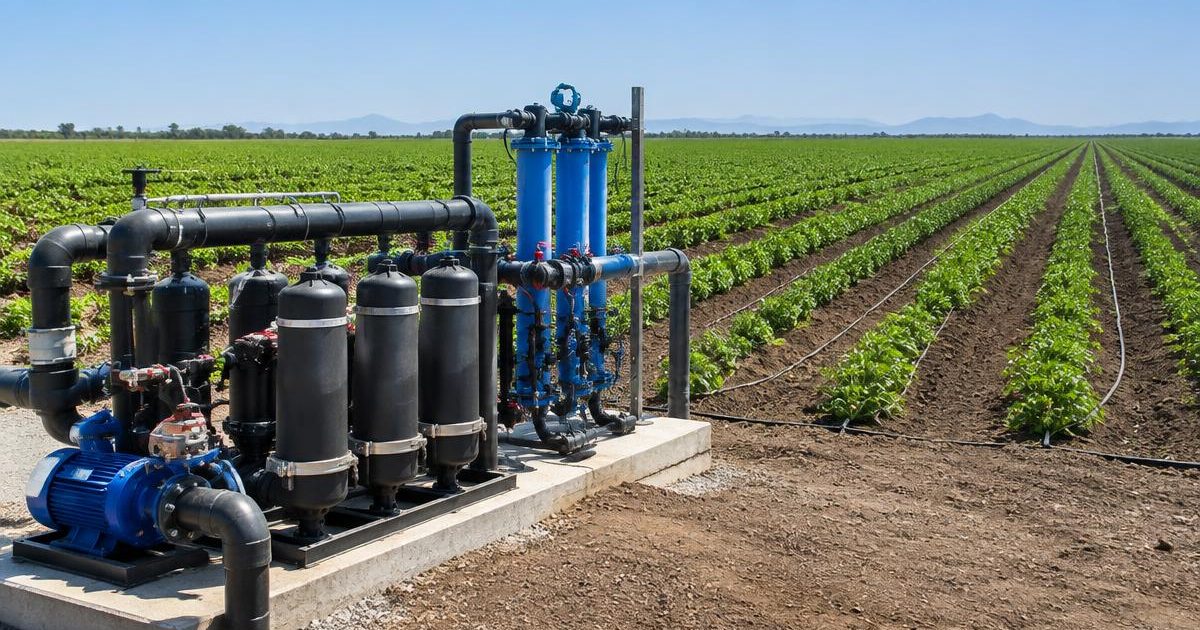
Head-works — the pump station, filtration bank, fertigation injection unit, control valves and the civil works to house and protect them — is frequently the part of a drip irrigation budget least visible from a per-hectare price alone, because its cost scales more with design flow and complexity than with area. A small, intensively automated block can have head-works costing more per hectare, relative to its field materials, than a much larger block on a simple manual system. Fertigation equipment in particular ranges from a basic venturi injector to a multi-tank dosing system with EC and pH control, and the choice should follow from the fertigation programme the crop requires — set using the fertigation calculator — rather than being specified before the nutrient delivery targets are known.
Using the calculators before requesting quotes
Before a hectare price can be turned into a realistic project budget, three planning calculators help establish the inputs a supplier needs to quote responsibly. The crop water requirement calculator takes crop, growth stage, local climate data and irrigation method to estimate net and gross irrigation depth, peak daily volume, seasonal volume and design flow — the figures that determine pump and mainline sizing and, indirectly, which cost band and automation level a project can justify. The fertigation calculator takes the design flow from that step along with target nutrient concentration and the fertilizer products selected to estimate dilution ratios and injector flow rates, which in turn shape the fertigation head-works specification. The drip irrigation ROI calculator takes an assumed installed cost per hectare — drawn from the ranges and drivers in this guide, adjusted for the project's own water quality, head and automation choices — together with the buyer's local water, labour and energy costs, to estimate payback against a flood or sprinkler baseline. None of the three calculators invents a price for the buyer; they turn the buyer's own site and crop data into the numbers a hectare price should be tested against.
Comparing the two cost bands
| Factor | Seasonal thin-wall tape (USD 1,500–3,500/ha) | Permanent pressure-compensating (USD 3,000–8,000/ha) |
|---|---|---|
| Expected service life | One to three seasons | Multiple years, often permanent plantings |
| Dripline construction | Thin-wall, lighter duty | Thick-wall or pressure-compensating inline |
| Filtration | Lighter screen or disc filtration | Sized for continuous duty, often media or sand filtration |
| Fertigation | Often basic or absent | Typically integrated from the outset |
| Automation | Manual or simple timer | Sensor- or ET-based scheduling common |
| Typical use case | Annual row crops, short rotations | Orchards, vineyards, multi-season vegetable blocks |
| Main cost swing factors | Water quality, plot geometry | Water quality, head, automation level, head-works |
A practical checklist before requesting quotes
- Confirm which cost band applies: seasonal tape or permanent pressure-compensating, based on the crop's planting cycle, not price alone.
- Obtain a water quality analysis before specifying filtration or fertigation equipment.
- Confirm static and dynamic head, elevation change across the field, and available power supply or need for a new connection.
- Map plot geometry, access constraints and any terracing or slope before finalising dripline layout.
- Match emitter spacing and flow rate to soil texture and crop row spacing, not a generic default.
- Decide the automation level deliberately, weighing labour and scheduling benefit against added capital and maintenance.
- Scope head-works (pump, filtration, fertigation, civil works) separately from field materials, since it scales with flow and complexity, not area.
- Run the crop water requirement and fertigation calculators before requesting quotes, so the design flow and nutrient targets are fixed.
- Record every assumption behind a budget figure so a supplier can see what it depends on.
Common mistakes buyers make with drip irrigation pricing
The most frequent mistake is budgeting from the midpoint of a published range without establishing which band — seasonal or permanent — actually applies to the crop and planting cycle in question. A close second is treating head-works and fertigation equipment as a fixed percentage add-on to field material cost, when in reality head-works scales with design flow and automation level and can represent a very different share of the budget on a small automated block than on a large manual one. Buyers also commonly specify automation before confirming water quality and head, then have to re-cost the project once filtration or pump requirements are known. On water quality specifically, a common and costly mistake is skipping laboratory analysis and discovering clogging or scaling problems only after installation, when the cheaper fix would have been a different filtration or treatment specification from the outset. Finally, comparing quotes from different suppliers without first normalising scope — emitter type, filtration duty, automation level, fertigation inclusion — produces price comparisons that look like they are for the same project when they are not.
Turning a hectare price into a structured RFQ
Once the applicable cost band, water quality findings, head and power situation, plot geometry, emitter specification, automation level and fertigation requirement are established, those decisions become the technical backbone of a request for quotation: area and crop, planting cycle and expected system life, water source and confirmed or assumed quality, design flow and head, automation scope, and fertigation targets if applicable. Recording the assumptions behind each decision lets a reviewer, and later a supplier, see exactly what the budget depends on and what still needs confirming before a binding price can be issued. The project budget calculator can carry the resulting cost bands into a wider project view alongside other capital items, and the agricultural tools directory lists the related calculators that typically feed into the same irrigation brief.
How SeedMatchGroup helps once the numbers are ready
SeedMatchGroup's planning calculators, including the crop water requirement, fertigation and drip irrigation ROI tools referenced above, are supplier-neutral and free to use; they do not send anything to any supplier. When a project is ready to move forward, the resulting figures can be carried into the RFQ builder to produce a single structured specification. Submitting an RFQ does not alert or contact any supplier automatically: a sourcing specialist reviews the brief first, and may come back to ask for missing details — water source confirmation, land documentation, budget range or timeline — before anything proceeds. If and when the brief is ready, SeedMatchGroup decides, at its discretion, whether and to which relevant suppliers to allocate it, considering factors such as project scope, crop, country, budget, timeline, technical fit and export capability. Supplier identities are kept private throughout, and all communication runs through SeedMatchGroup so that proposals can be compared on a normalized scope rather than mismatched assumptions. This service is intended for genuine commercial projects, generally from USD 250,000. There is no guaranteed number of quotes, no guaranteed response time, no guaranteed price, and no guarantee of financing or award — the structured agricultural project workflow describes how planning, costing, RFQ review and proposal comparison fit together, and the platform's terms are worth reviewing before submitting a request.
Sources and further reading
FAO Irrigation and Drainage Paper 56 — Crop Evapotranspiration sets out the reference evapotranspiration and crop coefficient method underlying the crop water requirement figures referenced in this guide. FAO CROPWAT is FAO's software for calculating crop water requirements and irrigation scheduling from climate and crop data. Neither resource endorses SeedMatchGroup.
Tools and next step
Surface or subsurface: state in the RFQ whether drip lines are laid on the surface or buried (subsurface drip). Buried systems add trenching or injection work, root-intrusion protection and flushing requirements, so suppliers quoting different placements are not quoting the same scope.
- Crop water requirement calculator - size design flow and peak irrigation demand first
- Fertigation calculator - set dosing and injector sizing for the head-works spec
- Irrigation RFQ - structure a supplier-ready request for quotation
- Fertigation RFQ - request quotes on fertigation equipment specifically
- Commercial drip irrigation system buyer's guide - further buying considerations
What is verified vs estimated: the price bands and cost-driver discussion above are SeedMatchGroup planning estimates, not quotes, and calculator outputs are planning-level figures only. Project-specific costs come from a water analysis, a confirmed design flow and actual supplier quotations against your site. For projects from USD 250,000, a SeedMatchGroup sourcing specialist reviews the brief with you before any manual supplier outreach begins; there is no guaranteed number of quotes, price or response time.
Turn "Drip Irrigation Cost per Hectare: Price Guide & RFQ Steps" into your RFQ
Answer a few questions and we will draft a structured RFQ you can review, edit and submit to our independent supplier network.
Frequently asked questions
- How much does commercial drip irrigation cost per hectare?
- As an indicative planning range, seasonal thin-wall tape systems typically run USD 1,500–3,500 per hectare and permanent pressure-compensating installations with filtration, fertigation and automation typically run USD 3,000–8,000 per hectare. These are SeedMatchGroup planning ranges, not quotes; actual cost depends on water quality, pumping head, plot geometry, emitter spacing and automation level.
- Why is there such a wide range between USD 1,500 and USD 8,000 per hectare?
- The range spans two different scopes: lighter-duty seasonal tape for one to three seasons, and permanent pressure-compensating systems built for multi-year or permanent-planting use with integrated filtration, fertigation and automation. Within each band, water quality, head, plot geometry and the level of automation specified move the final figure further.
- What is the single biggest hidden cost in a drip irrigation budget?
- Water quality and treatment, along with head-works (pump station, filtration, fertigation unit), are the most commonly underestimated components, because they scale with design flow and water chemistry rather than with area, and their cost cannot be judged from a hectare price alone without a water analysis and a confirmed design flow.
- Which calculators should I use before requesting drip irrigation quotes?
- Use the crop water requirement calculator to establish design flow and peak demand, the fertigation calculator to size dosing and injector requirements, and the drip irrigation ROI calculator to test an assumed installed cost per hectare against local water, labour and energy costs.
- Does submitting a drip irrigation budget through an RFQ guarantee supplier quotes?
- No. A sourcing specialist reviews every submitted RFQ before any supplier outreach and may request missing information. Allocation to suppliers is discretionary, and there is no guaranteed number of quotes, response time, price or outcome.
- Does plot shape really change the drip irrigation price per hectare?
- Yes. Irregular plots, land split by roads or drainage, and terraced or sloped ground need more submains, valves and connectors per hectare than a regular rectangular plot, and terraced sites usually require pressure-compensating emitters regardless of which cost band is otherwise targeted.
- Should I specify automation level before or after getting a drip irrigation quote?
- Before. Automation - scheduling, sensors, remote monitoring, zone control - is a deliberate choice that scales with the number of zones and is often the largest discretionary cost in the permanent-installation band, so it should be decided before a supplier prices the system.
Move from reading to sourcing
The pages below carry the commercial detail for this topic — cost ranges, supplier verification, specification checklists and financing routes.