
UAE Greenhouse and Hydroponics Projects: How to Compare Suppliers on Water, Energy and Yield
Request a technical brief and comparable greenhouse proposalsThree greenhouse suppliers, three proposals, three different yield claims — and no way to tell which one fits your UAE site. This guide shows how to turn a commercial greenhouse or hydroponic farm idea into one technical brief that every supplier must price the same way.
How do I compare greenhouse suppliers in the UAE?
Send every supplier the same technical brief covering crop, offtake, site climate, cooling, water, energy, controls, labour and commissioning, then compare scope, landed cost, CAPEX, OPEX and stated assumptions in one table before negotiating price.
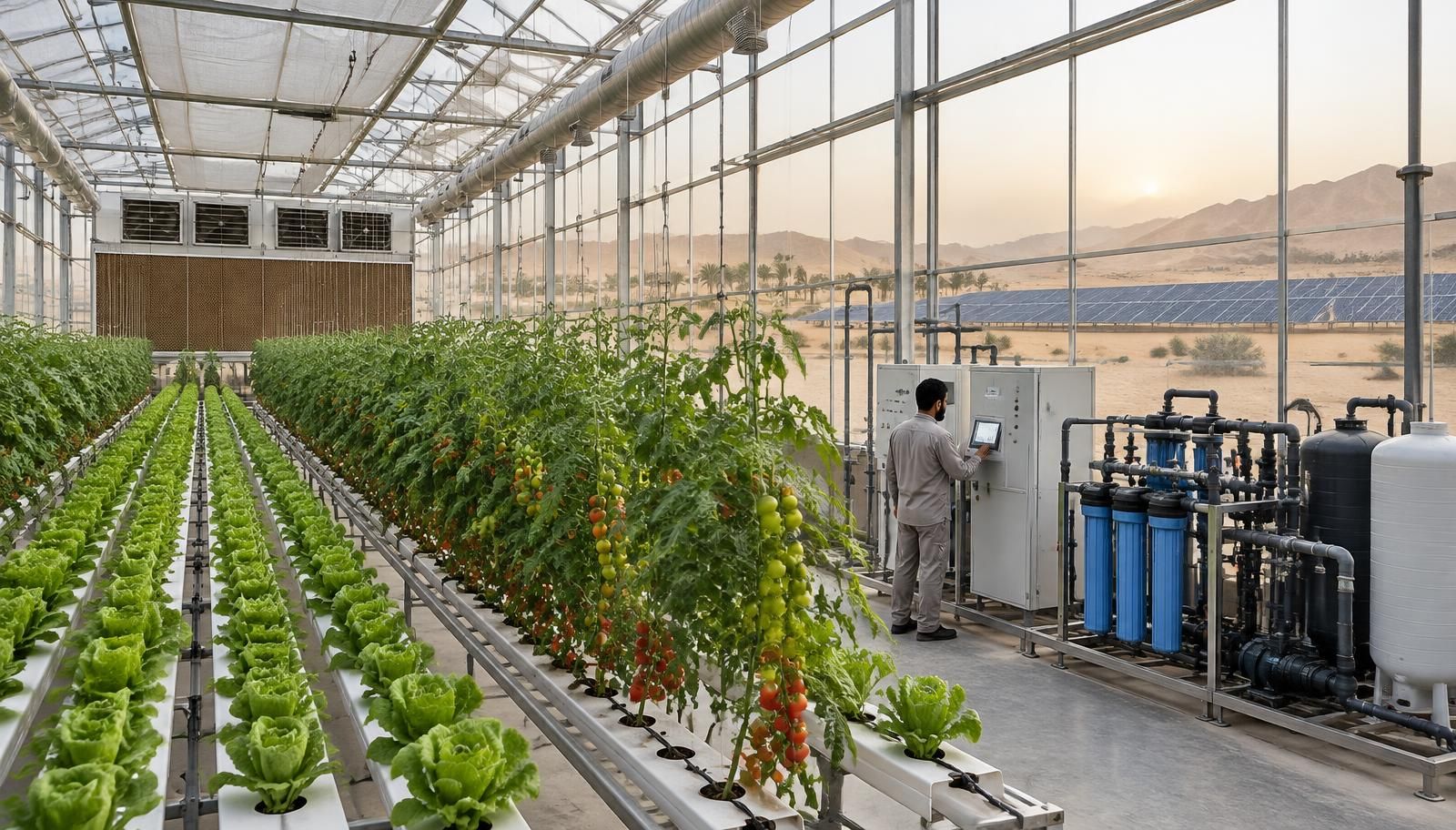
Key takeaways
- What does comparing greenhouse suppliers in the UAE actually mean?: Short answer: Comparing greenhouse suppliers in the UAE means sending every bidder the same technical brief — crop and offtake, site climate, cooling and dehumidification, water source and recirculation, lighting, contr…
- Why do UAE greenhouse proposals look so different from each other?: Because each supplier fills the gaps in your brief with its own standard design.
- Which crop and offtake decisions must come before any greenhouse supplier in the UAE?: Start with who will buy the produce, in what format and at what volume.
- How should you specify the climate envelope, cooling and dehumidification?: This is the largest source of difference between UAE proposals.
- What should a hydroponic farm in the UAE specify for water treatment and recirculation?: Water is both a cost and a risk.
What does comparing greenhouse suppliers in the UAE actually mean?
Short answer: Comparing greenhouse suppliers in the UAE means sending every bidder the same technical brief — crop and offtake, site climate, cooling and dehumidification, water source and recirculation, lighting, controls, energy, labour and commissioning — then normalising their proposals into one table of scope, landed cost, CAPEX, OPEX, risk and stated yield assumptions before you negotiate price.
That definition matters because UAE greenhouse and hydroponic projects rarely fail on structure alone. They fail when one bidder assumes pad-and-fan cooling, another assumes mechanical cooling, a third leaves water treatment to the buyer — and the buyer compares the headline prices anyway. The promise of this guide is narrow and practical: by the end, you will know what to put in your brief so that proposals for a commercial greenhouse in the UAE can be compared like for like.
SeedMatchGroup's role is on the buyer side. We help you scope requirements, structure the RFQ, compare normalised offers and assess supplier fit for projects of USD 250,000 or more. We are not the manufacturer, installer, operator, local supplier, regulator, investor or a source of financing, and we do not guarantee quotations, permits, funding or production results.
Why do UAE greenhouse proposals look so different from each other?
Because each supplier fills the gaps in your brief with its own standard design. The UAE combines very hot summers, high coastal humidity in Abu Dhabi, Dubai, Sharjah and the northern emirates, drier heat inland around Al Ain and Al Dhafra, dust loading, and a heavy reliance on desalinated or treated water. A supplier that normally builds for mild climates and a supplier that specialises in arid, semi-closed systems will propose very different envelopes, cooling equipment and energy loads for the same hectare.
When the brief is vague, those differences hide inside a single price. When the brief is specific, they become visible line items you can question.
Which crop and offtake decisions must come before any greenhouse supplier in the UAE?
Start with who will buy the produce, in what format and at what volume. Leafy greens in NFT channels, vine tomatoes on high-wire gutters, cucumbers and strawberries each drive different cooling, lighting, labour and packing requirements. Write down:
- The crop list and the share of area for each crop.
- The intended buyer type (retail, food service, export, processor) and any packing or cold-chain specification.
- Whether any offtake is agreed, in discussion or only assumed — and say so plainly in the brief.
- Planned production calendar, including whether you intend to grow through peak summer or pause.
Suppliers will often attach a yield figure to their proposal. Treat it as their assumption, ask what climate, cultivar, light and labour basis it uses, and keep it out of your financial model until you have tested it.
How should you specify the climate envelope, cooling and dehumidification?
This is the largest source of difference between UAE proposals. Specify the site's climate pattern (coastal humid or inland dry), the indoor targets you need for your crops, and the hours per year you expect to hold them. Then ask every supplier to answer the same questions:
- Which cooling approach is proposed (pad-and-fan, high-pressure fogging, mechanical or hybrid) and at which design dry-bulb and wet-bulb conditions?
- How is humidity removed when evaporative cooling cannot deliver enough on humid coastal days?
- Is the structure open, semi-closed or closed, and what screens, glazing or cladding support that choice?
- How are dust, sand and filter cleaning handled, and how often?
For a deeper cooling-only specification, use our UAE greenhouse cooling and climate automation RFQ guide.
What should a hydroponic farm in the UAE specify for water treatment and recirculation?
Water is both a cost and a risk. State your source (desalinated municipal supply, brackish well water, treated water), attach a recent analysis if you have one, and require each supplier to state the water-quality basis of their design. Ask how the proposal handles reverse-osmosis or other treatment, nutrient dosing, drain collection and recirculation, disinfection, condensate recovery and reject-water disposal. A supplier claiming a water-use figure must show the basis; no responsible supplier — and not SeedMatchGroup — can guarantee water savings before the system runs on your site.
Our drip irrigation UAE guide covers related irrigation scope if part of the project is open-field or substrate drip.
How do lighting, controls and energy change total cost?
Supplementary lighting is less common in UAE greenhouses than in northern Europe, but it can matter for vertical or indoor farms and some winter schedules. Ask whether lighting is included, at what intensity and photoperiod, and what electrical load it adds. For controls, require a list of what the climate computer measures and controls, data access and export, alarms, remote support, and integration with irrigation and cooling.
Energy is usually the dominant operating lever in a controlled environment agriculture UAE project because cooling runs for long hours. Ask every supplier for an estimated connected load, an annual energy profile with its assumptions, backup-power needs for controls and pumps, and whether PV or other on-site generation is assumed. Compare those figures in the free greenhouse CAPEX/OPEX/ROI scenario or, for hydroponic layouts, the hydroponic greenhouse feasibility calculator, using your own tariffs.
What labour, commissioning and service terms belong in the RFQ?
Ask suppliers to state the operating team their design assumes, the training they provide, who commissions the system and in which season, and what acceptance tests prove it performs. Commissioning in peak summer is a stress test of cooling and controls; say whether you want it scheduled or excluded. Require spare-parts lists, response times, local or remote service arrangements and warranty terms in writing. Do not assume a supplier has a local office or partner in the UAE — ask them to confirm it.
How do you compare greenhouse project UAE proposals side by side?
Normalise every offer into one comparison before negotiating. A practical checklist:
| Criterion | What to ask each supplier | Red flag |
|---|---|---|
| Scope coverage | Itemised list of what is included and excluded | Water treatment, controls or installation left "by others" without saying so |
| Climate design | Cooling approach and design conditions for your site | Generic "GCC" design with no site data |
| Water | Water-quality basis, recirculation and reject handling | Water-saving claim without a stated basis |
| Energy | Connected load and annual energy assumptions | No load figure, or PV assumed but not priced |
| Yield assumption | Crop, cultivar, light and labour basis behind any yield figure | Yield stated as a promise |
| Landed cost | Price delivered to site incl. freight, duties, installation | FOB or ex-works price compared with delivered prices |
| Commissioning | Season, acceptance tests, training | Handover without performance tests |
| Service | Spares, response time, warranty, local support | Verbal assurances only |
Score each criterion before you look at price. The supplier bid comparison scorecard gives a ready structure, and the hydroponic fit-out cost calculator helps you sanity-check fit-out lines with your own inputs.
Where do UAE agritech programmes fit — and what should you not assume?
Abu Dhabi's government describes the ADIO Innovation Programme as an AED 2 billion fund for research, development and innovation across high-growth sectors including agritech. That tells you agritech is a policy priority; it does not mean a given greenhouse project is eligible for support. Check eligibility directly with the programme.
In September 2021, the Abu Dhabi Media Office reported that ADQ unveiled plans for an AgTech Park in Al Ain Industrial City, with three controlled-environment agriculture partners to develop and operate greenhouse facilities. ADQ said it expects the 200-hectare park, once operational, to have an annual fresh produce capacity of 39 kilotons. Those are announced expectations, not delivered output, and they are not a benchmark for your project's yield.
Licensing, agricultural and environmental requirements are set by the relevant authorities, including the federal Ministry of Climate Change and Environment and, in Abu Dhabi, the Abu Dhabi Agriculture and Food Safety Authority. Requirements can differ by emirate and project type; confirm them before finalising scope. If financing is part of your plan, read agricultural import finance in the UAE — SeedMatchGroup does not arrange or guarantee funding.
What are the most expensive mistakes UAE greenhouse buyers make?
- Comparing prices before scopes are equal.
- Accepting a cooling design without site humidity data.
- Treating water treatment and reject disposal as an afterthought.
- Building a business case on a supplier's yield figure.
- Ignoring energy, labour and service in favour of CAPEX alone.
- Assuming local support, permits or programme funding without written confirmation.
How does SeedMatchGroup help you get comparable proposals?
We start from your outcome, not from a catalogue. A sourcing specialist reviews your brief, helps you complete the technical scope above, structures a comparable RFQ and, for projects of USD 250,000 or more, identifies manufacturers whose capability fits the site and crop. When proposals arrive, we help normalise them on scope, landed cost, CAPEX, OPEX, risks and stated assumptions so your team can decide. You choose whether and whom to contract; a shortlist is not an endorsement. Buyer-side tools and guides remain free, with no obligation.
If you are still shaping the wider project, start with commercial greenhouses in the UAE and controlled environment agriculture in the UAE, then build the request with the RFQ builder.
Before you approach suppliers, size the budget with the UAE greenhouse cost calculator (USD and AED, same bands as our cost guide plus the Gulf hot-arid uplift).
Next step: Request a technical brief and comparable greenhouse proposals. Projects of USD 250,000 or more qualify for assisted sourcing.
Evidence and method note
This guide was prepared on 14 October 2026 from the official sources linked above (Abu Dhabi Government — investing in innovation; Abu Dhabi Media Office — ADQ AgTech Park) and from SeedMatchGroup's buyer-side RFQ structure. It contains no customer results, supplier counts, prices, ROI figures or yield benchmarks. Programme details and authority requirements change; verify them at source before relying on them.
Turn "UAE Greenhouse and Hydroponics Projects: How to Compare Suppliers on Water, Energy and Yield" into your RFQ
Answer a few questions and we will draft a structured RFQ you can review, edit and submit to our independent supplier network.
Frequently asked questions
- How do I compare greenhouse suppliers in the UAE?
- Send every supplier the same technical brief covering crop, offtake, site climate, cooling, water, energy, controls, labour and commissioning, then compare scope, landed cost, CAPEX, OPEX and stated assumptions in one table before negotiating price.
- What cooling system is best for a commercial greenhouse in the UAE?
- There is no single best system. Pad-and-fan works better in dry inland heat; humid coastal sites often need dehumidification, fogging limits or mechanical support. Ask each supplier for its design conditions and humidity strategy for your exact site.
- Can a supplier guarantee water savings or yield for a hydroponic farm in the UAE?
- No proposal should be treated as a guarantee. Water use and yield depend on crop, climate control, water quality, management and labour. Ask for the basis behind any figure and test it in your own model.
- Does SeedMatchGroup build or operate greenhouses in the UAE?
- No. SeedMatchGroup is a buyer-side procurement and matching platform. It helps scope requirements, structure RFQs and compare normalised proposals; it is not a manufacturer, installer, operator, regulator, investor or lender.
- What is the minimum project size for assisted sourcing?
- Assisted B2B sourcing is for greenhouse and controlled-environment projects of USD 250,000 or more. Free planning tools and guides are available to any buyer without obligation.
- Is my UAE greenhouse project eligible for the ADIO Innovation Programme?
- Not automatically. Abu Dhabi describes the programme as an AED 2 billion fund covering sectors including agritech, but eligibility must be confirmed directly with the programme. SeedMatchGroup does not assess or guarantee funding eligibility.
Move from reading to sourcing
The pages below carry the commercial detail for this topic — cost ranges, supplier verification, specification checklists and financing routes.