
Greenhouse Fertigation and Drain-Water Recirculation RFQ: Water, Dosing, Disinfection and Acceptance
How to specify a commercial greenhouse fertigation and drain-water recirculation package before asking for quotes: water evidence, storage, filtration, dosing, disinfection, sensors, control interfaces, commissioning and acceptance.
What must a fertigation RFQ include before suppliers can quote?
Representative water analyses, peak demand and valve layout, recipe requirements, drain reuse targets, disinfection objectives, sensor and interface requirements and acceptance tests.
Key takeaways
- Short answer: Before requesting quotes for a greenhouse fertigation and recirculation system, write a specification that fixes the duty: source-water evidence, peak and daily irrigation volumes, the number of nutrient recipes, drain…
- Who this guide is for: It is written for commercial greenhouse growers, investors and project managers procuring substrate or soil-based fertigation, especially where drain water will be collected and reused.
- Step 1: Assemble water evidence first: Every fertigation design depends on the water it starts with.
- Step 2: Fix volumes, peaks and storage: State the irrigated area per valve or compartment, the crops, the expected peak daily water demand and the maximum number of simultaneous valves.
- Step 3: Define recipes and dosing architecture: Describe how many nutrient recipes you need to run at the same time, whether different crops or growth stages share a mixing unit, and how quickly recipes must change.
Short answer
Before requesting quotes for a greenhouse fertigation and recirculation system, write a specification that fixes the duty: source-water evidence, peak and daily irrigation volumes, the number of nutrient recipes, drain collection and reuse targets, disinfection objectives, required measurements, interfaces with the climate computer, and the tests that prove the system works. Suppliers can then design to the same duty. This guide covers that specification stage; once proposals arrive, use our separate guide on how to compare irrigation and fertigation proposals.
Who this guide is for
It is written for commercial greenhouse growers, investors and project managers procuring substrate or soil-based fertigation, especially where drain water will be collected and reused. Recirculation can reduce water and fertilizer discharge, but it adds treatment, monitoring and operating discipline. The RFQ is where you decide how much of that complexity you want suppliers to deliver.
Step 1: Assemble water evidence first
Every fertigation design depends on the water it starts with. Provide representative laboratory analyses of each source—well, surface, rainwater or desalinated water—covering at least pH, EC, alkalinity or bicarbonate, major ions, sodium, chloride, boron, iron and manganese, with sampling dates and seasonal gaps stated. If drain water will be reused, explain how its quality will be monitored, because sodium and chloride tend to accumulate in closed systems. Where evidence is missing, say so in the RFQ rather than letting each supplier assume clean water. Our guide on why water analysis must come before treatment and fertigation design explains this in more depth.
Step 2: Fix volumes, peaks and storage
State the irrigated area per valve or compartment, the crops, the expected peak daily water demand and the maximum number of simultaneous valves. Peak demand drives pump, filter, dosing and disinfection capacity, so do not quote only an annual average. Use the crop water requirement calculator to frame demand and the greenhouse water storage calculator to explore buffer volumes for raw water, clean drain and reject streams. These are indicative tools; final figures need confirmation by the designer with local climate and crop data.
Step 3: Define recipes and dosing architecture
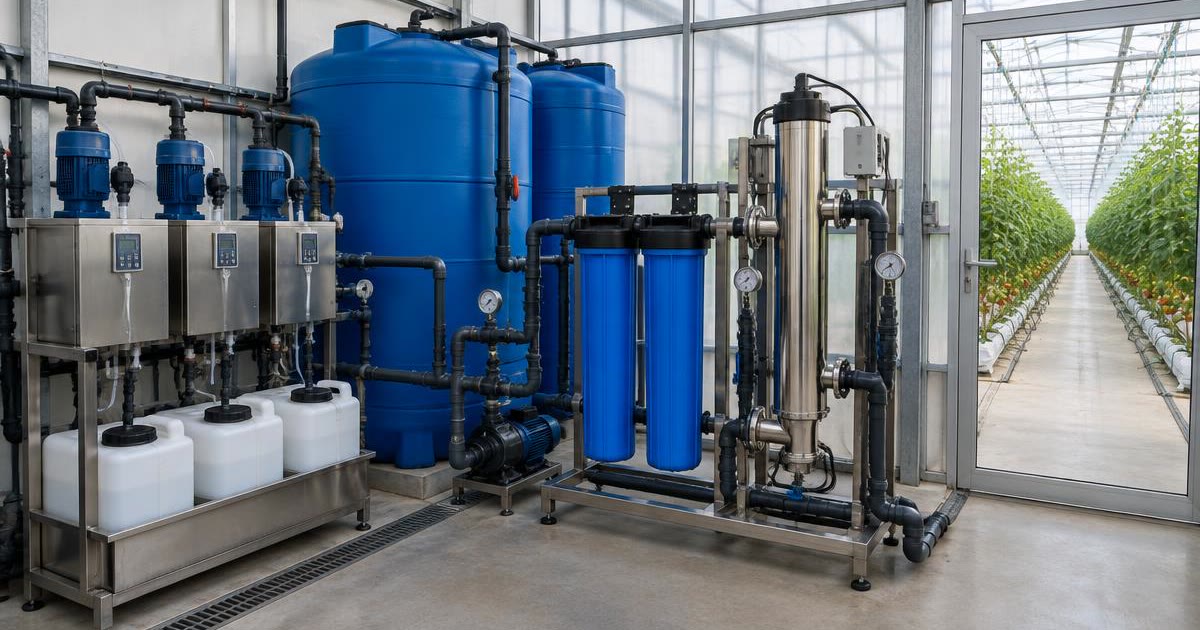
Describe how many nutrient recipes you need to run at the same time, whether different crops or growth stages share a mixing unit, and how quickly recipes must change. Ask suppliers to propose the number of stock tanks and their separation (for example keeping calcium apart from sulphates and phosphates), injection method, acid or base dosing, mixing and sampling points, and how EC and pH are controlled and verified. The fertigation calculator can help you test nutrient arithmetic once inputs are known, and the fertigation head-station cost calculator gives an indicative budget frame—neither replaces a qualified nutrient plan or safe chemical-handling design.
Step 4: Specify drain collection, reuse and disinfection
If you will recirculate, specify how drain is collected from gutters or slabs, the storage before and after treatment, the target share of drain reuse, and the blending strategy with fresh water. Disinfection technologies—UV, heat treatment, slow sand filtration, oxidation and others—differ in capacity, energy use, pre-filtration needs and how performance is verified. State the objective (for example reducing waterborne pathogen risk at the dosing inlet) and ask each supplier to justify its method, show the pre-treatment it depends on, and describe how effectiveness is checked in operation. The drainage recirculation calculator helps frame drain volumes and reuse scenarios as planning estimates.
Step 5: List sensors, alarms and control interfaces
Require EC and pH measurement after mixing (and, where justified, at the drip line), flow meters per valve or group, pressure before and after filters, tank levels, and drain measurements of volume, EC and pH. Ask for calibration routines and redundancy on critical sensors. Define the interface with the climate computer: which unit decides irrigation start, how radiation-based or moisture-based triggers are passed, and what happens on communication loss. Alarms for high or low EC, pH deviation, low flow, filter blockage and disinfection failure should stop dosing safely.
Step 6: Use a specification checklist
Send the same checklist to every supplier and require written answers.
| Specification item | Buyer provides | Supplier must state |
|---|---|---|
| Source water | Laboratory analyses and seasonal gaps | Treatment assumed and limits accepted |
| Demand | Area, valves, crops, peak daily demand | Pump, filter and dosing capacity at peak |
| Recipes | Number of simultaneous recipes and change speed | Tank separation, injection and control method |
| Drain reuse | Reuse target and blending policy | Collection, storage and treatment design |
| Disinfection | Objective and inlet/outlet points | Method, pre-treatment and verification approach |
| Measurement | Required parameters and locations | Sensor models, accuracy and calibration plan |
| Interfaces | Climate computer and data requirements | Protocol, responsibilities and fail-safe behaviour |
| Acceptance | Test list and witness points | Commissioning procedure and records |
Step 7: Write acceptance tests into the RFQ
Define how you will accept the installation: flow and pressure checks per valve at stated operating conditions, EC and pH accuracy against a calibrated handheld reference, recipe switching tests, alarm and shutdown tests, disinfection unit performance checks according to the supplier's method, and handover of drawings, settings, chemical safety data, operator training and spare-part lists. Agree tolerances and who witnesses each test. Uniformity checks of drip lines are often worth including where the irrigation network is in scope.
Step 8: Ask for operating cost transparency
Recirculation changes running costs: energy for pumps and disinfection, lamp or media replacement, acids and cleaning chemicals, laboratory monitoring and operator time. Ask suppliers to list consumables and maintenance intervals with assumptions visible, and compare scenarios with and without drain reuse. Avoid proposals that promise fixed water or fertilizer savings without describing the measurement basis.
Step 9: Plan responsibilities after handover
Recirculating systems depend on routine work: calibrating EC and pH probes, cleaning filters and tanks, replacing UV lamps or filter media, checking drain quality and adjusting recipes when sodium or chloride rises. Ask each supplier which tasks the operator performs, which require a service visit, the recommended frequency and the training provided. Request a spare-parts list for critical items such as dosing pumps, probes and disinfection components, with expected availability. Clarify remote support terms and who may change setpoints. Where the buyer lacks in-house skills, consider asking for an optional first-season support package priced separately so it can be compared on its own merits.
Common mistakes
- Issuing an RFQ without representative source-water analyses.
- Sizing on average demand and discovering peak shortfalls in summer.
- Ignoring sodium and chloride build-up in closed loops.
- Choosing a disinfection method without stating the objective and verification.
- Leaving the climate-computer interface undefined.
- Accepting "commissioning" without measurable tests and records.
Next step
Compile water reports, demand figures, recipe needs and reuse objectives, then structure them with the fertigation RFQ or the irrigation RFQ. For projects from USD 250,000, SeedMatchGroup is a human-led commercial agriculture platform supported by proprietary technology. A sourcing specialist reviews every brief before any manual supplier outreach. SeedMatchGroup is not a manufacturer, seed company, engineering contractor, lender, certification body or open marketplace, and it does not guarantee quotations, timing, prices or project outcomes.
Sources and further reading
Independent context: FAO Irrigation and Drainage Paper 29, Water quality for agriculture; Penn State Extension, water quality toolkit for greenhouse and nursery production. Industry reading on consistent irrigation decisions: Priva, how consistent irrigation choices drive crop uniformity. These resources do not endorse SeedMatchGroup, and SeedMatchGroup has no affiliation with them.
Turn "Greenhouse Fertigation and Drain-Water Recirculation RFQ: Water, Dosing, Disinfection and Acceptance" into your RFQ
Answer a few questions and we will draft a structured RFQ you can review, edit and submit to our independent supplier network.
Frequently asked questions
- What must a fertigation RFQ include before suppliers can quote?
- Representative water analyses, peak demand and valve layout, recipe requirements, drain reuse targets, disinfection objectives, sensor and interface requirements and acceptance tests.
- Is drain-water recirculation always worthwhile?
- Not always. It can reduce discharge and inputs but adds treatment, monitoring and operating effort; compare scenarios with and without reuse using stated assumptions.
- Which disinfection method should I specify?
- Specify the objective and verification approach and let suppliers justify a method; suitability depends on water quality, volumes, pre-filtration and operating skills.
- Why does peak demand matter more than annual use?
- Pumps, filters, dosing and disinfection must meet the highest simultaneous demand; sizing on averages causes summer shortfalls.
- How is this different from comparing proposals?
- This guide covers writing the specification before bids. Once proposals arrive, use the separate comparison guide to normalise scope and exclusions.
Move from reading to sourcing
The pages below carry the commercial detail for this topic — cost ranges, supplier verification, specification checklists and financing routes.