
Procurement playbook
Procurement Project Playbook: From Idea to Specification, Gantt, Budget, RFQ, Supplier Scorecard and Delivery
A practical playbook for buying seeds, greenhouses and irrigation systems: seven decision gates, a dated Gantt plan, a risk register, a weighted supplier scorecard and acceptance checks — with free editable templates and links to the SeedMatch tools that support each step.
SeedMatchGroup editorial team ·
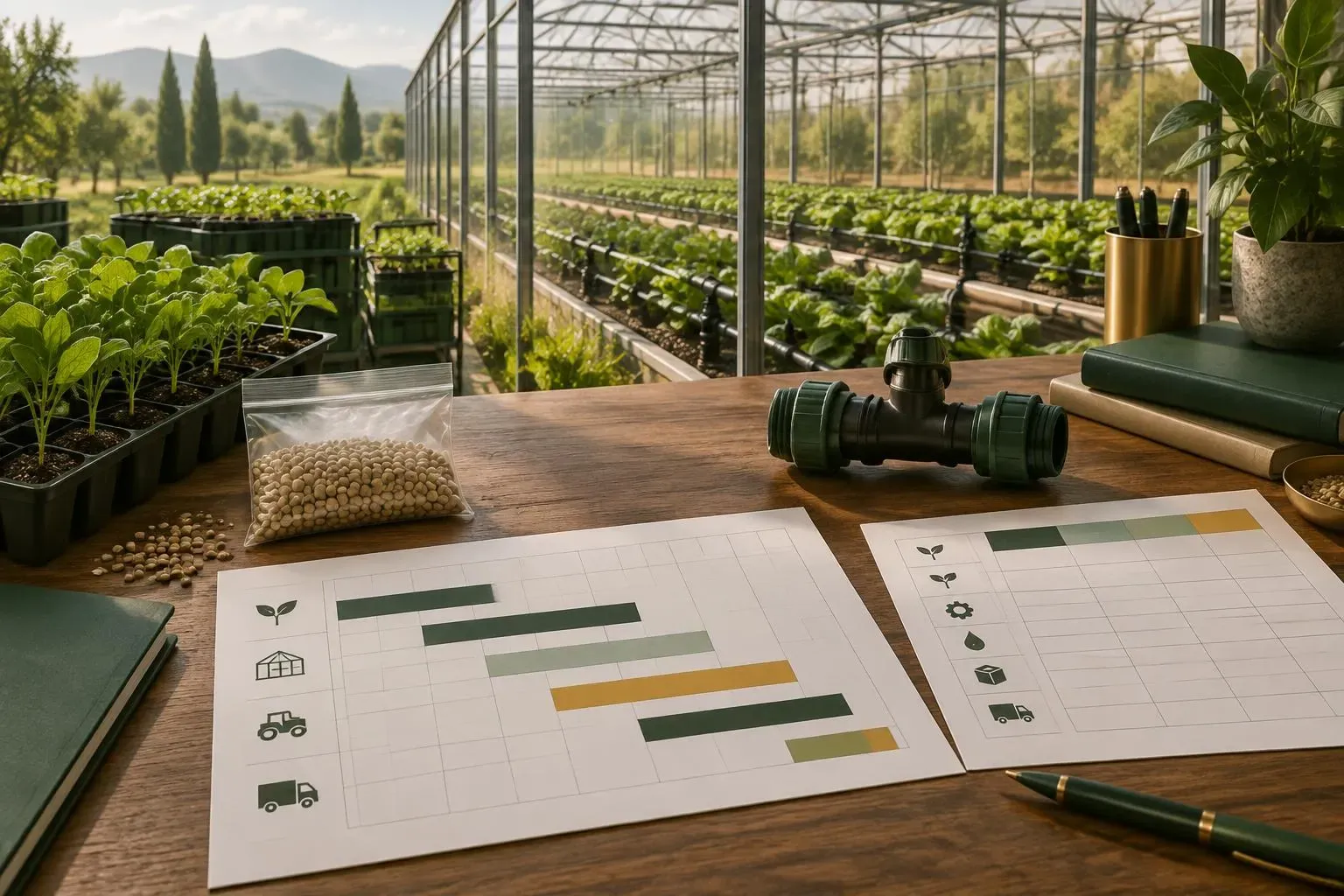
A procurement project succeeds when every purchase decision is made against written evidence, in the right order, by a named person. This playbook gives seed, greenhouse and irrigation buyers a repeatable method: seven decision gates (G0–G6), a dependency-aware timeline, a risk register, a weighted supplier scorecard and acceptance checks. Each step links to a SeedMatch tool you can use today and to an editable template you can download.
What this playbook is — and what it is not
It is a working method for professional growers, agribusinesses, investors and public programmes buying commercial agricultural projects. It complements our earlier article on the Knowledge Center, which explains how to research before buying. This guide is about running the purchase itself. It does not replace engineering design, agronomic advice, legal review or financing approval; where those decisions arise, the playbook tells you which evidence a qualified professional should check.
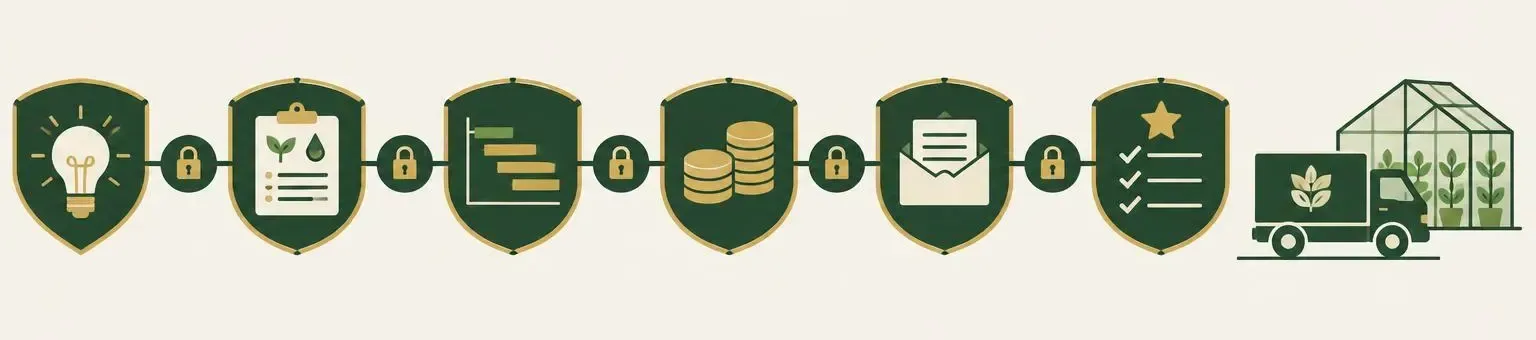
The seven decision gates
A gate is a short meeting or review where you decide whether the project may move on. The rule is simple: no evidence, no gate. A missing water analysis or seed certificate is recorded as open — not filled with a guess.
G0 — Idea and business case
Write the commercial outcome in one sentence: crop, output, market and timing. Name the person who approves budget. If a return-on-investment question exists, test it with the greenhouse ROI calculator as a scenario, not a promise.
G1 — Specification
This is where most agricultural purchases fail. For seeds, state crop, variety, destination, sowing method, minimum germination and purity, the test method and the purity basis. Seed lots are commonly tested under the ISTA International Rules for Seed Testing; varietal certification may follow the OECD Seed Schemes. For irrigation, attach a dated laboratory water analysis and the crop water-demand basis — the FAO Irrigation and Drainage Paper 56 method is a widely used reference. For greenhouses, record usable area, climate, power connection and access.
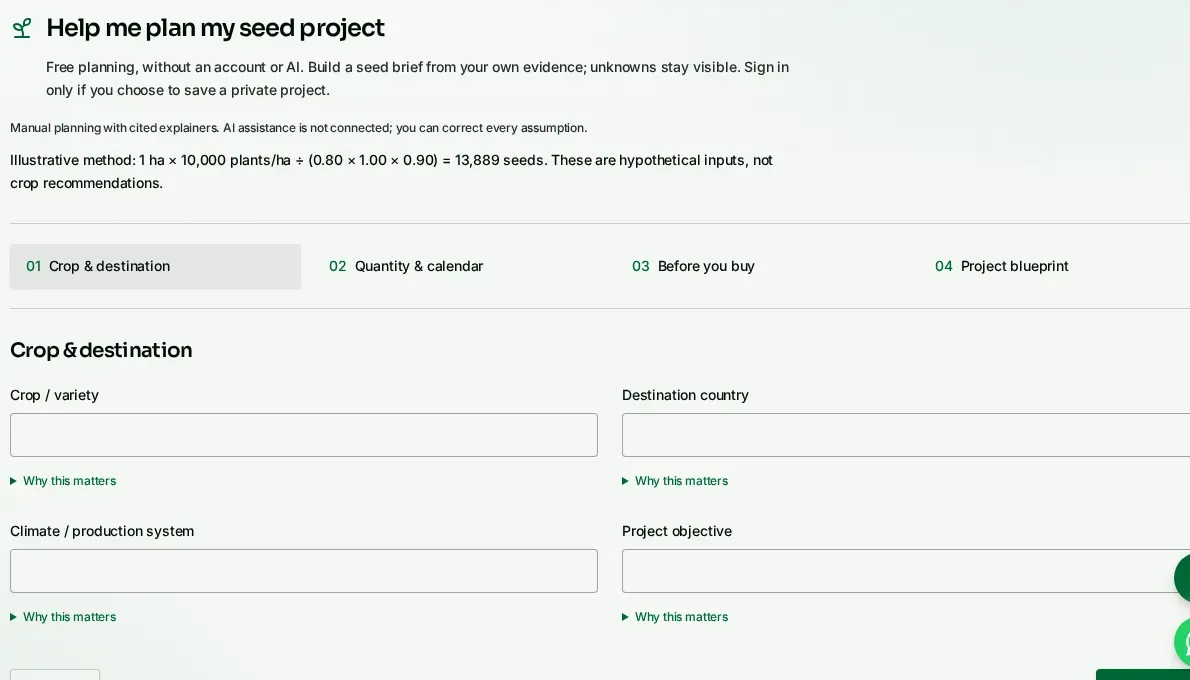
The public seed planning flow helps turn these inputs into a written blueprint, without an account. It shows its arithmetic. Worked example from the tool: 1 ha × 10,000 plants per ha ÷ (0.80 germination × 1.00 purity × 0.90 field establishment) = 13,889 seeds. For a hypothetical 2 ha block with the same inputs: 20,000 ÷ 0.72 = 27,778 seeds. You can check that with a calculator; the inputs are illustrative, not crop recommendations.
G2 — Plan and Gantt timeline
Turn the specification into tasks with owners, start and end dates and dependencies. Work backwards from the planting window: the latest acceptable seed arrival date, minus import clearance, minus shipping, minus production or picking time. Mark each duration as supplier-confirmed or assumed. Long-lead items — greenhouse structure, pumps and filtration, climate computers, certified seed of a specific variety — usually set the critical path.
The free procurement project workspace (sign-in required, no payment) lets you build this as tasks, subtasks and dependencies on a Gantt timeline, list, board or calendar, starting from a seed production, greenhouse, irrigation or processing template. The public procurement timeline guide explains typical phases and evidence gates.
G3 — Budget
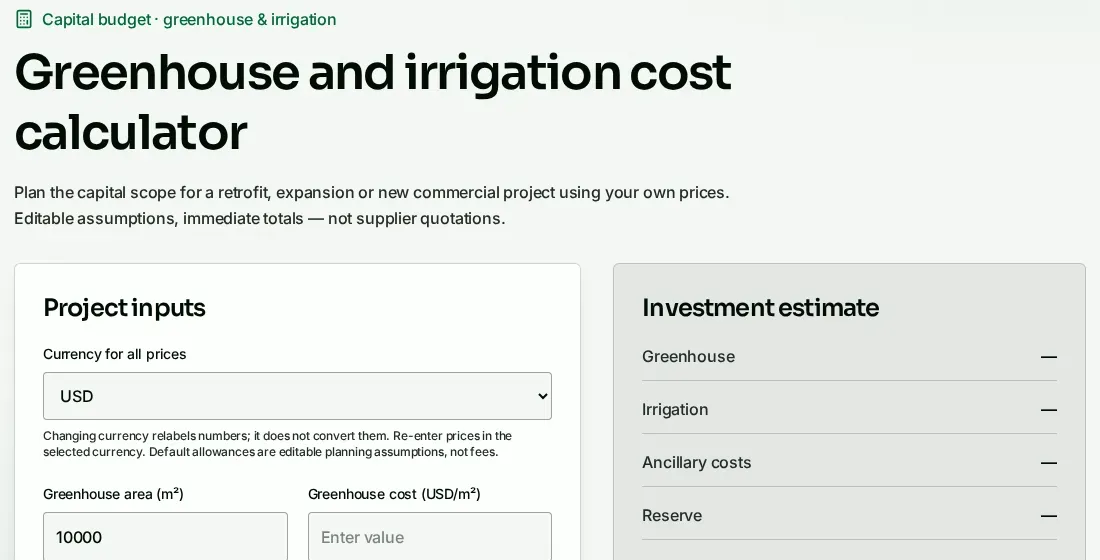
Separate capital expenditure (structure, irrigation, installation) from annual operating costs (energy, water, labour, inputs). Record each figure with its currency and price date, and keep estimated, quoted, committed and actual values in separate columns — they are different facts. Choose your own contingency and write down why. The greenhouse and irrigation cost calculator works with your own prices; it does not convert currencies or supply market quotes.
G4 — RFQ
Send one identical scope to every bidder: quantities, specifications, currency, delivery terms (Incoterm), installation responsibilities, warranty, required documents and an explicit exclusions list. For seed, request the test certificate, lot number, origin and the phytosanitary route; your national plant protection organisation confirms import requirements. The RFQ builder structures a private request that a SeedMatch sourcing specialist reviews before any supplier is approached, and the RFQ checklist helps you find gaps.
G5 — Scorecard and award
Agree criteria and weights before opening offers, then normalise each offer to the same currency, date and scope. Price an exclusion or flag it; never read a missing line as a saving. A hypothetical example with five criteria weighted 30/25/15/15/15 (technical compliance, total cost, delivery, warranty and service, documentation) and scores from 1 to 5:
Offer A scores 4, 3, 4, 3, 5 → 0.30×4 + 0.25×3 + 0.15×4 + 0.15×3 + 0.15×5 = 3.75. Offer B scores 3, 5, 3, 4, 3 → 0.90 + 1.25 + 0.45 + 0.60 + 0.45 = 3.65. The cheaper offer B does not win, because its technical gaps outweigh the price advantage under the weights the team agreed in advance. Change the weights and the result may change — which is why they are fixed first. Our supplier scorecard guide goes deeper on criteria.
G6 — Delivery, commissioning and acceptance
Define acceptance before you pay the final instalment: a commissioning checklist for irrigation (pressure, flow uniformity, filtration, dosing), a structural and climate-system handover for greenhouses, and a seed arrival check that matches lot numbers to certificates and, where agreed, re-tests a sample. Record any deviation with photos and dates.
Keep a living risk register
List risks with likelihood and impact from 1 to 5; the score is their product. Hypothetical examples: seed germination below specification (2 × 5 = 10), unknown irrigation water quality (3 × 4 = 12), import or phytosanitary delay (3 × 3 = 9). Each risk needs an early warning sign, a mitigation and an owner. Review it at every gate. The greenhouse procurement risk matrix shows additional risk categories for public and donor-funded projects.
Download the editable templates
The four templates below are free CSV files that open in Excel, Google Sheets or LibreOffice. Example rows are labelled hypothetical; replace them with your own evidence.
- Decision-gate checklist (G0–G6)
- Risk register
- Weighted supplier scorecard
- Timeline / Gantt task list
- CSV · opens in Excel, Google Sheets or LibreOffice · English column headings
How SeedMatch differs from a generic project-management tool
General project tools and spreadsheets are flexible and often stronger at broad team collaboration, integrations and resource planning. If your organisation already runs one well, keep it — the templates here import as CSV. What SeedMatch adds is agricultural context: seed, greenhouse, irrigation and processing templates; a budget that keeps estimated, quoted and actual values apart; manual offer comparison; and a human sourcing specialist who reviews a request before suppliers are contacted. Supplier identities and contact details are not shown to buyers without approval. We do not claim to be the best tool for every team; we aim to be useful for this specific kind of purchase.
Financing, only where it applies
The financing center explains pathways for commercial agriculture projects. Any financing remains subject to each provider's own eligibility and approval; this playbook does not imply that a project will be funded.
A one-page summary
G0 objective and approver → G1 specification with dated evidence → G2 timeline from the planting window → G3 budget with currencies and price dates → G4 one scope to every bidder → G5 weights before offers → G6 acceptance before final payment. When you are ready, open the procurement tools or start a free workspace.
Questions buyers ask
- What is a procurement project plan for an agricultural project?
- It is a written sequence of decisions, tasks, owners, dates, budget lines and acceptance criteria for buying seeds, greenhouse structures, irrigation or processing equipment. This playbook organises it into seven gates, G0 to G6.
- Which seed documents should an RFQ request?
- Typically the lot number, origin, a recent germination and purity test certificate with its method (for example ISTA), varietal certification where applicable (for example OECD Seed Schemes) and the phytosanitary route your national plant protection organisation requires.
- How do I build a supplier scorecard?
- Choose criteria and weights before opening offers, normalise each offer to the same currency, date and scope, score each criterion from 1 to 5, multiply by the weight and add. The downloadable scorecard template does the layout for you.
- Is the SeedMatch project workspace free?
- Yes. The core project workspace — tasks, Gantt timeline, budget and offer comparison — is free after sign-in. The calculators and this playbook's templates are public and need no account.
- Does SeedMatch connect me directly with suppliers?
- No. A SeedMatch sourcing specialist reviews your request first. Supplier introductions are handled manually after project review, and supplier contact details are not shared without approval.