
Planning specialty crop production from inputs to market requirements
Reviewed 2026-10-19
Short answer
Plan a high-value crop backwards from the market: confirm site and climate fit, choose cultivar and rootstock, then specify nursery stock, irrigation, fertigation and the post-harvest chain needed to meet the pack-out buyers expect. SeedMatch helps buyers specify and procure these inputs and infrastructure; it does not sell harvested fruit, promise yields or confirm varieties without documents.
Key terms
- Specialty crop
- A high-value fruit, vegetable or nursery crop grown to a tight quality specification, such as sweet cherries, berries or table grapes.
- Rootstock
- The root system a fruit cultivar is grafted onto; it influences tree vigour, planting density and time to first crop.
- Pack-out
- The share and grades of harvested fruit that meet the buyer's packed specification for size, colour, firmness and defects.
1. Site and climate fit
Confirm the site before choosing anything else. Stone fruit such as cherries need enough winter chill for the chosen cultivar, are vulnerable to spring frost at bloom and can crack when rain falls close to harvest. Collect chill records, frost history, harvest-month rainfall, soil drainage and water availability from local sources. If the site needs frost protection, rain covers or hail netting, include them in the capital budget from the start. Cherries are an orchard crop: covers protect an orchard, they do not make it a greenhouse.
2. Cultivar and rootstock
Cultivar sets the harvest window and market fit; rootstock sets vigour, density and how quickly the orchard bears. Many recent cultivars and rootstocks are protected varieties, so confirm licensing, royalties and propagation rights with the rights holder and nursery. Ask for plant-health certificates and check your national plant-protection authority's import rules before ordering.
3. Nursery stock and establishment
Specify tree type, caliper, rootstock, quantity, delivery season and cold-storage needs. Establishment usually spans more than one season, so phase deliveries and budget for trellis or support systems, protection structures and replacements.
4. Irrigation and fertigation
Drip irrigation with fertigation lets nutrients follow growth stage and the real water analysis. Size the head station, filtration and storage from the actual source, and attach the water analysis so every supplier quotes the same system.
5. Harvest window and labour
High-value fruit often has a short harvest window. Plan picking labour, field bins, shade and fast transfer to cooling. Combining cultivars with different timing can spread peak labour and packhouse load.
6. Pack-out and post-harvest
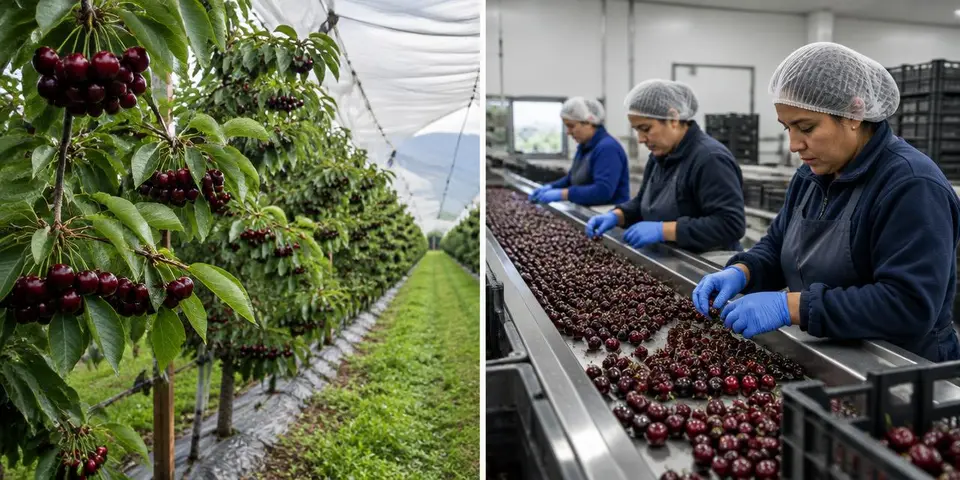
Downstream buyers specify size grading, firmness, colour, defect limits, packaging and residue limits. Write down the pack-out you are aiming for before sizing the packhouse: grading capacity, rapid cooling, cold rooms and cold-chain handling all follow from it.
7. Market requirements
If you plan to sell to importers or retailers, list the food-safety certifications, traceability and documents they require early, because they shape orchard records and packhouse design. Buyers of harvested fruit are served separately by Global B2B Group's produce sourcing.
Project request checklist
- Site data: chill, frost, harvest-month rainfall, soil and water analysis
- Target cultivars, rootstocks and licensing status
- Nursery stock specification, quantity and delivery season
- Frost protection, rain covers or netting, if needed
- Irrigation and fertigation scope sized from the water source
- Harvest window, labour plan and field-to-cooling time
- Target pack-out: grades, packaging and buyer documents
- Packhouse, cooling and cold-room capacity
- Total project value (qualified requests from USD 250,000) and phasing
These are general planning considerations. Confirm thresholds for your site and cultivar with local agricultural advisers or an agronomist.
Related tools and pages
Buyer questions
Are cherries a greenhouse crop?
Commercial cherries are mainly an orchard crop. Some growers add rain covers, tunnels or netting to manage rain and hail, but that is orchard protection, not a closed greenhouse.
Does SeedMatch sell cherries or other fruit?
No. SeedMatch helps buyers specify and procure production inputs and infrastructure. Buyers of harvested fruit can use Global B2B Group's produce sourcing.
Does SeedMatch supply fruit trees?
Requests for nursery stock and propagation infrastructure are reviewed case by case. We do not publish variety availability; licensing must be confirmed with the rights holder and supplier.
Can you tell me the yield or income to expect?
No. Yield and income depend on site, climate, cultivar, management and markets. Use local extension data and an agronomist's assessment.
What is the minimum project size?
Qualified project requests start at USD 250,000 total project value. Guides and tools are free, and submitting a request is free for buyers.
Ready to specify the project?
A sourcing specialist reviews every request before any supplier is approached. Qualified projects from USD 250,000; free for buyers.
Start a project request