
Selling Greenhouse Tomatoes, Cucumbers, Peppers and Herbs to Commercial Buyers: The Specification Checklist
Register as a produce sellerA grower-side checklist for offering greenhouse tomatoes, cucumbers, peppers and herbs to commercial buyers: crop and variety, grade and size, harvest window, volume, pack format, origin, cold-chain capability and documentation — everything declared, nothing implied.
What do commercial buyers need before they will discuss volume?
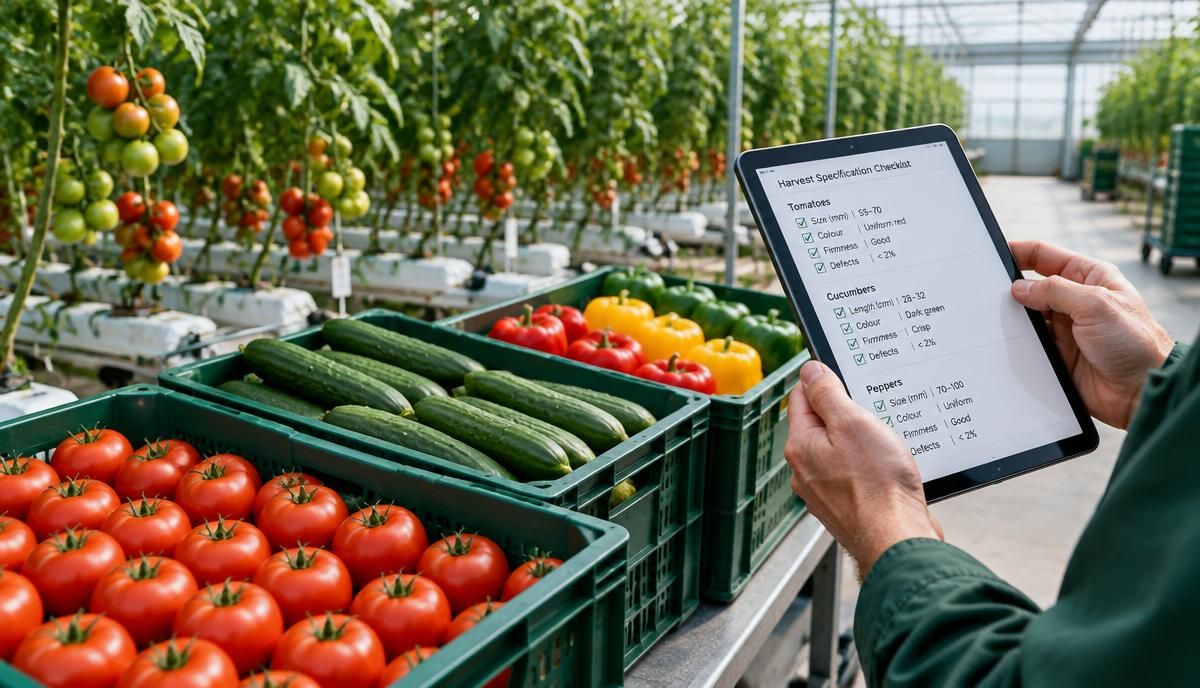
A written specification: crop and variety type, grade and size with tolerances, harvest window, volume per period, pack format, origin, cold-chain capability and documentation. Volume without a specification is not an offer a professional buyer can evaluate.
Key takeaways
- 1. Crop and variety — as the market buys it: State the product the way the trade buys it, not only the agronomic name.
- 2. Grade and size — with tolerances, in writing: There is no single global grade table for most greenhouse crops; grading schemes vary by market and commodity.
- 3. Harvest window and volume cadence: Buyers plan in rhythms.
- 4. Pack format and packout capability: Describe the pack as part of the product: box or crate format and net weight, trays or loose fill, labelling and barcoding capability, pallet pattern and height.
- 5. Origin and cold-chain capability: Origin sets transit time, phytosanitary documentation and which markets are realistic.
Short answer: commercial buyers do not buy 'tomatoes' — they buy a written specification: crop and variety type, grade and size with tolerances, harvest window, volume per period, pack format, origin, cold-chain capability and documentation. Growers who prepare that specification before approaching buyers get serious answers; growers who offer ungraded volume get polite silence. This checklist is what to prepare. It is the seller-side companion to our buyer's guide to greenhouse tomatoes.
It is written for commercial greenhouse growers and producer-exporters. SeedMatch reviews managed produce-sourcing opportunities from USD 250,000 in total annual or seasonal programme value — not per shipment — and every offer is staff-reviewed before any buyer sees it.
1. Crop and variety — as the market buys it
State the product the way the trade buys it, not only the agronomic name. For tomatoes: truss, loose round, cherry/cocktail or plum type. For cucumbers: long English, snack or pickling type. For peppers: colour, blocky or pointed type. For herbs: cut vs potted, and the specific herb. Include the variety name where it matters to the buyer's programme, and note whether the variety is established in your target market or new to it.
2. Grade and size — with tolerances, in writing
There is no single global grade table for most greenhouse crops; grading schemes vary by market and commodity. What makes an offer credible is a written standard you actually grade to: size band or count, colour stage, firmness, defects allowed, and the tolerance on each. Where a neutral reference applies to your market — Codex Alimentarius standards or national marketing standards — cite it (Codex Alimentarius). If you hold a food-safety certification, name the scheme, scope and validity dates exactly as issued; never claim a certification you cannot document.
3. Harvest window and volume cadence
Buyers plan in rhythms. State: your first and last harvest dates for the offer, peak weekly volume in the main window, and total volume across the offer period. Be honest about ramp-up and ramp-down — a programme that assumes peak volume in week one fails on first delivery. If your window depends on planting decisions not yet made, say so; a conditional window is useful, an invented one is not.
4. Pack format and packout capability
Describe the pack as part of the product: box or crate format and net weight, trays or loose fill, labelling and barcoding capability, pallet pattern and height. State your packout reality — grading line, cooling capacity, dispatch rhythm — because buyers will test delivered quality against it. Post-harvest handling and temperature management largely decide whether the grade you packed is the grade that arrives; the FAO's post-harvest resources are a useful neutral reference (FAO post-harvest).
5. Origin and cold-chain capability
Origin sets transit time, phytosanitary documentation and which markets are realistic. State your farm or packhouse location, the ports or corridors you can serve, and your cold-chain capability: pre-cooling, cold storage, refrigerated transport access, and whether temperature is recorded in transit. For cross-border offers, phytosanitary requirements are set by the destination country's plant protection authority under the IPPC framework and vary by commodity and destination — confirm them with the official authority before promising a route.
6. Documentation and traceability
Prepare the document set before the first conversation: company registration, export licences where applicable, food-safety or quality certifications with scope and dates, product specifications with photographs, packing specifications, and lot-level traceability (which greenhouse, which harvest date, which packout run). Commercial buyers increasingly require traceability per lot; state what you can provide and in what format.
The seller's offer checklist
- Crop and variety type as the market buys it, with tolerances stated.
- Grade and size standard in writing, with the reference scheme where one applies.
- Harvest window: first/last dates, peak weekly volume, total offer volume.
- Pack format, packout capability, cooling and dispatch rhythm.
- Origin, serviceable corridors and cold-chain capability.
- Documents: registration, certifications with dates, specifications, traceability per lot.
- Everything declared and verifiable — no implied certifications, stock or buyer commitments.
How SeedMatch helps sellers
SeedMatch is a human-led sourcing platform, not a public marketplace. Growers register through our confidential seller intake; every offer is reviewed by our team before any buyer sees it, your identity stays private until you consent to an introduction, and we never publish seller profiles or contact details. Managed opportunities start at USD 250,000 in programme value; below that threshold your registration stays a private draft. We do not guarantee a sale, a buyer, a price or an offtake — we run a reviewed, confidential matching process.
Turn "Selling Greenhouse Tomatoes, Cucumbers, Peppers and Herbs to Commercial Buyers: The Specification Checklist" into your RFQ
Answer a few questions and we will draft a structured RFQ you can review, edit and submit to our independent supplier network.
Frequently asked questions
- What do commercial buyers need before they will discuss volume?
- A written specification: crop and variety type, grade and size with tolerances, harvest window, volume per period, pack format, origin, cold-chain capability and documentation. Volume without a specification is not an offer a professional buyer can evaluate.
- Is there one international grading standard I should use?
- No single global grade table exists for most greenhouse crops. Use a written standard with tolerances that you actually grade to, referencing Codex or national marketing standards where they apply to your target market, and make sure handling and temperature preserve the grade to the delivery point.
- How do I state volume if planting is not finished yet?
- State it as conditional: the planned window, the assumptions behind it and the decision points. A clearly labelled conditional window lets a buyer plan; an invented firm window destroys trust on the first missed delivery.
- Does SeedMatch publish my farm or contact details to buyers?
- No. Seller offers are private and staff-reviewed. Your identity is disclosed to a buyer only after our team approves the match and you consent to the introduction. There are no public seller profiles and no direct messaging.
- What is the minimum programme value for a managed opportunity?
- USD 250,000 in total annual or seasonal programme value — not per shipment. Below that threshold your registration remains a private draft and does not become a qualified sourcing request.
- Does listing an offer with SeedMatch guarantee a sale?
- No. SeedMatch runs a confidential, staff-reviewed matching process. We do not guarantee a buyer, a sale, a price or an offtake agreement, and no seller should treat registration as a purchase commitment from anyone.
Move from reading to sourcing
The pages below carry the commercial detail for this topic — cost ranges, supplier verification, specification checklists and financing routes.