
How to build an investment plan for a greenhouse or growing system: CAPEX/OPEX, ROI scenarios, specification, RFQ and supplier offer comparison
Reviewed: · SeedMatchGroup
Short answer
Write the specification first, collect CAPEX and OPEX as ranges, run low, base and high scenarios for yield, price and costs, and only then issue one RFQ with the same scope and assumptions to every supplier. Compare offers after normalising scope, exclusions and lifecycle costs — never on headline price alone.
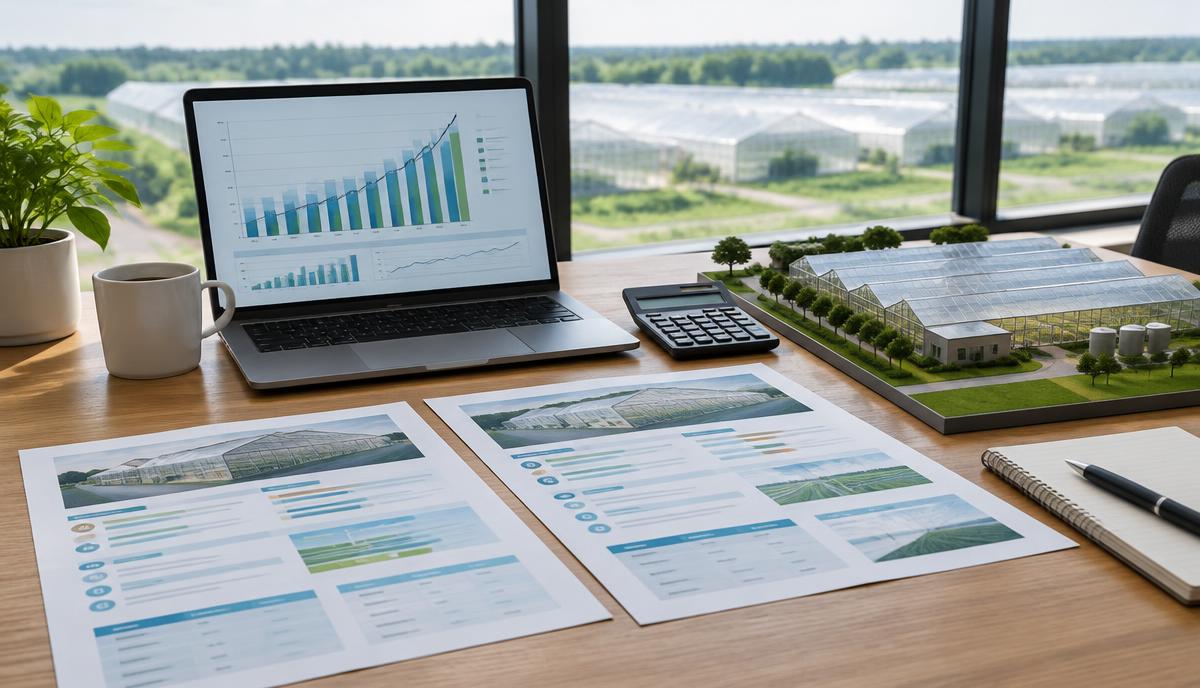
Financiers, partners and suppliers all ask the same question in different words: what exactly are you building, what will it cost to build and run, and what happens if things go worse than planned? This guide gives the structure of a plan that answers it honestly.
Part 1 — Specification (what you are buying)
- Crop, calendar, target volume and quality
- Site data: climate records, water analysis, loads, access, permits
- Structure, covering, climate, irrigation/fertigation, automation scope
- Performance to be achieved and how it will be tested at handover
- Training, spares, service and warranty expectations
Part 2 — CAPEX and OPEX as ranges
| Line | Low | High | Evidence |
|---|---|---|---|
| Structure and covering | budget quote | ||
| Climate, irrigation, automation | budget quotes | ||
| Site works, connections, water treatment | contractor estimate | ||
| Design, permits, project management | |||
| Contingency | your policy | ||
| Annual energy, labour, inputs, maintenance, insurance | own records / quotes |
Never fill a line with a number you cannot trace.
Part 3 — ROI scenarios
Hypothetical structure; enter your own values in the CAPEX/OPEX/ROI scenario calculator.
| Driver | Low | Base | High |
|---|---|---|---|
| Marketable yield | your worst comparable cycle | your typical | your best |
| Average price | low season / low contract | expected | high |
| OPEX | high case | expected | low case |
Report simple payback and ROI for each scenario as undiscounted, before tax and financing, and say so. If the low case does not survive, change the plan before seeking money.
Part 4 — The RFQ
Send every supplier the same package: specification, site data, scope boundaries, required performance and tests, delivery and installation window, payment and warranty terms requested, and an offer template with fixed line items. Ask suppliers to list assumptions and exclusions explicitly.
Part 5 — Comparing offers fairly
| Check | Why |
|---|---|
| Scope matches the specification line by line | Missing items look cheap |
| Exclusions priced in | Foundations, civil works, freight, duties often excluded |
| Design basis stated | Different design days mean different performance |
| Performance guarantees and tests | What happens if targets are missed? |
| Lifecycle cost | Energy, maintenance, spares, replacement intervals |
| References for similar climate and crop | Verify independently |
Score after normalising; then negotiate.
If information is missing
Mark gaps in the plan and the RFQ, ask suppliers to state their assumption for each, and close the most important gaps (water, loads, demand) before final selection. SeedMatchGroup reviews commercial projects from USD 250,000; financing, if any, is assessed by independent third parties with your consent.
Specification, ranges, scenarios, one RFQ and a normalised comparison — in that order — give you a plan that partners can check and suppliers can price fairly.
Tools and next steps
Frequently asked questions
- What is a reasonable contingency?
- It depends on project stage, site risk and your financier's policy. State the percentage and the reason.
- Should ROI include financing?
- Show it before financing first, then add financing as a separate case so the project and the loan are judged separately.
- How many suppliers should receive the RFQ?
- Enough to compare — often three to five qualified suppliers — with the same package.
- Can I compare a turnkey offer with separate packages?
- Yes, after mapping every package to the same scope and adding interface, coordination and risk costs.
- Does a good plan guarantee returns?
- No. It makes risks visible. Results depend on crop, variety, climate, water, market and execution.
Sources
- Penn State Extension — Greenhouse Production
- FAO — Global Agro-Ecological Zones (GAEZ v4)
- FAO Irrigation and Drainage Paper 56 — Crop Evapotranspiration (Allen et al., 1998)
General planning guidance. Results depend on crop, variety, climate, water, regulation and market; numerical examples are hypothetical. Confirm decisions with qualified local specialists.
Related guides in this series
- Expand Greenhouse Area or Upgrade First? A Data-Led Test
- Greenhouse Expansion Planning: Demand, Water, Energy, CAPEX
- Commercial Greenhouse Design Basis: Climate, Crop, Water, Budget
- Precision Fertigation: ETc, Drain EC and Distribution Uniformity
- Greenhouse Trial Design: Baseline, KPIs and Sensor Calibration
- Greenhouse Crop Cycle Analysis: Yield per m², Inputs, Rejects
- Greenhouse Retrofit in Phases: Controls, Cooling, Fertigation
- Greenhouse Yield and Quality: Irrigation, EC, Climate Data
- Choosing Greenhouse Vegetable Varieties: HR/IR, Cycle, Market