
How to plan a greenhouse by climate, crop, market, water and budget: structure, covering and control
Reviewed: · SeedMatchGroup
Short answer
Start from the crop and market window you want to supply, then describe the site's climate extremes and water. Those three set the climate envelope the greenhouse must hold. Choose structure, covering and control level to hold that envelope within budget — not the other way round — and confirm every choice with local engineers and the selected supplier.
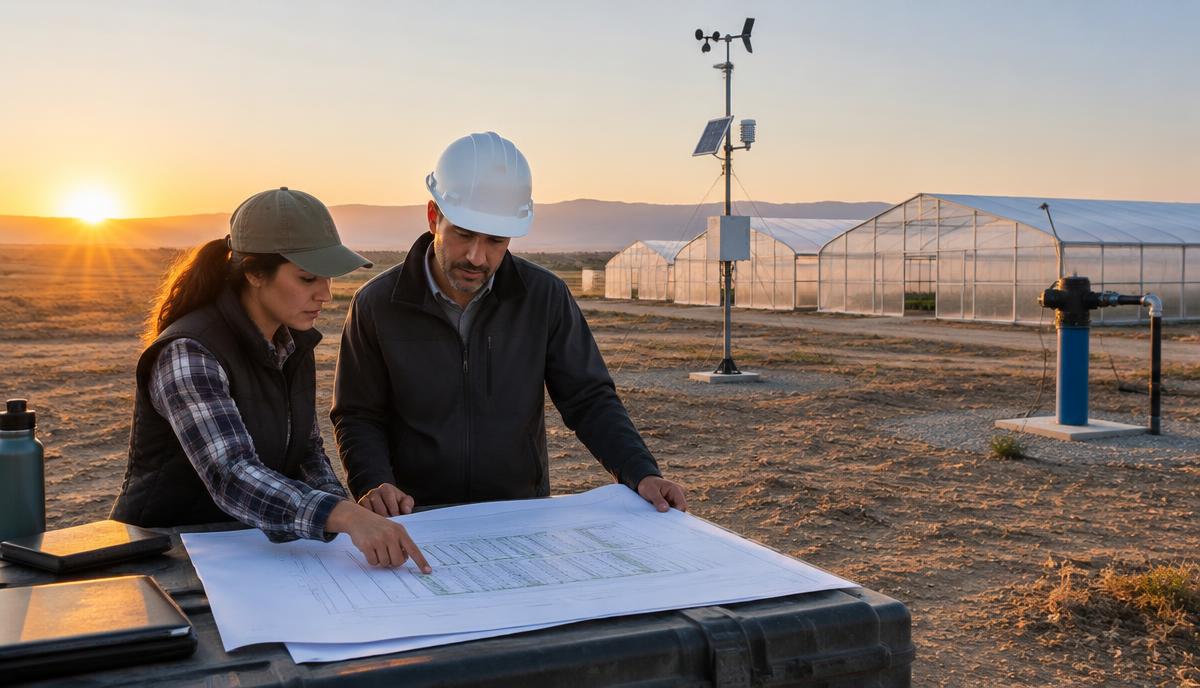
Many projects start with a structure catalogue. Better projects start with a crop calendar and a site file. This guide turns crop, climate, market, water and budget into a written basis of design that suppliers can price on equal terms.
Step 1 — Crop, variety segment and market window
Write down what you will grow, for which buyers and in which weeks. Requirements differ widely by crop and variety, so record the crop's temperature, humidity and light needs from your seed supplier or agronomist, not from a generic table.
- Crop and variety segment
- Planting and harvest weeks you must hit
- Quality specifications the buyer applies (size, colour, shelf life)
- Volume per week
Step 2 — Site climate and risks
| Item | Why it matters | Source |
|---|---|---|
| Max/min temperatures and their duration | Cooling and heating load | Local weather station records (several years) |
| Humidity in hot months | Evaporative cooling performance | Same |
| Solar radiation and day length | Shading, lighting, covering choice | Same |
| Wind and snow loads | Structural design | National building code, engineer |
| Hail, dust, salt spray | Covering durability | Local experience, insurer |
FAO GAEZ gives a regional suitability picture; it does not replace site measurements.
Step 3 — Water quantity and quality
Estimate seasonal water need from crop evapotranspiration (FAO-56: ETc = Kc × ETo) plus system losses, and compare with the licensed volume. Test the source: pH, EC, alkalinity, sodium, chloride, boron and other ions are interpreted for your crop and system with a local adviser. Poor water may require treatment, which affects budget and layout.
Step 4 — Structure, covering and control: a decision table
| Decision | Main drivers | Questions to answer |
|---|---|---|
| Structure type and height | Climate, wind/snow load, crop height, budget | Which design loads? Which gutter height for ventilation? |
| Covering (film, polycarbonate, glass, net) | Light, heat retention, hail/dust, lifespan | Light transmission and replacement interval stated by the maker? |
| Ventilation and cooling | Hot-season temperatures and humidity | Vent area, fan-and-pad or fogging sized for which design day? |
| Heating and screens | Cold-season minimums, energy price | Peak load, fuel, screen type? |
| Control and sensors | Crop sensitivity, labour, data needs | What is logged, alarmed and automated? |
There is no universal best choice; a lower-tech structure that holds the envelope can beat an expensive one that the budget cannot operate.
Step 5 — Budget as a range
Build CAPEX and OPEX ranges per option with the CAPEX/OPEX/ROI scenario calculator. Include site works, water treatment, packhouse links and contingency. Compare options on cost per marketable kg for your crop window, not on price per m².
Checklist before you ask for quotes
- Crop calendar and quality specification written
- Several years of site climate data, or a stated gap
- Water analysis and licensed volume
- Design loads confirmed by a local engineer
- Target climate envelope per season
- Budget range and financing assumptions
- Acceptance tests you will require
Write the crop calendar, site climate, water and budget first. The right structure, covering and control level follow from them, and suppliers can then quote on the same basis.
Tools and next steps
Frequently asked questions
- Which covering is best?
- It depends on climate, crop light needs, hail or dust risk and budget. Ask suppliers for documented light transmission, lifespan and warranty for your conditions.
- Do I need heating?
- Only if your crop window includes periods below the crop's minimum. Your site records and crop requirements answer this, not a general rule.
- How tall should the greenhouse be?
- Height affects air volume, ventilation and crop work. Your engineer and supplier should justify it for your climate and crop.
- Can I start without climate data?
- You can start measuring now and use nearby station data with a clear note. Design loads must still follow local codes.
- Does good planning guarantee yield?
- No. It reduces design risk. Yield depends on crop, variety, climate, water, management and market.
Sources
- FAO — Global Agro-Ecological Zones (GAEZ v4)
- Penn State Extension — Greenhouse Production
- Penn State Extension — Interpreting Irrigation Water Tests
- FAO Irrigation and Drainage Paper 56 — Crop Evapotranspiration (Allen et al., 1998)
General planning guidance. Results depend on crop, variety, climate, water, regulation and market; numerical examples are hypothetical. Confirm decisions with qualified local specialists.
Related guides in this series
- Expand Greenhouse Area or Upgrade First? A Data-Led Test
- Greenhouse Expansion Planning: Demand, Water, Energy, CAPEX
- Precision Fertigation: ETc, Drain EC and Distribution Uniformity
- Greenhouse Trial Design: Baseline, KPIs and Sensor Calibration
- Greenhouse Investment Plan: CAPEX, OPEX, ROI Scenarios, RFQ
- Greenhouse Crop Cycle Analysis: Yield per m², Inputs, Rejects
- Greenhouse Retrofit in Phases: Controls, Cooling, Fertigation
- Greenhouse Yield and Quality: Irrigation, EC, Climate Data
- Choosing Greenhouse Vegetable Varieties: HR/IR, Cycle, Market