
How to plan a greenhouse expansion from demand, seasonality, water, energy, labour, site and CAPEX/OPEX data
Reviewed: · SeedMatchGroup
Short answer
Size the expansion from documented demand by week or month, convert that volume into area using your own best comparable yield, then check that water, energy, labour, site and permits can support that area. Only then model CAPEX and OPEX as ranges and turn the result into a written RFQ.
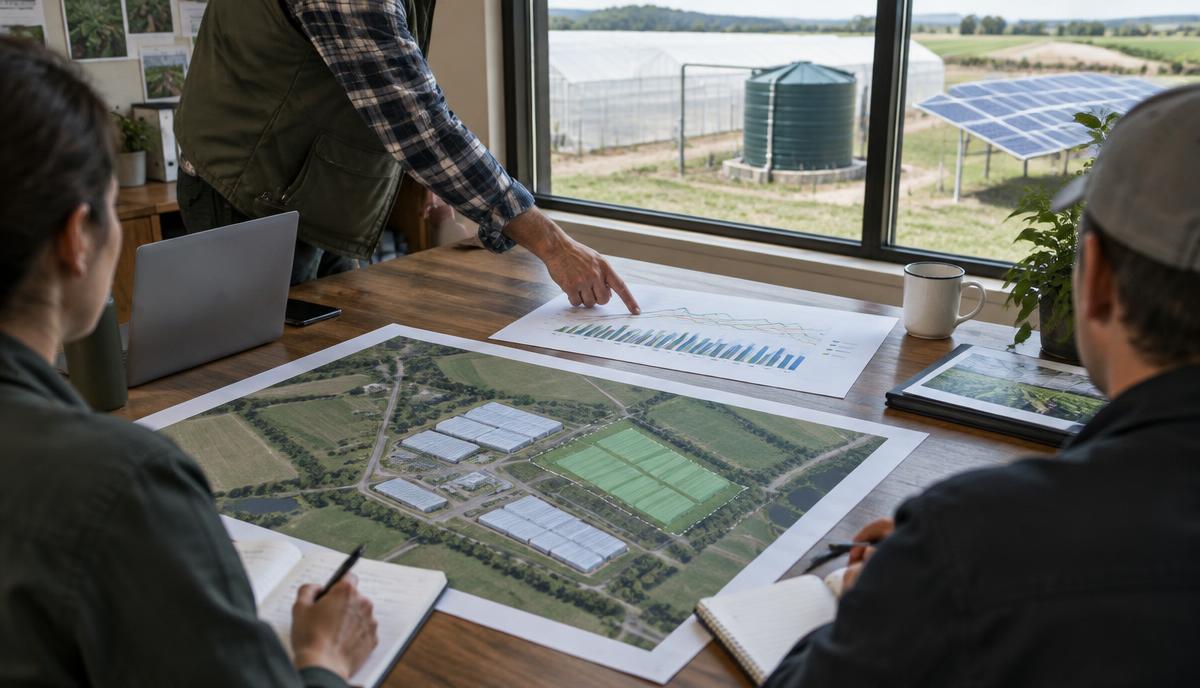
An expansion plan is a chain: demand sets volume, volume sets area, area sets water, energy and labour, and those set cost. Break any link and the plan is a guess. This guide gives you a worksheet for each link and tells you what to do when a link has no data yet.
Link 1 — Demand and seasonality
List the volume you can sell by week or month, with its evidence:
| Month | Current supply (kg) | Documented extra demand (kg) | Evidence |
|---|---|---|---|
| Jan | contract / buyer email / sales history | ||
| … |
Count only demand you can show. A wish list from a single buyer is a risk to note, not a volume to build for.
Link 2 — From volume to area
Area needed (m²) = extra marketable kg per cycle ÷ your best comparable marketable kg/m² per cycle.
Use a range (your average and your best cycle) and add a margin for start-up cycles. If the new crop or season differs from your history, treat the yield as an assumption and say so.
Link 3 — Water, energy and labour
- Water: estimate the crop water requirement for the new area and season (FAO-56 method: ETc = Kc × ETo), add system losses and drain, and compare with licensed volume and source capacity. Test water quality for the new source.
- Energy: heating, cooling, pumping, lighting (if any), packhouse and cold storage — peak kW and annual kWh or fuel.
- Labour: hours per m² from your own records × new area, peak weeks, housing and transport.
The calculators linked below help with water flow and heating energy.
Expansion RFQ and commissioning checklist
Send every supplier the same package and accept only answers in the same structure, so proposals become comparable.
In the RFQ - Baseline: your audit rows for the crop and season the expansion must serve - Site data: climate records, design loads, water analysis and licensed volume, power capacity - Scope boundaries: what is in, what is excluded, interfaces with the existing greenhouse and controls - Performance to be demonstrated, with the design day stated - Requested fixed-line offer template, assumptions and exclusions list
Comparison table (one column per supplier) | Check | Evidence requested | |---|---| | Scope matches line by line | priced bill of quantities | | Design basis | ventilation/cooling/heating calculations | | Water and energy assumptions | stated inputs | | Integration with existing controls | protocol, data export | | Lifecycle cost | maintenance, spares, replacement intervals | | References | similar crop and climate, contactable |
Commissioning and acceptance - Climate: achieved vs target on a representative hot or cold day - Irrigation: distribution uniformity and pressure test - Fertigation: EC/pH accuracy against a calibrated hand meter - Sensors and alarms: calibration record and live alarm test - Training, as-built drawings, manuals and passwords handed over - Retention payment released only after the tests pass
Acceptance criteria are contract terms you agree with the supplier and local engineer; they are not universal values.
Link 4 — Site and permits
- Land tenure, slope, drainage and flood risk.
- Access for trucks, power line distance, water source distance.
- Zoning, building permits, environmental rules for water discharge.
- Climate and soil suitability context: FAO GAEZ gives a regional picture, not a site decision.
Missing items go on a dated action list before any supplier is asked to price.
Link 5 — CAPEX and OPEX as ranges
Hypothetical structure — fill with your own quotes and records.
| Item | Low | High | Source |
|---|---|---|---|
| Structure and covering | supplier budget | ||
| Climate systems | |||
| Irrigation and fertigation | |||
| Automation and sensors | |||
| Site works and connections | |||
| Contingency | your policy | ||
| Annual energy, labour, inputs, maintenance | your records |
Run the totals in the CAPEX/OPEX/ROI scenario calculator. Treat the output as a scenario, not a forecast.
Turning the plan into an RFQ
Write down crop, season, area range, site data, water analysis, energy limits, required performance and acceptance tests. Ask each supplier for the same scope, exclusions and assumptions so offers can be compared on one basis.
A good expansion plan is traceable from the buyer's order to the supplier's quote. Fill each link with evidence, mark gaps honestly, and let the weakest link set the size and timing.
Tools and next steps
Frequently asked questions
- What if I have no written demand?
- Run a smaller phase or a pilot season first, or secure letters of intent. Do not size area on hoped-for sales.
- Can I use my current yield for the new area?
- Only if crop, season and technology match. Otherwise treat it as an assumption and use a range.
- Which link is most often missed?
- Water and labour in peak weeks. Both are slow to fix after construction.
- Should I phase the expansion?
- Phasing reduces risk when demand or resources are uncertain; it can increase unit cost. Compare both in the same model.
- Is the calculator result a forecast?
- No. It is a scenario built from your inputs. Results depend on crop, variety, climate, water, market and execution.
Sources
- FAO — Global Agro-Ecological Zones (GAEZ v4)
- FAO Irrigation and Drainage Paper 56 — Crop Evapotranspiration (Allen et al., 1998)
- Penn State Extension — Interpreting Irrigation Water Tests
- Penn State Extension — Greenhouse Production
General planning guidance. Results depend on crop, variety, climate, water, regulation and market; numerical examples are hypothetical. Confirm decisions with qualified local specialists.
Related guides in this series
- Expand Greenhouse Area or Upgrade First? A Data-Led Test
- Commercial Greenhouse Design Basis: Climate, Crop, Water, Budget
- Precision Fertigation: ETc, Drain EC and Distribution Uniformity
- Greenhouse Trial Design: Baseline, KPIs and Sensor Calibration
- Greenhouse Investment Plan: CAPEX, OPEX, ROI Scenarios, RFQ
- Greenhouse Crop Cycle Analysis: Yield per m², Inputs, Rejects
- Greenhouse Retrofit in Phases: Controls, Cooling, Fertigation
- Greenhouse Yield and Quality: Irrigation, EC, Climate Data
- Choosing Greenhouse Vegetable Varieties: HR/IR, Cycle, Market