
How to upgrade an older greenhouse in phases: controls, ventilation and cooling, shading, irrigation and fertigation
Reviewed: · SeedMatchGroup
Short answer
Start with an audit of what the existing systems actually deliver against their setpoints, fix measurement and control first (sensors, controller, logging), then upgrade the system your logs show limits the crop most — often ventilation/cooling or irrigation uniformity — one phase at a time, with a before/after KPI for each phase.
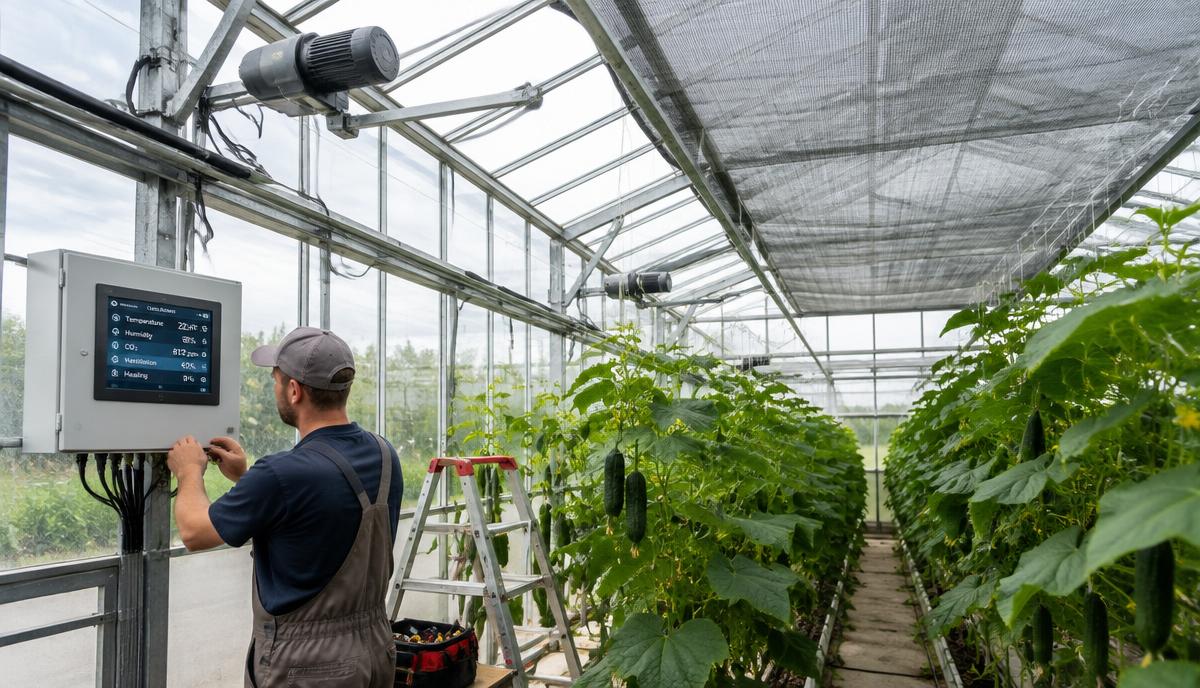
Older houses rarely need everything replaced at once. They need the right order. This guide gives an audit checklist, a phasing template and the KPIs to set before each phase, so each investment can be judged on your own results.
Audit checklist: what do the systems really deliver?
| System | What to check | Evidence |
|---|---|---|
| Sensors | Location, shielding, calibration date | Side-by-side check with a reference instrument |
| Controller | Setpoints vs. achieved values | Logs on hot, cold and humid days |
| Ventilation | Vent opening area, motors, screens | Vent position logs, visual check |
| Cooling (pad-and-fan, fogging) | Pad condition, water supply, fan capacity | Temperature drop across the house |
| Shading / screens | Fabric condition, drive system | Light and temperature logs |
| Heating (if any) | Boiler or heater output, distribution | Fuel use vs. degree-hours |
| Irrigation | Dripper uniformity, pressure, filtration | Catch-can test, pressure readings |
| Fertigation | Dosing accuracy, EC/pH control | Supply vs. drain EC/pH records |
Why measurement and control usually come first
If a sensor reads wrong or the controller cannot log, you cannot prove any later upgrade worked. Calibrated, well-placed sensors and a controller that records achieved values give you the baseline for every following phase. This phase is often modest in cost and short in duration.
A phasing template
| Phase | Scope | Trigger from your data | KPI before → after |
|---|---|---|---|
| 0 | Sensors, logging, controller check | Missing or doubtful records | % of hours with valid data |
| 1 | Ventilation / cooling | Max temperature above crop target on many days | Hours above target per week |
| 2 | Shading / screens | Light or heat stress at midday | Midday temperature, leaf scorch, rejects |
| 3 | Irrigation uniformity | Uneven growth or EC by row | Distribution uniformity, drain % |
| 4 | Fertigation control | EC/pH swings vs. recipe | Deviation from recipe, rejects |
Change the order if your data says so. Each phase should be specified, quoted and accepted on its own.
Hypothetical example of a phase decision
Hypothetical numbers, assumptions shown.
Logs show 22 summer days with more than 4 hours above the crop's target maximum. A ventilation and pad upgrade is proposed. KPI before: average 4.5 hours/day above target on hot days. Target to verify: a lower figure, measured with the same calibrated sensors, over a comparable period. Whether this improves marketable yield must be checked in the next cycle's records, not assumed.
Questions to put in the RFQ for each phase
- What design conditions (outside temperature, humidity, radiation) is the system sized for?
- What achieved values will be guaranteed, measured how and where?
- Does it integrate with the existing controller and sensors?
- Installation window: can it be done between cycles?
- Commissioning, training, spares and service terms.
- What is excluded?
When data is missing or the house is very old
- Run phase 0 for one season before choosing later phases.
- Ask an independent engineer to check the structure before adding loads (screens, fans, pads).
- If repair cost approaches new-build cost, compare a rebuild option on the same KPIs.
An older greenhouse can often be improved step by step. Measure first, fix the proven limit, set a KPI for every phase, and let each phase earn the next.
Tools and next steps
Frequently asked questions
- What should I upgrade first?
- Measurement and control, then the system your logs show limits the crop most. There is no universal order.
- Can I upgrade during a crop?
- Some work can; structural and irrigation changes are usually safer between cycles.
- Will a new controller increase yield?
- Not by itself. It makes the climate measurable and repeatable; the yield effect depends on crop, management and the other systems.
- How do I know a phase worked?
- Compare the KPI before and after with the same calibrated sensors and a comparable period, then check marketable output in the next cycle.
- Do I need an engineer?
- For structural loads, electrical capacity and cooling design, yes — use a qualified local professional.
Sources
- Penn State Extension — Greenhouse Production
- Penn State Extension — Interpreting Irrigation Water Tests
- FAO Irrigation and Drainage Paper 56 — Crop Evapotranspiration (Allen et al., 1998)
General planning guidance. Results depend on crop, variety, climate, water, regulation and market; numerical examples are hypothetical. Confirm decisions with qualified local specialists.
Related guides in this series
- Expand Greenhouse Area or Upgrade First? A Data-Led Test
- Greenhouse Expansion Planning: Demand, Water, Energy, CAPEX
- Commercial Greenhouse Design Basis: Climate, Crop, Water, Budget
- Precision Fertigation: ETc, Drain EC and Distribution Uniformity
- Greenhouse Trial Design: Baseline, KPIs and Sensor Calibration
- Greenhouse Investment Plan: CAPEX, OPEX, ROI Scenarios, RFQ
- Greenhouse Crop Cycle Analysis: Yield per m², Inputs, Rejects
- Greenhouse Yield and Quality: Irrigation, EC, Climate Data
- Choosing Greenhouse Vegetable Varieties: HR/IR, Cycle, Market