
How to improve greenhouse output and quality by managing irrigation, fertigation, climate and harvest data together
Reviewed: · SeedMatchGroup
Short answer
Record marketable kg and grade-outs every week next to the irrigation, drain, EC/pH and climate data for the same block. When quality or yield drops, look back two to four weeks in those logs for the change that preceded it, test one correction on part of the crop, and keep what your own data confirms.
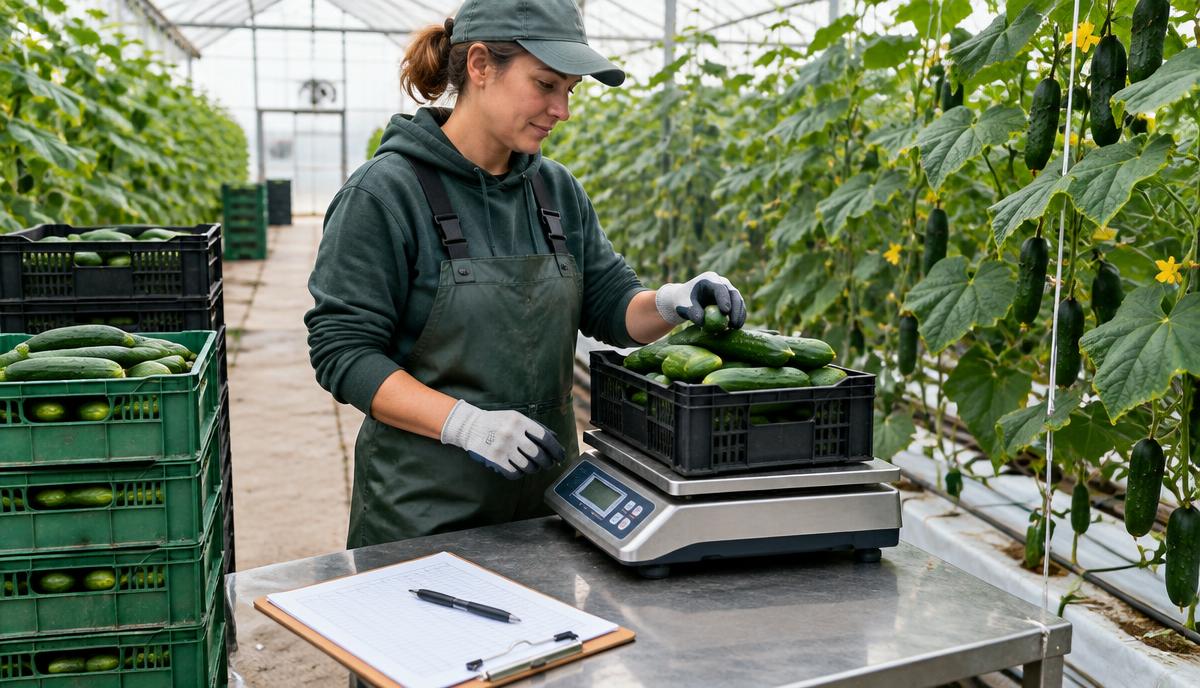
Most greenhouses collect plenty of data but keep it in separate places: the controller, the fertigation unit, the packhouse and the payroll. Improvement starts when those records sit on one weekly sheet. This guide shows what to record, how to review it and when to call an adviser.
The weekly block sheet
| Column | Unit | From |
|---|---|---|
| Marketable kg | kg per block | Harvest scale, packhouse |
| Grade-outs by reason | % | Grading sheet |
| Water applied | L/m² | Controller or meter |
| Drain (substrate) | % of applied | Drain meter or cup |
| Supply and drain EC / pH | mS/cm, pH | Fertigation logs, hand meter |
| Day/night temperature, humidity | °C, % | Climate computer |
| Radiation or light sum | as logged | Climate computer |
| Pest/disease notes | text | Scouting |
| Labour hours | h per block | Time sheets |
Reading the sheet: look back, not sideways
Yield and quality respond to conditions with a delay that depends on crop and stage. When a problem appears, scan the previous weeks for a change — a heat spell, a drain EC rise, a dosing fault, a change in irrigation start time. Mark candidate causes; do not adjust several things at once.
Irrigation and fertigation checks
- Uniformity: a catch-can test across the block; large differences between emitters show up as uneven growth.
- Drain and EC: compare drain EC with supply EC over time; a steady rise can indicate salt accumulation — interpret with your adviser for your crop and substrate.
- Water quality: test the source and any change of source; Penn State Extension notes that water quality problems can reduce yield, but limits depend on crop and system.
- Recipes: nutrient recipes are crop-, stage- and water-specific. Take them from your agronomist or supplier; there is no universal recipe.
Climate checks
- Compare achieved temperature and humidity with the targets your crop adviser set.
- Check sensor placement and calibration before trusting a trend.
- Note hours above or below target per week; these are easier to act on than averages.
Testing a correction
- Choose one change suggested by the sheet.
- Apply it to part of the crop; keep a comparable part unchanged.
- Track the same weekly columns for both.
- Keep the change only if marketable kg or grade-outs improve without a new problem.
When to bring in help
Call a local agronomist, extension service or accredited laboratory for leaf/water/substrate analysis, persistent disease or pest pressure, or when the data shows a problem you cannot explain. Pest and disease control must follow local registrations and labels.
One weekly sheet per block, read backwards when something changes, and one tested correction at a time — that routine turns existing data into better decisions.
Tools and next steps
Frequently asked questions
- Which single number matters most?
- Marketable kg per m² with grade-outs by reason. It connects every other record to income.
- Is there an ideal EC or temperature?
- No universal value. Targets depend on crop, variety, stage, substrate, water and season; take them from your adviser and supplier.
- How often should I review the sheet?
- Weekly for the block sheet; immediately when alarms or quality complaints appear.
- Do I need new sensors?
- Only if existing ones are missing, badly placed or not calibrated. Fix measurement before buying more.
- Will this guarantee higher yield?
- No. It helps you find and test improvements. Results depend on crop, variety, climate, water, market and execution.
Sources
- Penn State Extension — Greenhouse Production
- Penn State Extension — Is Irrigation Water Quality Causing Yield Reductions?
- Penn State Extension — Interpreting Irrigation Water Tests
- FAO Irrigation and Drainage Paper 56 — Crop Evapotranspiration (Allen et al., 1998)
General planning guidance. Results depend on crop, variety, climate, water, regulation and market; numerical examples are hypothetical. Confirm decisions with qualified local specialists.
Related guides in this series
- Expand Greenhouse Area or Upgrade First? A Data-Led Test
- Greenhouse Expansion Planning: Demand, Water, Energy, CAPEX
- Commercial Greenhouse Design Basis: Climate, Crop, Water, Budget
- Precision Fertigation: ETc, Drain EC and Distribution Uniformity
- Greenhouse Trial Design: Baseline, KPIs and Sensor Calibration
- Greenhouse Investment Plan: CAPEX, OPEX, ROI Scenarios, RFQ
- Greenhouse Crop Cycle Analysis: Yield per m², Inputs, Rejects
- Greenhouse Retrofit in Phases: Controls, Cooling, Fertigation
- Choosing Greenhouse Vegetable Varieties: HR/IR, Cycle, Market