
Greenhouse project planning
Why Greenhouse Projects Should Start With the Crop and Climate — Not the Supplier
Most commercial greenhouse projects begin with the wrong question. The first search is usually "who sells greenhouses?", and within a few weeks the buyer holds five proposals that cannot be compared with each other.
A greenhouse is not a product. It is a growing system built around a crop, a climate, a water source, an energy supply and a production target. Once those are defined, supplier selection becomes a straightforward commercial exercise instead of a guessing game.
This guide walks through the planning sequence that serious projects follow: define, calculate, configure, compare, finance, implement — and only then choose the supplier.
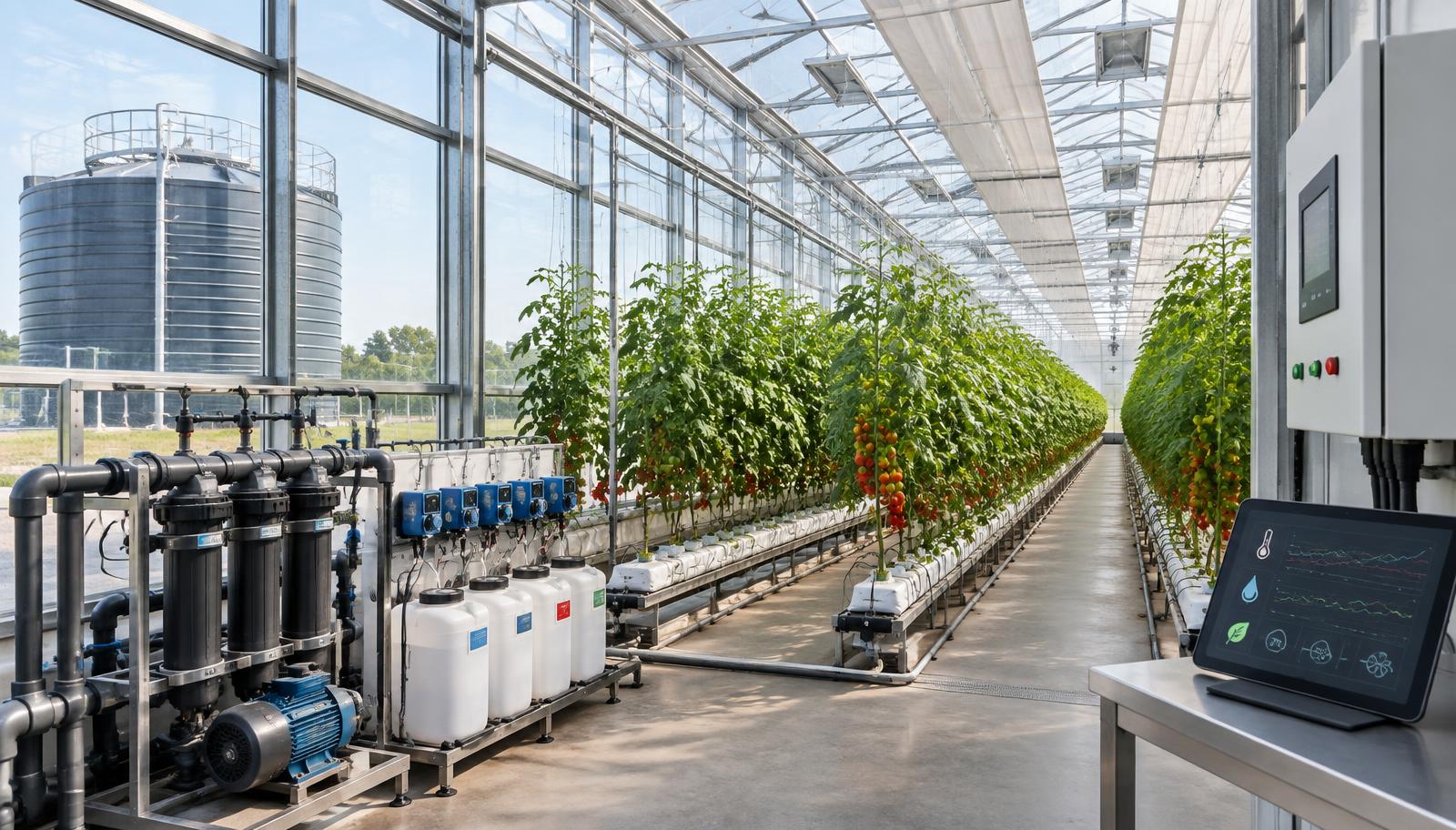
How should a commercial greenhouse project be planned?
A commercial greenhouse project should be planned around the crop, target production, local climate, available water, irrigation, fertigation, heating, cooling, ventilation, lighting, automation and budget before suppliers are selected. Starting with the production requirement makes it easier to choose the right greenhouse technology, compare quotations on the same basis and avoid investing in a system that is too simple, too complex or poorly suited to local conditions.
- Define the crop, variety, market and production target before any greenhouse size is discussed.
- Let the local climate decide structure, ventilation, cooling, heating, screens and lighting.
- Size water, irrigation, fertigation and energy demand from the crop, not from a supplier's standard package.
- Issue one structured RFQ so every supplier quotes against the same scope and assumptions.
- Compare complete delivered systems, including installation, commissioning, training and operating cost.
1. Why searching for a supplier first is the wrong first step
When a buyer contacts greenhouse manufacturers before defining the project, each supplier answers a slightly different question. Every proposal reflects that supplier's standard product, its default climate assumptions and the scope it prefers to sell.
The result is a set of quotations that look comparable on price and are not comparable at all. The gap between two proposals is often scope, not value.
- Different greenhouse structures, spans, gutter heights and load assumptions
- Different climate design assumptions for temperature, humidity and radiation
- Different ventilation concepts — roof vents, side vents, forced ventilation
- Different irrigation systems, or irrigation excluded entirely
- Different automation levels, from manual valves to full climate computers
- Heating and cooling included in some proposals and optional in others
- Supplementary lighting present in one quotation and absent from the next
- Different fertigation packages, dosing accuracy and water-treatment scope
- Different installation scope, civil works, supervision and commissioning
- Different assumptions about plant density, crop cycle and expected production
2. Start with the crop and the market
The crop determines almost everything downstream: plant density, row layout, gutter height, climate set points, irrigation frequency, nutrient recipe, labour intensity and post-harvest handling. A tomato project and a leafy-green project of the same area are two different investments.
The market matters just as much. Production for a domestic wholesale market, a supermarket programme and an export programme carry different quality, packaging, traceability and continuity requirements — and those requirements feed straight back into greenhouse specification.
- Crop and variety, including grafted or specialty material where relevant
- Target market: domestic, regional, supermarket programme or export
- Target production volume and the period over which it must be delivered
- Crop cycle length, number of cycles per year and planned changeover windows
- Quality, grading, food-safety and certification requirements
- Seasonality and the months where local supply or price is weakest
- Future flexibility: which second or third crop the structure must also support
3. Local climate determines the system
A greenhouse design that performs well in the Netherlands can fail in Oman, and a structure suited to a Mediterranean winter may be unusable in a Sahel summer. The climate file for the specific site — not the country average — should drive the technical concept.
Two sites in the same country can require different cooling strategies if one is coastal and humid and the other inland and dry. This is where generic catalogue offers quietly transfer risk to the buyer.
- Temperature range, including extreme summer and winter days, not just averages
- Relative humidity, which decides whether evaporative cooling is effective at all
- Solar radiation and the need for shading, diffuse covering or supplementary light
- Wind loads, snow loads and local structural codes
- Rainfall, rainwater harvesting potential and drainage
- Seasonal variation that determines whether heating is a capital line or an afterthought
- Dust, salinity or sand exposure affecting screens, covers and filtration
4. Choose the right technology level
Technology level is a commercial decision, not a prestige decision. The right level is the one the crop value, the local technical support and the operating budget can sustain over ten years.
High-tech systems give more production control and usually higher output per square metre, but they also demand reliable power, trained staff and a service chain. Mid-tech structures are frequently the correct answer in emerging markets where energy or maintenance capacity is limited.
- Crop value per square metre and whether it can carry higher capital cost
- Reliability of grid power and the cost of backup generation
- Availability of local service, spare parts and trained growers
- Labour cost and availability versus the cost of automation
- Water cost and whether recirculation is economically justified
- Phasing: a mid-tech first phase can be designed to accept later upgrades
6. Water, irrigation and fertigation
Water is a project input, not an accessory. Water quantity decides whether the planned area is feasible at all, and water quality decides how much treatment the project must fund before a single dripper is installed.
Fertigation is the delivery of dissolved nutrients through the irrigation system. It should be designed around crop, climate and growing medium — substrate, soil or hydroponic — rather than bought as a generic dosing skid.
- Water source: borehole, surface water, municipal supply, harvested rainwater or desalinated water
- Water analysis: EC, pH, sodium, chloride, bicarbonate, iron, manganese and biological load
- Treatment needs: sand separation, filtration, softening, acid dosing, iron removal or reverse osmosis
- Storage volume sized for peak demand plus an outage margin
- Irrigation design: dripper flow, uniformity, valve zoning and hydraulic limits
- Fertigation: number of stock tanks, dosing accuracy, EC/pH control and recipe changes across the cycle
- Drainage collection, drain percentage monitoring and recirculation with disinfection where justified
7. Climate control and energy
Climate control is where operating cost is decided. Two structures with a similar purchase price can differ substantially in annual energy consumption once ventilation, screens and insulation are compared.
Evaluate the delivered climate capability against the site's design days, then evaluate what it costs to run for a full year. Total cost of ownership, not equipment price, is the correct comparison.
- Natural ventilation capacity as a percentage of floor area, and insect screening losses
- Evaporative cooling — pad and fan or high-pressure fogging — and its limits in humid climates
- Heating source, distribution and the temperature the system must hold on the coldest design night
- Energy screens, shade screens and blackout screens, and their control logic
- Supplementary lighting only where crop and market economics justify it
- Grid capacity, transformer sizing, backup generation and fuel logistics
- Solar integration where tariffs, land and load profile make it viable
8. Automation, sensors and monitoring
Automation is not mandatory, and it is not free. Its value comes from consistency: the same climate and irrigation decisions taken the same way every day, with a record of what happened.
The right automation level matches the scale of the project, the labour environment and the skills of the team that will operate it. A dashboard nobody reads adds cost, not control.
- Climate sensors for temperature, humidity, radiation, CO2 and outside weather
- Irrigation control by time, radiation sum or substrate moisture and drain feedback
- Fertigation control with EC and pH monitoring and recipe logging
- Remote dashboards and alarms for power failure, pump failure or climate deviation
- Crop registration and yield tracking to connect decisions to results
- Drones or remote sensing where open-field or nursery areas sit alongside protected cultivation
10. Compare complete solutions, not structure price
The cheapest greenhouse frame is rarely the cheapest project. Once irrigation, fertigation, climate control, installation, commissioning and spare parts are added, the ranking of proposals often reverses.
Build one comparison sheet where every proposal is normalised to the same scope, and record explicitly what each supplier excluded.
- Structure: spans, gutter height, load design, corrosion protection and expected lifespan
- Covering material, light transmission, diffusion and replacement interval
- Climate systems: ventilation, cooling, heating, screens and control
- Irrigation and fertigation scope, including filtration and water treatment
- Automation, sensors and integration between subsystems
- Installation, supervision, civil works interface and commissioning
- Warranties, spare-parts packages and response time for service
- Grower training, agronomic support and handover documentation
- Annual energy and water demand under local conditions
- Scalability to the next phase without rebuilding what already exists
10a. Greenhouse project cost: the planning-level figures
Greenhouse project cost is decided by technology level, climate design conditions and scope boundary — not by the frame price. The bands below are planning-level figures for controlled-agriculture projects: installed hardware plus erection on a prepared site, excluding land, permits, packhouse and working capital.
Use them to sanity-check a budget and to spot a proposal that is priced outside its technology class. A committed price only comes from supplier offers against one written specification.
- Net house / shade structure: USD 8–20 per m² (USD 80K–200K per hectare) — shading and pest exclusion only
- Single-span polytunnel: USD 25–50 per m² (USD 250K–500K per hectare) — natural ventilation, basic drip
- Multi-span polyhouse, mid-tech: USD 50–120 per m² (USD 500K–1.2M per hectare) — vents, screens, fertigation, basic climate controller
- Venlo glass, high-tech: USD 150–350 per m² (USD 1.5M–3.5M per hectare) — diffuse glass, grow-pipe heating, energy screens, CO₂, climate computer
- Semi-closed controlled agriculture: USD 300–600 per m² (USD 3.0M–6.0M per hectare) — active cooling, dehumidification, supplemental LED, high-density hydroponics
- Site preparation, foundations and utility connections: add 15–30% on top of hardware CAPEX
- Financing cost over 5–7 years, where the project is funded: add 8–15%
- Climate design uplift on the same structure: +15–30% cold continental, +10–25% hot arid, +15–35% hot humid, +5–15% high altitude
- Annual operating cost: roughly USD 5–12 per m² for tunnels, USD 12–30 mid-tech, USD 30–70 Venlo glass, USD 60–140 semi-closed
- Structure and glazing normally absorb 60–70% of hardware CAPEX; climate control 10–20%; irrigation and fertigation 5–10%
11. Consider financing early, not after the quotations arrive
Financing shapes scope. A project that will be part-funded by export credit or development finance must document its technical and commercial case in a specific way, and that documentation is far easier to produce while the project is being defined than after proposals are on the table.
Common pathways include supplier credit, export credit agency cover, commercial bank facilities, development finance and blended project-finance structures. Each has its own requirements for feasibility documentation, equity contribution and country eligibility.
SeedMatch is not a lender. We help buyers structure the project and understand possible financing pathways with relevant third parties, and we prepare the technical documentation those parties ask for.
- Supplier or equipment credit tied to a specific scope of supply
- Export credit cover linked to the country of manufacture
- Commercial bank facilities against collateral and offtake
- Development finance for projects with food-security or employment impact
- Blended structures combining equity, grant support and debt
12. How SeedMatch changes the procurement process
SeedMatch is a structured greenhouse and controlled-agriculture procurement platform, not a supplier directory. The work starts before any supplier is contacted: crop, climate, production target, water, energy and technology level are defined first, then calculated, then written into one RFQ.
Every project is reviewed by a person. Suppliers are approached only once the requirement is clear enough for their responses to be comparable, and all communication runs through SeedMatch.
The value proposition is simple: build the right growing system — not just buy a greenhouse.
- Define the crop, market and production goal
- Translate local climate into technical requirements
- Use calculators to size area, water, energy and indicative investment
- Structure the project into phases that can actually be financed and built
- Build one RFQ that every supplier answers on the same basis
- Compare greenhouse technologies and complete delivered solutions
- Identify relevant suppliers for the specific requirement
- Explore financing pathways with relevant third parties
- Human support at every stage, with supplier identities managed by SeedMatch
9. The greenhouse RFQ checklist
A structured RFQ is the difference between five comparable proposals and five incomparable ones. Fill in every line before you contact a supplier — and state clearly where information is still missing.
- Country and exact site location
- Site coordinates, altitude and local climate data
- Crop, variety and growing medium
- Target annual production and delivery period
- Greenhouse area and planned phasing
- Water source, available volume and full water analysis
- Water treatment and storage already on site
- Power availability, voltage, capacity and reliability
- Irrigation requirements and zoning
- Fertigation requirements and recipe control
- Cooling and heating requirements with design temperatures
- Supplementary lighting requirement, if any
- Automation and monitoring level required
- Installation scope and local civil works responsibility
- Commissioning and performance handover expectations
- Grower training and agronomic support
- Indicative budget range
- Financing requirement and preferred pathway
- Target timeline for construction and first planting
- Known constraints, permits and open questions
5a. Greenhouse technology levels compared
A high-level orientation only. The correct level depends on crop value, climate severity, energy cost and local technical capacity — not on which system is most advanced.
| Technology level | Typical strengths | Main planning considerations | Energy & automation | Often suitable when |
|---|---|---|---|---|
| Basic protected agriculture | Lowest capital cost, fast construction, simple maintenance | Limited climate control; production follows the outside season | Little or no energy demand; manual or timer irrigation | Mild climate, lower-value crops, limited capital or first pilot phase |
| Mid-tech greenhouse | Better climate control, longer season, good cost-to-output balance | Needs reliable water, competent growers and a real maintenance plan | Moderate energy use; basic climate and fertigation controllers | Most emerging-market commercial projects and phased expansions |
| High-tech controlled environment | Highest production control, consistency and yield per square metre | High capital cost; demands trained staff, service chain and stable power | High energy use; integrated climate computer, sensors and recirculation | High-value crops, demanding markets, severe climates or year-round programmes |
5. Calculate before you buy
Numbers change conversations. Before any supplier is contacted, a project should have an indicative view of area, plant density, water demand, storage volume, fertigation load, heating and cooling demand, energy requirement and total investment range.
These figures are not a substitute for engineering design and they do not predict yield. They exist so the buyer can recognise a proposal that is undersized, oversized or based on assumptions that do not match the site.
Use the SeedMatch calculators to build that first picture: the greenhouse investment calculator for indicative project cost, the greenhouse size planner for area and layout, the crop water requirement calculator and greenhouse water storage calculator for water demand, the fertigation calculator for dosing and head-station scope, the greenhouse cooling and heating load calculators for climate demand, the greenhouse energy calculator for consumption, and the greenhouse TCO calculator for lifetime cost. Every calculator is listed in the agricultural project calculators hub.
The planning sequence, in order
Define, calculate, configure, compare, finance, implement — supplier selection belongs near the end, not at the start.
- 1Define the crop, market, production target and site.
- 2Calculate area, water, energy, climate demand and indicative investment.
- 3Configure the technology level and the phase structure.
- 4Build one structured RFQ with the full scope and assumptions.
- 5Compare complete delivered solutions on a single normalised sheet.
- 6Confirm the financing pathway and documentation requirements.
- 7Select suppliers, contract, implement and commission with a handover plan.
Signals that a project is not ready for suppliers yet
If any of these are unresolved, quotations will be assumptions rather than offers.
- No crop or production target defined — only an area in square metres
- No water analysis and no confirmed volume available at peak demand
- No site-specific climate data, only a country-level assumption
- No confirmed power capacity or backup plan
- No budget range and no view of how the project will be funded
- No decision on who carries civil works, permits and local installation
How we work — and what we do not do
- SeedMatch is a structured procurement platform with human review, not a supplier directory and not an automatic marketplace.
- We do not publish supplier names, contact details or direct communication channels; all contact runs through SeedMatch.
- We do not guarantee yields, prices or supplier performance, and we publish no invented cost or ROI figures.
- We are not a lender. We help structure the project and explain possible financing pathways with relevant third parties.
- We work with commercial projects from USD 250K upwards; below that threshold we are usually not the right partner.
How this plays out in different markets
The same planning sequence produces very different technical answers depending on where the project sits.
- Gulf and desert climates
- Cooling capacity, water source and water treatment dominate the design long before structure choice.
- Mediterranean and North Africa
- Ventilation, shading and winter minimum temperatures usually decide between mid-tech and high-tech.
- Sub-Saharan Africa
- Power reliability, spare-parts logistics and grower training often justify a simpler, serviceable system.
- Northern Europe and high latitudes
- Heating, energy screens and supplementary lighting drive both capital and operating cost.
- Central Asia and the Caucasus
- Wide seasonal swings make insulation and heating design the central engineering question.
- Latin America
- Altitude and radiation vary sharply between sites, so site-specific climate data matters more than country averages.
Illustrative planning patterns only. Every project is assessed against its own site data.
Who this guide is written for
Written for people responsible for delivering a commercial project, not for hobby growers.
- Commercial growers and agribusinesses
- Agricultural investors and funds
- Government and food-security programmes
- Project developers and EPC teams
- Consultants and agronomists
Related planning topics
Each of these has a dedicated page on SeedMatch:
- Commercial greenhouse projects, cost structure and turnkey delivery models
- Greenhouse irrigation systems, drip design and water storage
- Fertigation head stations, dosing and multi-zone control
- Greenhouse climate control, cooling and energy efficiency
- Hydroponic and substrate growing systems
- Greenhouse automation, sensors and monitoring
- Agricultural project financing pathways and documentation
Questions buyers ask before starting a greenhouse project
Start with the project, not the supplier list
Send SeedMatch the location, crop, target production and project requirements, and we can help structure the procurement process — define the requirement, size it with calculators, build the RFQ and compare complete solutions.
Define the crop. Understand the climate. Calculate the requirement. Choose the right technology. Structure the RFQ. Compare complete solutions. Then choose the supplier.
Planning guidance only. No yield, price or performance guarantees. SeedMatch works with commercial projects from USD 250K upwards and is not a lender.