
Greenhouse Drain-Water Disinfection Compared: UV, Heat, Slow Sand, Ozone and Chemicals
Compare disinfection offersPros, cons and limitations of the main ways to disinfect recirculated nutrient solution, with selection criteria by farm size, water quality and crop, based on published horticultural research.
Which disinfection method is best?
There is no single best method. Published comparisons favour heat or UV for larger sites and slow sand filtration for smaller ones, with the final choice depending on drain-water volume, water clarity, target pathogen and operating capacity.
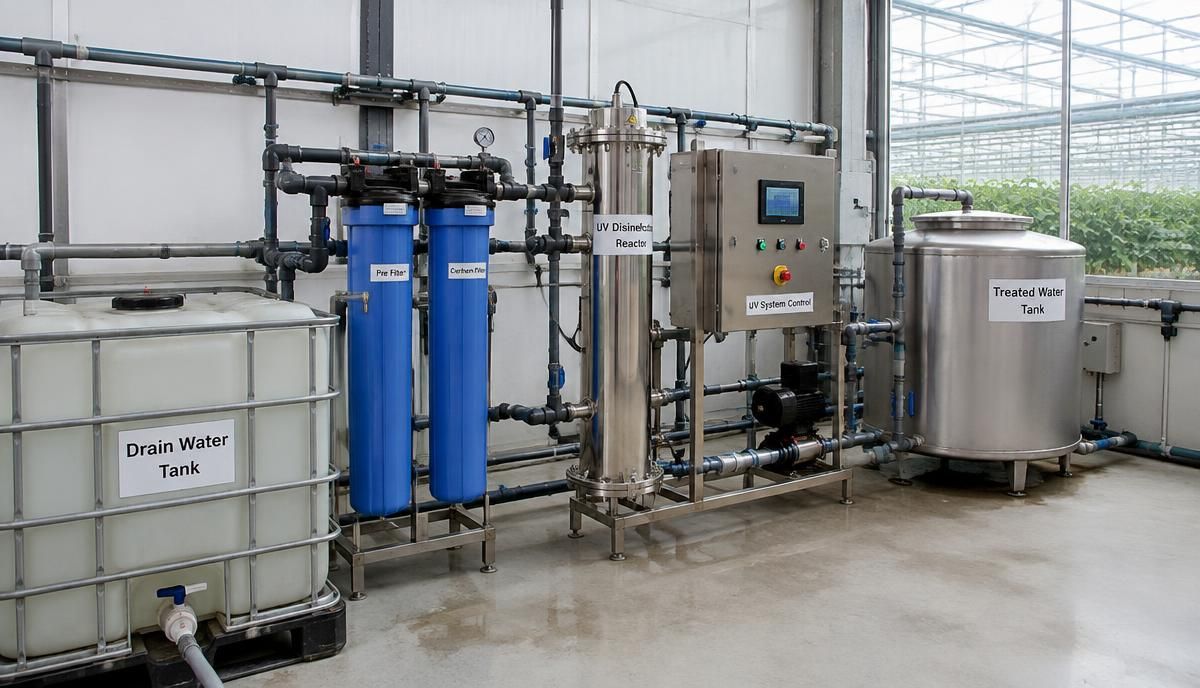
Key takeaways
- Why disinfect drain water at all?: Recirculation cuts nutrient leaching and water use, but the rapid spread of root disease is the main reason growers hesitate to adopt it [(Ehret et al.)](https://www.agronomy-journal.org/articles/agro/abs/2001/04/a1402/…
- Comparison table: Sources for the table: [van Os](https://www.actahort.org/books/843/843_29.htm) and the review by [Ehret et al.](https://www.agronomy-journal.org/articles/agro/abs/2001/04/a1402/a1402.html), which notes that sterilising…
- Slow sand filtration: design matters: In Wageningen trials on tomato in rockwool, *Phytophthora cinnamomi* was removed completely by fine and middle sand at a filtration rate of 0.1 m³/m²/h, while *Fusarium* and tomato mosaic virus were only delayed [(WUR)]…
- Selection criteria: Turn the chosen method into comparable quotes with the [cost, ROI and procurement checklist](/blog/greenhouse-drain-water-disinfection-cost-roi-procurement-checklist), and see how disinfection fits the whole loop in [fe…
- Next step: Turn the chosen method into comparable quotes with the [cost, ROI and procurement checklist](/blog/greenhouse-drain-water-disinfection-cost-roi-procurement-checklist), and see how disinfection fits the whole loop in [fe…
*Prepared by the SeedMatchGroup editorial team from the cited research. It is planning guidance, not a crop diagnosis or an agronomist's sign-off.*
Short answer: heat treatment and UV are the established options for larger recirculating greenhouses, slow sand filtration suits smaller sites, ozone and membrane filtration work but cost more, and cheap oxidants such as sodium hypochlorite and hydrogen peroxide are better for cleaning pipes and equipment than for disinfecting the solution. That is the conclusion of a desk study by E.A. van Os, which suggests heat or UV above roughly 2 ha and slow sand filtration below roughly 1 ha (Acta Horticulturae 843).
Why disinfect drain water at all?
Recirculation cuts nutrient leaching and water use, but the rapid spread of root disease is the main reason growers hesitate to adopt it (Ehret et al.). Disinfection treats the drain water before it is mixed back into the supply.
Comparison table
| Method | Strengths | Limitations | Usually fits |
|---|---|---|---|
| Heat treatment | Very effective sterilisation | Energy use and investment; kills beneficial microflora | Larger sites with heat available |
| UV radiation | Effective; no chemical residue | Needs clear water and pre-filtration; lamp maintenance; kills beneficial microflora | Larger sites with good pre-filtration |
| Slow sand filtration | Low running cost; keeps much of the beneficial microflora | Large footprint; effectiveness varies with pathogen and filter design | Smaller sites |
| Ozone | Effective oxidant | High investment; safety and off-gas handling | Sites that can manage the equipment |
| Membrane filtration | Very effective physical removal | Expensive; fouling | Specialist or high-value cases |
| Hypochlorite / hydrogen peroxide | Cheap and simple | Poor performance against pathogens in the solution | Sanitising pipes and equipment |
Sources for the table: van Os and the review by Ehret et al., which notes that sterilising methods (heat, oxidants, UV) and membranes are generally very effective but may harm beneficial microorganisms, while slow filtration is less disruptive but its effectiveness may vary by pathogen.
Slow sand filtration: design matters
In Wageningen trials on tomato in rockwool, *Phytophthora cinnamomi* was removed completely by fine and middle sand at a filtration rate of 0.1 m³/m²/h, while *Fusarium* and tomato mosaic virus were only delayed (WUR). Ask suppliers to state sand grade and filtration rate, and to say which pathogens their design is meant to control.
Selection criteria
- Drain-water volume and peak flow: the unit must handle your real peak drain, not average flow.
- Water clarity: UV performance depends on pre-filtration and clear water.
- Target pathogen: confirmed by a laboratory, see how to diagnose root rot.
- Farm size and energy: heat suits sites with heat available; slow sand needs space.
- Operations: lamp, sand or membrane maintenance, monitoring, and who does it.
- Beneficial microflora: decide whether a suppressive microflora matters for your crop.
Next step
Turn the chosen method into comparable quotes with the cost, ROI and procurement checklist, and see how disinfection fits the whole loop in fertigation recirculation RFQ specification.
Turn "Greenhouse Drain-Water Disinfection Compared: UV, Heat, Slow Sand, Ozone and Chemicals" into your RFQ
Answer a few questions and we will draft a structured RFQ you can review, edit and submit to our independent supplier network.
Frequently asked questions
- Which disinfection method is best?
- There is no single best method. Published comparisons favour heat or UV for larger sites and slow sand filtration for smaller ones, with the final choice depending on drain-water volume, water clarity, target pathogen and operating capacity.
- Is hydrogen peroxide enough to disinfect recirculated solution?
- A published desk study rated hypochlorite and hydrogen peroxide as cheap but poor against pathogens in the solution, and better suited to sanitising pipes and equipment.
- Does UV remove beneficial microbes too?
- Sterilising methods such as UV, heat and strong oxidants may reduce beneficial microorganisms as well as pathogens; slow filtration is generally less disruptive.
- How does SeedMatchGroup handle a requirement like "Greenhouse Drain-Water Disinfection Compared: UV, Heat, Slow Sand, Ozone and Chemicals"?
- A buyer submits one private brief through the RFQ builder. Pros, cons and limitations of the main ways to disinfect recirculated nutrient solution, with selection criteria by farm size, water quality and crop, based on published horticultural research. A dedicated sourcing specialist normalises it into a single technical specification, issues it to qualified international manufacturers, integrators and EPC contractors, and returns offers that can be compared line by line on the same scope, lead time and delivery terms.
Move from reading to sourcing
The pages below carry the commercial detail for this topic — cost ranges, supplier verification, specification checklists and financing routes.