
Fertilizer Selection for Tomato, Pepper and Olive
Prepare a crop-specific fertilizer brief from soil, water and crop evidence; compare product analyses and landed costs without generic nutrient prescriptions.
What is the best fertilizer for tomato, pepper or olive?
There is no universal best product. An agronomist should interpret crop stage, soil or substrate and irrigation-water evidence, then approve source, rate, timing and application method. Compare documented products against that approved programme.
Key takeaways
- What evidence should be collected before buying?: University of Minnesota Extension describes soil testing as a baseline for interpreting crop and soil nutrient requirements.
- Crop checklist: tomato, pepper and olive are different briefs: This table sets review questions, not rates.
- How should NPK labels and units be compared?: Record whether a product analysis is expressed as nitrogen (N), phosphate (P₂O₅) and potash (K₂O), or elemental phosphorus/potassium.
- Fertigation compatibility: what can a product label establish?: Request documented solubility at the intended concentration and water temperature, insoluble-residue information, approved injection/application use, storage instructions and any restrictions on mixing.
- Selection checklist before comparing quotations: Quantity calculations convert your approved product rates and area into product requirements.
There is no universally best fertilizer for farming, tomato, pepper or olive. Product selection follows crop needs, soil or substrate evidence, irrigation-water analysis and the application system. A qualified agronomist must set rates and timing. SeedMatchGroup helps structure commercial specifications and compare available quotations, not diagnose nutrient deficiencies or prescribe a feeding programme.
What evidence should be collected before buying?
University of Minnesota Extension describes soil testing as a baseline for interpreting crop and soil nutrient requirements. University of Georgia Extension covers irrigation-water salinity and toxicity risks and the four fertilizer-management decisions: source, rate, timing and placement. These references support an evidence-first process, not a universal crop recipe.
- Identify crop, variety/rootstock where relevant, production system, growth stage, cultivated area (ha), planting schedule and the next application period.
- Obtain representative soil/substrate and water tests; record laboratory method, sampling location, units and date. Leaf/tissue results should be interpreted by a qualified adviser using the applicable crop sampling method.
- Document prior applications and background nutrients from water, soil amendments or organic inputs; avoid counting the same nutrient contribution twice.
- Ask the agronomist for an approved programme: nutrient basis, product rate, application method, timing, monitoring and corrective-action responsibility.
Crop checklist: tomato, pepper and olive are different briefs
| Crop and system | Questions for agronomist review | Procurement information |
|---|---|---|
| Tomato, soil or substrate | Which crop stage, root-zone conditions and current soil/water evidence define this programme? | Approved product analyses, cultivation area, feeding period and irrigation interface |
| Pepper, soil or substrate | Does the programme reflect the pepper crop, growth stage and measured root-zone conditions rather than a copied tomato recipe? | Separate approved schedule, required grade and monitoring plan |
| Olive orchard | Which block age, bearing status, irrigation regime and locally interpreted soil/leaf tests apply? | Orchard block area, seasonal delivery plan and approved application method |
This table sets review questions, not rates. Do not transfer a hydroponic tomato programme to soil-grown pepper or an olive orchard. The current sources support general testing and nutrient management; local olive-specific interpretation remains the agronomist’s responsibility.
How should NPK labels and units be compared?
Record whether a product analysis is expressed as nitrogen (N), phosphate (P₂O₅) and potash (K₂O), or elemental phosphorus/potassium. These are not interchangeable labels. Compare like nutrient bases and product concentration units; ask for clarification rather than combining incompatible declarations. University of Minnesota Extension explains the role of labelled nutrient concentrations in calculating product requirements.
Product kilograms multiplied by a declared mass fraction give kilograms of that nutrient on the same declared basis. For example, an explicitly hypothetical 100 kg product at 10% N contains 10 kg declared N; this arithmetic is not a recommended dose or product specification. Liquid products require density and a clear mass/volume basis before converting litres to kilograms.
Fertigation compatibility: what can a product label establish?
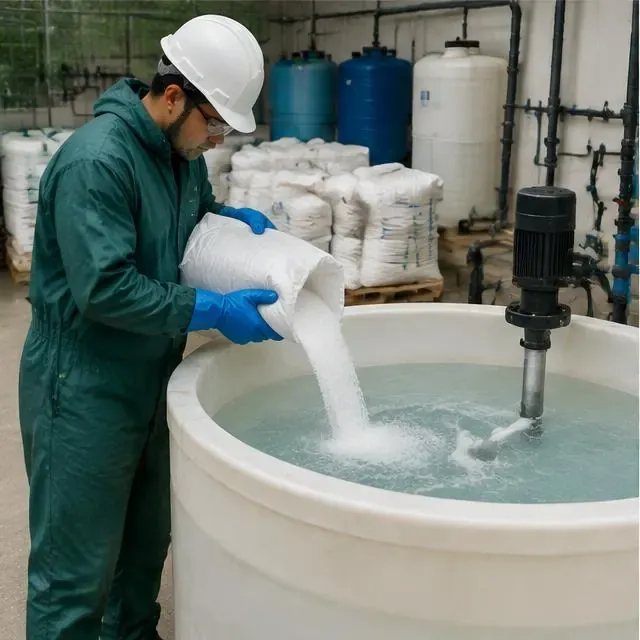
Request documented solubility at the intended concentration and water temperature, insoluble-residue information, approved injection/application use, storage instructions and any restrictions on mixing. A water-soluble label does not prove that any two products can share a concentrated stock tank or that a mixture suits your water. Agronomist and system-designer review must cover the actual product documentation, water chemistry, stock concentration and dosing configuration.
Do not issue a generic acid, chlorine or tank-mixing instruction from a calculator. Handling, chemical separation and operator safety must follow the applicable label, safety data sheet and professional procedure. Missing compatibility documentation is a procurement gap, not evidence of compatibility.
Selection checklist before comparing quotations
- Product name, guaranteed analysis and nutrient basis; physical form, declared package mass and batch documentation.
- Intended application method and documented solubility/mixing limitations reviewed for the actual irrigation system.
- Safety data sheet, certificate of analysis where required, applicable local registration and traceability documents; request evidence rather than assume certification.
- Product kg or tonnes per delivery, delivery schedule, packaging, storage conditions and destination.
- Currency, quote date, Incoterm, freight, duties and included services. Keep landed cost distinct from agronomic suitability.
What do the NPK, quantity and ROI tools actually tell you?
Quantity calculations convert your approved product rates and area into product requirements. Nutrient calculations use the declared analysis. Landed-cost comparisons normalize buyer-entered offers and charges. Neither calculation selects the right recipe, validates a product, predicts yield nor proves fertilizer ROI. A project ROI model needs explicit saleable-output, price and cost assumptions; do not assign a yield gain or saving to a fertilizer without applicable evidence.
Turn the approved programme into a private supply request
Which procurement stage should the buyer declare?
Keep three stages distinct: specification pending agronomist approval; approved quantities awaiting comparable offers; or replenishment against an established programme. Record the actual stage, first required delivery, product kg or tonnes per shipment, annual requirement and destination. A requested delivery date is not a confirmed supplier lead time. Do not substitute a grade or change a nutrient programme solely because an offer is cheaper.
Separate recurring fertilizer/input quantities from greenhouse structure, dosing hardware, irrigation and climate-control CAPEX. Attach or describe the approved specifications, crop/area, quantities, destination and shipment needs in the existing fertilizer pathway. Human-led fertilizer supply procurement starts at USD 250,000; smaller or unbudgeted requirements should use the information and planning tools. Supplier identities and communications remain private through SeedMatchGroup.
Sources and expert-review status
Content revised October 18, 2026. This is procurement guidance supported by extension references, not an expert-reviewed nutrition programme. No named agronomist has reviewed this article; expert review is pending. Obtain local agronomic approval before purchase or application.
All SeedMatch calculators are indicative only. They are not financial advice, not agronomic advice and not engineering design. Final numbers require supplier, agronomist, engineer and local regulatory review.
SeedMatch Group is an independent agricultural project sourcing and RFQ platform. We do not operate farms, produce seeds, manufacture fertilizers, manufacture irrigation systems, build greenhouses, provide regulated finance, or connect buyers directly to suppliers through an unmanaged marketplace. Supplier outreach happens only after a commercial project brief is reviewed.
Turn "Fertilizer Selection for Tomato, Pepper and Olive" into your RFQ
Answer a few questions and we will draft a structured RFQ you can review, edit and submit to our independent supplier network.
Frequently asked questions
- What is the best fertilizer for tomato, pepper or olive?
- There is no universal best product. An agronomist should interpret crop stage, soil or substrate and irrigation-water evidence, then approve source, rate, timing and application method. Compare documented products against that approved programme.
- Does a water-soluble label prove tank-mix compatibility?
- No. Compatibility depends on actual products, water chemistry, stock concentration and the dosing system. Request product documentation and professional review; calculators do not certify mixing compatibility.
- Can a calculator establish fertilizer ROI?
- Not from nutrient concentration alone. ROI requires evidence-backed output, revenue and cost assumptions; fertilizer quantity and landed-cost calculators do not predict yield gains or savings.
- How does SeedMatchGroup handle a requirement like "Fertilizer Selection for Tomato, Pepper and Olive"?
- A buyer submits one private brief through the RFQ builder. Prepare a crop-specific fertilizer brief from soil, water and crop evidence; compare product analyses and landed costs without generic nutrient prescriptions. A dedicated sourcing specialist normalises it into a single technical specification, issues it to qualified international manufacturers, integrators and EPC contractors, and returns offers that can be compared line by line on the same scope, lead time and delivery terms.
Move from reading to sourcing
The pages below carry the commercial detail for this topic — cost ranges, supplier verification, specification checklists and financing routes.