
Agrivoltaics and Farm Solar Procurement: Country Rules, RFQ Checklist and Bid Comparison
Start a farm-solar RFQHow commercial growers buy agri-PV and farm solar: the official rules in Germany, France, Japan, India and the United States, what to put in the RFQ, how to compare bids on crop impact and lifecycle cost, and which import and compliance risks to assign before signing.
What is agrivoltaics?
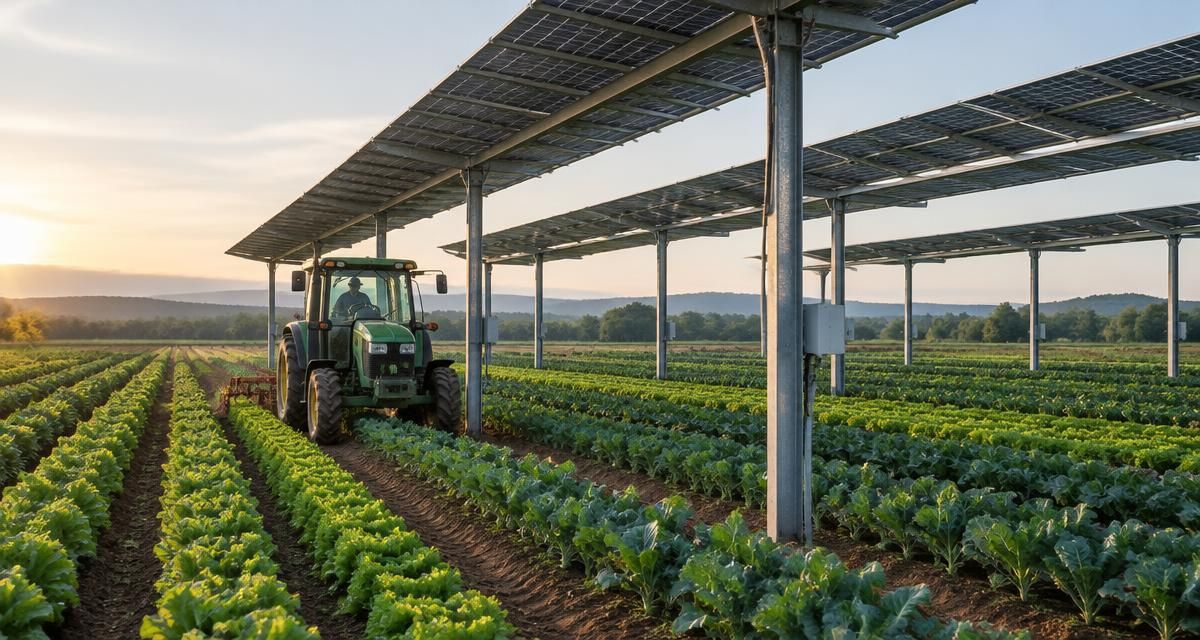
Agrivoltaics (agri-PV) is the combined use of the same land for crop or livestock production and solar electricity, for example with elevated panels over crops, vertical bifacial rows between crop strips, or modules on greenhouses. Several countries define it in law, so the definition that applies to your site matters for permits and support.
Key takeaways
- Short answer: Agrivoltaics (agri-PV) means producing crops and solar electricity on the same land.
- About this guide: Author: SeedMatch Group editorial team.
- Four project types, four different RFQs: Mixing these in one tender produces bids that cannot be compared.
- Country rules to check before you request bids: The rules below were checked on 25 October 2026.
- RFQ checklist for a farm-solar or agri-PV project: Use the same table for every bid, and record exclusions explicitly.
Short answer
Agrivoltaics (agri-PV) means producing crops and solar electricity on the same land. Before comparing supplier bids, the deciding question is usually regulatory rather than technical. In Germany, France and Japan, whether the land keeps its agricultural status — and whether the project qualifies for a permit or support — depends on explicit rules about clearance height, land lost to the structure, ground coverage and crop yield under the panels. In India and the United States the most relevant frameworks are farm-solar support programmes (PM-KUSUM and USDA REAP) rather than an agrivoltaics definition. Write the applicable rules into the RFQ, ask every bidder to show how the design meets them, and compare crop impact, energy yield, lifecycle cost and who carries the compliance risk — not just price per kWp.
About this guide
Author: SeedMatch Group editorial team. Sources checked: 25 October 2026 (official government and regulator pages listed at the end). Scope: commercial farm-solar projects from about USD 250,000 — elevated agri-PV over crops, vertical bifacial rows, solar on or beside greenhouses, and solar pumping for irrigation. It is general procurement information, not legal, tax or engineering advice. Rules and support programmes change; confirm the current position with the competent authority and a qualified local engineer before you commit.
Four project types, four different RFQs
| Project type | Typical use | Buyer decision that drives the design | Main risk to price in |
|---|---|---|---|
| Elevated agri-PV over crops or orchards | Arable, vegetables, fruit | Clearance height, row spacing, light reaching the crop | Yield loss, restricted machinery access |
| Vertical bifacial rows | Arable land, grassland | Row distance versus machinery working width | Lower energy per hectare, wind loads |
| Solar on or beside greenhouses | Protected crops | Light transmission versus the crop's light requirement | Crop light deficit in winter |
| Solar pumping or hybrid irrigation power | Irrigated field and tree crops | Daily water demand, pump duty point, storage | Undersized array, no backup in cloudy periods |
Mixing these in one tender produces bids that cannot be compared. Decide the type first, then write one specification per type.
Country rules to check before you request bids
The rules below were checked on 25 October 2026. They decide what a compliant design looks like, so they belong in the RFQ, not in a later legal review.
Germany: EEG special solar installations, DIN SPEC 91434 and the clearance-height bonus
Under the EEG 2023, agri-PV is supported as a "special solar installation" on arable land with simultaneous crop cultivation, on land with permanent or multi-year crops, and on permanent grassland, for installations commissioned or bid from 1 January 2023. The land must also meet the Bundesnetzagentur determinations, which refer to DIN SPEC 91434:2021-05 — the technical guideline setting requirements for keeping agriculture as the main use. Since Solarpaket I entered into force on 16 May 2024 there is a separate award procedure for this segment, and the separate maximum value or agri-PV bonus requires a clear height of at least 2.10 m, or at least 0.80 m for exclusively vertical installations (Clearingstelle EEG|KWKG). RFQ consequence: state the DIN SPEC category you are targeting, the clear height, and require each bidder to document how agricultural main use is maintained.
France: the April 2024 agrivoltaics decree
Decree no. 2024-318 of 8 April 2024 requires agriculture to remain the main activity. The area no longer usable because of the installation may not exceed 10% of the total area it covers; for installations above 10 MWp not covered by the proven-technology order, the coverage rate (projected module area divided by the parcel area) may not exceed 40%. Agricultural production counts as significant when the average yield per hectare on the parcel is above 90% of that observed on a control zone or local reference. Installations are checked before commissioning and then periodically — every five years for proven technologies, every three years where coverage is below 40%, otherwise annually — and operators report annually to ADEME (Légifrance). RFQ consequence: ask for the coverage-rate calculation, the control-zone or reference plan and the monitoring and reporting scope as priced line items.
Japan: 営農型太陽光発電 (solar sharing) and the Farmland Act
Installing posts on farmland for solar sharing requires farmland conversion permission for the posts. From 1 April 2024 the criteria moved into the Farmland Act Enforcement Regulations with a MAFF guideline. The temporary permission is normally up to three years, and up to ten years where, for example, a recognised core farmer (担い手) farms the land underneath, idle farmland is used, or the land is class 2 or class 3 farmland. MAFF's practical Q&A treats farming as not properly continued if the yield under the panels falls by roughly 20% or more against the municipal average for the same year. Where the solar owner and the farmer differ and a surface right is created, Farmland Act Article 3 permission is also required (MAFF). RFQ consequence: require simple, easily removable posts, a long-term farming plan and a named party for annual reporting.
India: PM-KUSUM
PM-KUSUM has three components: Component A for decentralised grid-connected solar or other renewable plants (farmers can install plants of up to 2 MW on barren or fallow land and sell power to the local DISCOM at a tariff set by the state regulator), Component B for standalone solar pumps, and Component C for solarising grid-connected agricultural pumps. The scheme is implemented through state agencies, and MNRE describes a capacity target to March 2026 — check the current status and any extension before relying on support (MNRE, PM-KUSUM portal). RFQ consequence: confirm the state implementing agency and whether the support route restricts which equipment or vendors you may use.
United States: USDA REAP
USDA's Rural Energy for America Program offers agricultural producers and rural small businesses grants of up to 50% of total eligible project costs, loan guarantees on loans of up to 75%, and combined grant and guarantee funding of up to 75%; renewable energy system grants range from USD 2,500 to USD 1 million (USDA Rural Development). Agrivoltaics-specific siting rules are set by states and local zoning, and grid interconnection by the utility. RFQ consequence: if you plan to apply, the application timing and eligible-cost definitions shape what the bid must itemise.
Other target markets
For Spain, Portugal, Mexico, Canada, the UAE, South Africa, Kenya and Uganda, our 25 October 2026 check did not identify a dedicated national agrivoltaics regime comparable to those in France or Japan. That is a gap to verify, not freedom from rules: land-use, environmental, building, grid-connection and electrical-installer requirements still apply and are often regional. In Brazil, grid-connected farm systems are generally framed by the distributed-generation law (Lei 14.300/2022). Ask bidders to name the permits they assume and to price the consequences if an assumption is wrong.
RFQ checklist for a farm-solar or agri-PV project
- Site: location, parcel areas, slope, soil, flood or wind exposure, existing irrigation and access routes.
- Crop plan: crops under and between the arrays, rotation, machinery working widths and heights, light requirement.
- Regulatory target: the rule set the design must meet (for example DIN SPEC category, French coverage rate, Japanese temporary-conversion conditions) and who prepares the permit file.
- Energy use case: self-consumption (pumping, cold rooms, greenhouse climate), export, or both; load profile by month and hour.
- Grid: available connection capacity, utility process, export limits and metering.
- Structure: clear height, row spacing, foundation type, corrosion category of the steel, design wind and snow loads.
- Equipment: module, inverter and tracker specifications and the certifications required (for example IEC 61215 and IEC 61730 for modules, IEC 62109 for inverter safety).
- Pumping (if relevant): daily water volume, total dynamic head, pump duty point, water storage versus batteries, backup source.
- Monitoring: energy metering, crop-yield monitoring plan and any control zone the rules require.
- Delivery: incoterm, importer of record, installation scope, commissioning tests and acceptance criteria.
- After-sales: warranties, in-country spare parts, response times, operation and maintenance price.
- Commercial: payment milestones linked to delivery and commissioning; support or grant timing if applicable.
How to compare bids
| Criterion | What to ask every bidder | Red flag |
|---|---|---|
| Regulatory compliance | Show the calculation against the applicable rule (height, coverage, land loss, yield test) | "Compliance is the client's responsibility" with no design evidence |
| Crop impact | Light reaching the crop by season and the basis for the estimate | A yield figure without method or comparable site |
| Energy yield | Simulated yield with stated losses and degradation | Only peak kWp, no yield model |
| Lifecycle cost | Capex, O&M, inverter replacement, insurance, decommissioning | Low capex, unpriced O&M |
| Interfaces | Who owns irrigation, grid, civil works and permits | Gaps between packages that nobody prices |
| Service | In-country service team, spares stock, response time | Warranty enforceable only abroad |
Use the same table for every bid, and record exclusions explicitly. A lower price that excludes foundations, grid works or monitoring is not a cheaper bid.
Tradeoffs to decide before tendering
- Height versus cost: a higher clear height keeps machinery access and may be needed for compliance or support, but it increases steel weight, foundations and wind loads.
- Density versus crop light: more modules per hectare raise energy yield and reduce light for the crop; the French yield test and the Japanese yield criterion make this a compliance question, not only an agronomic one.
- Fixed, vertical or tracking: trackers can manage shading over the crop but add moving parts and maintenance; vertical rows suit wide machinery but produce a different daily energy profile.
- Battery or water storage for pumping: storing water in a tank or reservoir can be a simpler way to shift pumping into sunny hours than storing electricity; compare both on lifecycle cost.
- Self-consumption or export: export depends on grid capacity and tariffs; self-consumption depends on matching loads to production.
Sourcing and import risks
- Origin and trade measures: duties and trade-remedy measures on solar cells, modules and inverters differ by country and change; ask for the country of origin of cells and modules and have your customs broker confirm the duty position before award.
- Certification: require test certificates from accredited laboratories for the exact model, not a product family.
- Corrosion and structure: agricultural environments with fertigation, livestock or coastal air need a stated corrosion category and coating system.
- Land and contracts: where the land owner, the farmer and the power producer differ, the lease and the farming obligation must align with the permit conditions.
- Service exposure: confirm who repairs inverters and trackers locally and how long a replacement takes.
What SeedMatch Group does and does not do
For eligible projects from USD 250,000, a sourcing specialist reviews your brief, invites suitable suppliers and installers, and lays out their bids on comparable fields. The service is free for buyers, and communication runs through SeedMatch Group — buyers do not contact suppliers directly during the process. SeedMatch Group is not an installer, EPC contractor, utility, lender, legal adviser or certification body, and it does not guarantee permits, support payments, crop yields, energy output, quotations or timing.
Tools and next steps
Review system options in the Solar Agriculture Center and the solar greenhouse hub. Size pumping and backup loads with water pumping energy, irrigation energy and the backup power calculators; estimate greenhouse loads with the greenhouse energy calculator; test the funding structure with the project financing calculator. When the site, crop plan and regulatory target are clear, turn them into a brief with the RFQ builder or request a project review.
Sources (checked 25 October 2026)
- Clearingstelle EEG|KWKG — requirements for agri-PV under the EEG 2023, Solarpaket I and clearance heights
- Federal Ministry for Economic Affairs and Energy — Solarpaket: agri-PV and special PV segment
- Légifrance — Décret n° 2024-318 du 8 avril 2024 relatif au développement de l'agrivoltaïsme
- MAFF — farmland conversion permission for renewable energy and solar sharing
- MAFF — solar sharing support guidebook (permission periods and yield criterion)
- MNRE — PM-KUSUM scheme and PM-KUSUM national portal
- USDA Rural Development — Rural Energy for America Program grants
- Planalto — Lei nº 14.300/2022 (distributed generation, Brazil)
Turn "Agrivoltaics and Farm Solar Procurement: Country Rules, RFQ Checklist and Bid Comparison" into your RFQ
Answer a few questions and we will draft a structured RFQ you can review, edit and submit to our independent supplier network.
Frequently asked questions
- What is agrivoltaics?
- Agrivoltaics (agri-PV) is the combined use of the same land for crop or livestock production and solar electricity, for example with elevated panels over crops, vertical bifacial rows between crop strips, or modules on greenhouses. Several countries define it in law, so the definition that applies to your site matters for permits and support.
- How high must agri-PV panels be in Germany?
- For the separate maximum value or agri-PV bonus under the EEG as amended by Solarpaket I, the installation must have a clear height of at least 2.10 m, or at least 0.80 m if it is exclusively vertical. The land must also meet the Bundesnetzagentur determination, which refers to DIN SPEC 91434. Confirm the current rules with the Clearingstelle EEG|KWKG or a German adviser.
- What does the French 2024 agrivoltaics decree require?
- Decree 2024-318 requires agriculture to remain the main activity: no more than 10% of the covered area may become unusable, installations above 10 MWp outside the proven-technology order are limited to a 40% coverage rate, and yield on the parcel must exceed 90% of a control zone or local reference, with periodic checks and annual reporting to ADEME.
- Do I need permission for solar sharing in Japan?
- Yes. The posts need temporary farmland conversion permission under the Farmland Act, normally for up to three years and up to ten years in certain cases, and farming must continue properly underneath — MAFF guidance treats a yield fall of roughly 20% or more against the municipal average as a problem.
- Which support exists for farm solar in India and the United States?
- In India, PM-KUSUM supports farmer solar plants, standalone solar pumps and solarisation of grid-connected pumps through state agencies. In the United States, USDA REAP offers grants of up to 50% of eligible costs and loan guarantees for agricultural producers and rural small businesses. Check current eligibility and deadlines before relying on either.
- Does SeedMatch Group install solar systems or guarantee support payments?
- No. SeedMatch Group reviews eligible project briefs from USD 250,000, invites suitable suppliers and compares their bids for the buyer free of charge, with communication handled through the platform. It does not install equipment, act as a lender or legal adviser, or guarantee permits, support, yields, energy output or prices.
Move from reading to sourcing
The pages below carry the commercial detail for this topic — cost ranges, supplier verification, specification checklists and financing routes.