
UAE Greenhouse Planning: Climate-Smart Procurement Guide
Discuss your UAE greenhouse projectPlan a commercial or hydroponic greenhouse in the UAE: site, crop, cooling, water, energy and turnkey scope, with WMO climate data and a proposal checklist.
Is hydroponics automatically the right choice for a UAE greenhouse?
No. It needs crop, water, climate, operator and financial assessment for the actual site. Hydroponics is a growing method, not proof of suitability or profitability. No. Calculator outputs are planning estimates; qualified designers validate engineering, and the relevant authority confirms applicable water and permit requirements.
Key takeaways
- Short answer: A UAE greenhouse project should be planned from the site, crop and climate brief before any package is chosen.
- Start with the site and crop, not a greenhouse package: A commercial greenhouse in the UAE should be procured against a documented growing plan: exact site, crop, production season, protected area, available water and electricity, and the responsibilities included in deliver…
- Build a site-specific climate brief: [MOCCAE describes UAE agriculture](https://moccae.gov.ae/en/knowledge/agriculture-development-and-health) in an arid environment with low rainfall and high temperatures, and discusses climate-smart methods including hyd…
- Compare cooling, shading and ventilation together: Do not choose fans, screens and cooling independently.
- Analyse water before selecting treatment and irrigation: Obtain a dated laboratory analysis of the proposed source.
Short answer
A UAE greenhouse project should be planned from the site, crop and climate brief before any package is chosen. Give every bidder the same cooling, water, energy and turnkey-responsibility basis, then compare itemised proposals. Long-term WMO 1991–2020 averages (for example an August mean daily maximum of 41.9 °C at Dubai International Airport) describe the climate, but cooling must be sized on a site design day.
Start with the site and crop, not a greenhouse package
A commercial greenhouse in the UAE should be procured against a documented growing plan: exact site, crop, production season, protected area, available water and electricity, and the responsibilities included in delivery. Climate-smart planning means comparing these constraints together, not accepting an isolated cooling claim or an attractive structure price. Crop suitability, water access and permit matters require assessment by qualified local professionals and the relevant UAE authorities.
The UAE cooling and automation guide covers the cooling package in greater depth. Start with the UAE greenhouse buyer guide if your scope is still being defined.
Build a site-specific climate brief
MOCCAE describes UAE agriculture in an arid environment with low rainfall and high temperatures, and discusses climate-smart methods including hydroponics. That national description is context, not a design weather file. Give the emirate, coordinates, coastal or inland exposure, site access, existing buildings and land-use status. Request locally relevant weather observations, with dates and the engineering conditions selected for sizing.
For long-term context, WMO 1991–2020 climate normals give August mean daily maximums of 41.9 °C at Dubai, 43.4 °C at Abu Dhabi and 42.9 °C at Sharjah international airports. The Dubai, Abu Dhabi and Sharjah greenhouse guides show each station's figures and source. Averages are not design days: hotter, more humid days set the cooling load.
Record the crop's proposed temperature, humidity and light targets, operating months and tolerated interruptions. Ask an agronomist to assess whether those targets fit the cultivar and site. A proposal should identify which conditions it can maintain, for how long and with what water and energy demand.
Compare cooling, shading and ventilation together
Do not choose fans, screens and cooling independently. Ask the designer to explain the interaction between cover transmission, shading, air exchange, insect screens and humidity removal. Ventilation drawings should show the proposed air path and any pressure losses associated with screens or filters.
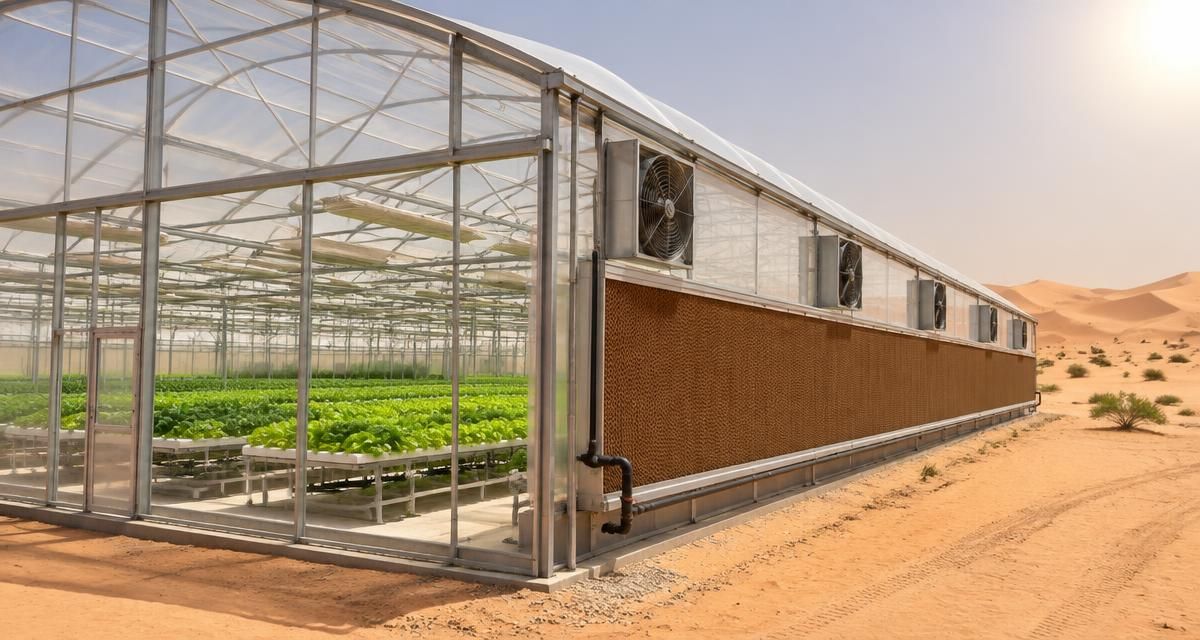
For evaporative pads or fogging, require stated dry-bulb and wet-bulb design conditions and water-quality requirements. The FAO greenhouse horticulture guide provides technical background on climate management; it does not approve a particular UAE design. Compare mechanical or hybrid alternatives using the same crop targets and operating calendar. The cooling calculator helps examine assumptions, but is not final engineering or a performance guarantee.
Analyse water before selecting treatment and irrigation
Obtain a dated laboratory analysis of the proposed source. Include electrical conductivity, pH, alkalinity, sodium, chloride and any microbiological parameters the local adviser considers relevant. Record available daily volume, peak flow, pressure, storage and supply interruptions. Do not assume that desalinated, groundwater or delivered water is suitable merely because it is available.
Separate irrigation, cooling, cleaning, treatment losses and discharge in the water balance. Ask who supplies pretreatment, dosing, filtration and disinfection, and who maintains them. Use the water consumption calculator for a planning scenario and the irrigation and fertigation catalogue to organize scope; neither establishes an allocation or discharge permission.
Select crops and seeds with local agronomic evidence
Tomatoes, cucumbers, leafy crops, herbs or strawberries are possible subjects for evaluation, not blanket recommendations. Compare cultivar requirements, root-zone conditions, crop cycle, labour, pollination needs, packing and intended buyer specifications. Keep saleable yield separate from total biomass, and distinguish a trial result from a forecast for your facility.
Specify seed class, treatment, lot quantity, planting dates and the documents to review. Match fertilizer grade, solubility and dosing compatibility to the water analysis and agronomic plan; this article does not prescribe nutrient rates. The seed catalogue and plant nutrition catalogue are scope references, not confirmation of stock, registration or import eligibility.
Make energy and automation assumptions visible
Ask for monthly electricity consumption and maximum simultaneous power by cooling, lighting, pumps and auxiliaries. Installed kilowatts are not annual kilowatt-hours. Identify critical loads, backup runtime, restart behaviour and utility-connection responsibility. DEWA's tariff page describes Dubai consumption bands and fuel surcharges; confirm the account category, taxes and current bill, and do not use Dubai rates as a UAE-wide tariff.
Specify sensor locations, calibration, alarm recipients, data ownership, export formats and offline control. Name the party integrating irrigation, climate equipment and software. Compare subscriptions, spare parts and training alongside hardware. Any solar contribution needs its own documented assessment rather than an assumed saving. Use the lifecycle cost calculator with transparent operating inputs, not promised payback.
Compare complete turnkey responsibilities
One proposal may include civil works and commissioning while another prices only the greenhouse shell. Normalize the installed scope, currency, price date, freight, taxes and exclusions before comparing totals. The greenhouse systems catalogue helps group equipment without presenting a public supplier directory.
Request evidence behind references and performance statements through the SeedMatch team. Agree measurable acceptance conditions, training, warranty boundaries, maintenance and spare-part arrangements. An indicative delivery calendar must show dependencies on surveys, utilities and approvals; it is not a committed opening date.
A practical seven-step procurement checklist
- 1. Define the site: emirate, land-use status, footprint, access and project stage.
- 2. Agree the crop basis: cultivar, operating season, saleable output assumptions and local agronomic review.
- 3. Confirm utilities: dated water analysis, flow/storage, electrical capacity and applicable utility category.
- 4. Fix the climate scope: shading, ventilation, cooling, humidity targets and test conditions.
- 5. Map all interfaces: structure, irrigation, nutrition, controls, civil works, installation and training.
- 6. Compare proposals: included scope, exclusions, consumption assumptions, service and evidence gaps.
- 7. Review before ordering: authority requirements, import documents, acceptance milestones and unresolved risks.
Use project planning to keep material, labour and schedule allowances explicit.
Local review and your next step
The National Food Security Strategy 2051 supports sustainable production using modern technologies; it is not funding approval or an offtake contract. Confirm current land, water, environmental and import requirements with the appropriate authority or qualified local adviser. Obtain local regulatory review before committing to a transaction; this is not legal advice.
When ready, use the existing UAE project RFQ. Buyer sourcing is free for qualifying projects from USD 250,000. A sourcing specialist reviews the brief; supplier communication remains mediated by SeedMatch Group. No quotation, availability, approval or outcome is guaranteed. Fresh produce commodity sourcing belongs with Global B2B Group, our parent group. Sources reviewed 12 November 2026.
UAE procurement: keep emirate, tariff and scope evidence separate
Identify the emirate and site rather than assuming that a Dubai weather station or tariff applies throughout the UAE. Request covered/usable area, crop calendar, site design conditions, water analysis, cooling and irrigation demand, available electrical capacity and backup needs. Split structure, irrigation/fertigation, climate control and automation from local civil works and utility connections. WMO climate normals describe historical conditions, not a system design day or equipment performance.
Use the official sources linked in the UAE approvals guide and UAE cost calculator; confirm eligibility and current rates for the actual service location. Guidance reviewed 16 November 2026, not a new tariff observation. Keep AED source amounts separate from USD planning amounts and disclose the conversion date/basis. Carry exclusions and unconfirmed permissions into the greenhouse RFQ; SeedMatch Group coordinates procurement, not local engineering or installation.
Related UAE planning pages
- UAE greenhouse buyer guide and checklist - six-stage planning checklist, cost drivers and official permit sources
- UAE greenhouse approvals guide - MOCCAE and EDE approvals for seeds, plants and fertilizers
- Dubai, Abu Dhabi and Sharjah emirate guides with WMO climate tables
- Greenhouse cooling calculator and UAE cost calculator - planning estimates, not quotes
- Commercial greenhouse suppliers - how SeedMatch compares supplier proposals without publishing supplier names
Turn "UAE Greenhouse Planning: Climate-Smart Procurement Guide" into your RFQ
Answer a few questions and we will draft a structured RFQ you can review, edit and submit to our independent supplier network.
Frequently asked questions
- Is hydroponics automatically the right choice for a UAE greenhouse?
- No. It needs crop, water, climate, operator and financial assessment for the actual site. Hydroponics is a growing method, not proof of suitability or profitability.
- Can a calculator confirm cooling capacity or water permission?
- No. Calculator outputs are planning estimates; qualified designers validate engineering, and the relevant authority confirms applicable water and permit requirements.
- How should I compare turnkey greenhouse suppliers?
- Compare the same installed scope, crop targets, utility assumptions, exclusions, acceptance tests and service responsibilities through the SeedMatch team, not headline price alone.
- What should a UAE greenhouse cooling system proposal specify?
- The dry-bulb and wet-bulb design conditions, crop temperature and humidity targets, cooling water quality and volume, peak electrical load and the acceptance test at commissioning. Compare pad-and-fan, fogging, mechanical and hybrid options on the same basis.
- Is greenhouse planning different in Dubai, Abu Dhabi and Sharjah?
- The approach is the same, but site climate, utility provider and authority requirements differ. Use your own site's weather data and confirm requirements with the relevant emirate authority and utility.
- Which approvals apply to seeds and fertilizers for a UAE greenhouse?
- Federal services cover an agricultural activity licence, an import permit and release permit for each seed or plant consignment, and registration of fertilizers with the Emirates Drug Establishment. Land, building and utility approvals are local. See the UAE greenhouse approvals guide for the official sources; this is not legal advice.
Move from reading to sourcing
The pages below carry the commercial detail for this topic — cost ranges, supplier verification, specification checklists and financing routes.