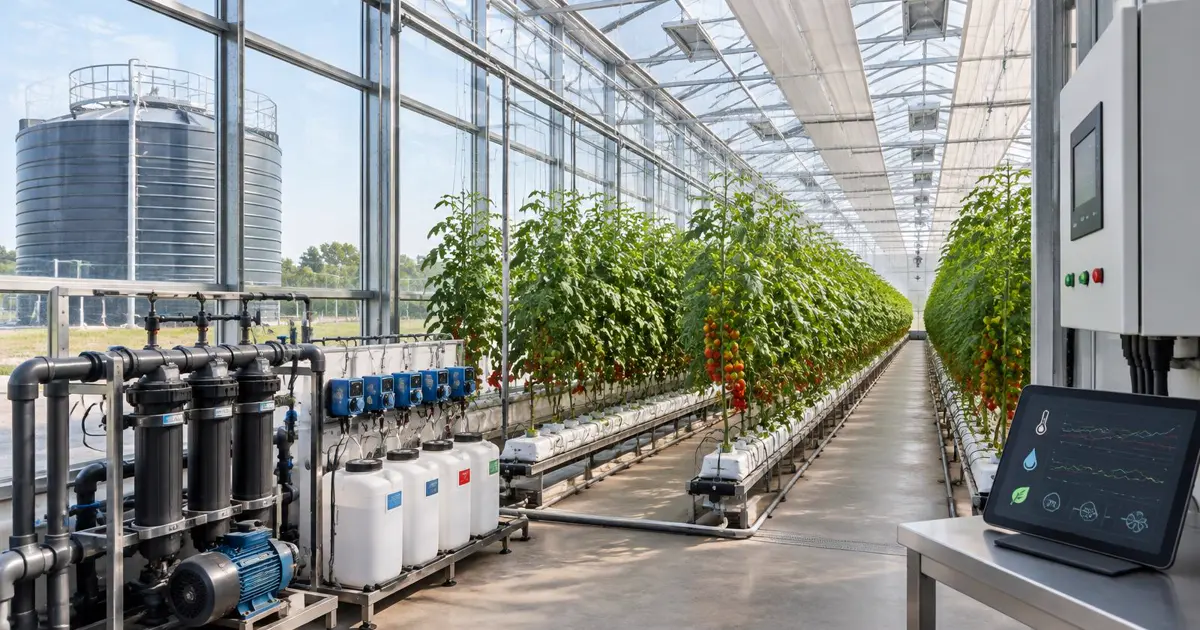
A complete commercial greenhouse package connects structure and covering, climate control, water treatment, irrigation/fertigation, growing systems, automation and installation through one written scope. Nursery, seed and crop-input requirements support that project rather than replace it. Turnkey means only the work actually agreed in the contract; SeedMatch Group serves professional growers, agribusinesses, investors and governments worldwide through human-led, supplier-neutral sourcing. It coordinates project briefs and independent quotations, not farm operation, manufacturing, installation, seed certification or lending.
Record crop and growing medium, covered and usable area, production season, dated climate inputs, source-water report, available power and package boundaries. Compare acceptance criteria before totals. Buyer inputs, bidder claims and authority confirmations are separate evidence—not interchangeable approvals.
Free for buyers. Human-led commercial procurement starts at USD 250,000. Scope guidance is not a supplier quotation, engineering approval or warranty; supplier communication stays private and mediated.
Direct answer
What makes a commercial greenhouse project complete?
A complete project has one agreed scope connecting the structure, climate control and cooling, water treatment, irrigation/fertigation, automation, installation and commissioning. Every package needs a responsible party, documented interfaces and acceptance criteria. SeedMatch Group coordinates human-reviewed sourcing and bid clarifications; appointed professionals and contracting parties own engineering and delivery.
Confirm inclusions and exclusions in writing, not from a turnkey label.
Use the same crop, site, water and power assumptions for every bid.
Planning estimates are not quotations or engineering approvals.
Seven connected scope packages
Request written evidence and an accountable owner for each package and interface.
Design and site
Crop, covered area and phases; survey, soil investigation, access, drainage, local permits, water analysis and available electrical capacity.
Structure and covering
Structure type, bay dimensions, gutter height, covering and foundations; engineer-confirmed wind, snow and crop-support loads for the actual site.
Climate control
Site weather data and crop targets; ventilation, cooling, heating and screen duties, energy supply, alarms and design assumptions.
Hydroponics and irrigation
Crop-compatible soil, substrate, NFT or DWC system; water balance, filtration, dosing, EC/pH monitoring, drainage and any recirculation treatment.
Controls and interfaces
Sensors, electrical panels, climate computer, irrigation controls, integration responsibilities, data access and fallback operation.
Installation and acceptance
Civil works boundaries, unloading, erection labour and supervision, testing, commissioning, operator training and as-built documents.
Warranty and service
Written coverage by package, duration and start event; exclusions, claims procedure, labour/travel costs, spare parts and service commitments.
Before accepting a complete-package proposal
One scope and responsibility matrix
Separate included equipment from civil works, freight, duties, utilities and owner-supplied items. Identify the party responsible for every design and installation interface.
Commissioning is an acceptance process
Agree tests for the contracted systems, who performs them, documentation, operator training and how outstanding items are resolved. Equipment handover is not a yield guarantee.
Warranty must be package-specific
Request written duration, start event, coverage, exclusions, claims procedure and service/spares terms. Do not assume one equipment warranty covers the entire project.
Prepare one technical brief before comparing prices
Record the site and crop, covered and usable area, production season, climate basis, water analysis, utilities, package boundaries, budget scope and requested milestones. Leave missing evidence unconfirmed.
A written scope for design, structure, climate, water treatment, irrigation and fertigation, growing systems, controls, installation, commissioning, training and warranty. Land, civil works, utility connections and post-harvest facilities may be separate; inclusion must be confirmed in the actual quotation.
No. A complete project can use one turnkey contract or several coordinated packages. The responsibility matrix must identify who designs, supplies, installs and tests each interface, including work excluded from the equipment quote.
No. Warranty coverage, exclusions, start event, response terms and delivery dates must come from the actual contracting parties in writing. SeedMatch does not manufacture or install equipment and does not promise a standard warranty or delivery period.
Define the crop, site, area, water, energy, required systems, budget and target schedule in the existing greenhouse RFQ. Commercial sourcing starts at USD 250,000. A sourcing specialist reviews the brief and obtains buyer authorization before contacting suppliers. Submission does not automatically share the request; buyer guidance and public tools are free.
Give bidders the same crop, production season, site temperature and humidity conditions, water analysis, available flow and electrical capacity. Separate ventilation and cooling duties from irrigation, fertigation and water treatment, then identify shared water, power and control interfaces. Calculator results are planning scenarios; the appointed design team must verify final capacities and local requirements.
Check technical compliance against one RFQ before comparing totals. Mark structure, climate control, cooling, irrigation/fertigation, automation and installation as included, excluded, optional or unconfirmed. Compare currency, quotation date and validity, delivery place, freight and taxes, payment milestones and separately priced exclusions. Unquoted work is unknown, not zero. Clarifications go through SeedMatch's sourcing team; the lowest equipment price is not automatically the lowest complete-project cost.
Agree acceptance criteria before contracting: structural and installation checks, operation of ventilation and cooling, irrigation flow and dosing checks, sensor calibration, alarms and control interfaces under the agreed test conditions. Name who performs and witnesses each test. Request test records, as-built drawings, manuals, operator training and an outstanding-items list. Commissioning demonstrates agreed system checks, not guaranteed crop yield, revenue or a universal warranty.
Compare systems by specification, capacity and complete cost
Reviewed 17 November 2026. These existing buyer guides define requestable scope, not stocked products or verified supplier coverage. Availability, installation and local service must be confirmed by a sourcing specialist before an offer is relied on.
Covered and usable growing area in m²/ha; span and gutter height in metres; covering, design loads, foundations, installation and acceptance owner. Compare one turnkey contract with coordinated packages against the same responsibility matrix.
CAPEX / operating basis: Separate structure and erection from civil works, utility connections, freight, tax, commissioning and working capital.
Use the same crop, production season and covered area for every offer. Internal USD/m² bands are preliminary hardware-and-erection estimates, not local supplier prices.
CAPEX / operating basis: Multiply only the applicable band by covered area; do not add a bulk discount. Keep annual OPEX separate and record quotation currency, FX date and validity.
Distinguish building footprint from total rack cultivation area and number of tiers. Specify lighting duty, operating hours, connected kW, HVAC sensible/latent loads, water treatment and control interfaces.
CAPEX / operating basis: Request racks, LEDs, HVAC, envelope, water and controls separately. Model electricity in kWh × the applicable tariff; no assumed yield or payback.
Crop and irrigated area, zones, peak flow in m³/h, operating pressure in bar, emitter spacing, water analysis, filtration, dosing, pumping and storage in m³.
CAPEX / operating basis: Compare drip, sprinklers or recirculation on the same crop and source-water duty. Price pumps, filters, distribution, dosing and installation; do not infer daily demand from hectares alone.
Local design temperature and humidity, ventilation, shading, heating/cooling duty in kW, sensor coverage, alarms and the control protocol. Require the appointed engineer to validate the load case.
CAPEX / operating basis: Compare passive ventilation, evaporative cooling and active HVAC against actual humidity and crop limits. Price energy, backup, calibration and maintenance separately.
Crop, variety/rootstock, seed count or transplant quantity, lot evidence, germination test date, plant size, planting window and destination-specific plant-health checks.
CAPEX / operating basis: Keep recurring seed and transplant purchases outside structure CAPEX. Trial and agronomic evidence are needed before assigning a saleable-yield assumption.
Crop and growth stage, water/soil analysis, nutrient composition, solubility, compatibility, quantity in kg/t, packaging, storage and destination approval status.
CAPEX / operating basis: Compare nutrient delivered, not bag price alone; separate recurring nutrients from dosing equipment. No universal application rate or assumed organic approval.
Crop, peak intake in t/day, grading and packing throughput in t/h, product temperature, cooling time, storage tonnes, dispatch schedule and refrigeration duty.
CAPEX / operating basis: Size for peak harvest and dwell time, not greenhouse area alone. Quote pack line, refrigeration, building, backup power and commissioning separately.
Seed lots and inputs are a separate specification within procurement. Harvested commodity produce buyers should source through Global B2B Group. Finance guidance means preparing scope and assumptions for independent provider discussions; SeedMatch Group is not a lender and does not promise introductions, eligibility or approval.
Move complete greenhouse solutions into a structured RFQ
Editorial · not a sales pitch
This page is reference material. When you are ready to convert planning into pricing, a structured RFQ replaces weeks of unstructured email with days of comparable, supplier-neutral offers.
What to submit — Greenhouse structure & systems
The facts a complete, supplier-neutral request on this topic includes. Use it as a checklist before submitting.
Covered area (m² or ha), bay/gutter layout preference and target gutter height
Site location, altitude and design loads (wind, snow, seismic) if known
Crop and production system (soil, substrate, hydroponic, nursery)
Covering choice: polyethylene film, polycarbonate or glass — and expected lifetime
Irrigation/fertigation scope and water source quality
Target commissioning date, phasing and budget band (USD $250K+)
Incoterms, destination port/site and who handles civil works and erection
Helpful attachments
Site plan or coordinates with plot dimensions
Soil/water analysis where available
Any existing concept drawing, BOQ or previous supplier offer
Where this goes next
Opens the RFQ Builder pre-scoped as a greenhouse project so suppliers quote structure, covering, climate and irrigation on the same basis. You stay in control — nothing is submitted until you review and confirm.
Free to submit · supplier-neutral · reviewed by a specialist before any supplier is contacted.
What to do next
Most organizations move through these four steps in order. Each one can be started independently, and nothing is shared with suppliers until you approve the scope.
Send a quick message with your project type, crop and country. A sourcing specialist will review it and confirm the next steps; timing depends on the request and available information.
A sourcing specialist reviews your scope and obtains your authorization before contacting suppliers. Submission does not automatically share your request.
Next step
Turn this into a live commercial project
Open one private brief. A sourcing specialist validates and organises the RFQ, manages outreach to suitable independent suppliers, and presents any responses through SeedMatch on a consistent technical and commercial basis. Response numbers and timing are not guaranteed.
Short, direct answers to the questions commercial growers, developers and EPC contractors ask before issuing an RFQ. A dedicated sourcing specialist — not an automated form — works through your brief with you.
What is included in a turnkey greenhouse project?
A turnkey commercial greenhouse project typically covers the structure and covering, foundations, ventilation, cooling and heating, thermal and shade screens, irrigation and fertigation, water treatment and pumping, hydroponic or substrate systems where used, electrical infrastructure, climate and irrigation automation, freight, installation, commissioning and grower training. Not every supplier delivers every component — many strong manufacturers cover structure and climate only, with irrigation, fertigation and controls sourced separately.
Can SeedMatch source a complete greenhouse project?
Yes. SeedMatch works from your project brief — crop, climate, area, production target and automation level — and identifies suitable international suppliers for the structure and for each system package. You receive comparable offers on a common scope instead of proposals that cannot be compared. Commercial negotiation stays with you; supplier identities and pricing are released through the RFQ workflow.
How do I choose a greenhouse supplier?
Compare suppliers on climate-specific engineering references, structural certification for local wind and snow loads, the systems they actually deliver in-house, spare-parts and service coverage in your country, installation and commissioning responsibility, documentation quality, and payment and delivery terms. A supplier with strong references in your climate zone and crop is usually a lower project risk than the lowest quoted price.
What information is required to quote a greenhouse project?
Suppliers need location and climate extremes, greenhouse area and phasing, crop and production target, water source and water analysis, growing method, required cooling and heating, automation level, energy source, and site conditions. Without this, quotes arrive on different scopes and cannot be compared. The checklist below is the minimum set for a serious commercial RFQ.
Project scale context
Exact design depends on crop, climate, wind and snow loads, temperature and humidity extremes, water quality, production target, automation level and local infrastructure. The figures below are scale context for scoping an RFQ, not a specification.
Project size
What typically changes at this scale
1 hectare
Entry commercial scale. Usually single crop, one climate zone, semi-automatic fertigation, natural or fan ventilation depending on climate.
5 hectares
Multi-zone climate control, dedicated fertigation room, dedicated pumping and filtration, packhouse and cold chain become part of scope.
10 hectares
High-tech specification is usually justified: climate computer, thermal screens, recirculating hydroponics, water treatment and disinfection.
20+ hectares
Phased construction, EPC-style contracting, on-site energy, labour housing and logistics infrastructure enter the project plan.
RFQ readiness — what suppliers need from you
Quotations are only comparable when every supplier answers the same brief. Have these points ready and the first round of offers arrives on one scope. Anything you do not have yet, a sourcing specialist will work through with you.
Country and project location (nearest town, altitude, port of entry)
Greenhouse area in m² or hectares, and whether it is phased
Crop or crops, and production target (kg/m²/year or stems/m²/year)
Climate data: minimum and maximum outside temperature, humidity, wind, solar radiation
Water source, available volume and water analysis (EC, pH, sodium, chloride, bicarbonate)
Growing method: soil, substrate/hydroponic or a mix
Required automation level: manual, semi-automatic or fully computer-controlled
Cooling and heating requirement, and available energy source
Greenfield site or expansion / retrofit of an existing project