
Commercial Greenhouse Cost Calculator: per m², Sq Ft, Acre & Hectare
Free commercial greenhouse construction cost calculator: area, structure, covering and technology level give an indicative CAPEX range per m² and hectare; add your own climate, irrigation, installation and power quotes.
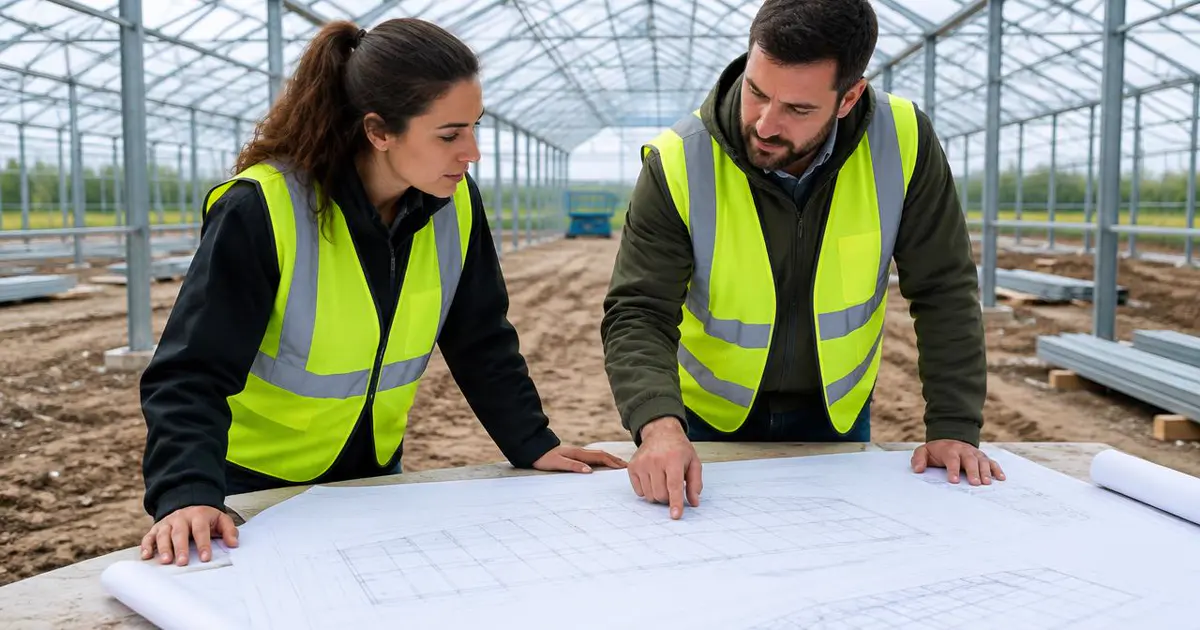
Commercial Greenhouse Cost Calculator: per m², Sq Ft, Acre & Hectare
Free commercial greenhouse construction cost calculator: area, structure, covering and technology level give an indicative CAPEX range per m² and hectare; add your own climate, irrigation, installation and power quotes.
- Single tunnel: ~USD 25–50 per m² installed
- Multi-span (medium-tech): ~USD 50–120 per m²
- Venlo glass (high-tech): ~USD 150–350 per m²
- Semi-closed / high-tech: ~USD 300–600 per m²
- Technology factor scales the band from ~0.7 (low-tech) to 2.0 (high-tech)
- 1 hectare = 10,000 m² · 1 acre ≈ 4,047 m² · 1 m² ≈ 10.76 sq ft — at factor 1.0, 1 ha multi-span ≈ USD 500K–1.2M
Estimate only — not a quotation. Outputs are planning calculations based on the values you enter and the assumptions stated by this tool. Defaults are not confirmed project evidence. Real pricing, specifications and lead times vary by country, site conditions and supplier, and are confirmed only in written offers collected through a private RFQ.
1 hectare = 10,000 m². Enter the net covered area.
Roof vents, insect netting, fertigation and basic climate control.
0.7 = low-tech manual house · 1.0 = standard commercial · 1.5–2.0 = high-tech with full climate control, screens and automation.
Indicative result
- Cost per m²
- US$50 – US$120 / m²
- Total CAPEX — 10,000 m²
- US$500K – US$1.2M
- Assumptions
- Multi-span — medium-tech, technology factor ×1.00. Structure, covering and erection on a prepared site; land, utilities and packhouse excluded.
Turn this estimate into a project brief
Send these figures to the greenhouse RFQ form. Your inputs and results are attached to the brief, a sourcing specialist reviews it, and only then are suitable suppliers or project partners approached.
Buying more than once? Save these project details to your buyer profile so your site, crop, budget and timeline are pre-filled on every future request.
Indicative only. Not financial advice, not agronomic advice, not engineering design. Final numbers require supplier, agronomist, engineer and local regulatory review.
Project evidence behind the estimate
Guidance reviewed 16 November 2026. The USD bands are internal planning assumptions, not verified local prices or dated supplier quotes. Record the country/site, covered versus usable area, crop calendar, climate design basis, water analysis and electrical capacity. Separate structure, irrigation/fertigation, climate controls and automation; quote installation and commissioning responsibilities explicitly, without counting erection twice.
Attach quote dates, currencies, validity and any dated exchange-rate basis to your request; unknown costs remain unconfirmed. Read the complete-project RFQ specification and CAPEX and OPEX guide. For published country planning bands, compare the South Africa greenhouse cost guide, the Netherlands greenhouse cost guide and the commercial greenhouse price guide; these are planning bands, not supplier quotes. SeedMatch Group coordinates the reviewed request, not manufacture or installation.
Full project budget: add your own quotes
The band above covers structure, covering and erection only. Climate equipment, irrigation and fertigation, installation, power and site works vary strongly by country, climate load and site, so enter amounts from your own quotes or engineer's estimate (USD). Nothing is pre-filled.
Your own assumption, e.g. from supplier service offers.
- Project CAPEX incl. your lines
- US$500K – US$1.2M
- Annual maintenance
- US$0 – US$0
Geography matters: wind/snow loads, cooling or heating duty, water quality and import logistics change these lines. See the commercial greenhouse cost guide and country cost guides.
Method, defaults and worked example
Read the full method, units and limitationsWho this is for: Commercial greenhouse buyers screening an early structure-and-covering CAPEX allowance before site design and supplier quotations.
Inputs and units
- Cultivated area in m²; 1 hectare = 10,000 m² and 1 acre ≈ 4,047 m².
- Structure band in USD/m² and a dimensionless technology factor.
- Optional buyer-entered project lines in USD and annual maintenance as a percentage of CAPEX.
Plain-language formula
- Structure CAPEX low/high = area (m²) × selected band low/high (USD/m²) × technology factor.
- Project CAPEX = structure CAPEX + each buyer-entered project line; a blank line is not treated as a quoted price.
- Annual maintenance = project CAPEX × buyer-entered maintenance percentage ÷ 100.
Default provenance: Reviewed 15 November 2026 by the SeedMatch Group editorial team. The structure bands and technology factors are internal editorial planning assumptions shared with the commercial greenhouse cost guide. They are not supplier quotations, market averages or independently validated project prices. Additional project-cost fields start blank.
Worked example: 1 hectare of multi-span greenhouse
- Area = 10,000 m²; internal multi-span band = USD 50–120/m²; technology factor = 1.0.
- Low case = 10,000 × 50 × 1.0 = USD 500,000. High case = 10,000 × 120 × 1.0 = USD 1,200,000.
Interpretation: The illustrative structure, covering and erection allowance is USD 500K–1.2M. Land, site works, utilities and other excluded lines remain unknown until the buyer adds evidence or quotations.
Limitations
- The technology factor is a screening allowance, not an engineered bill of quantities.
- No crop yield, energy demand, construction schedule, supplier availability or return is inferred from the result.
Sources and next checks
- Commercial greenhouse cost guide — Owner of the shared internal planning bands and scope exclusions.
- Greenhouse project budget planner — Separate buyer-entered CAPEX, OPEX, reserves and funding.
Preliminary estimate only: outputs are not supplier quotations, independent agronomy or engineering advice, financing approval, or guarantees of price, performance, savings, yield or return.
From project scope to a reviewed RFQ
Use the same crop, site, water, energy and scope evidence at each step. Planning outputs remain preliminary until qualified professionals and written supplier offers confirm the project.
Price scenarios from dated briefings, by year
Enter your current yearly energy and fertilizer spend. Each column applies the yearly changes published in that year's briefing. These are planning scenarios, not quotes, and they don't change the CAPEX estimate above.
| Item | Today | 2026 briefing |
|---|---|---|
| Energy / fertilizer change | — | +24% / +31% |
| Yearly spend | US$150K | US$190K |
| Source | Your input | October 2026 procurement briefing · World Bank Commodity Markets Outlook, 28 April 2026 |
Only briefings with dated, sourced price figures appear here. Earlier briefings in the briefing archive are market reports without price scenarios, so no earlier year is shown yet. Country-level official energy and fertilizer references are listed on local price sources.
Indicative only
- This tool is indicative only.
- It is not financial advice.
- It is not agronomic advice.
- It is not engineering design.
- Final numbers require supplier, agronomist, engineer and local regulatory review.
SeedMatch Group is an independent agricultural project sourcing and RFQ platform. We are not a farm, seed producer, fertilizer manufacturer, irrigation manufacturer, greenhouse builder, EPC contractor, lender or financial advisor. Supplier and project partner outreach is handled only after a commercial project brief is reviewed.
Supplier and manufacturer content is provided for research, transparency and discovery only. Buyers submit one project or RFQ to SeedMatch Group; our team validates and organises it, manages any suitable supplier or manufacturer outreach, and presents the responses through SeedMatch. There is no public directory of company identities, automatic matching, direct messaging or direct buyer-supplier contact.
Frequently asked questions
At a standard technology factor of 1.0 and using this calculator's bands, 1 hectare (10,000 m²) works out to roughly USD 250K–500K for single tunnels, 500K–1.2M for medium-tech multi-span, 1.5M–3.5M for Venlo glass and 3M–6M for semi-closed high-tech houses. Climate control, energy screens and automation raise it (factor up to 2.0); land, site works and utilities are extra.
1 acre is about 4,047 m². With the same bands at factor 1.0 that is roughly USD 101K–202K (single tunnel), 202K–486K (multi-span), 607K–1.42M (Venlo glass) and 1.21M–2.43M (semi-closed), before land, site works and utilities. These are planning ranges, not prices for a greenhouse for sale.
Dividing the per-m² bands by 10.76 gives roughly USD 2.3–4.6 per sq ft for single tunnels, 4.6–11.1 for multi-span, 13.9–32.5 for Venlo glass and 27.9–55.7 for semi-closed at factor 1.0, excluding land and site works.
It multiplies your cultivated area by a base cost band per m² for the chosen structure type, then applies your technology factor. A factor of 1.0 is a standard commercial build; below 1.0 strips automation and climate equipment, above 1.0 adds climate control, screens, fertigation and automation. The result is an indicative CAPEX range, not a quotation.
It scales the base structure cost for the equipment level: around 0.7 for a low-tech manually managed house, 1.0 for a standard commercial build with basic ventilation and irrigation, and 1.5–2.0 for a high-tech house with full climate control, energy screens, CO₂ dosing, hydroponics and automation.
No. The bands cover the structure, covering and erection on a prepared site. Land, grading, roads, water source, power connection and packhouse facilities are separate and depend on the country and site — see the country cost pages for local adjustments.
It is a planning-level range for early budgeting. Steel, glass and freight prices move, and final pricing depends on design, climate loads and supplier scope. For a committed price, send the estimate to the RFQ form — a sourcing specialist reviews the brief before any supplier outreach.
More buyer questions? Greenhouse buyer FAQ hub — cost, financing, climate and agronomy answers for commercial greenhouse buyers.
Plan the project around the numbers
A calculator output is a starting point. Pair it with the planning guides below to align timeline, irrigation, budget and risk before you launch an RFQ.
One private brief, specialist review, private supplier research and a like-for-like comparison.
Spec gaps, MOQ, delivery, Incoterms and evidence labels for seeds, greenhouses, irrigation, fertilizers and produce.
Month-by-month schedule from concept to first harvest across 9 stages.
Design principles for drip, pivot, fertigation and filtration on commercial projects.
How CAPEX, working capital and operating cost drive the project business case.
The ten most expensive planning and procurement pitfalls — and how to avoid them.
Procurement answers behind these numbers
A model output only holds if the scope, contract route and delivery terms match the assumptions. These reference answers cover the commercial decisions that move the figure.
- Turnkey EPC vs separate equipment packages
- What belongs in a greenhouse equipment specification
- Normal payment milestones in equipment contracts
- Which Incoterms to use for greenhouse and irrigation equipment
- How long a commercial greenhouse takes from order to handover
- What is normally the owner's scope on a greenhouse project
Turning this estimate into a request? The greenhouse systems request builder lists what changes a quote — structure, cover, climate and installation scope — and opens a pre-filled request that our team reviews before any supplier is contacted.
Understanding the values
What each choice in this calculator means, and how the options differ in practice.
- Polyethylene film — single-span tunnel
- The lowest-cost structure. The plastic covering lasts only a few seasons and climate control is minimal, so it suits mild climates and short-season crops rather than year-round production.
- Polyethylene film — multi-span
- Gutter-connected spans with ventilation and shading. A mid-range option that balances cost against usable climate control for commercial vegetable production.
- Polycarbonate sheets — multi-span
- Rigid twin-wall covering with better insulation and hail resistance than film. Higher upfront cost, lower covering replacement and heating loss over time.
- Glass — Venlo type
- The high-tech option: aluminium-glazed house with the longest lifespan and highest light transmission. Chosen for year-round, high-value production where climate control justifies the investment.
- Technology factor
- Scales the base structure cost for equipment level: below 1.0 strips automation and climate equipment, 1.0 is a standard commercial build, and above 1.0 adds climate control, screens, fertigation and automation.
Illustrative project summary
1 ha multi-span tomato house
A new commercial entrant builds a first multi-span block with fertigation, insect screens and a basic climate computer.
1 ha · Multi-span polyhouse · Tomatoes
Indicative full greenhouse project CAPEX
USD 575K – USD 1.56M
Illustration only, not a real project or quotation. This is the structure, equipment and site-works budget for the example greenhouse, not the price of this calculator’s individual system, seeds or inputs, and not a result calculated from your entries. Excludes land, permits, packhouse, financing costs and working capital.
Based on the published commercial greenhouse cost benchmark. Written offers require a private project review; commercial projects start from USD 250K.
What can change the result?
This is a preliminary planning estimate based on the values you entered. The variables below usually move the outcome most, and should be confirmed with an agronomist, engineer and supplier offers before final design.
- Growing area and layout — hectares alone are not a greenhouse specification
- Greenhouse type and technology level (tunnel, naturally ventilated, high-tech)
- Structure specification, wind and snow loads, and site civil works
- Energy and utility tariffs, plus tariff escalation over time
- Financing terms, contingency and currency movement
Questions this calculator answers
Typical buyer and investor searches this tool is built for, including the markets where we run the most commercial projects.
- commercial greenhouse construction cost per hectare for a commercial project
- commercial greenhouse construction cost for a 2-hectare project — India
- commercial greenhouse construction cost: indicative planning ranges — Kenya
- commercial greenhouse construction cost benchmarks for investors — Saudi Arabia
- commercial greenhouse construction cost under local market conditions — Mexico
- commercial greenhouse construction cost — what to specify in a supplier RFQ
Method and decision path
How to use this result in a commercial project
Use the result to test scope and compare scenarios. It is not a design, agronomic prescription, financing offer or supplier quotation.
1. Enter site evidence
Replace defaults with measured area, climate, water, energy, crop and commercial assumptions.
2. Test scenarios
Change one assumption at a time and record the effect on capacity, cost, demand or return.
3. Validate the duty
Ask the relevant agronomist, engineer or financial adviser to check the inputs and constraints.
4. Prepare a private RFQ
Carry the confirmed scope into a human-reviewed brief so written offers can be compared on the same basis.
Final specifications, performance, prices, supplier participation and timing depend on the site and written supplier responses; none is guaranteed by this calculator.
Tell us five things and we route your brief
These fields decide which specialist and which suppliers see your request. Nothing is submitted here — your answers are carried into the private RFQ.
The USD 250K project threshold applies to capital projects. Recurring fertilizer programmes are reviewed by shipment size, annual volume and sourcing fit.
A sourcing specialist shortlists reviewed providers for your scope and returns comparable offers. Supplier details stay with us — all communication runs through SeedMatchGroup.
Estimate only: these figures are indicative planning numbers, not a quotation. Final pricing, specifications and lead times come from supplier offers after your brief is reviewed.
Plan the project around the numbers
A calculator output is a starting point. Pair it with the planning guides below to align timeline, irrigation, budget and risk before you launch an RFQ.
One private brief, specialist review, private supplier research and a like-for-like comparison.
Spec gaps, MOQ, delivery, Incoterms and evidence labels for seeds, greenhouses, irrigation, fertilizers and produce.
Month-by-month schedule from concept to first harvest across 9 stages.
Design principles for drip, pivot, fertigation and filtration on commercial projects.
How CAPEX, working capital and operating cost drive the project business case.
The ten most expensive planning and procurement pitfalls — and how to avoid them.
Procurement answers behind these numbers
A model output only holds if the scope, contract route and delivery terms match the assumptions. These reference answers cover the commercial decisions that move the figure.
- Turnkey EPC vs separate equipment packages
- What belongs in a greenhouse equipment specification
- Normal payment milestones in equipment contracts
- Which Incoterms to use for greenhouse and irrigation equipment
- How long a commercial greenhouse takes from order to handover
- What is normally the owner's scope on a greenhouse project
Move commercial greenhouse cost calculator: per m², sq ft, acre & hectare into a structured RFQ
Editorial · not a sales pitchCalculator outputs are indicative. When your numbers stabilise, a supplier-neutral RFQ turns those estimates into a consistent brief for comparing the written offers that participating suppliers provide.
The facts a complete, supplier-neutral request on this topic includes. Use it as a checklist before submitting.
- Covered area (m² or ha), bay/gutter layout preference and target gutter height
- Site location, altitude and design loads (wind, snow, seismic) if known
- Crop and production system (soil, substrate, hydroponic, nursery)
- Covering choice: polyethylene film, polycarbonate or glass — and expected lifetime
- Climate scope: ventilation, screens, heating, cooling/pad-fan, CO₂, controls
- Irrigation/fertigation scope and water source quality
- Target commissioning date, phasing and budget band (USD $250K+)
- Incoterms, destination port/site and who handles civil works and erection
- Site plan or coordinates with plot dimensions
- Soil/water analysis where available
- Any existing concept drawing, BOQ or previous supplier offer
Opens the RFQ Builder pre-scoped as a greenhouse project so suppliers quote structure, covering, climate and irrigation on the same basis. You stay in control — nothing is submitted until you review and confirm.
Free to submit · supplier-neutral · reviewed by a specialist before any supplier is contacted.
Running these numbers for a client project?
Agronomists, greenhouse and irrigation consultants use this calculator for feasibility, then hand the project to us for supplier shortlisting, RFQ preparation and quote comparison. You stay client-facing and we work through you.
Your client relationship stays with you — we work through you and never contact your client unless you ask.
Indicative only
- This tool is indicative only.
- It is not financial advice.
- It is not agronomic advice.
- It is not engineering design.
- Final numbers require supplier, agronomist, engineer and local regulatory review.
SeedMatch Group is an independent agricultural project sourcing and RFQ platform. We are not a farm, seed producer, fertilizer manufacturer, irrigation manufacturer, greenhouse builder, EPC contractor, lender or financial advisor. Supplier and project partner outreach is handled only after a commercial project brief is reviewed.
Supplier and manufacturer content is provided for research, transparency and discovery only. Buyers submit one project or RFQ to SeedMatch Group; our team validates and organises it, manages any suitable supplier or manufacturer outreach, and presents the responses through SeedMatch. There is no public directory of company identities, automatic matching, direct messaging or direct buyer-supplier contact.